Yin-Yang Taijitu Myth Meaning & Symbolism
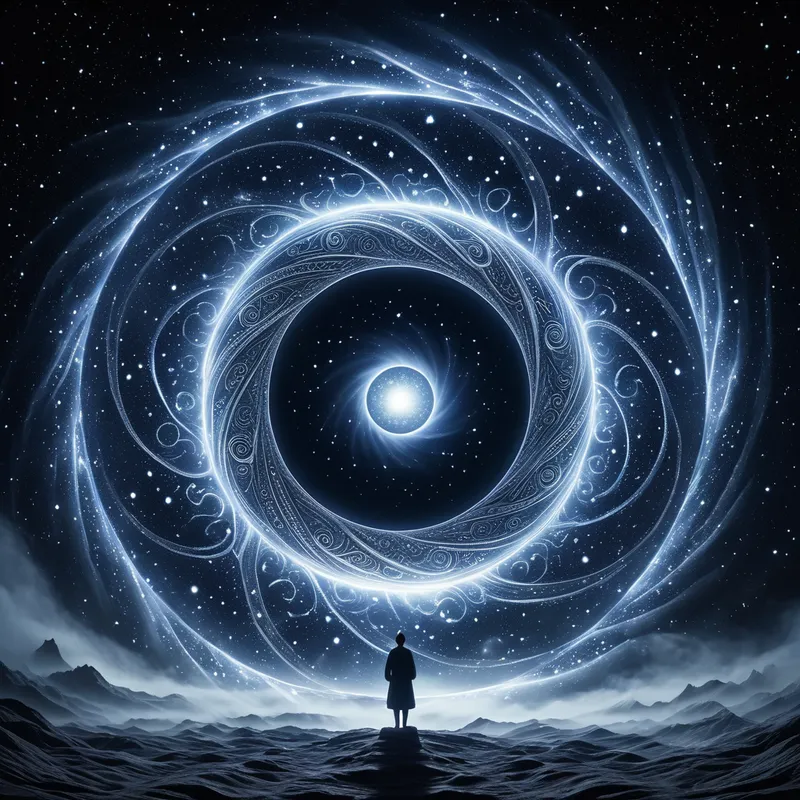
The primordial myth of the Taijitu, where the Great Ultimate births the dance of Yin and Yang, weaving the cosmos from their eternal, harmonious tension.
The Tale of Yin-Yang Taijitu
Before time had a name, there was only the Wuji—the boundless, silent, and perfect void. It was not empty, but full of a potential so profound it was beyond being and non-being. It was the great, dreaming stillness.
And within that stillness, a breath was drawn. Not by any god, for there were none, but by the potential itself. This breath was the first movement, the first stirring of intention in the eternal night. From the Wuji emerged the Taiji, the Great Ultimate. It was not a [thing](/myths/thing “Myth from Norse culture.”/), but a principle—the first yes, the first no, the first distinction yearning to be made.
The Taiji began to turn, a slow, inevitable whirl in the heart of [the void](/myths/the-void “Myth from Buddhist culture.”/). As it turned, it grew heavy with the weight of its own possibility. From its core, two essences began to separate, like cream rising from milk, like warmth distinguishing itself from cold. They were not yet opposites, but lovers yet to meet.
The lighter essence, bright and airy, surged upward. It was active, fiery, and radiant. This was Yang. The heavier essence, deep and receptive, settled downward. It was still, watery, and dark. This was Yin. For a moment, they existed apart, two halves of a cosmic sigh.
But the turning of the Taiji would not allow it. The upward rush of Yang reached its zenith and, exhausted by its own ascent, found itself cooling, softening, becoming receptive. Within its brightest point, a seed of darkness was born. Simultaneously, the deep descent of Yin reached its nadir and, compressed by its own depth, found itself warming, stirring, becoming active. Within its darkest depth, a seed of light was kindled.
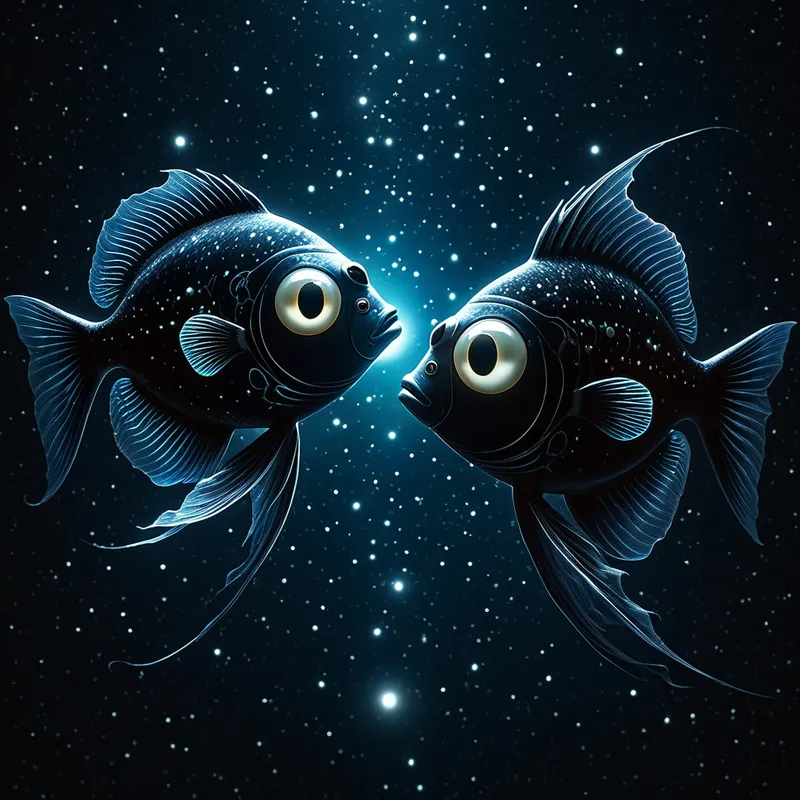
They flowed into one another. Yang, now carrying the seed of Yin, curved gracefully into the realm of darkness. Yin, now carrying the seed of Yang, swept upward into the realm of light. Their boundary was not a line of separation, but a flowing, serpentine river of transformation. They became the two great fish swimming in the celestial ocean, each chasing the other’s tail, each containing the essence of the other within its eye.
Their eternal dance—the Taijitu—was the first pattern. From the rhythm of their embrace sprang the Wuxing, the five phases. From the five phases, the ten thousand things—the mountains and rivers, the beasts and the birds, the sun and [the moon](/myths/the-moon “Myth from Tarot culture.”/)—all cascaded into being. The cosmos was not commanded into existence; it was sung into being by the harmonious tension of the dark and the light, forever intertwined in the great, turning wheel.
Cultural Origins & Context
The myth of the Taijitu is not a single story told by a bard, but a cosmological framework that permeated ancient Chinese thought. Its earliest philosophical systematization is found in the [I Ching](/myths/i-ching “Myth from Chinese culture.”/) (Book of Changes) and was profoundly developed during the Warring States period by the naturalist school of [Yin-Yang](/myths/yin-yang “Myth from Taoist culture.”/) and the Wuxing. It was later integral to Daoist metaphysics and Confucian cosmology.
It was passed down not merely as folklore, but as a foundational principle for understanding reality. Scholars, diviners, doctors, and farmers alike used its logic. The I Ching provided a practical tool for navigating life’s changes based on this model, while Daoist alchemists saw in it the map for internal cultivation and longevity. Its societal function was profoundly unifying: it offered a coherent, observable explanation for everything from seasonal cycles and political upheaval to health and personal destiny, teaching that all transformation follows this primordial, balanced pattern.
Symbolic Architecture
The Taijitu is the ultimate [symbol](/symbols/symbol “Symbol: A symbol can represent an idea, concept, or belief, serving as a powerful tool for communication and understanding.”/) of non-dualistic [consciousness](/symbols/consciousness “Symbol: Consciousness represents the state of awareness and perception, encompassing thoughts, feelings, and experiences.”/). It represents the [psyche](/myths/psyche “Myth from Greek culture.”/)’s fundamental [structure](/symbols/structure “Symbol: Structure in dreams often symbolizes stability, organization, and the framework of one’s life, reflecting how one perceives their environment and personal life.”/), where opposites are not enemies but mutually generative partners.
The eye within the fish reveals the profound truth: the opposite is not outside, but sleeps within the very heart of the self.
Yin symbolizes the unconscious, the [shadow](/symbols/shadow “Symbol: The ‘shadow’ embodies the unconscious, repressed aspects of the self and often represents fears or hidden emotions.”/), the receptive, the [body](/symbols/body “Symbol: The body in dreams often symbolizes the dreamer’s self-identity, personal health, and the relationship they have with their physical existence.”/), the [moon](/symbols/moon “Symbol: The Moon symbolizes intuition, emotional depth, and the cyclical nature of life, often reflecting the inner self and subconscious desires.”/), and the [valley](/symbols/valley “Symbol: A valley often symbolizes a period of transition or a place of respite between two extremes.”/). Yang symbolizes consciousness, the [persona](/symbols/persona “Symbol: The social mask or outward identity one presents to the world, often concealing the true self.”/), the active, the [spirit](/symbols/spirit “Symbol: Spirit symbolizes the essence of life, vitality, and the spiritual journey of the individual.”/), the sun, and the [mountain](/symbols/mountain “Symbol: Mountains often symbolize challenges, aspirations, and the journey toward self-discovery and enlightenment.”/). The myth teaches that neither can exist in purity. The brightest light casts the deepest [shadow](/symbols/shadow “Symbol: The ‘shadow’ embodies the unconscious, repressed aspects of the self and often represents fears or hidden emotions.”/) (the Yin dot in Yang), and the darkest [night](/symbols/night “Symbol: Night often symbolizes the unconscious, mystery, and the unknown, representing the realm of dreams and intuition.”/) holds the promise of [dawn](/symbols/dawn “Symbol: The first light of day, symbolizing new beginnings, hope, and the transition from darkness to illumination.”/) (the Yang dot in Yin). The curved [boundary](/symbols/boundary “Symbol: A conceptual or physical limit defining separation, protection, or identity between entities, spaces, or states of being.”/) signifies the permeable, fluid [nature](/symbols/nature “Symbol: Nature symbolizes growth, connectivity, and the primal forces of existence.”/) of these states—they are always in the process of becoming one another.
Psychologically, the entity is the Self in its nascent, dynamic form. The “conflict” is the initial [differentiation](/symbols/differentiation “Symbol: The process of distinguishing or separating parts of the self, emotions, or identity from a whole, often marking a developmental or psychological milestone.”/) from the unconscious unity of the Wuji, which creates the [tension](/symbols/tension “Symbol: A state of mental or emotional strain, often manifesting physically as tightness, pressure, or unease, signaling unresolved conflict or anticipation.”/) necessary for [life](/symbols/life “Symbol: The symbol of ‘Life’ represents a journey of growth, interconnectedness, and existential meaning, encompassing both the joys and challenges that define human experience.”/) and consciousness. The “[resolution](/symbols/resolution “Symbol: In arts and music, resolution refers to the movement from dissonance to consonance, creating a sense of completion, release, or finality in a composition.”/)” is not a victory of one side, but the establishment of a dynamic, rotating [equilibrium](/symbols/equilibrium “Symbol: A state of balance, stability, or harmony between opposing forces, often representing inner peace or external order.”/)—the [birth](/symbols/birth “Symbol: Birth symbolizes new beginnings, transformation, and the potential for growth and development.”/) of a conscious [relationship](/symbols/relationship “Symbol: A representation of connections we have with others in our lives, often reflecting our emotional state.”/) between opposites within the psyche.
The Dreamer’s Resonance
When the Taijitu appears in a modern dream, it is often a sign from the deep psyche that a process of integration is underway. The dreamer may be caught in a rigid, polarized state: identifying solely with their assertive, logical Yang side while repressing their intuitive, emotional Yin, or vice-versa.
The symbol manifests somatically as a feeling of spinning, balancing, or a centering calm amidst turmoil. Psychologically, it signals that the unconscious is presenting a model of wholeness. The dream is not advocating for a bland compromise, but for a sacred dance. It asks the dreamer to find the seed of stillness within their activity, and the seed of creative action within their passivity. To dream of the Taijitu is to be shown that one’s perceived flaws or weaknesses (the Yin) contain the necessary nutrients for one’s strengths (the Yang) to truly flourish, and that one’s driven ambitions must learn receptivity to be sustainable.
Alchemical Translation
The myth models the entire process of individuation. The Wuji represents the original, unconscious state of childhood or an unexamined life. The emergence of the Taiji is the first stirring of ego-consciousness, the “I” that separates from the maternal unconscious.
The alchemical work is not to return to the undifferentiated void, but to consciously recreate the turning circle, now with the ego as the witness at the center.
The painful, initial differentiation into Yin and Yang mirrors the psychic splitting where we disown parts of ourselves to form a coherent identity. The hero’s journey in this myth is the long, often turbulent process of bringing these opposites back into relationship. This is the coniunctio oppositorum—[the sacred marriage](/myths/the-sacred-marriage “Myth from Various culture.”/).
The transmutation occurs when we consciously acknowledge the “dot” within: when the successful executive (Yang) makes space for vulnerability and rest (Yin dot), and when the nurturing caregiver (Yin) asserts her own needs and boundaries (Yang dot). The flowing boundary is [the ego](/myths/the-ego “Myth from Jungian culture.”/)’s flexibility, allowing these states to transition without crisis. The [triumph](/myths/triumph “Myth from Roman culture.”/) is the establishment of a self-regulating psyche, a microcosm of the cosmic pattern, where conflict becomes dialogue, tension becomes creativity, and the individual becomes a vessel for the dynamic, harmonious flow of life itself.
Associated Symbols
Explore related symbols from the CaleaDream lexicon: