Yin-Yang Polarity Myth Meaning & Symbolism
A primordial myth of cosmic unity fracturing into complementary opposites, whose eternal dance births all existence and defines the rhythm of the soul.
The Tale of Yin-Yang Polarity
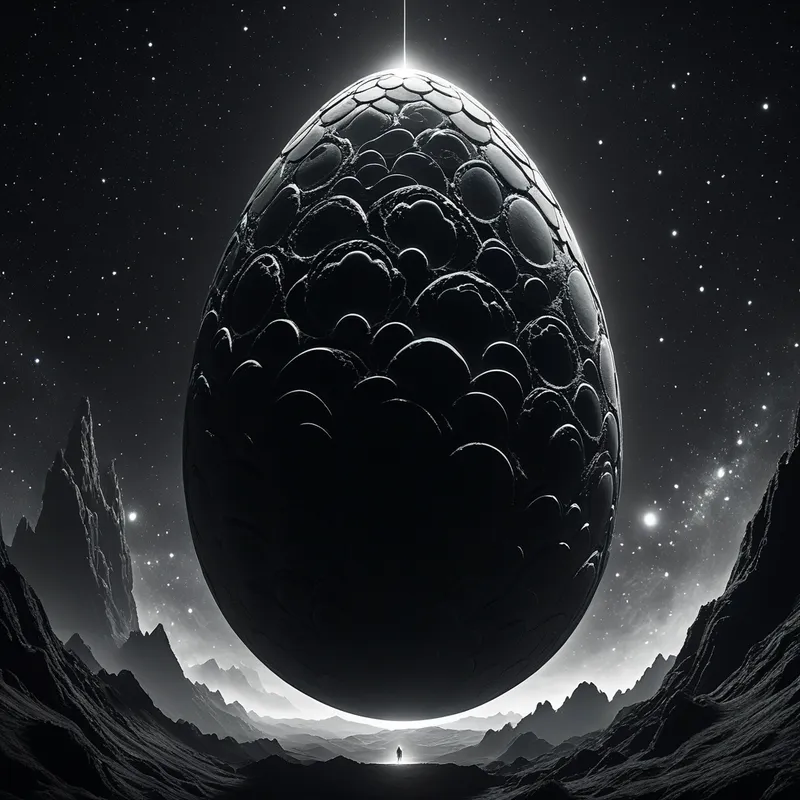
In the time before time, there was no east or west, no above or below. There was only the Hundun, the formless, egg-like chaos, a perfect and silent sphere of undifferentiated potential. It dreamed, and in its dreaming, it contained everything that ever could be, pressed together so tightly that nothing was distinct. It was the great, slumbering womb of the cosmos.
But within that profound stillness, a tension grew. A longing. A whisper of a thought: What if? The thought echoed in the void, and the egg began to stir. A vibration, soft as a moth's wing, trembled through its essence. Then came a sound—not a crack, but a sigh, a release of a breath held for an eternity.
From that sigh, the shell of Hundun did not shatter but unfolded. And from within, two great breaths, two primordial spirits, emerged not as adversaries, but as lovers parting from a long embrace. One was dark, cool, and heavy, flowing like ink into water. This was Yin. The other was bright, warm, and ascending, rising like incense smoke. This was Yang.
Yin sank, drawn to the center, becoming the receptive earth, the hidden valleys, the quiet of midnight, the yielding flesh. Yang rose, becoming the creative heavens, the towering mountains, the blaze of noon, the assertive spirit. For a moment, they gazed across the vast gulf between them, a chasm of pure stillness. A terrible loneliness gripped them both. In their separation, they were incomplete; heaven without earth was a scream into nothing, earth without heaven was a tomb.
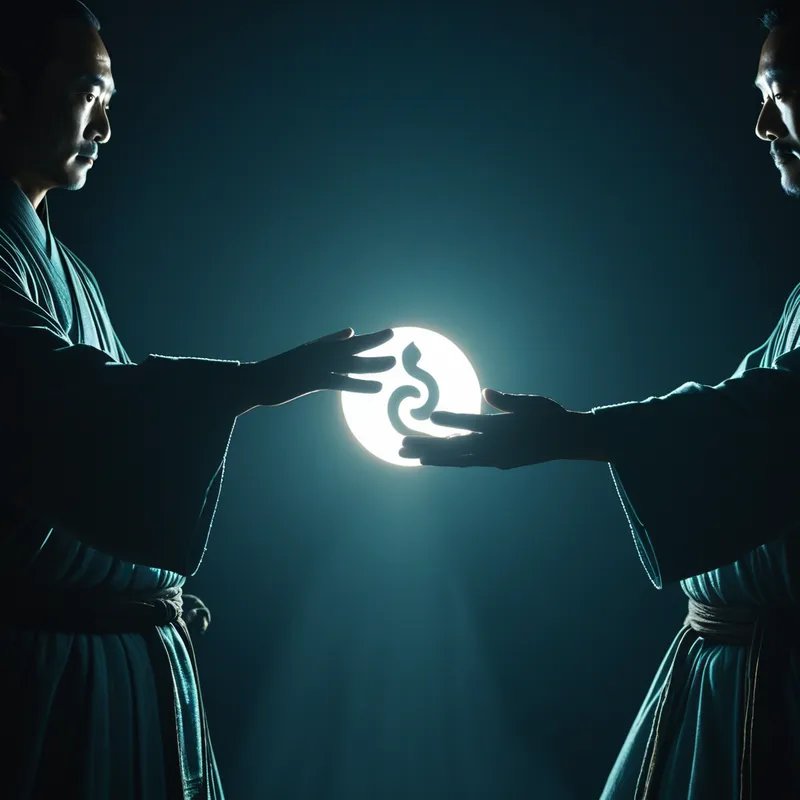
Then, Yang reached out. Not with a hand, but with a ray of sunlight that pierced the gathering dark. Yin responded, not with a block, but by cradling the light in a pool of shadow. This was the first touch. Not a collision, but a caress.
And so began the dance. Yang, in its zenith, would find a seed of Yin at its core, and begin to wane. Yin, in its deepest depth, would find a spark of Yang glowing, and begin to wax. They chased each other in an eternal, graceful spiral. From their interplay, the ten thousand things were born: the cycle of day and night, the seasons turning, the inhale and exhale of life, the very pulse of the rivers and the growth of the forests. They were not making the world; they were the world, in its fundamental, dynamic tension. The myth tells us the cosmos was not created by a word, but by a relationship—a perpetual, sacred conversation between two inseparable voices.
Cultural Origins & Context
This is not a myth with a single author or a definitive text inscribed on temple walls. It is a foundational pattern woven into the very fabric of Chinese thought, emerging from the deep, collective observation of the natural world. Its earliest philosophical crystallization is found in the appendices of the I Ching (Book of Changes), and it forms the bedrock of Daoist cosmology and Confucian social theory.
It was passed down not just by sages, but by farmers watching the sun cross the sky and the moon rule the night, by doctors noting the rhythms of fever and chill, by statesmen observing periods of war and peace. Its societal function was profoundly practical: it was a model for understanding everything. It governed medicine (TCM), statecraft, art, martial arts, and family life. It taught that conflict is not an aberration but a phase in a larger cycle, that order naturally gives way to creative chaos, and that true strength lies in adaptability and recognizing the seeds of change within the present moment.
Symbolic Architecture
At its heart, the myth of Yin-Yang is not a story about two things, but about one relationship. It symbolizes the fundamental architecture of reality as dynamic process, not static substance.
The whole of existence is a single breath, divided only so that it may know itself in the meeting of inhale and exhale.
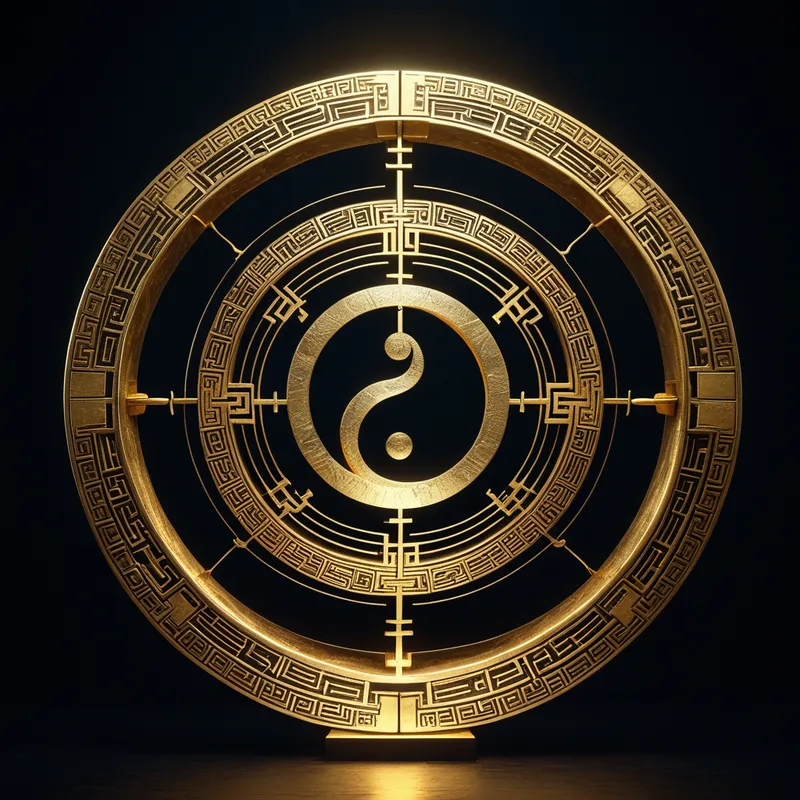
Psychologically, Yang represents consciousness, the ego, assertion, logic, and outward-directed action. Yin represents the unconscious, the body, receptivity, intuition, and inward-directed reflection. The myth tells us that neither can exist healthily without the other. An ego (Yang) utterly disconnected from the unconscious (Yin) is brittle, fanatical, and doomed to burn out. An unconscious life, with no guiding consciousness, is formless, passive, and stagnant. The sacred circle of the Tai Chi symbol perfectly captures this: each force contains the seed of its opposite, and their boundary is a flowing, curved line, not a rigid wall.
The Dreamer's Resonance
When this myth stirs in the modern psyche, it often manifests in dreams of profound duality and seeking wholeness. One might dream of being chased by one's own shadow, only to turn and embrace it. Or dream of a house with a sun-drenched upper floor and a dark, earthy basement, feeling a compulsion to open the door between them.
Such dreams signal a somatic and psychological process of re-balancing. The dreamer may be living in an extreme: all work (Yang) and no rest (Yin), all intellect and no feeling, all giving and no receiving. The dream presents the neglected opposite in symbolic form, not as an enemy, but as a lost partner waiting to dance. The tension in the dream is the ache of separation, and its resolution is always found in recognition, connection, and the beginning of a new, more integrated rhythm.

Alchemical Translation
The individuation process—the journey toward psychic wholeness—is precisely the alchemical translation of this myth. We begin in our personal Hundun: a state of unconscious oneness with our parents and the world, where our contradictions are unacknowledged. Individuation requires the "cracking of the egg," the difficult separation of our conscious identity (Yang) from the undifferentiated mass of the unconscious (Yin).
The goal is not to defeat one's shadow, but to court it, to learn its steps until the dance itself becomes the destination.
This initial separation feels like loneliness, conflict, and inner civil war—the vast gulf between Yang and Yin. The alchemical work is in the subsequent relating. It is the conscious ego learning to listen to the body's wisdom (Yin). It is the intuitive self learning to articulate its visions in the world (Yang). We integrate our anima/animus, accept our shadow, and honor both our need for agency and our need for surrender. The triumph is not a final, static state of "balance," but the achievement of a fluid, resilient capacity to move with the inherent cycles—to lead when it is time to lead, and to yield when it is time to yield, knowing that each already contains the germ of the other. We become, in our small human way, a living Tai Chi, a microcosm of the cosmic dance that first breathed the world into being.
Associated Symbols
Explore related symbols from the CaleaDream lexicon: