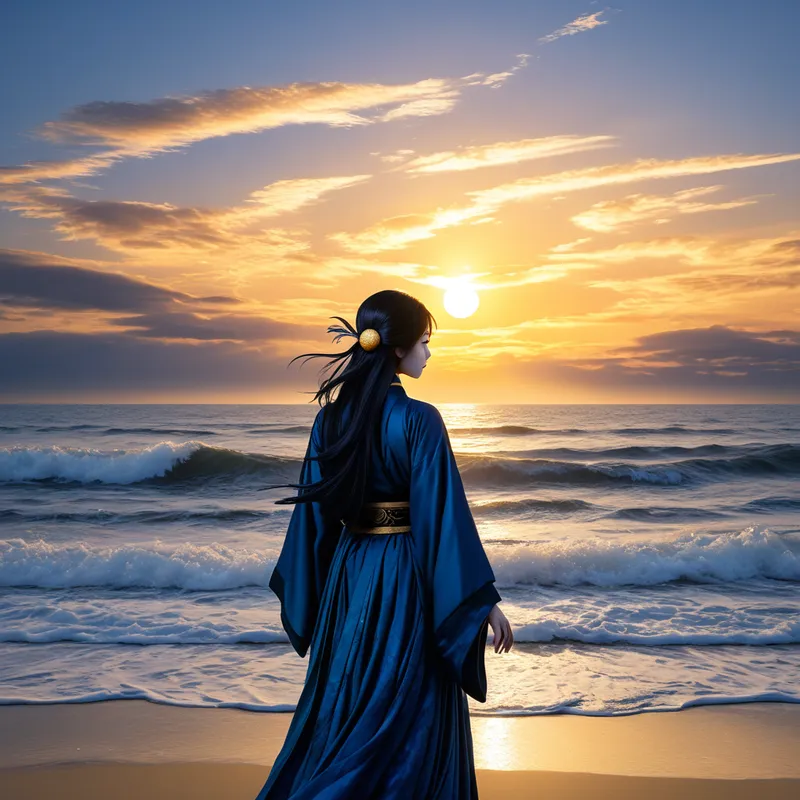
Yūgure Myth Meaning & Symbolism
A mythic personification of twilight, where the veil between worlds thins, offering a fleeting moment of profound insight and sacred transition.
The Tale of Yūgure
Listen, and let the breath of the world still. For I will tell you of the hour that is not an hour, the moment that slips through the fingers of the sun and the grasp of the moon. This is the tale of Yūgure.
In the Age of the Gods, when the world was still soft and singing, there was a space between spaces. The great Amaterasu would finish her daily journey across the heavens, her golden chariot dipping toward the western mountains. Tsukuyomi would stir in his silver palace, preparing his cool, silent reign. But between the lowering of the sun’s banner and the raising of the moon’s standard, there was a breath. A sigh. And in that sigh, a presence was born.
They called it Yūgure. It had no temple of stone, no fixed form. It was the deepening blue in the east while the west still bled orange and rose. It was the long, whispering shadow of the pine that was not there at noon. It was the first, hesitant chirp of the evening cricket, and the last, desperate cry of the returning crow. Yūgure was the keeper of the threshold.
One evening, as the light bled into the umi, a young fisher named Kaito, his heart heavy with a grief he could not name, stood on the shore. He had not come for fish. He had come because the world of day—its sharp edges, its clear duties—had become a cage. He watched the sun drown in fire, and as the world held its breath, he saw it. Not a god, not a spirit, but the moment itself given shape: a figure of shimmering, unstable light at the water’s edge, one hand holding the last ember of day, the other cradling the first seed of starry night.
“Who are you?” Kaito whispered, his voice lost in the vast, quiet hum of the transitioning world.
The figure, Yūgure, did not turn its head, for it had no fixed face. Its voice was the rustle of reeds and the distant ring of a temple bell. “I am the question mark between day’s statement and night’s reply. I am the painter who mixes the palette of two worlds, yet owns neither. You seek an end to your day, fisherman. But do you have the courage to stand in the ending?”
Kaito felt the solid sand beneath his feet grow insubstantial. The familiar coastline seemed to recede, replaced by a misty shore that was both his and not his. In the deepening twilight, the veil between what was seen and what was felt grew thin. Memories, sharp as broken shell, washed up with the tide—not just his own, but the echoes of all who had ever stood at such a brink. Yūgure extended a hand that was neither solid nor light. “To cross, you must leave your certainty on this shore. The other side is not an answer. It is a different kind of question.”
Trembling, Kaito let go of the weight he carried—the name of his grief, the shape of his loss. He let it fall onto the sand, where the twilight shadows swallowed it whole. He stepped forward, not into darkness, but into the embrace of the threshold itself. For a heartbeat that lasted an eternity, he was nowhere and everywhere, no one and everyone. He was the transition.
And then, the first true star pierced the violet sky. The moment passed. Yūgure dissolved into the now-complete night, its duty fulfilled. Kaito stood on the same shore, but the world was not the same. The night was not an absence, but a presence. He had not found an answer to his grief, but he had found the sacred space in which it could change. He carried the twilight within him, a silent, shimmering witness to all that passes and all that begins.
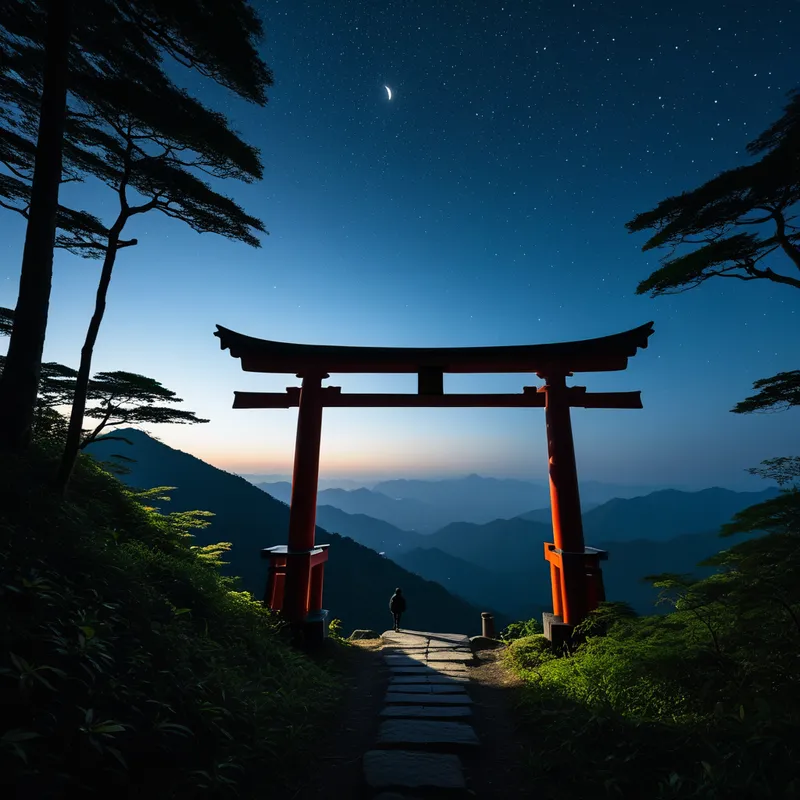
Cultural Origins & Context
The concept of Yūgure is less a formalized myth with a canonical text and more a profound atmospheric and spiritual understanding woven into the fabric of Japanese aesthetics and Shinto belief. It emerges from the ancient, animistic view of the world where natural phenomena are imbued with spirit—kami. Twilight, this dramatic and fleeting daily event, was seen as a powerful sekai, a temporal borderland where the rules of the mundane world relaxed.
This mythic sensibility was preserved and refined in the courtly culture of the Heian period (794-1185 CE), particularly in poetry. The word “yūgure” itself is a staple of waka and later haiku, where it is a kigo (seasonal word) for autumn, evoking a poignant, melancholic beauty—mono no aware. It was a time for reflection, for seeing the world in a different, softer light, and for feeling the presence of the unseen. Storytellers and priests would speak of this hour as a time when spirits walked more freely, when portals could open, and when the human heart, softened by the dying light, was most receptive to mystery and change. Its societal function was to ritualize and make sacred the daily experience of impermanence, teaching that within every ending lies the subtle, sacred genesis of a new beginning.
Symbolic Architecture
Yūgure is the archetypal symbol of the limen. It is not day, nor night, but the essential process of becoming. Psychologically, it represents the critical, often uncomfortable, transitional phases of the psyche: the space between an old identity and a new one, between a conscious realization and its integration, between a wounding and its healing.
The twilight does not seek to resolve the tension between light and dark; it is the vessel that holds that tension sacred. In that holding, a third thing is born—understanding.
The figure of Kaito is the ego, burdened by the known world (“day”), who is called to the shore of the unconscious. The grief he cannot name is often the sum of unlived life or unlamented loss. Yūgure itself is a personification of the Self—the total, regulating center of the psyche—in its function as the mediator of opposites. It offers not salvation, but the sacred space of the threshold. The act of “leaving his certainty on the shore” is the crucial ego-surrender required for any genuine transformation. The myth teaches that we do not solve our core tensions by choosing one side; we transcend them by consciously enduring the creative ambiguity of the in-between.
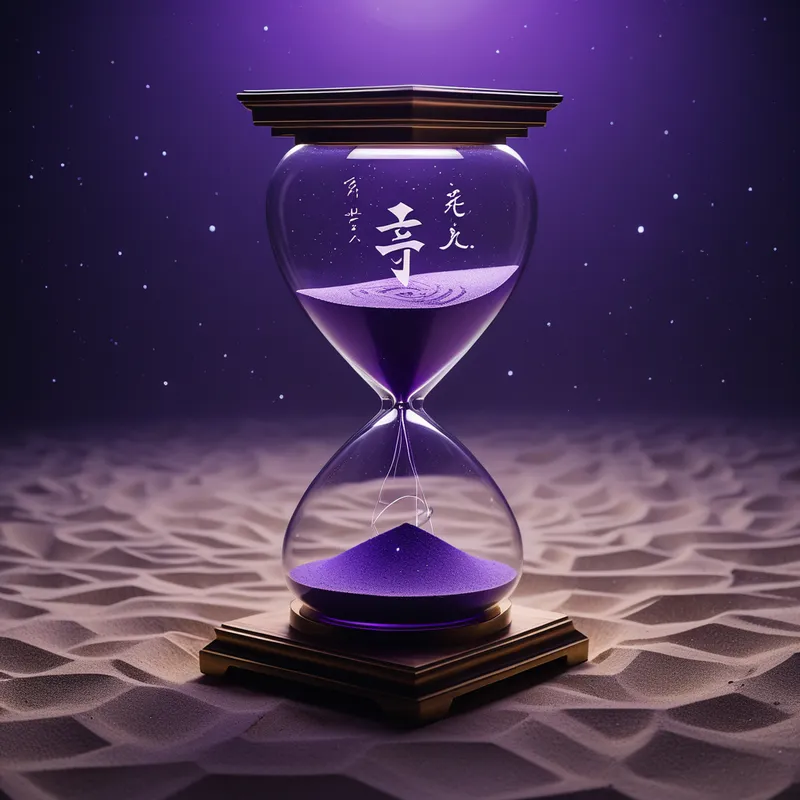
The Dreamer’s Resonance
When the pattern of Yūgure appears in modern dreams, it rarely manifests as a literal twilight scene. Instead, it is felt as a quality of experience. One might dream of standing in a doorway unable to move forward or back, of watching a familiar landscape slowly change color, or of holding two contradictory objects that begin to merge. The somatic sensation is often one of suspension—a breath held, a weightlessness, or a profound stillness amidst internal chaos.
Psychologically, this signals that the dreamer is in a potent liminal state in their waking life. An old job, relationship, or belief system is fading (“the sun is setting”), but the new structure has not yet coalesced (“the moon has not risen”). The psyche is in the workshop of the unconscious, where elements are being broken down and recombined. This dream state is an invitation from the Self to stay with the discomfort, to resist the human urge to prematurely label the experience as either good or bad, success or failure. It is the process of psychic alchemy occurring in the dark, and the dream is a reminder that this twilight is not a place of failure, but of sacred, necessary gestation.
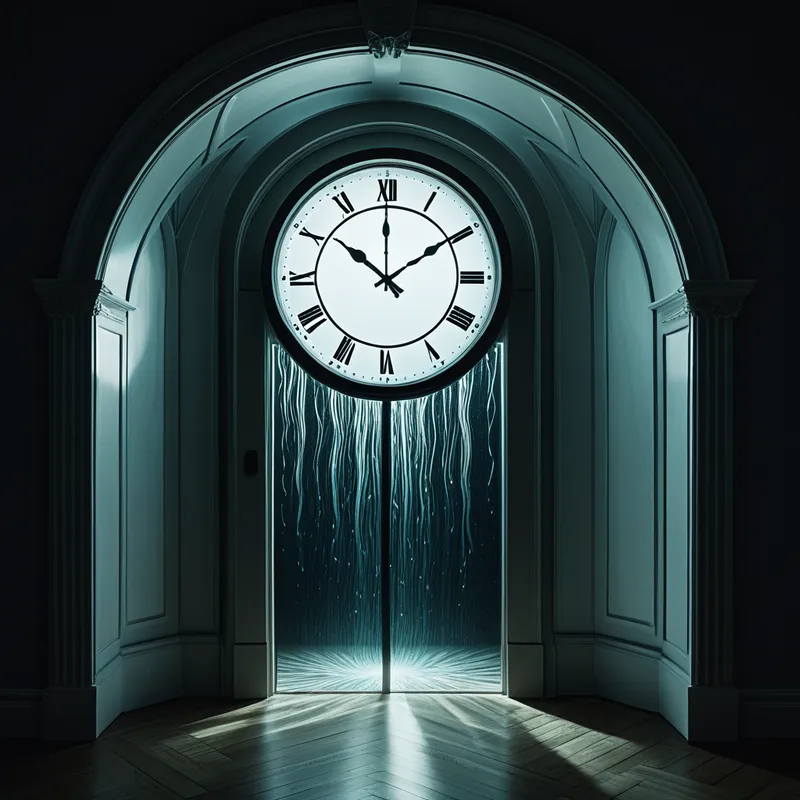
Alchemical Translation
The alchemical process mirrored in the myth of Yūgure is the solutio followed by the coniunctio. Kaito’s solid, day-world grief (the prima materia) is dissolved in the waters of the twilight shore. His ego’s rigid form is softened, made permeable. This dissolution is not destruction, but a return to a primal, potential state.
Individuation is not a journey toward a fixed point of light, but the increasing capacity to dwell consciously in the creative twilight, where all potentials are alive.
The true alchemical “gold” produced is not a final, static state of enlightenment, but the developed capacity to tolerate and find meaning in life’s inherent transitions. The modern individual, through engaging with this mythic pattern, learns to identify their own “twilight hours”—periods of depression, creative blocks, life changes, or deep uncertainty—not as pathologies to be cured, but as sacred thresholds to be honored. The goal becomes the cultivation of the “inner Yūgure”: that wise, witnessing part of ourselves that can hold the tension of opposites without collapsing into one pole or the other. We learn to be the painter who mixes the palette, the keeper of our own threshold, finding in every ending the faint, sacred outline of a beginning not yet born. In doing so, we transmute the leaden fear of change into the gold of conscious becoming.
Associated Symbols
Explore related symbols from the CaleaDream lexicon: