Yggdrasil's First Shoot Myth Meaning & Symbolism
From the primal void, the first gods sacrifice the giant Ymir. From his body, they fashion the worlds, and from his brow, the World Tree's first shoot ascends.
The Tale of Yggdrasil’s First Shoot
Listen. Before the sun knew its path, before the winds had names, there was only [the Ginnungagap](/myths/the-ginnungagap “Myth from Norse culture.”/)—the yawning void. To the north lay [Niflheim](/myths/niflheim “Myth from Norse culture.”/), a realm of ice, mist, and grinding cold. To the south, [Muspelheim](/myths/muspelheim “Myth from Norse culture.”/), a kingdom of unending fire and molten stone. In the emptiness between them, where the frost of one met the breath of the other, a rime began to form. From this living frost, a being coalesced: Ymir, the first of the [frost giants](/myths/frost-giants “Myth from Norse culture.”/). He slept, and from the sweat of his sleeping form, more giants were born.
And from the melting ice, another form came forth: Audhumla. Her milk fed the giant Ymir. As she licked the salty, life-giving ice-blocks, she uncovered, over three days, a new being: Buri. From Buri came a son, Borr, and Borr took a giantess for a wife. Their children were three brothers: Odin, Vili, and Ve.
The young gods looked upon the chaotic, teeming world of the giants, a formless expanse sustained only by Ymir’s dreaming bulk. They saw no order, no purpose, only a cycle of primal consumption. A resolve hardened in their hearts, a terrible and necessary thought. [The world](/myths/the-world “Myth from Tarot culture.”/) could not remain as it was. For something new to be born, the old must be undone.
With a unity of purpose that would echo through all ages, Odin, Vili, and Ve rose against the progenitor. It was not a battle of glory, but a solemn, cosmic act. They confronted the sleeping Ymir and brought him down. His blood, a torrential flood, gushed forth, drowning nearly all the race of frost giants, save one pair who fled to the edges of creation. The roar of his fall was the first sound of ending, and from it, the first possibility of a beginning began.
In the profound silence that followed, the three brothers stood amidst the colossal remains. Here was the raw material of all things. From Ymir’s flesh, they molded [the earth](/myths/the-earth “Myth from Hindu culture.”/), rich and solid. From his unspilled blood, they formed the seas and all waters. From his bones, they raised the mountains; from his teeth, the cliffs and stones. They took his skull and set it aloft to form the dome of [the sky](/myths/the-sky “Myth from Persian culture.”/), placing sparks from Muspelheim within it to become the sun, moon, and stars. From his brains, they cast the clouds.
Their work was vast, but it was not yet complete. A world fashioned, but not yet connected; realms defined, but not yet sustained. Then Odin’s gaze fell upon the giant’s brow, the seat of thought and being. There, from the very essence of the sacrificed primal mind, something was stirring. Not a part of their design, but a gift from the act of creation itself.
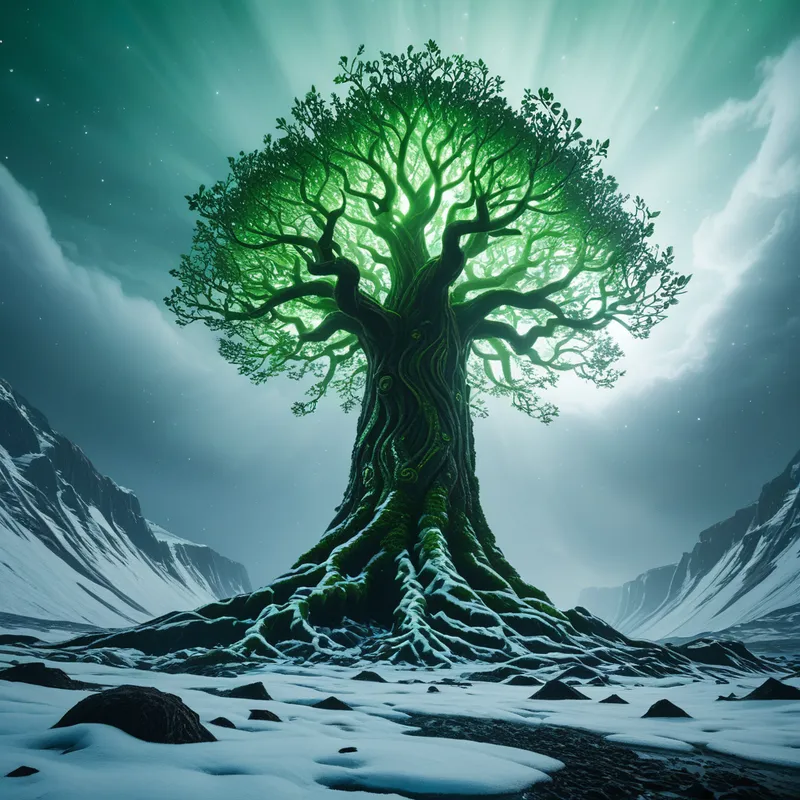
A single, vibrant shoot, green as the first hope, pierced the new soil they had made from Ymir’s flesh. It grew not from the earth alone, but from the confluence of all they had wrought—the solidity of flesh, the memory of blood in the soil, the aspiration of the raised skull-sky above. It ascended, a living axis. Its roots quested downward, seeking hidden waters and truths. Its branches reached upward, cradling the new lights in the sky and stretching into realms unseen. This was the first breath of [Yggdrasil](/myths/yggdrasil “Myth from Global/Universal culture.”/), the World Ash. Its first shoot was the moment the cosmos became a living system, a whole greater than the sum of its parts. The tree was born not as a [thing](/myths/thing “Myth from Norse culture.”/) they made, but as a thing that became from their sacred, terrible, and necessary deed.
Cultural Origins & Context
This foundational narrative is pieced together primarily from the Poetic Edda, especially the Völuspá (The Prophecy of the Seeress) and Grímnismál (The Sayings of Grímnir), and the later Prose Edda of Snorri Sturluson. It was not a story told for mere entertainment around the fire, but a sacred cosmology—an answer to the most profound questions of existence. Skalds (poets) and possibly cultic storytellers would have recited these tales during significant gatherings, embedding the order of the cosmos into the minds of the people.
Its societal function was multifaceted. It established a cultural identity distinct from the primal chaos of the giants, framing the gods (and by extension, their human followers) as beings of order, craft, and conscious action. It also normalized the hard truths of their world: creation requires sacrifice; order is born from violence; life is sustained by a great and suffering tree, constantly under threat. The myth provided a template for understanding their place in a universe that was dynamic, interconnected, and inherently sacred, yet perpetually balanced on the edge of dissolution.
Symbolic Architecture
The myth is a masterclass in symbolic [depth](/symbols/depth “Symbol: Represents profound layers of consciousness, hidden truths, or the unknown aspects of existence, often symbolizing introspection and existential exploration.”/). Ymir represents the undifferentiated, unconscious plenum—the totality of potential that is both nourishing and chaotic. The three brothers—Odin ([spirit](/symbols/spirit “Symbol: Spirit symbolizes the essence of life, vitality, and the spiritual journey of the individual.”/)/inspiration), Vili (will/conscious intent), and Ve (sanctity/holistic being)—symbolize the emergent forces of [consciousness](/symbols/consciousness “Symbol: Consciousness represents the state of awareness and perception, encompassing thoughts, feelings, and experiences.”/) itself. Their act is the primordial act of discrimination: the conscious [psyche](/myths/psyche “Myth from Greek culture.”/) separating itself from the unconscious [mass](/symbols/mass “Symbol: Mass often symbolizes a gathering or collective experience, representing shared beliefs, burdens, or the weight of emotions within a community.”/) to perceive and shape [reality](/symbols/reality “Symbol: Reality signifies the state of existence and perception, often reflecting one’s understanding of truth and life experiences.”/).
The first act of creation is not an act of making, but an act of seeing—of distinguishing the self from the swirling whole. The sacrifice is the birth-pang of consciousness.
Yggdrasil’s shoot, sprouting from Ymir’s [brow](/symbols/brow “Symbol: The brow represents thought, expression, and perception. It is the seat of intellect and emotional display.”/), is the ultimate [symbol](/symbols/symbol “Symbol: A symbol can represent an idea, concept, or belief, serving as a powerful tool for communication and understanding.”/) of this process. It is the [axis](/symbols/axis “Symbol: A central line or principle around which things revolve, representing stability, orientation, and the fundamental structure of reality or consciousness.”/) mundi, the central pillar of reality that arises from the act of creation. It represents the living [structure](/symbols/structure “Symbol: Structure in dreams often symbolizes stability, organization, and the framework of one’s life, reflecting how one perceives their environment and personal life.”/) of the psyche and the [cosmos](/symbols/cosmos “Symbol: The entire universe as an ordered, harmonious system, often representing the totality of existence, spiritual connection, and the unknown.”/)—the interconnected [system](/symbols/system “Symbol: A system represents structure, organization, and interrelated components functioning together, often reflecting personal or social order.”/) that allows for communication between different levels of being (the realms). It is not planted; it emerges, signifying that true order is not imposed arbitrarily, but grows organically from the foundational sacrifice that makes [awareness](/symbols/awareness “Symbol: Conscious perception of self, surroundings, or internal states. Often signifies awakening, insight, or heightened sensitivity.”/) possible.
The Dreamer’s Resonance
When this mythic pattern stirs in the modern dreamer, it often signals a profound psychic reorganization. Dreaming of a great, felled giant or a vast, lifeless landscape may reflect a necessary “ending”—the dissolution of an old, monolithic identity (a job, a relationship, a self-concept) that has become a stagnant, all-encompassing “Ymir.” The dreamer may feel they are participating in a difficult, even violent, act of dismantling.
The subsequent emergence of a single, potent, growing plant—especially from the head or a place of thought—is the compensatory symbol. It is the psyche’s assurance that from this necessary ending, a new, integrative structure is already forming. This is not a simple “new beginning,” but the birth of an internal Yggdrasil: a personal worldview or psychic framework that can hold complexity, connect disparate parts of [the self](/myths/the-self “Myth from Jungian culture.”/) (the “realms”), and provide a stable axis amidst life’s chaos. The somatic feeling is often one of deep, unsettling upheaval followed by a quiet, resilient sense of core strength pushing upward.
Alchemical Translation
For the individual on the path of individuation, this myth models the opus magnum—[the great work](/myths/the-great-work “Myth from Alchemical culture.”/). The “Ymir” within is the unconscious, personal and collective, in its raw, undigested form. It contains all our potential but also our chaotic impulses, inherited traumas, and unexamined drives. The conscious ego (the triad of Odin-Vili-Ve) cannot simply coexist with this giant; it must engage it, confront it, and ultimately sacrifice its dominant, unconscious rule.
The killing of Ymir is the alchemical nigredo—the blackening, the dissolution of the old, compacted state. It is the painful but essential deconstruction of outworn psychic structures.
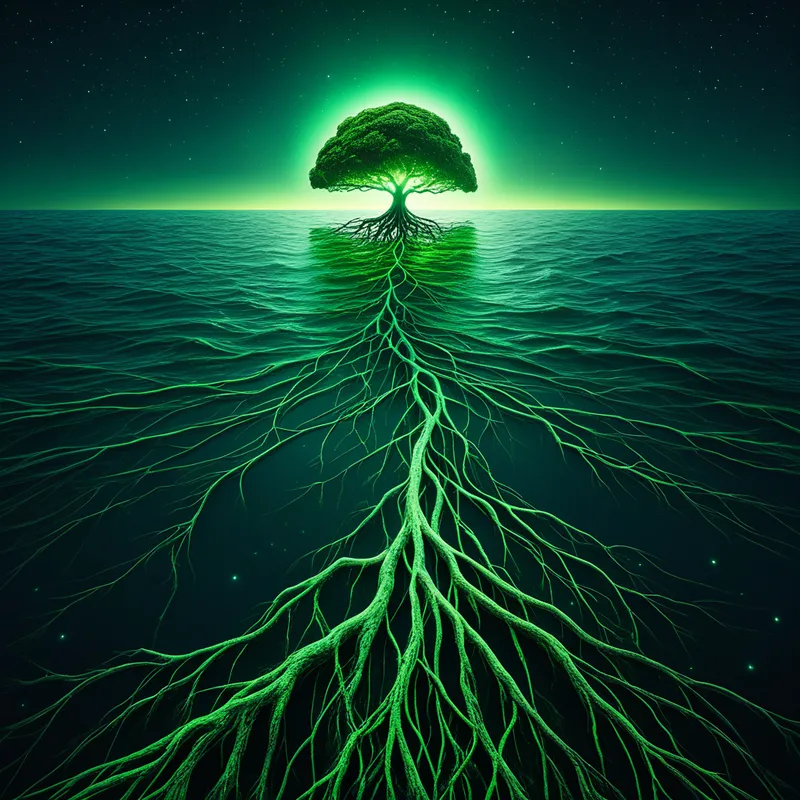
The fashioning of the world from Ymir’s body is the albedo—the whitening. Here, the insights and energies from the unconscious are purified and reconstituted into usable forms: new attitudes, creative pursuits, and a more grounded sense of self (the “earth”). Finally, Yggdrasil’s first shoot is the symbol of the [rubedo](/myths/rubedo “Myth from Alchemical culture.”/)—the reddening, the creation of the philosophical gold. This is the birth of the Self, the central, organizing principle of the mature psyche. It is not [the ego](/myths/the-ego “Myth from Jungian culture.”/), but the living, growing system that connects the ego to the depths and the heights. It is the internal [World Tree](/myths/world-tree “Myth from Global culture.”/), whose roots drink from the dark waters of the unconscious and whose branches touch the light of spirit, allowing the individual to stand firm and interconnected in the midst of life’s eternal cycle of creation and decay.
Associated Symbols
Explore related symbols from the CaleaDream lexicon: