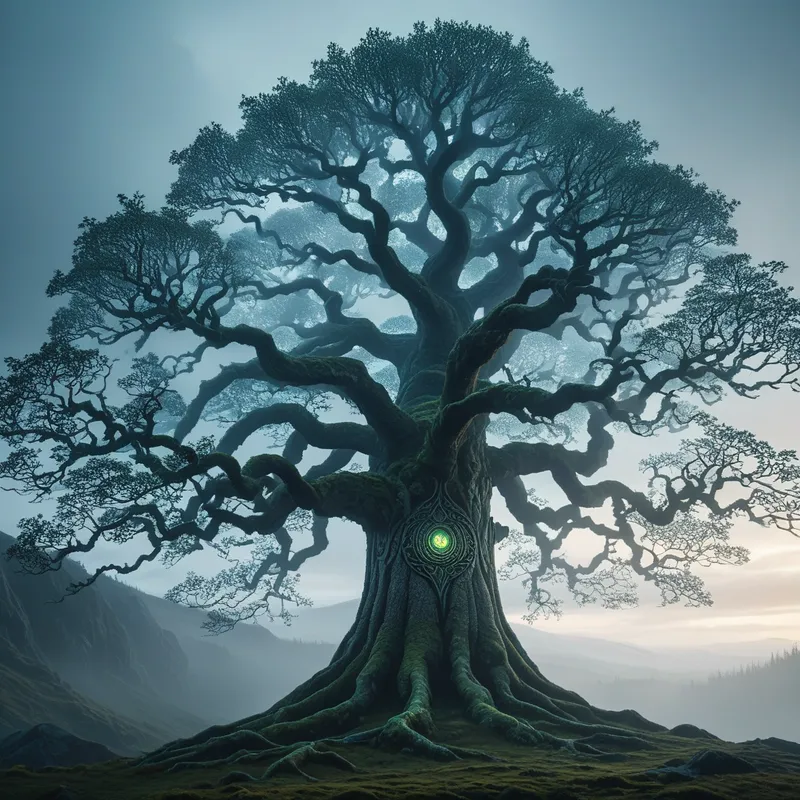
Yggdrasil's Canopy Myth Meaning & Symbolism
The story of the gods' perilous journey to the highest branches of the World Tree to secure the wisdom and order of the cosmos.
The Tale of Yggdrasil’s Canopy
Listen. The wind does not just blow; it carries whispers from the roots of the world. High above, where the air thins to the breath of giants and the light of Ginnungagap still lingers, stretches the canopy of Yggdrasil. This is no mere crown of leaves. It is the vault of heaven, the loom where fate is threaded, a realm so lofty that even the gaze of the Aesir strains to see it.
Beneath this hidden firmament, the worlds trembled in their infancy. Law was but a suggestion, and chaos, the old serpent Nidhogg, gnawed ever deeper. The gods in Asgard knew a truth that chilled their divine blood: a cosmos without order is a feast for entropy. They possessed strength, they possessed craft, but they lacked the supreme, structuring wisdom—the very sap that could fortify the Tree against the relentless gnawing at its roots.
Only one being was said to hold such knowledge, hoarded in the highest, most inaccessible branches: Hraesvelgr, the Corpse-Swallower, whose beating wings are the winds of the world. And the price for this wisdom? It was not gold, nor service. It was a portion of the self. It was sacrifice.
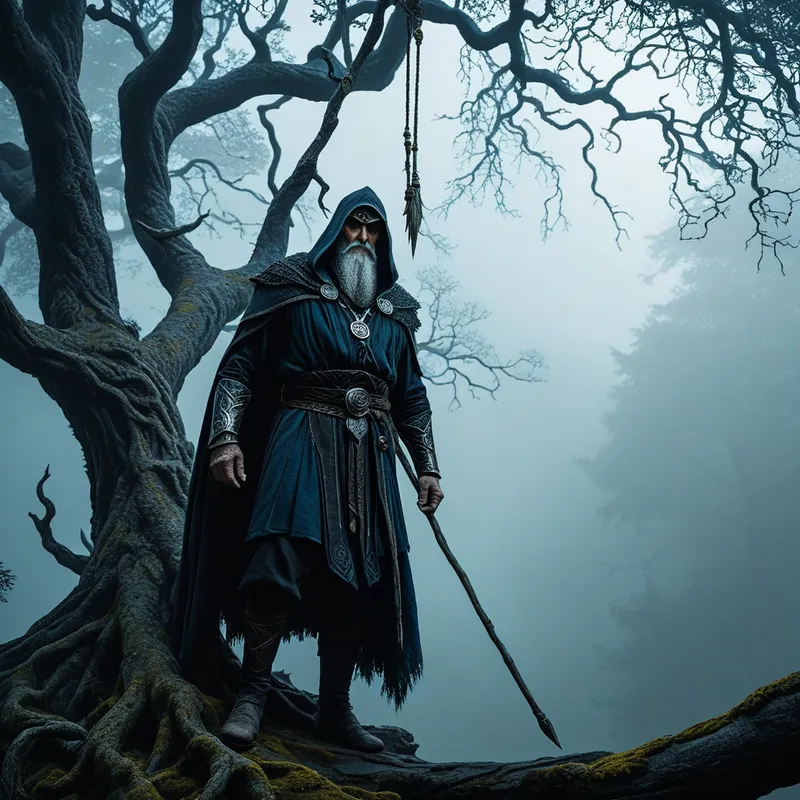
The All-Father, Odin, felt the weight of this truth like a stone in his chest. His one eye, which had seen much, could not see the pattern that would bind all things. With a resolve that silenced the halls of Asgard, he took up his spear, Gungnir, and walked to the base of the Great Ash. He did not climb as a man climbs. He offered himself to the Tree. With a cry that was both invocation and agony, he drove the spear into his own side and hung himself from a mighty bough of the canopy, a sacrifice to himself.
For nine nights, a number sacred and terrible, he hung. The winds of Hraesvelgr tore at him. The cold of the heights seeped into his bones. The abyss below yawned, whispering of the void from which all things came and to which all would return. He stared into it, his eye unblinking, until the boundaries of self blurred. He died to his old knowing. And in that threshold space between life and death, suspended between heaven and root, the secrets stirred. The runes—the primal, shaping sounds of reality—did not appear to his eye, but unfolded within his being. With a final, ragged gasp, he reached down and took them up, and the knowledge flooded him, heavy and bright.
He fell from the tree, forever changed. The wisdom was won. The law was secured. The canopy, once a distant mystery, was now woven into the very fabric of his consciousness, and through him, into the order of the worlds. The Tree was whole, from deepest root to highest leaf, because a god had dared to hang in its crown and pay the price.
Cultural Origins & Context
This profound narrative, known as Odin’s self-sacrifice upon Yggdrasil, is recorded primarily in the Old Norse poem Hávamál (“The Sayings of the High One”), preserved in the 13th-century Poetic Edda. It is crucial to understand that these texts were compiled by Christian scholars, like Snorri Sturluson, from an oral tradition that had thrived for centuries. The myth was not a scripture, but a living cosmology passed down by skalds (poets) and elders around hearth-fires in the long, dark winters of Scandinavia.
Its societal function was multifaceted. For a culture facing a harsh, often unforgiving environment, the myth modeled the necessity of extreme sacrifice for the greater good and the acquisition of vital wisdom. It legitimized the role of the ruler or seer (the goði) who must undergo ordeal for the people’s benefit. Furthermore, it framed the cosmos as a fragile, living system (Yggdrasil) that required active, painful maintenance by its inhabitants. The myth was a map of reality, explaining not only how cosmic order came to be but also the terrifying, personal cost of wisdom and structure in a universe inclined toward chaos.
Symbolic Architecture
The canopy of Yggdrasil is not merely a location; it is the symbolic zenith of consciousness, the realm of overarching pattern, law, and unified knowledge. It represents the highest integration of experience, the “view from above” where disparate elements coalesce into a coherent whole. The struggle to reach it is the psyche’s struggle for meaning.
The canopy is the achieved pattern; the hanging is the dreadful, necessary unraveling of the old self that must precede it.
Odin here is the archetype of the conscious ego undertaking the ultimate quest: the quest for the Self. His one eye represents focused, directed consciousness. His hanging is the ultimate surrender of that very consciousness—a voluntary descent into the unconscious (symbolized by the abyss below and the wound) to retrieve a deeper, more foundational order. The spear, Gungnir, is his will, turned ruthlessly inward to pierce his own illusions. The runes he wins are the fundamental units of meaning, the psychic DNA that allows him to re-order his world from a place of authentic, hard-won knowledge, not imposed authority.
The Dreamer’s Resonance
When this myth stirs in the modern dreamer, it often manifests as dreams of vertiginous heights, of being in the upper floors of an impossibly tall, living structure, or of seeking something vital in an attic or rooftop garden that feels ancient and charged. There may be a somatic sense of suspension, of hanging, or of a piercing wound in the side or chest that does not bring death but a strange, lucid awareness.
Psychologically, this signals a critical phase of individuation: the ego’s recognition that its current framework of knowledge is insufficient. The dreamer is at the threshold of a major synthesis. The old “tree” of their identity has grown tall, but its “canopy”—its guiding principles and highest ideals—is inaccessible or chaotic. The psyche is invoking the Hraesvelgr archetype, the fierce wind of spirit that demands a sacrifice. The dreamer is being prepared to “hang”—to endure a period of painful uncertainty, ego-deflation, or depression—not as a failure, but as the necessary ordeal to receive a more authentic, self-generated order for their life.
Alchemical Translation
The alchemical process mirrored in this myth is the nigredo leading to the albedo—the blackening putrefaction that gives way to whitening enlightenment. Odin’s journey is a perfect map of psychic transmutation.
First, the opus (the great work) is defined: to secure order and wisdom (The Philosopher’s Stone of integrated consciousness). The prima materia (base material) is Odin’s own un-illuminated self. The crucible is the canopy of Yggdrasil, the liminal space between known and unknown. The fire is his own agony and the wind of spirit.
The spear is the separatio, violently dividing the ego from its attachments. The hanging is the solutio, the dissolution of form in the waters of the unconscious. The nine nights are the putrefactio, the black, transformative decay.
From this deliberate darkness emerges the illuminatio: the runes, shining with their own light. This is the whitening, the revelation. Odin does not simply acquire data; he is re-constituted around a new core of meaning. He returns to Asgard not just wiser, but fundamentally altered—his very substance transmuted. For the modern individual, this myth teaches that true wisdom, the kind that can order a life authentically, is never found through mere accumulation. It is forged in the voluntary, terrifying surrender of the ego’s control, a hanging in the unknown, to receive the patterning intelligence that comes from the deepest roots and the highest branches of one’s own being.
Associated Symbols
Explore related symbols from the CaleaDream lexicon: