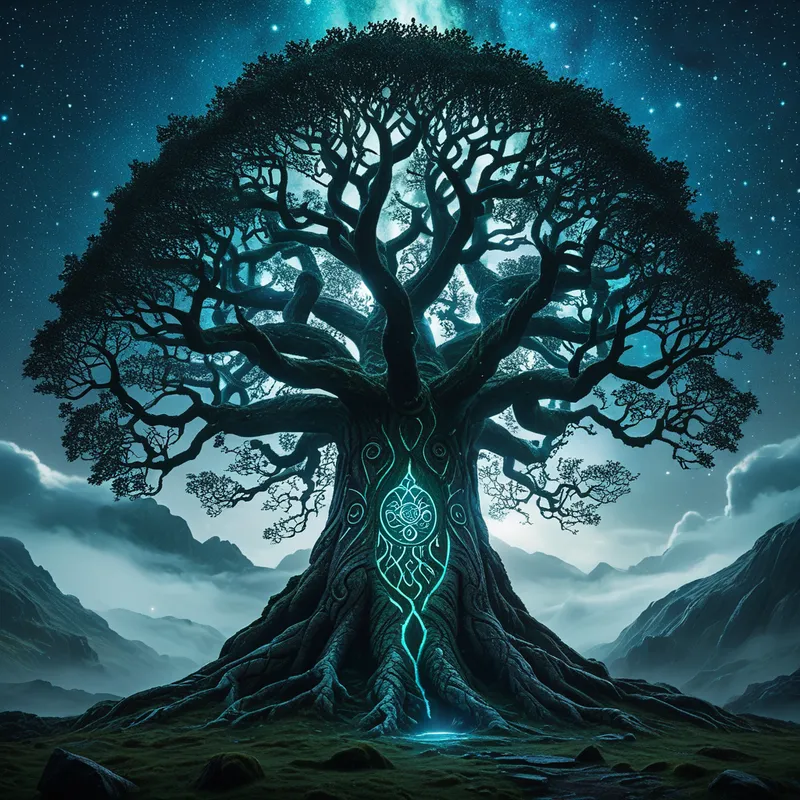
Yggdrasil's Bark Myth Meaning & Symbolism
A tale of sacrifice and cosmic maintenance, where the gods bind the World Tree's wounds with its own bark to preserve all realms from decay.
The Tale of Yggdrasil's Bark
Hear now, a tale not of glorious battle, but of silent, ceaseless vigil. A story whispered by the roots that drink from Urðarbrunnr and sighed by the leaves that brush the highest stars.
The great Yggdrasil groans. Its ache is not a sudden wound, but a deep, grinding weariness. From its highest bough in Asgard to its deepest root in Niflheim, a shudder passes through all the Nine Worlds. The eagle at its crown shrieks a warning; the dragon Níðhöggr gnaws with renewed fervor. The four stags, Dáinn, Dvalinn, Duneyrr and Duraþrór, cease their grazing, their flanks heaving. The Tree, the axis of all that is, is fraying.
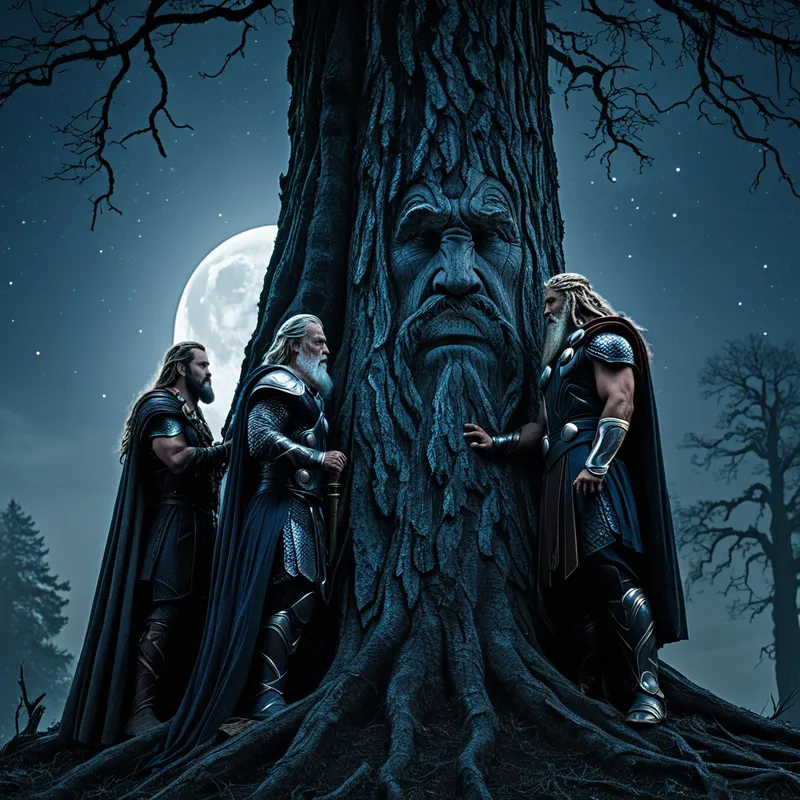
Odin feels it first, a hollowing in his one good eye. He calls the council. Not in the shining hall of Valhalla, but at the very foot of the suffering Tree, where the Norns weave their threads with water from the well. Thor stands with hammer heavy, not raised for giants, but held in helpless grip. Frigg places a hand upon the rough bark, and her sight turns inward, witnessing the slow seep of vitality from a thousand tiny rents.
The conflict is not against a foe, but against entropy itself. The rising action is a quiet, desperate survey. They see where the bark splits from the relentless wind of the worlds. They see the weeping sap where creatures have climbed, where fate has been carved, where time itself has worn the skin of the universe thin. The Tree gives endlessly—its sap is time, its bark is boundary, its branches are possibility. And it is bleeding out.
The resolution is not a victory, but a sacrament. The gods do not seek a foreign cure. They look to the wound itself. With hands that have wielded spears and spun destiny, they now perform the most humble of tasks. They gather the very bark that has fallen, the skin the Tree has shed in its agony. They mix it with the white mud from the Well of Urd, the waters of memory and fate. And there, under the watchful eyes of the Norns, they begin to bind. They patch the fissures. They seal the leaks. They mend the great Tree with its own substance. It is a sacrifice not of blood, but of attention; not of conquest, but of care. As they work, a deep, resonant hum replaces the groan. The worlds, held in the Tree’s embrace, let out a collective, unconscious sigh. The work is never done, but for a time, the unraveling is stayed.
Cultural Origins & Context
This narrative is not found in a single, discrete Eddic poem, but is woven from the fabric of the cosmology described in the Prose Edda and the allusive verses of the Poetic Edda. It is a myth of maintenance, a concept central to the Norse worldview. The cosmos was not a perfect, static creation, but a dynamic, living system perpetually under threat from forces of chaos (jötnar) and decay.
This story would have been told not to glorify a hero’s deed, but to explain the fragility and preciousness of order (örlög). It was a societal metaphor: just as the gods must tirelessly tend the World Tree, so too must a community tend its fences, its ships, its relationships, and its laws. The function was pedagogical and grounding, teaching that survival depends not on grand, final victories, but on the daily, often thankless, work of repair and preservation. It was likely a tale for the long, dark winters, a reminder that even the gods are engaged in the same struggle against entropy that every farmer, sailor, and chieftain faced.
Symbolic Architecture
At its core, the myth presents Yggdrasil as the archetypal Axis Mundi. Its bark is the boundary membrane of reality itself—the differentiation that allows for the existence of separate worlds, distinct beings, and individual consciousness. The damage to the bark symbolizes the inevitable erosion of these boundaries: the seepage of chaos into order, of unconscious contents into conscious life, of decay into structure.
The most profound healing often requires binding the wound with a piece of the very self that was injured.
The gods’ act is profoundly symbolic. They do not import a solution; they use the Tree’s own shed bark. This represents the psychological truth that the resources for healing and integration are contained within the system that is suffering. The “bark” we must use is often the scar tissue of past experiences, the shed “skins” of former selves, or the accepted limitations of our own nature. The white mud from the Well of Urd signifies the necessity of mixing this self-material with the waters of fate and memory—true healing requires conscious acknowledgment of one’s past and destiny.
The Dreamer's Resonance
When this myth pattern surfaces in modern dreams, it seldom appears as a clear Norse tableau. Instead, the dreamer may find themselves in a house with leaking walls, trying to plug holes with scraps of the same crumbling plaster. They may be desperately trying to hold together a splitting piece of furniture, or tending to a sick, giant animal that represents their own body or psyche. The somatic feeling is one of urgent, anxious maintenance against a slow, overwhelming tide of decay.
Psychologically, this signals a process of “boundary repair.” The dreamer is likely experiencing a sense of psychic entropy: burnout, emotional leakage, a feeling that the structures of their life (career, relationships, identity) are fraying at the edges. The dream is not a call to find a magical external solution, but to engage in the humble, repetitive work of self-care and integration—to use one’s own resources (the “bark”) to shore up one’s own boundaries. It is the psyche’s way of modeling the slow, unglamorous work of holding oneself together.
Alchemical Translation
In the alchemy of individuation, this myth models the stage of mortificatio and separatio followed by a conscious coagulatio. The initial wounding and shedding of bark is the necessary mortificatio—the breaking down of outworn psychic structures and protective personas. The recognition of the damage is the separatio—the conscious differentiation of what is decaying from what remains vital.
The act of binding the wound with the shed bark is the coagulatio, the reconstitution of the self on a new, more conscious level. Here, the “lead” of suffering and fragmentation is transmuted into the “gold” of a more resilient, self-aware structure.
The individuated self is not a flawless monument, but a lovingly and perpetually mended world-tree, its scars become its strength, its maintenance its meaning.
For the modern individual, the allegory is clear. Our psychic wholeness is not a static state achieved once and for all. It is a dynamic, living system (the Self as Yggdrasil) that requires constant attention. The “gods” are our conscious ego-functions. The “bark” is the material of our own lived experience—our memories, our accepted flaws, our endured pains. The alchemical work is to consciously gather these fragments and use them to repair the breaches in our being. We heal not by becoming someone new, but by becoming more fully, and more resiliently, ourselves—binding our wounds with the wisdom of our own scars, and in doing so, holding our own inner cosmos together.
Associated Symbols
Explore related symbols from the CaleaDream lexicon: