Yellow Emperor's Bone Flutes Myth Meaning & Symbolism
The Yellow Emperor crafts flutes from the bones of a vanquished foe, transforming chaos and grief into the first music that orders the human world.
The Tale of Yellow Emperor’s Bone Flutes
Listen, and hear [the wind](/myths/the-wind “Myth from Various culture.”/) that sings through the hollows of [the world](/myths/the-world “Myth from Tarot culture.”/). It was not always so. Once, [the wind](/myths/the-wind “Myth from Various culture.”/) only howled.
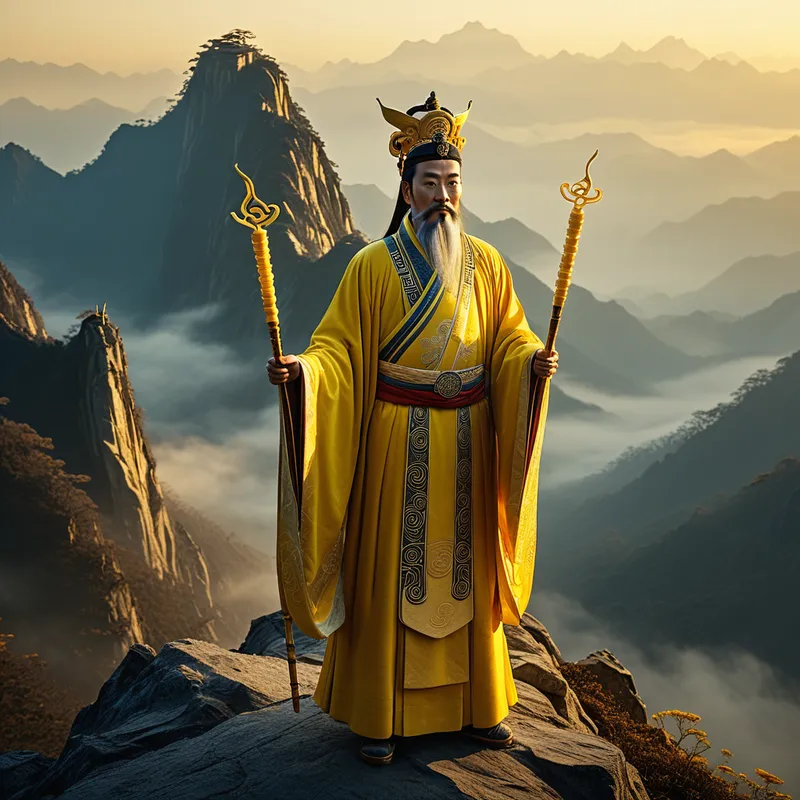
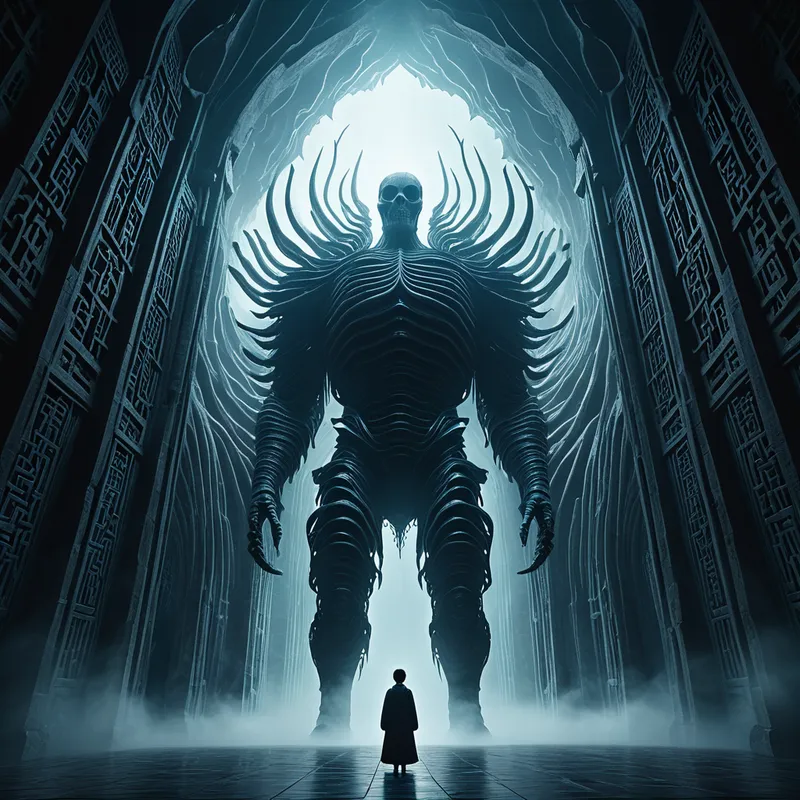
In the dawn-time of the world, when the rivers ran with no set course and the mountains shifted like restless beasts, the [Yellow Emperor](/myths/yellow-emperor “Myth from Chinese culture.”/), Huangdi, ruled with a mind that sought the pattern behind the storm. Yet his reign was besieged by a roar that drowned all thought—the rebellion of Chiyou, a being of forged metal and wild tempest, whose eighty-one bronze-headed brothers shook the heavens with their clamor. Theirs was the music of pure chaos: the shriek of grinding metal, the thunder of unbound feet, the cacophony of a world refusing shape.
The great battle at Zhuolu darkened the sun with dust and magic. Chiyou breathed thick fogs to blind the imperial armies, but Huangdi, in his wisdom, raised the south-pointing chariot to find direction in the murk. [The earth](/myths/the-earth “Myth from Hindu culture.”/) itself grew weary of the tumult. Finally, with the aid of [the dragon](/myths/the-dragon “Myth from Chinese culture.”/) Ba and his own celestial strategies, [the Yellow Emperor](/myths/the-yellow-emperor “Myth from Chinese culture.”/) prevailed. Chiyou fell, his chaotic power stilled.
But victory was a silent, heavy [thing](/myths/thing “Myth from Norse culture.”/). The land was scarred, and the people were haunted, their spirits still echoing with the recent din. The Emperor walked the field in the aftermath, the air thick with the memory of rage and loss. Then he came upon the remains of his formidable foe. And here, the myth turns from war to a profound, unsettling craft.
He did not bury the bones as refuse, nor raise them as a grim trophy. He commanded them to be gathered—the great ribs and long bones of the bull-demon. In a quiet pavilion high in the mountains, under the watchful eye of [the star](/myths/the-star “Myth from Tarot culture.”/) Thuban</ab title>, the Emperor became an artisan of resonance. With tools of jade and drills of bronze, he bored into the very substance of his vanquished chaos. He measured the lengths against the Li of the heavens, aligning each hole with a celestial pitch.
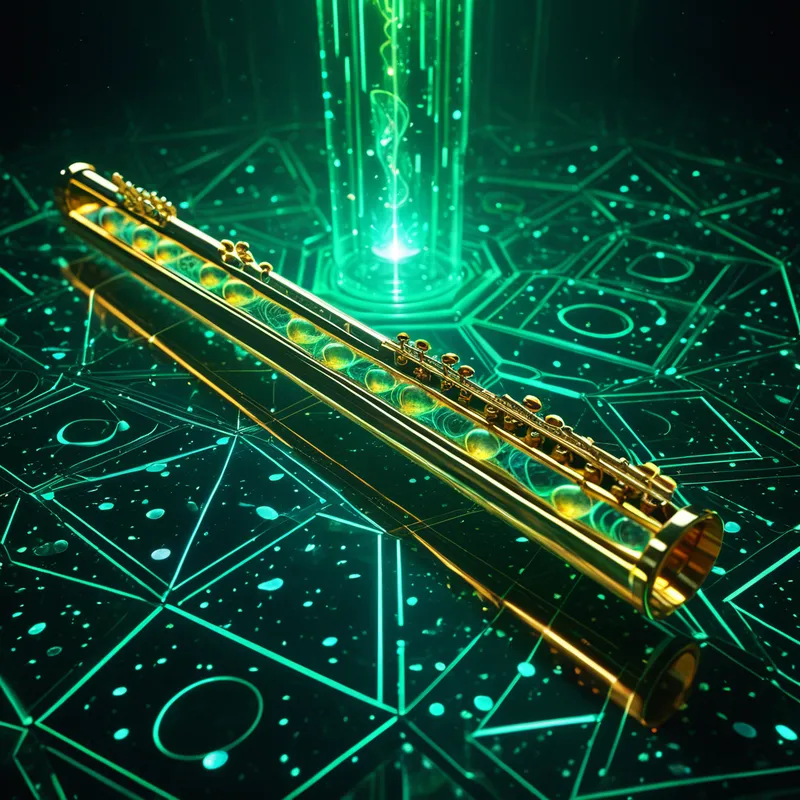
He fashioned flutes.
And when he raised the first flute to his lips and breathed into the hollow of his enemy’s bone, the sound that emerged was not a scream, but a clear, pure note. It hung in the air, steady and true. He played another, and another, crafting melodies that mirrored the orderly flow of rivers, the gentle growth of crops, the harmonious movement of the stars. The chaotic roar of Chiyou was gone. In its place was music—the first structured, intentional music given to humanity. The wind now had a song, and the human heart, a pattern to soothe its own inner turmoil.
Cultural Origins & Context
This myth, emerging from the deep strata of Chinese legendary history, is not a folktale of the village but a state myth of the highest order. It is intimately tied to the figure of the Huangdi, a culture hero par excellence who is credited with the invention of everything from the cart and the boat to medicine and the calendar. The story of the bone flutes is a cornerstone of this civilizing narrative.
It was preserved and transmitted through the very channels it mythologizes: state ritual and historical texts. Scholars posit its roots in ancient shamanic (Wu) practices, where music and bone oracle tools were used to mediate between heaven and earth. The myth was later formalized in texts like the Shiji and other Warring States and Han dynasty compilations, which sought to create a coherent, moral pre-history for the emerging imperial order.
Its societal function was profound. It served as an etiological myth for the origin of music (Yue), which in Confucian thought was not mere entertainment but a fundamental force for social harmony and ethical cultivation. More critically, it provided a sacred model for statecraft: the true ruler does not simply destroy his enemies; he incorporates and transforms their essence, turning the very substance of chaos into the instrument of order. It is a myth about the alchemy of governance.
Symbolic Architecture
At its core, this myth is a masterclass in symbolic [transmutation](/symbols/transmutation “Symbol: A profound, alchemical process of fundamental change where one substance or state transforms into another, often representing spiritual evolution or personal metamorphosis.”/). The elements are stark and powerful: the raw, chaotic power of Chiyou, the ordering intelligence of Huangdi, and the bone as the mediating substance.
The bone represents the irreducible core, the lasting [framework](/symbols/framework “Symbol: Represents the underlying structure of one’s identity, emotions, or life. It signifies the mental or emotional scaffolding that supports or confines the self.”/). It is what remains after the flesh of immediate conflict has fallen away—the hard [truth](/symbols/truth “Symbol: Truth represents authenticity, honesty, and the quest for knowledge beyond mere appearances.”/), the enduring consequence, the [skeleton](/symbols/skeleton “Symbol: A skeleton symbolizes the foundational aspects of life and mortality, representing both the physical body and the spiritual essence of being.”/) of a traumatic [event](/symbols/event “Symbol: An event within dreams often signifies significant life changes, transitions, or emotional milestones.”/). Chiyou is not just an [enemy](/symbols/enemy “Symbol: An enemy in dreams often symbolizes an internal conflict, self-doubt, or an aspect of oneself that one struggles to accept.”/); he is the psychological embodiment of the unintegrated [shadow](/symbols/shadow “Symbol: The ‘shadow’ embodies the unconscious, repressed aspects of the self and often represents fears or hidden emotions.”/), the tumultuous passions, the rebellious instincts, and the chaotic forces that threaten the sovereignty of the conscious self (the Emperor).
The true ruler does not exile his shadow; he learns its scales and teaches it to sing.
The act of crafting flutes is an act of conscious, sacred [digestion](/symbols/digestion “Symbol: Represents processing, assimilation, and elimination of experiences, emotions, or information. Often symbolizes how we handle life’s challenges and absorb what nourishes us.”/). Huangdi does not pretend the battle never happened. He takes the literal bones of the conflict and subjects them to measurement (Li), discipline, and [breath](/symbols/breath “Symbol: Breath symbolizes life, vitality, and the connection between the physical and spiritual realms.”/). The holes drilled are not wounds, but apertures for [spirit](/symbols/spirit “Symbol: Spirit symbolizes the essence of life, vitality, and the spiritual journey of the individual.”/) (Qi) to pass through in a controlled way. The chaotic roar is deconstructed and re-synthesized into a scale, a [language](/symbols/language “Symbol: Language symbolizes communication, understanding, and the complexities of expressing thoughts and emotions.”/).
[Music](/symbols/music “Symbol: Music in dreams often symbolizes the harmony between the conscious and unconscious mind, illustrating emotional expression and communication.”/) here is the [symbol](/symbols/symbol “Symbol: A symbol can represent an idea, concept, or belief, serving as a powerful tool for communication and understanding.”/) of emergent order—not a rigid, silent law, but a dynamic, living [structure](/symbols/structure “Symbol: Structure in dreams often symbolizes stability, organization, and the framework of one’s life, reflecting how one perceives their environment and personal life.”/) that can hold and express complexity. The [flute](/symbols/flute “Symbol: The flute epitomizes elegance and grace, often symbolizing harmony, beauty, and spirituality.”/)’s song is the sound of the integrated [psyche](/myths/psyche “Myth from Greek culture.”/): the raw [energy](/symbols/energy “Symbol: Energy symbolizes vitality, motivation, and the drive that fuels actions and ambitions.”/) of the instinctual world, now channeled into something that creates [cohesion](/symbols/cohesion “Symbol: The quality of sticking together or forming a unified whole, often representing unity, strength, and integrity in dreams.”/), meaning, and [beauty](/symbols/beauty “Symbol: This symbol embodies aesthetics, harmony, and the appreciation of life’s finer qualities.”/).
The Dreamer’s Resonance
When this myth stirs in the modern unconscious, it often surfaces in dreams of confrontation and strange creation. One might dream of finding bones—perhaps in a basement, a forgotten attic, or a stark landscape. These are not frightening in a monstrous way, but feel heavy with potential. The dreamer may feel compelled to do something with them: to clean them, arrange them, or, most tellingly, to try and make them resonate or produce sound.
This is the psyche signaling a move from trauma management to alchemical processing. The “bones” represent the core, structural memories of a past conflict, a loss, or a personal “Chiyou”—a period of inner chaos, addiction, rage, or depression that has been subdued but not yet integrated. The somatic sensation is often one of dense weight in the chest or gut, coupled with a curious, creative urge.
The dream of crafting an instrument from this material indicates [the ego](/myths/the-ego “Myth from Jungian culture.”/)’s readiness to become the Huangdi of its own inner kingdom. It is no longer satisfied with merely silencing the inner demon; it seeks to use its very essence to create a new capacity. The process is not easy—the drilling can feel like a violation or a painful revisiting. But the outcome dreamed of is always a form of music: a personal voice, a unique melody of understanding that arises from the very hardship one endured.
Alchemical Translation
The individuation journey modeled here is not one of heroic conquest ending in celebration, but of sovereign integration resulting in a new creative faculty. It maps the process of psychic transmutation with startling clarity.
First, the Confrontation (The Battle of Zhuolu): The conscious self must engage with its own chaotic, overwhelming complexes. This is a necessary, often brutal, stage of civil war within the psyche. Victory here is simply establishing enough consciousness to “subdue” the autonomous complex, to bring it under some form of awareness.
The Critical Turn (The Contemplation of the Bones): This is where many processes stall. The alchemical work begins not with the fight, but with the reflection after. It requires a willingness to stay with the aftermath—the guilt, the grief, the residual fear—and to see it not as waste, but as primal material. This is the [prima materia](/myths/prima-materia “Myth from Alchemical culture.”/) of the soul: the hard, white facts of our suffering.
[The Opus](/myths/the-opus “Myth from Alchemical culture.”/) (Crafting the Flutes): This is the meticulous work of analysis, art, and ritual. It is finding the “celestial measurements”—the universal patterns, psychological theories, or artistic forms—that can give structure to the raw material. Drilling the holes is the act of creating apertures for reflection: “Where did this pain come from? What pitch does it hold?” It is a deliberate, sometimes painful re-shaping of memory and energy.
The melody that orders your world must be breathed through the hollow places of your deepest defeat.
The New Function (The Music of Order): The final stage is not just peace, but a new capacity. The integrated complex no longer operates as an autonomous disruptor (Chiyou’s roar) but as a source of creativity and depth. The rage becomes fierce advocacy. The grief becomes profound empathy. The chaotic experience becomes the unique “music” one brings to the world—a personal wisdom, a therapeutic insight, an artistic style that could not have existed without that specific, digested struggle. The ruler of the psyche has not just secured his borders; he has enriched his realm with a new and beautiful language, born from the bones of the old enemy.
Associated Symbols
Explore related symbols from the CaleaDream lexicon: