Yarilo Myth Meaning & Symbolism
The story of the youthful god of spring, whose passionate life, sacrificial death, and cyclical rebirth embody the eternal return of vitality and the soul's transformative journey.
The Tale of Yarilo
Listen, and hear the tale that the earth herself whispers when the ice cracks and the first green shoots dare to pierce the frozen crust. In the time before memory, when the world was raw and gods walked the birch forests, there was a youth whose coming was the world’s delight. His name was Yarilo.
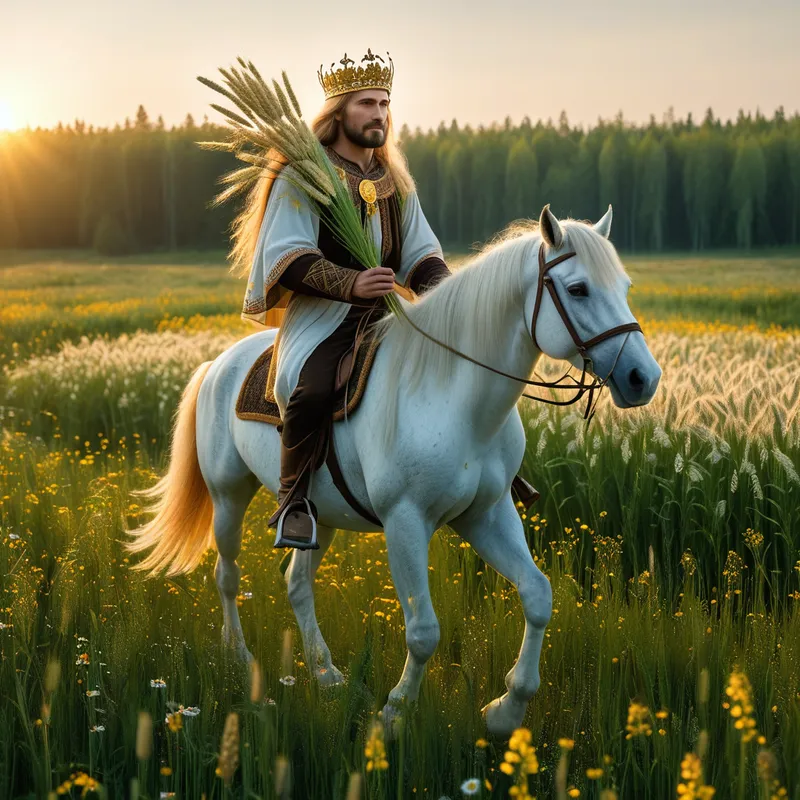
He arrived not with thunder, but with a whisper of warm wind. He was the beautiful one, the golden-haired son, his eyes the blue of the spring sky after rain. Where his bare feet touched the snow, crocuses bloomed. His laughter was the sound of melting streams. He rode a white horse, and its hooves did not break the tender soil but made it fertile. In his hand, he carried not a weapon, but a sheaf of wheat, heavy with promise. He was life incarnate, a surge of irresistible, passionate force. The maidens would weave wreaths of periwinkle and cornflower for him, and he would dance with them in the meadows, his dance a whirlwind of joy that made the very sap rise in the trees and the hearts quicken in the chests of all living things.
For a season, the world was his bride. The fields swelled with grain under his gaze; the forests grew thick and green. His was a rule of abundance, of unchecked growth, of fervent love for the world. But as the sun reaches its zenith, it must begin its descent. The wheat in his hand ripened to gold, then began to dry. The passionate force that gives life, if left unchecked, burns itself out. The world, glutted on his vitality, grew heavy and still.
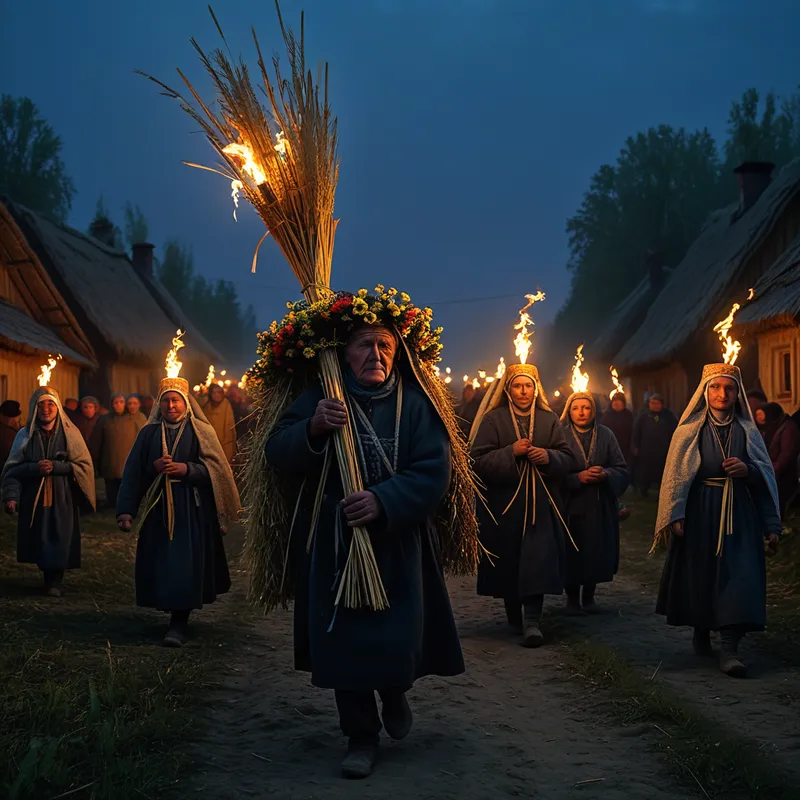
And so, the tale turns. The bright god must depart. There was no villain, no monstrous foe—only the turning of the great wheel. In the waning light of the summer solstice, the people, with hearts full of love and sorrow, would fashion his likeness from the last sheaves of straw. They adorned this effigy with the very flowers he loved and carried it to the edge of the village, to the fields now bare from harvest. With songs that were both lament and prayer, they would lay the figure upon a pyre. The fire would catch, consuming the straw god, turning his vibrant image to smoke and ash. His light was extinguished, his presence withdrawn from the world. A great silence would fall, the silence of autumn and the long, dreaming sleep of winter.
But this is not an end. It is a promise buried deep in the frozen earth. For in the ashes of that fire, scattered upon the field, lay the secret. When the days grew coldest and darkest, the people remembered. They knew the beautiful, doomed youth was not gone. He had journeyed into the dark womb of Morana, into the realm of roots and stones. And there, in that silent, secret place, he gestated. He became the seed in the heart of the earth, waiting. And when the sun’s strength returned, just a little, a new, irresistible force would push upward. Not the golden youth, but the green shoot. Not the dancer, but the rising sap. He was reborn, not as he was, but as the principle of return itself. The beautiful god died so that the world might live, and in living, prepare for his return once more.
Cultural Origins & Context
The myth of Yarilo is not a single, codified scripture, but a living pattern woven into the seasonal rituals of the pre-Christian Slavs. It was passed down not in books, but in the cyclical actions of agrarian communities whose survival was inextricably linked to the rhythms of nature. The “myth” was performed, not merely told. It was enacted in the spring and summer khorovods, where young men and women embodied the god’s fertile energy, and in the harvest-time rituals of his symbolic death.
The societal function was profound and practical. It was a cosmological anchor, explaining the terrifying and glorious cycle of life, death, and rebirth. By ritually participating in Yarilo’s journey—celebrating his arrival, mourning his departure, and trusting in his return—the community aligned itself with the forces of nature. It was an act of sympathetic magic: by performing the god’s cycle, they ensured the cycle of their crops and their herds. The storytellers were the entire village, from the elders who remembered the correct songs to the children who gathered flowers for the effigy. It was a myth of immanence, where the divine was not distant, but palpably present in the growth of the grain and the passion of the heart.
Symbolic Architecture
At its core, Yarilo is not just a god of spring; he is the archetypal principle of eros in its fullest, most primal sense—the [life](/symbols/life “Symbol: The symbol of ‘Life’ represents a journey of growth, interconnectedness, and existential meaning, encompassing both the joys and challenges that define human experience.”/) force, passionate vitality, creative surge, and the instinctual drive toward union and growth. His myth maps the inevitable trajectory of any pure, unbridled force of [nature](/symbols/nature “Symbol: Nature symbolizes growth, connectivity, and the primal forces of existence.”/): a glorious, explosive [emergence](/symbols/emergence “Symbol: A process of coming into being, rising from obscurity, or breaking through a barrier, often representing birth, transformation, or revelation.”/), a peak of radiant [expression](/symbols/expression “Symbol: Expression represents the act of conveying thoughts, emotions, and individuality, emphasizing personal communication and creativity.”/), and a necessary [dissolution](/symbols/dissolution “Symbol: The process of breaking down, dispersing, or losing form, often representing transformation, release, or the end of a state of being.”/).
The sacrifice of the beautiful god is the universe’s law: all particular forms must perish so that the forming principle may continue.
His [death](/symbols/death “Symbol: Symbolizes transformation, endings, and new beginnings; often associated with fear of the unknown.”/) is not a tragedy but an integral phase. The straw effigy burned represents the [husk](/symbols/husk “Symbol: A hollow, discarded outer shell, often representing emptiness, potential, or transformation after the core has been removed.”/), the outworn form. The passionate [youth](/symbols/youth “Symbol: Youth symbolizes vitality, potential, and the phase of life associated with growth and exploration.”/) cannot rule forever; his [energy](/symbols/energy “Symbol: Energy symbolizes vitality, motivation, and the drive that fuels actions and ambitions.”/) must be surrendered, recycled, and transformed. He descends to become the [Earth](/symbols/earth “Symbol: The symbol of Earth often represents grounding, stability, and the physical realm, embodying a connection to nature and the innate support it provides.”/)’s secret, the potential hidden in the Seed. Psychologically, Yarilo represents the exhilarating but transient energies of [youth](/symbols/youth “Symbol: Youth symbolizes vitality, potential, and the phase of life associated with growth and exploration.”/), inspiration, and raw [passion](/symbols/passion “Symbol: Intense emotional or physical desire, often linked to love, creativity, or purpose. Represents life force and deep engagement.”/). He is the burst of a new [idea](/symbols/idea “Symbol: An ‘Idea’ represents a spark of creativity, innovation, or realization, often emerging as a solution to a problem or a new outlook on life.”/), the flush of new love, the project begun with boundless enthusiasm. His cycle warns that these energies cannot be sustained indefinitely in their initial form; they must be allowed to “die,” to be integrated into the deeper [soil](/symbols/soil “Symbol: Soil symbolizes fertility, nourishment, and the foundation of life, serving as a metaphor for growth and stability.”/) of the psyche, to be reborn as something more sustainable and wise.
The Dreamer’s Resonance
When the pattern of Yarilo stirs in modern dreams, it often signals a profound somatic and psychological process related to cycles of creative energy and personal vitality. One might dream of a radiant, captivating figure who suddenly withers or is lost; of a magnificent, fleeting festival that ends in a quiet, empty field; or of holding a beautiful, living plant that suddenly turns to dust in one’s hands.
These dreams point to an encounter with the natural rhythm of one’s own life force. The somatic feeling is often one of intense, buzzing aliveness followed by a deep, hollow fatigue—the “burnout” after a period of manic productivity or emotional intensity. Psychologically, the dreamer is processing the necessary death of a phase. It could be the end of a passionate relationship, the completion of a creative endeavor, or the passing of a youthful identity. The dream is not merely expressing grief, but initiating a sacred process: the ritual burial of that spent energy so that its essence can nourish what is to come. It is the psyche’s way of performing the ancient rite, assuring the dreamer that this dissolution is not failure, but part of the sacred round.
Alchemical Translation
The alchemical journey mirrored in Yarilo’s myth is the process of solve et coagula—dissolve and coagulate—applied to the soul’s vital energies. For the modern individual seeking individuation, Yarilo models the transmutation of raw, instinctual passion into conscious, life-affirming spirit.
The first stage is identification with the god: we are swept up in a passion, a cause, an identity. We are the golden youth on the white horse, full of power and promise. The alchemical work begins with the sacrifice: the conscious acknowledgment that this phase must end. This is the mortificatio, the killing of the king. We must willingly lay our outworn form—our rigid identity, our exhausted project, our childish passion—on the pyre. This is an act of supreme courage, often felt as a defeat.
The true rebirth is not the repetition of spring, but the wisdom harvested from the ashes of summer.
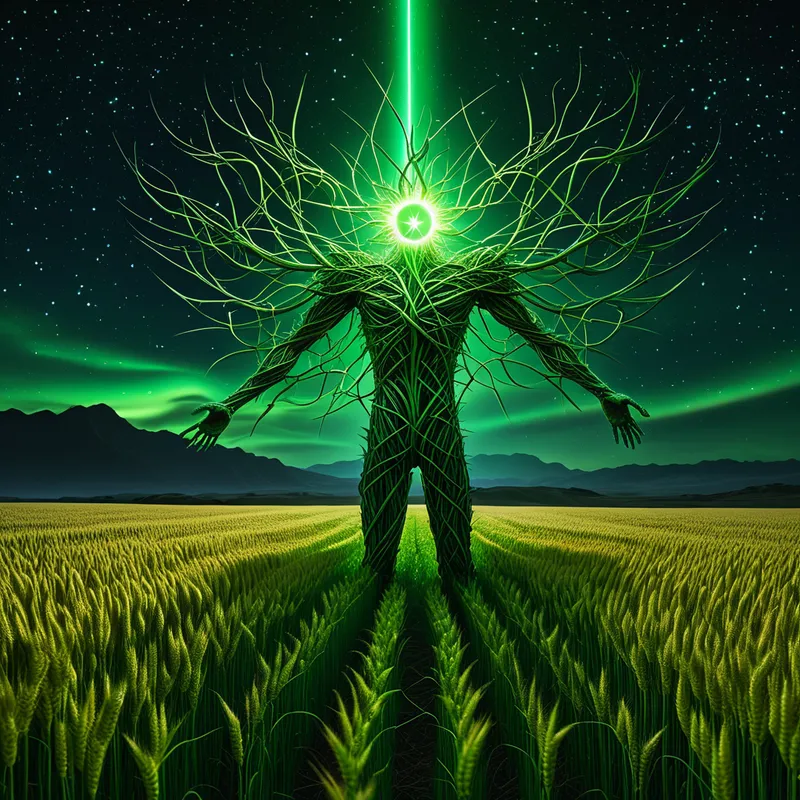
The ashes are then gathered. This is the nigredo, the dark night where the dissolved elements lie latent. Here, in the depressive, fallow period, the work is invisible. The seed of the experience gestates in the Cave of the unconscious. Finally, with patience and the turning of inner time, the coagula occurs. The energy re-emerges, not as blind passion, but as cultivated vitality. The love that was possessive becomes compassionate. The creative fury becomes disciplined artistry. The youthful zeal becomes enduring commitment. The god is reborn within the individual as a resilient, cyclical source of life, no longer at the mercy of the seasons but understanding oneself as an embodiment of the cycle itself.
Associated Symbols
Explore related symbols from the CaleaDream lexicon:
- Sun — The celestial counterpart to Yarilo, representing the radiant, life-giving force whose annual journey from weakness to strength and back mirrors his own cycle of vitality and retreat.
- Seed — The essence of Yarilo in his dormant, underworld phase; the compressed potential of life and rebirth that holds the promise of his return after the sacrificial fire.
- Sacrifice — The central, voluntary act in the myth, where the god’s current form is surrendered to fire, representing the necessary dissolution of a spent phase to fertilize the future.
- Horse — Yarilo’s sacred white steed, symbolizing untamed instinctual energy, virility, and the powerful, graceful movement of life force across the landscape of the world.
- Fire — The transformative element that consumes the straw effigy, purifying and reducing the old form to ash, which becomes the fertile ground for the new cycle.
- Dance — The expression of Yarilo’s joyful, chaotic, and fertile energy, a ritual of ecstatic union with the life force that stirs both the earth and human passion.
- Earth — The receptive, dark womb of the goddess that receives Yarilo’s ashes and seed, the matrix of all transformation and the ground from which all rebirth springs.
- Rebirth — The ultimate promise and core theme of the myth, the guaranteed return of vitality in a new form, affirming the eternal, cyclical nature of existence beyond individual death.
- Flower — The delicate, beautiful, and ephemeral manifestation of Yarilo’s power, particularly the periwinkle and cornflower, representing spring’s fleeting beauty and passionate bloom.
- Wheat — The fruit of Yarilo’s vitality, held in his hand as a symbol of abundance, harvest, and the tangible yield of the life force, which itself becomes the material of his effigy.