Yamauba Myth Meaning & Symbolism
A haunting myth of the wild mountain crone, embodying nature's untamed power and the terrifying, transformative wisdom found in the deep unconscious.
The Tale of Yamauba
Listen, and let the mountain wind carry the tale. Beyond the last rice paddy, past the chattering stream where the kappa dwell, the world climbs into a realm of sheer rock and whispering pine. Here, the paths are made by boar and bear, and the mist clings like a cold, wet skin. This is the domain of Yamauba.
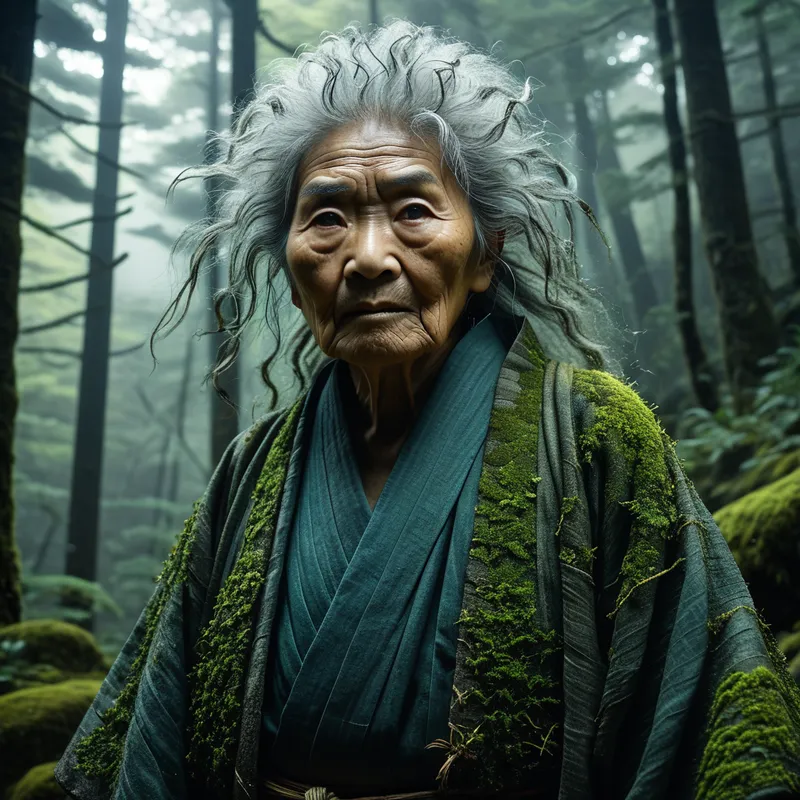
She was old when the oldest cedar was a sapling. Her hair, a wild cascade of silver and black, snagged the stars. Her eyes held the depth of mountain pools—still, dark, and knowing. She wore a kimono of tattered bark and moss, and her voice was the creak of ancient boughs. To the villagers in the valley, she was a story told to frighten children from wandering: a cannibal hag who lured the lost to her hut to devour them. But the mountain knew her true name.
One bitter twilight, as the snow began to fall in fat, silent flakes, a young woman named Otsuyu stumbled up the treacherous path. Her infant was swaddled against her breast, cold and silent. Driven from her village by famine and scorn, she had nowhere to go but up, into the teeth of the storm. Her breath came in ragged sobs, her feet were raw and bleeding on the frozen stone.
Just as the last light died and despair wrapped its bony fingers around her heart, she saw it: a soft, golden glow emanating from a cleft in the rock. The smell of roasting chestnuts and steaming broth cut through the icy air. Drawn by a hope more primal than fear, Otsuyu pushed through the final curtain of snow-laden bamboo.
There, in a cave-hut woven from living roots, sat the Yamauba. She was not as the stories said—a monstrous giant—but a weathered, powerful woman, stirring a pot over a crackling fire. Her eyes met Otsuyu’s, and in that glance was no hunger, but a vast, unsettling pity. “Come,” the crone said, her voice like stones grinding in a riverbed. “The mountain takes, but it also gives shelter.”
For days, Otsuyu stayed. The Yamauba fed her rich, wild stews of mushroom and herb, wrapped her child in furs warm with the scent of sun and earth. The hag sang strange, wordless lullabies that made the wind outside still its fury. Yet, Otsuyu could not shake her dread. At night, she would watch the Yamauba’s shadow, cast huge and monstrous by the fire, and remember the tales. One evening, she glimpsed a pile of clean-picked bones in a dark corner.
Trembling, she resolved to flee at dawn. But that night, the Yamauba spoke. “You carry death in your arms, child,” she said, not unkindly. “The cold has bitten too deep. The village life has left him weak. But the mountain has another breath.” Before Otsuyu could protest, the crone took the lifeless infant. She placed him upon the hearthstone, breathed into his mouth not air, but the scent of pine resin and first bloom. She hummed a tone that vibrated in the stone beneath them.
Otsuyu watched in terror and awe as color returned to her child’s cheeks. His chest rose. The Yamauba handed him back, warm and wailing with robust life. “Go now,” the mountain witch commanded, her form seeming to merge with the shadows of the cave. “Tell them the Yamauba gives life as easily as she takes it. The wild is not your enemy. It is the womb and the tomb. Remember.”
And as Otsuyu stumbled back down the mountain at first light, child alive at her breast, she looked back once. The cleft in the rock was gone. Only mist and silent, watching pines remained.

Cultural Origins & Context
The Yamauba is not a singular figure from a sacred text, but a fluid archetype that seeped up from the collective soil of pre-modern Japan. Her roots are in the animistic Shinto worldview, where mountains (reizan) were seen as potent, dangerous, and profoundly alive realms of the dead and the divine. She is a folkloric precipitate, a story shaped by the practical fears and awe of villagers living in the precarious shadow of the wilderness.
Her tales were passed down orally, told by the hearth in irori light, by traveling storytellers, and through the medium of Ningyō jōruri and Noh theater. In Noh, especially, she was given a profound, tragic dimension—often a woman of nobility exiled to the mountains, her humanity distorted by isolation and suffering into a monstrous form. This reflects a key societal function: the Yamauba myth served as a narrative container for everything civilized society feared and expelled. She represented the marginal—the elderly woman without family, the outsider, the untamed feminine power that refused domestication. She was the ultimate “other,” a warning against venturing beyond the social order, yet also a tacit acknowledgment of the power that exists at its very edges.
Symbolic Architecture
Psychologically, the Yamauba is a masterful embodiment of the shadow and the Great Mother in her most ambivalent, chthonic form. She is not pure evil, but nature itself in its raw, amoral totality—simultaneously nurturing and devouring, creative and destructive.
The Yamauba does not reside in the cultivated garden; she is the untamed forest. To encounter her is to confront the part of the psyche that civilization has tried to prune away.
Her mountain abode symbolizes the unconscious, a steep, difficult-to-navigate terrain far from the ego’s orderly village. The lost traveler—Otsuyu—represents the conscious personality in a state of crisis, forced by circumstance (famine, exile) to venture into this repressed territory. The initial fear of being consumed is the ego’s terror of being dissolved, overwhelmed by primal instincts or unresolved trauma. Yet, the transformation that occurs is not one of destruction, but of brutal, necessary alchemy. The Yamauba’s “cannibalism” can be read symbolically as the process by which the unconscious assimilates outworn aspects of the self. Her gift of life, breathed into the dead infant, signifies the paradoxical truth: contact with the deepest, most terrifying layers of the psyche is often the prerequisite for renewal and authentic vitality.
The Dreamer’s Resonance
When the Yamauba pattern stirs in the modern dreamscape, she rarely appears as a literal witch. She may manifest as an intimidating older woman of immense, unsettling power; a vast, dark forest that feels both threatening and sacred; a forgotten, root-choked cellar in one’s childhood home; or even a wild animal—a bear or a wolf—that exudes a terrifying maternal energy.
The somatic experience is key: a chilling dread mixed with a pull of profound curiosity. The dreamer often feels “lost” in their own life, at an impasse where conventional solutions have failed. The Yamauba’s emergence signals that the psyche is forcing a confrontation with what has been marginalized. This could be repressed rage, untapped creative wildness, grief over lost connections to nature or instinct, or the fear of aging and societal irrelevance. The psychological process is one of approaching the hearth in the dark wood—moving toward the very source of fear with the faint, desperate hope that within it lies not annihilation, but a strange, transformative wisdom. The dream is an invitation to stop running from one’s personal “mountain” and to turn, however fearfully, and face what dwells there.

Alchemical Translation
The journey to the Yamauba’s hut is a blueprint for a critical phase of individuation: the confrontation with the shadow and the archetypal feminine in its most potent, non-human form. For the modern individual, the “village” is the persona—the adapted, socially acceptable self. The “famine” or “exile” is the feeling of emptiness, inauthenticity, or crisis that propels one inward.
The alchemical fire in the Yamauba’s hut does not burn cleanly; it smokes and sputters with the resin of old wounds and the fat of devoured illusions. Its warmth is only felt after one sits in its terrifying glow.
The process begins with the conscious decision (or desperate need) to enter the wilds of the inner world (“the mountain”). The rising action is the struggle with fear and the old stories we tell ourselves about our own darkness (“she will eat me”). The pivotal moment is the surrender at the hearth—the acceptance of shelter from the very thing we feared. This is the nigredo, the blackening, where the old self feels dissolved.
The Yamauba’s act of transmutation—breathing life into the “dead infant”—symbolizes the albedo, the whitening. The “infant” is the nascent, authentic self, vulnerable and often left for dead by the demands of the persona. Its revival by the shadow itself is the ultimate paradox of healing: our wholeness is restored not by avoiding our deepest wounds and wildness, but by allowing that primal, amoral psyche to work upon us. We do not become the Yamauba; we receive her gift. We return to the world of light and society carrying a piece of the mountain’s breath within us—a resilience, a connection to instinct, a wisdom that is fierce, compassionate, and truly our own. The myth teaches that the path to the sage does not bypass the witch; it goes directly through her hearth.
Associated Symbols
Explore related symbols from the CaleaDream lexicon: