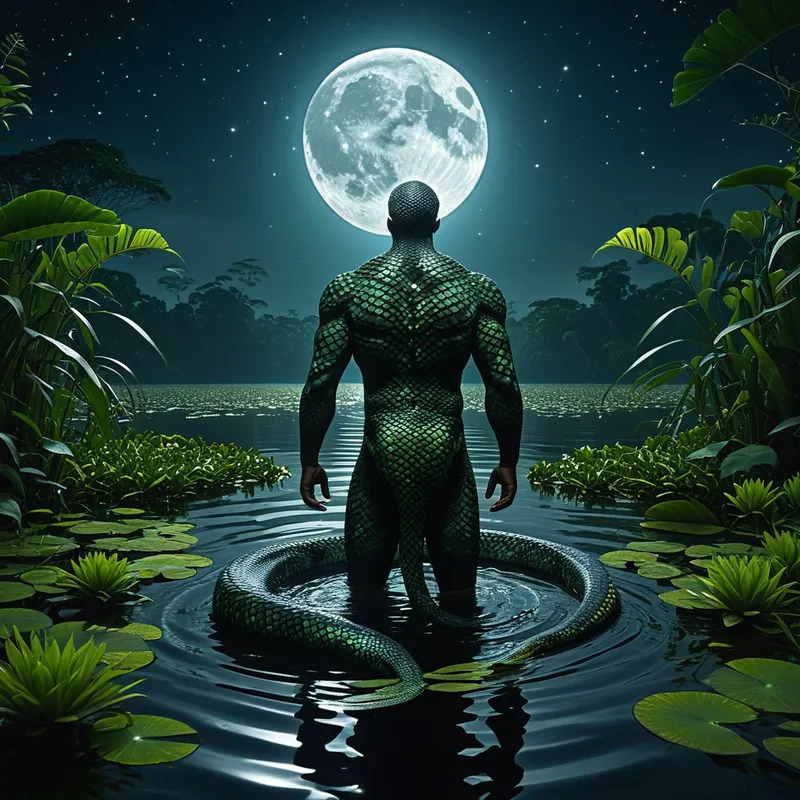
Yacuruna Myth Meaning & Symbolism
A myth of the shape-shifting river lords who dwell in inverted cities, challenging us to integrate the primal, watery depths of our own nature.
The Tale of Yacuruna
Listen, and let the story seep into your bones like the river’s chill. There is a world beneath the world, a kingdom where the sky is mud and the trees grow downward. This is the realm of the Yacuruna.
In the time when the river was the only road, a fisherman, skilled and quiet, cast his nets where the water ran deepest and blackest. The current there did not sing but hummed a low, hypnotic tune. One evening, as the sun drowned in the canopy, his canoe began to turn of its own accord, caught in a gentle, irresistible whirlpool. The water’s surface, usually broken by leaves and insects, became a perfect, dark mirror. And in that mirror, he did not see the fading sky. He saw lights. He saw the peaked roofs of great houses, the outlines of plazas and towers—a magnificent city, but inverted, growing down into an impossible abyss.
From this glassy portal emerged a figure. At first, it seemed a man of noble bearing, handsome and serene, dressed in fine, iridescent scales. But the fisherman’s blood turned to ice. This being sat astride a massive Boa, and where a man’s head should be, rested the sleek, unblinking head of an anaconda. This was the Yacuruna. It did not speak with a mouth, but its voice filled the fisherman’s mind, a sound like stones grinding in a deep current. It offered a trade: the meager, fleeting fish of the surface world for the eternal wisdom of the deep. It promised knowledge of all the river’s secrets, the language of the dolphins, the medicine in the rarest roots.
All it asked for was a glance. Not a glance away, but a glance into—a full surrender to the reflection. To look and not look away. To accept the inverted city as home. The fisherman, his heart a trapped bird, felt the pull. The world above seemed thin, insubstantial compared to the glowing mystery below. He leaned over the canoe’s edge, drawn to his own reflection, which now wore the Yacuruna’s serene, reptilian face.
But as his fingers broke the water’s skin, a forgotten memory surfaced—the smell of earth after rain, the sound of his child’s laughter from the riverbank. It was a tiny, warm anchor in the face of the cold sublime. With a cry torn from his very soul, he wrenched his gaze away, splashing the holy water, breaking the mirror. The vision shattered. The humming stopped. He was alone on a still, ordinary river, paddling frantically toward the distant firelight of his village, forever haunted by the beauty of the kingdom he refused.

Cultural Origins & Context
The myth of the Yacuruna springs from the heart of the Upper Amazon, particularly among the Shipibo-Conibo, Kichwa, and other riparian peoples. This is not a story confined to a sacred text; it is a living narrative breathed into existence by the river itself, told by shamans (curanderos) and elders to explain the unseen dynamics of their world.
The Amazon River is not merely a resource; it is a person, a deity, a highway, and a tomb. Its surface is the membrane between the known world of the forest and the utterly alien, inverted world of the deep. The Yacuruna are the rulers of that psychic and physical geography. Stories of them serve as profound ecological and social parables. They explain drownings, sudden currents, and mysterious illnesses as encounters with these beings. They enforce taboos, warning against fishing or bathing in sacred pools, thus protecting vulnerable ecosystems. The myth also maps the psychological landscape, delineating the boundary between community (the village) and the perilous, alluring unknown (the deep river). It is a story told to cultivate respeto—a deep, fearful respect—for the powers that dwarf human ambition.
Symbolic Architecture
The Yacuruna is the ultimate symbol of the inverted, autonomous psyche. Its kingdom is not in the heavens but in the abyssal waters, a perfect metaphor for the unconscious.
The true self is not found by climbing toward the light, but by descending, without drowning, into the inverted city of the soul.
The Yacuruna itself embodies the Shadow in its divine, terrifying form. It is not merely a monster; it is a lord, offering wisdom and power. Its shape-shifting ability—appearing as a handsome man, a seductive woman, or an anaconda-headed deity—represents the adaptive, persuasive nature of unconscious contents, which often manifest in forms designed to appeal to or challenge our conscious attitudes. The anaconda head signifies primal, instinctual wisdom, a knowledge that is non-verbal and utterly Other.
The inverted city is the crowning symbol. It represents the unconscious psyche’s structure, which is a mirror-image of the conscious ego’s world. Its laws are opposite, its values strange, its beauty unsettling. The fisherman’s crisis is the ego’s confrontation with this totality. The price of the Yacuruna’s gifts is dissolution of the ego-bound self—to become a citizen of that inverted realm is to be assimilated by the unconscious, a state akin to psychosis or spiritual possession in the shamanic crisis.
The Dreamer’s Resonance
When the archetype of the Yacuruna swims into modern dreams, it heralds a profound encounter with the deep, autonomous Self. You may dream of mirrored waters showing a different life, of meeting an alluring yet frightening stranger near a body of water, or of discovering a beautiful, submerged room in your own house.
Somatically, this can feel like a literal pull—a dizziness, a feeling of being drawn downward or into a reflection. Psychologically, it marks a pivotal moment in individuation. The dream-ego (the fisherman) is being offered a treaty by a powerful aspect of its own nature that it has kept at bay. This is often the creative genius, the buried trauma, the wild sexuality, or the spiritual hunger that society or the conscious personality has deemed “monstrous.” The terror in the dream is the ego’s resistance to its own expansion and transformation. The dream is the river; it is presenting the reflection and asking if you have the courage to look, and the wisdom to know when to pull back.

Alchemical Translation
The myth of the Yacuruna models the alchemical nigredo, the descent into the black waters for the purpose of transmutation. The fisherman’s journey is not one of heroic conquest, but of sacred negotiation.
The first step is encounter. The conscious life (the surface fishing) becomes unsatisfying; one is drawn to the “deep water” of therapy, art, crisis, or meditation. The Yacuruna appears, personifying the latent power within that depth. The second step is recognition. This is not about fighting a monster, but recognizing the lordliness of the shadow—seeing the wisdom in the anaconda’s gaze. The offered gift—the knowledge of the river—symbolizes the creative and intuitive powers unlocked by engaging with the unconscious.
Individuation is not a victory of light over dark, but the establishment of a conscious relationship between the village and the inverted city.
The critical, third step is the refusal and return. This is the myth’s deepest wisdom. The fisherman does not marry the Yacuruna; he rejects the total assimilation. He chooses the human, flawed, connected world of smell and sound and family. His triumph is not in gaining the underwater kingdom, but in having seen it and returned, forever changed. Psychically, this translates to integrating the shadow’s energy without being identified with it. One learns the river’s secrets—becomes more creative, more intuitive, more whole—but remains grounded in the human community. The Yacuruna is not killed or banished; it remains in its realm, a power now known and respected. The individual becomes, like a shaman, a mediator between the two worlds, carrying the awe of the deep into the warmth of the firelight, forever bearing the mark of the reflection they survived.
Associated Symbols
Explore related symbols from the CaleaDream lexicon: