Xocolātl Myth Meaning & Symbolism
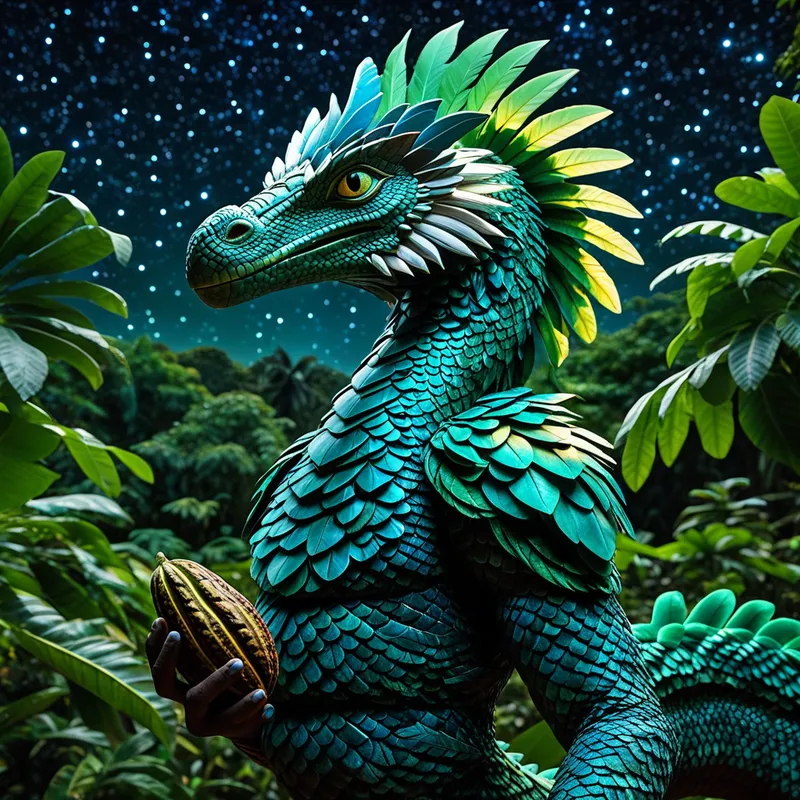
The myth of how the feathered serpent god Quetzalcoatl brought the sacred cacao to humanity, a gift born from divine blood and underworld struggle.
The Tale of Xocolātl
Listen. Before the world knew sweetness, it knew the sacred bitterness. This is not a story of men, but of gods, of the very blood that binds the cosmos.
In the time of the Fifth Sun, the world was heavy and silent. The people of the earth ate maize, drank water, but their spirits were dull, their hearts untethered from the rhythms of the heavens. High above, in the shimmering realm of Tamoanchan, the gods convened. They were beings of radiant energy, sustained by the sacred force of teotl. Their sustenance was not food, but beauty, song, and sacrifice—the precious water of life itself. Yet, they looked upon humanity and saw a profound lack. There was no drink for celebration, for communion, for touching the divine spark within.
The great Quetzalcoatl, the plumed serpent, whose heart was ever turned toward his human creations, felt this lack as a personal wound. He resolved to bring them a gift, a divine nourishment. But such a gift could not be plucked from the gardens of paradise. It was hidden, guarded, in the deepest, most forbidden place: the Mictlan.
Quetzalcoatl, the morning star, descended into the eternal dusk. He passed the nine treacherous layers of Mictlan, facing chilling winds, clashing mountains, and obsidian-bladed winds. He stood finally before the bone-throne of Mictlantecuhtli and his consort, Mictecacihuatl. The air was dust and silence. “You seek the tree of the dark nectar,” rasped the Lord of the Dead. “It grows where my realm touches the roots of the world. Its fruit is knowledge of life and death. To take it, you must pay the price of life.”
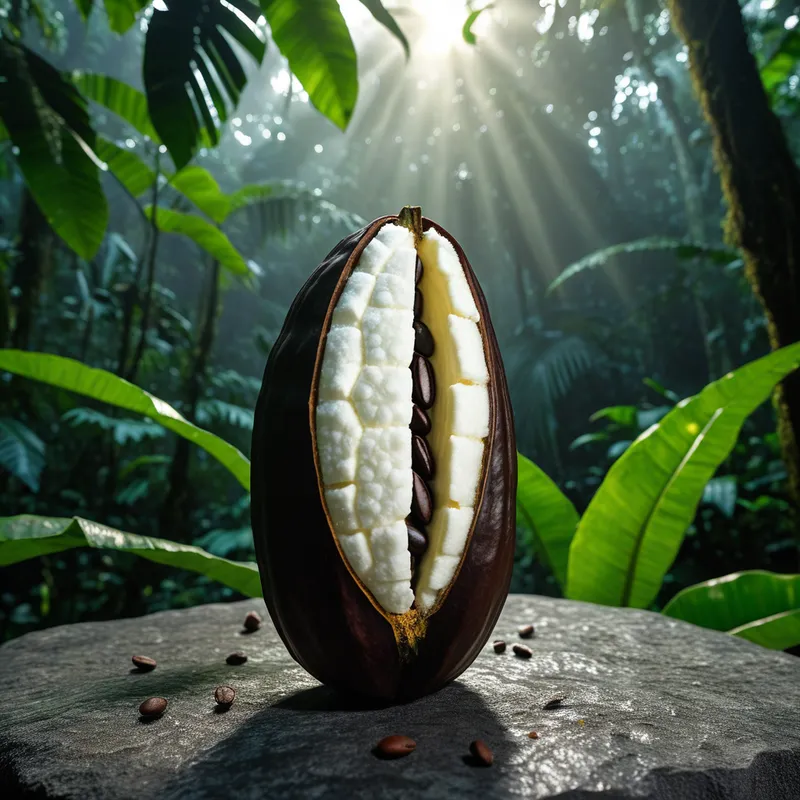
The price was not Quetzalcoatl’s life, but a portion of his divine essence—his blood. There, in the gloom, the Feathered Serpent let his sacred blood fall upon the barren soil at the feet of a strange, gnarled tree bearing heavy, leathery pods. Where each drop fell, the soil quickened. The tree’s roots drank the divine offering, and its pods swelled, ripening from green to a deep, bloody gold.
Quetzalcoatl gathered the precious pods and ascended, carrying the darkness of the underworld back into the light. He brought the cacao to the people of Tollan. He showed them how to roast the bitter beans, to grind them on a metate, to mix the paste with water, chili, and vanilla. He did not give them a sweet drink, but a bitter, spicy, invigorating foam—a drink that mirrored the journey itself: the bitterness of the earth, the fire of transformation, the airy foam of spirit.
He called it xocolātl. And when the people drank it, their hearts quickened. They felt the vitality of the earth and the whisper of the gods. It became the blood of ceremony, the currency of nobles, the sacred beverage of warriors before battle. It was not mere food. It was the embodied memory of a god’s journey into the dark, paid for with his own life-essence, to bring a spark of divine awareness to humankind.
Cultural Origins & Context
The myth of Xocolātl’s divine origin is woven into the broader cosmological tapestry of the Mexica (Aztec) worldview. For them, cacao was not a casual commodity but a sacred substance, literally “the food of the gods.” Its consumption was ritually circumscribed, primarily reserved for the elite—rulers, priests, veteran warriors, and wealthy merchants. It was a central element in feasts, diplomatic exchanges, and marriage ceremonies.
The story was likely part of an oral tradition preserved and recited by tlacuilos (scribe-painters) and priests. Its function was multifaceted: it explained the supreme value and spiritual potency of cacao, it reinforced the principle of divine sacrifice as the necessary cost for cosmic order and human benefit, and it cemented the role of Quetzalcoatl as the benevolent civilizing god. The myth served as a metaphysical justification for the intense, almost ritualized preparation of the drink itself, transforming a culinary act into a re-enactment of the god’s alchemical journey.
Symbolic Architecture
At its core, the myth of Xocolātl is a profound map of alchemical transformation, where value is born from a descent into darkness and a willing sacrifice.
The most sacred gifts are never found in the light; they are retrieved from the dark, paid for with a piece of one’s own soul.
The Cacao Tree itself is a world axis. Its roots in Mictlan tap into the realm of the dead, the unconscious, and raw potential. Its fruit, reaching into the earthly world, contains the seed of awakening. Quetzalcoatl’s journey is the archetypal nekyia—the hero’s descent into the underworld. He does not go to conquer death, but to negotiate with it, to retrieve a specific treasure of consciousness. His blood sacrifice is the critical catalyst. Divine life-force must be exchanged for the fruit of knowledge; spirit must engage with matter to create something new.
The bitter taste of xocolātl is its primary symbol. It represents the unvarnished truth, the necessary suffering, the “hard medicine” that leads to strength and vitality. It is not meant to be merely pleasant, but to change the one who drinks it. The foam, painstakingly created by pouring the drink from height, represents the spiritual essence (ehecatl) infused into the earthly mixture—the rising of spirit from the depths.
The Dreamer’s Resonance
When this myth stirs in the modern unconscious, it often manifests in dreams of bitter medicines, forbidden gardens in dark places, or being tasked with retrieving a precious, heavy object from a basement, cave, or forgotten room. The dreamer may taste something unexpectedly bitter that nonetheless brings clarity or energy.
Somatically, this points to a psychological process of integrating one’s “bitter” experiences. The dreamer is being called to descend into their personal Mictlan—the repressed memories, traumas, or rejected aspects of the self that feel like a psychic underworld. The process feels arduous, dark, and fraught with resistance (the clashing mountains, the obsidian wind). The treasure—the cacao pod—is the latent potential, the unique gift, or the profound insight that can only be forged in that darkness. The dream signals that the time has come to pay the “blood price”—to invest genuine life-energy and conscious attention—to redeem that potential and bring it into the light of day.

Alchemical Translation
For the individual on the path of individuation, the Xocolātl myth models the transmutation of suffering into sacred agency. Our culture often seeks to avoid bitterness, to sweeten every experience. This myth insists the opposite: the path to vitality runs directly through the acceptance and conscious processing of life’s inherent bittersweetness.
Individuation is the art of preparing your own xocolātl: grinding the bitter beans of your experience, roasting them in the fire of reflection, and whipping the mixture until the foam of spirit rises.
The first stage is the Descent (Nigredo). One must voluntarily confront the shadow, the personal underworld of unresolved pain and primal fear. This is Quetzalcoatl entering Mictlan. The second stage is the Sacrifice (Mortificatio). One must offer up an old identity, a cherished illusion, or a pattern of avoidance—a piece of one’s psychic “blood”—as payment. This investment of self is what fertilizes the new growth. The third stage is the Retrieval and Preparation (Albedo/Citrinitas). The retrieved insight (the cacao bean) is not useful in its raw state. It must be “roasted” (analyzed, made conscious), “ground” (integrated into one’s life story), and finally “whipped” (connected to one’s creative spirit and shared).
The final sacred drink is the Integrated Self (Rubedo)—a personality no longer seeking only sweetness, but able to hold complexity, bitterness, and vitality in a single vessel. It is a self nourished not by avoidance, but by the full, resonant, and often challenging truth of its own journey. You become the brewer of your own spirit, serving a drink that is uniquely, powerfully, and authentically your own.
Associated Symbols
Explore related symbols from the CaleaDream lexicon: