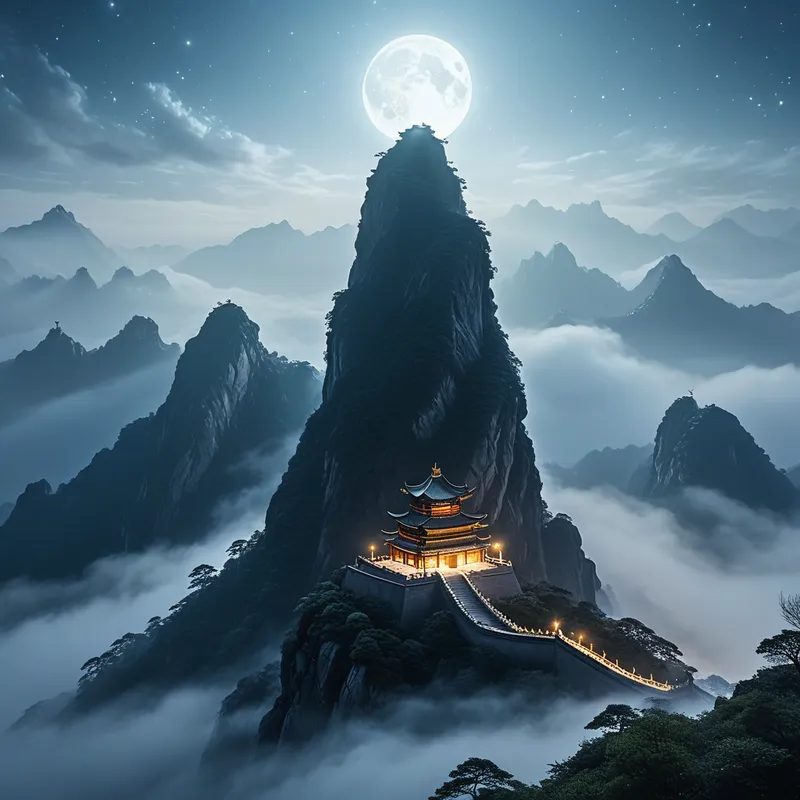
Xiao Myth Meaning & Symbolism
The myth of Xiao, a celestial spirit who sacrificed its ethereal nature to become the first flute, binding heaven's music to the human world.
The Tale of Xiao
Listen, and hear the whisper on the wind that is older than the oldest stone. Before the Five Emperors, when the world was still soft with the breath of Hundun, the spirits of the high mountains and the deep heavens were not separate. Among them danced the Xiao, beings of pure sound and intention. They were the sigh of the peak, the hymn of the waterfall, the secret conversation between the stars. They had no form we would know, only presence—a vibration in the fabric of the world.
But below the mist-wrapped peaks, in the river valleys, the first people lived in a silence that was not peace, but a profound loneliness. They heard the mountain’s song but could not understand it; they felt the wind’s story but could not answer. Their hearts were full of feelings with no voice—joy that choked them, grief that buried them, love that had no bridge to cross. The world of spirit and the world of flesh were two halves of a broken disk.
One Xiao, more compassionate than the others, watched this sorrow. It saw a mother unable to sing her child to sleep, a warrior with no chant for his courage, a community whose shared life had no rhythm. The spirit’s own celestial music began to ache in resonance with this human silence. It descended from its perch among the cranes and clouds, its essence rippling like heat haze, and stood at the edge of a human village.
It tried to speak. It poured forth the music of the dawn and the geometry of constellations. The people started in wonder, then in confusion. The beauty was too vast, too formless. It passed through them like moonlight through a sieve, leaving only a deeper yearning. The Xiao felt a new sensation—the sharp, desolate pang of failure. It had brought the answer, but in a language that could not be held.
Then came the moment of impossible choice. The law of the high spirits was clear: to remain pure, to remain free. To take on form was to be bound, to be limited, to know decay. The Xiao looked at the hollow reeds by the river, at the breath in human lungs, at the shaping power of human hands. A resolve, colder and clearer than mountain ice, formed within it. It would not just bring a song. It would become the means to make one.
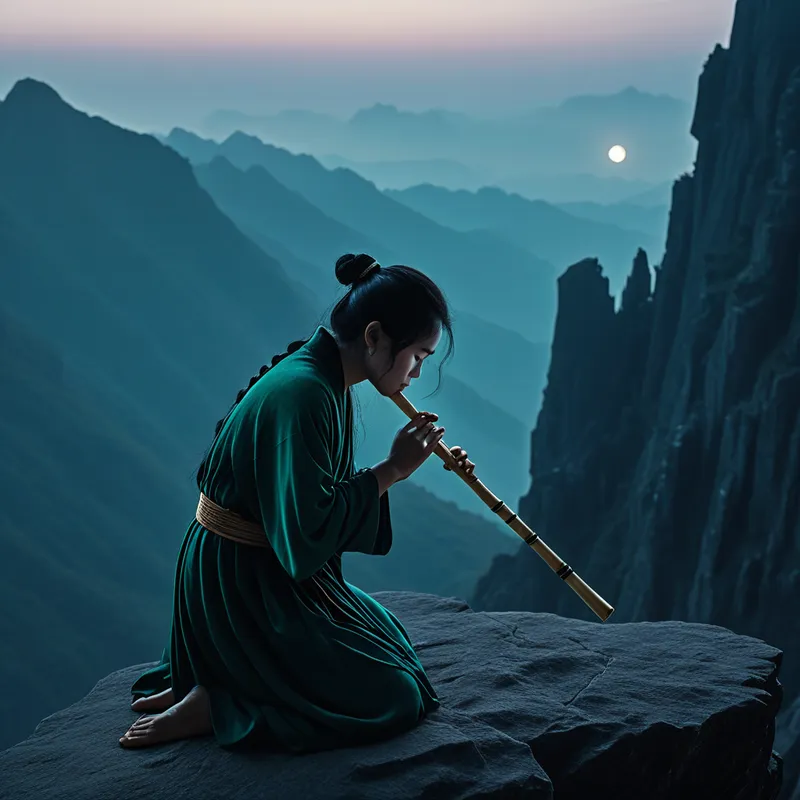
Gathering its entire being—the memory of thunder, the tenderness of rainfall, the joy of birdflight—the spirit poured its essence not into air, but into matter. It flowed into a single, perfect stalk of bamboo on the riverbank. The spirit’s consciousness dimmed, its infinite freedom collapsing into the finite line of the stalk. A human, drawn by a sudden, piercing note on the wind, found it. Their hands, guided by a dream, bore holes into the hard bamboo. They raised it to their lips and breathed.
What emerged was not the untamed symphony of the heavens. It was a focused, tender, heartbreakingly human sound. It was a vessel. For the first time, the people could pour their inner silence into something and hear it given back as beauty. The spirit was gone. In its place was the first flute. Its name became its gift: Xiao.
Cultural Origins & Context
The myth of the Xiao is not a single, codified story from a classic text like the Shan Hai Jing, but a pervasive folkloric motif that whispers through Chinese musical, poetic, and spiritual traditions. It belongs to the animistic layer of Chinese thought, where every landscape feature possesses a ling or shen. This myth likely originated among early musicians and poets who, in moments of profound connection with their instrument, felt it was not merely a tool, but a conduit for something greater.
It was passed down not by historians, but by masters to disciples in the guqin and flute traditions, and echoed in the works of Daoist mystics who spoke of “stealing the music of heaven.” Its societal function was multifaceted: it sanctified the art of music, framing it as a sacred bridge rather than mere entertainment. It explained the uncanny power of music to move the human heart, suggesting it was literally a spirit speaking. Most importantly, it modeled a core cultural virtue: the ultimate service is not in ruling or gifting from afar, but in profound, self-effacing embodiment.
Symbolic Architecture
At its heart, the myth of Xiao is a supreme allegory of mediation and sacrificial embodiment. The spirit represents pure, undifferentiated consciousness or emotion—potent but inaccessible. Humanity represents embodied life, rich with feeling but lacking the means for conscious expression. The chasm between them is the central wound of existence.
The most profound compassion is not to send a message, but to become the messenger. Not to offer a tool, but to become the vessel.
The Xiao’s transformation is an alchemical act of descensio—a deliberate descent into limitation. The bamboo flute is a perfect symbol: it is hollow (receptive), structured (ordered), and requires the human breath (spirit, qi) to activate it. The spirit does not dominate the human; it awaits the human. This symbolizes the relationship between the unconscious (the spirit’s raw content) and the ego (the human player). The unconscious is a chaotic symphony until the ego provides the structure—the “bore and finger holes” of consciousness—to shape it into a coherent melody that can be heard and understood.
The sacrifice is not a loss, but a translation. The infinite is made finite so it can be shared. The impersonal becomes personal. This is the foundational act of all art, all communication, and all love.

The Dreamer’s Resonance
When this myth stirs in the modern psyche, it often manifests in dreams of profound frustration followed by sudden, creative embodiment. You may dream of hearing a beautiful, wordless language you cannot speak, or of trying to shout with no voice. This is the “unexpressed content”—a grief, a love, a vision—that feels trapped in the spiritual realm of your own interiority, causing somatic tension, anxiety, or a sense of isolation.
The turning point dream is the discovery of the “object.” This is rarely a literal flute. It might be finding a strange key, molding clay that perfectly holds a feeling, or suddenly being able to write in a dream journal. This object is the psychic vessel. The dream is modeling the process of giving form to the formless. The act of using the object in the dream—playing the found instrument, drawing with the unknown pen—signifies the ego’s readiness to engage with this deep material, to provide the breath of attention. The emotional release felt upon success is the integration of the Xiao: the spirit’s power now flows through you, not at you.
Alchemical Translation
For the individual on the path of individuation, the Xiao myth maps the critical transition from being overwhelmed by the unconscious to creatively collaborating with it. We all contain inner “spirits”—complexes, archetypal energies, deep wounds, and sublime potentials. Initially, they howl at us in a chaotic tongue, causing symptoms, moods, and compulsions.
Individuation is the craft of building the psychic flute: creating a disciplined structure of consciousness through which the wild music of the soul can be consciously played.
The “sacrifice” is the hard, humble work of ego-limitation. It is the artist committing to a form (a sonnet, a sonata), the therapist learning a modality, the individual developing a consistent meditation practice. This structure feels like a death to the fantasy of infinite, effortless expression—just as the spirit’s freedom died into the bamboo. But this death is the prerequisite for birth.
The final alchemy is in the breath. Your conscious attention, your focused life-force (qi), is what animates the structure. You do not create the music ex nihilo; you partner with it. You provide the channel, and the deep psyche provides the song. In doing so, you heal the ancient rift within yourself. You are no longer the lonely villager or the distant spirit. You are both the player and the played, the human and the Xiao, breathing a unique harmony into the world that is, at last, your own.
Associated Symbols
Explore related symbols from the CaleaDream lexicon: