Xian Myth Meaning & Symbolism
The myth of the Xian tells of mortals who achieve immortality through spiritual discipline, embodying the ultimate human aspiration to transcend physical and psychic limitations.
The Tale of Xian
Listen, and let the mists of time part. In the days when the world was young and the veil between heaven and earth was thin, there walked among mortals those who were not quite mortal. They were the Xian. They did not spring from the gods, but from the dust and longing of humanity itself.
Our tale begins not with a thunderclap, but with a whisper—the quiet, persistent ache in a human heart that knows there must be more than birth, struggle, and dust. It begins with a scholar who turned from dusty scrolls to gaze at the eternal mountains. With a woodcutter who, deep in the primordial forest, heard the music of the wind in the pines and forgot his axe. With an alchemist who sought not gold, but the gold within.
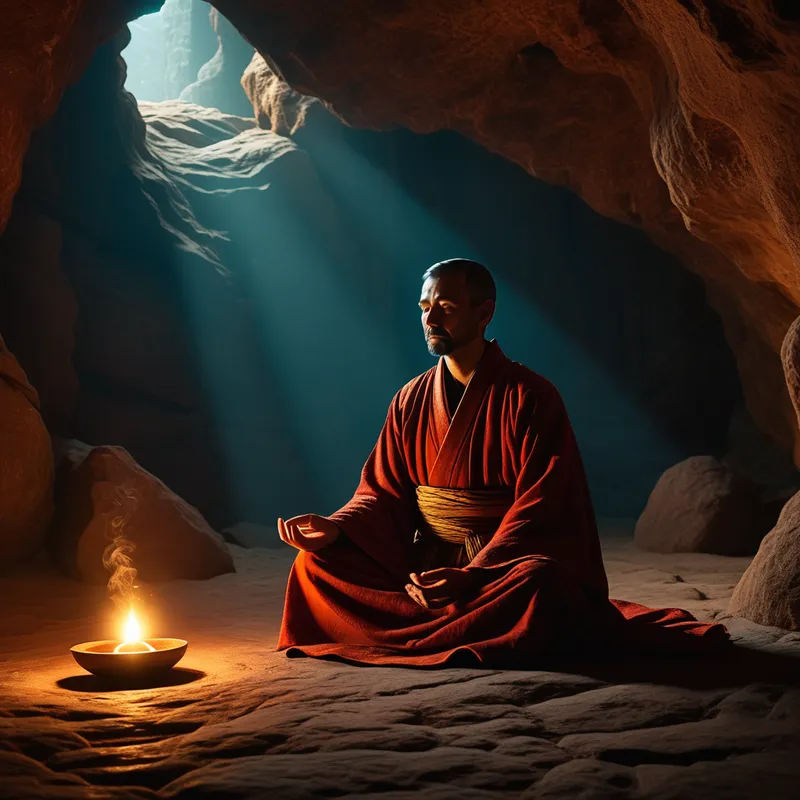
One such was Li, a man of letters whose soul was parched by courtly intrigue. He abandoned his post and followed the river to its source, high in the Kunlun Mountains. For years, he lived on dew and pine nuts, his mind emptying of ambition, filling only with the rhythm of his breath and the turning stars. He faced not dragons, but the silent, roaring beasts of his own pride and fear. In a cave behind a waterfall of liquid jade, he sat until moss grew on his robes and birds nested in his hair.
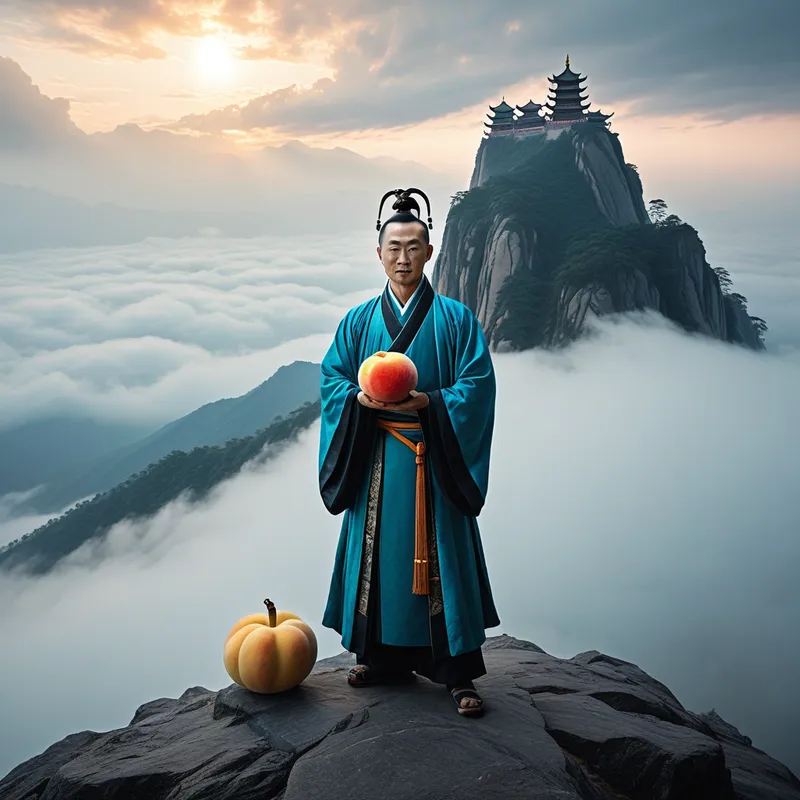
The resolution was not a battle, but a dissolution. One morning, as the first light touched the peak, Li breathed in and did not breathe out as mortals do. His body became light as a crane’s feather. He drank from a spring that tasted of starlight, and ate a peach from a tree that bore fruit once a thousand years. He did not die; he simply stepped sideways from the wheel of Samsara. He became a Xian, a being of the mountains and mists, riding clouds, free of the weight of the world. His triumph was a silence so profound it echoed through eternity.
Cultural Origins & Context
The myth of the Xian is not a single story but a vast, shimmering tapestry woven from the threads of early Chinese shamanism, philosophical Daoism, and folk religion. Its roots sink deep into the Warring States period and the Han Dynasty, a time of great turmoil and profound questioning about the nature of life, death, and the cosmos.
These stories were passed down not by a centralized priesthood, but by a diverse array of voices: Daoshi (Daoist masters) in their mountain retreats, oral storytellers in village squares, and scribes recording the fantastical accounts in texts like the Shan Hai Jing and the biographies of immortals (Liexian Zhuan). Their societal function was multifaceted. For the ruling class, they offered a promise of eternal power and legitimacy. For the common person, they were a sublime form of escapism and hope—proof that the constraints of poverty, social hierarchy, and mortality were not absolute. The Xian myth democratized transcendence; it was a path open, in theory, to anyone with the will and wisdom to walk it.
Symbolic Architecture
At its core, the Xian is the ultimate symbol of psychospiritual alchemy. The immortal is not born but made, through a rigorous internal process that mirrors the external practices of Daoist alchemy. The mountain retreat represents the conscious withdrawal from the collective values of society (the persona) to confront the inner wilderness.
The journey to become Xian is the journey from identification with the ephemeral ego to communion with the eternal Self.
The elixir of life, whether ingested as a pill or cultivated internally through Qigong and meditation, symbolizes the coniunctio oppositorum—the sacred marriage of opposites within the psyche. The opposing forces of spirit and matter, conscious and unconscious, Yang and Yin, are fused into a third, transcendent substance: the diamond body of the immortal. The Xian’s cloud-riding ability signifies liberation from the heaviness of unresolved complexes and the gravitational pull of neurotic suffering.
The Dreamer’s Resonance
When the archetype of the Xian stirs in the modern dreamer, it signals a profound crisis and opportunity in the process of individuation. One may dream of finding a hidden, serene garden at the top of a skyscraper, of breathing underwater with ease, or of floating above one’s own sleeping body. These are not mere fantasies of escape, but somatic metaphors for a psychological process seeking liberation.
The dreamer is likely experiencing a powerful, often painful, differentiation from collective norms—a feeling of being alienated from the mundane “rat race.” The somatic sensation is one of lightness struggling against a perceived weight. This weight is the accumulated mass of external expectations, internalized judgments, and unlived life. The dream of the Xian is the psyche’s innate intelligence proposing a solution: not to fight the weight, but to transmute it through a disciplined, inward-focused ascesis. The dream is a call to find one’s own “mountain cave”—a space for profound introspection.
Alchemical Translation
For the modern individual, the myth of the Xian provides a timeless map for psychic transmutation. The first step is the “Retreat to the Mountain”: the conscious, often difficult decision to withdraw psychic energy from external validation and worldly achievements to focus on inner reality. This is the beginning of the opus contra naturam, the work against one’s own habitual nature.
The long, silent meditation in the cave is the engagement with the shadow—the meeting of all we have rejected in ourselves. The brewing of the elixir is the slow, patient work of therapy, active imagination, or artistic creation, where raw emotional pain (the prima materia) is consciously contained and worked upon until it reveals its hidden spiritual value.
Immortality, in psychological terms, is not the endless prolongation of the ego, but the ego’s graceful dissolution into the authority of the Self.
The final transcendence, riding the cloud, is the stable attainment of a perspective from the Self. One returns to the world, but is no longer of it in the same enslaved way. One carries an inner mountain cave of peace, an elixir of meaning that cannot be spilled. The individual becomes, in a sense, a modern Xian: grounded in reality, yet liberated from its unconscious compulsions, able to move through life with the effortless grace of one who rides the intrinsic patterns of their own deepest nature.
Associated Symbols
Explore related symbols from the CaleaDream lexicon: