Xi Wangmu's Peach Garden Myth Meaning & Symbolism
The Queen Mother of the West guards a celestial orchard whose peaches grant immortality, offering them only to the worthy in a sacred, cyclical ritual.
The Tale of Xi Wangmu’s Peach Garden
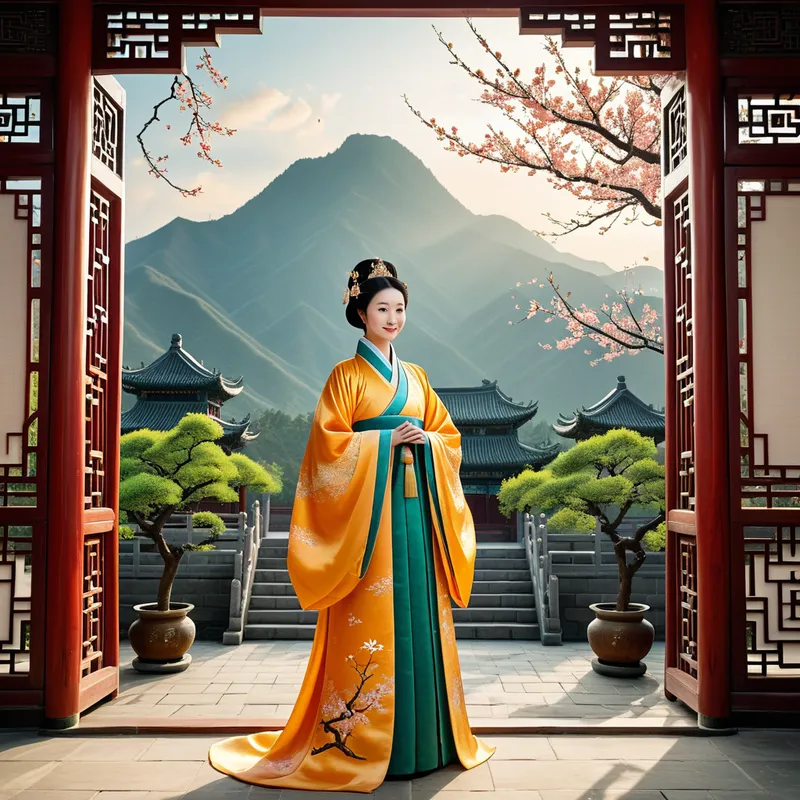
Beyond the western reaches of the known world, where [the earth](/myths/the-earth “Myth from Hindu culture.”/) rises to meet the vault of heaven, stands the mythic Kunlun Mountain. Its peaks are sheathed in eternal mist, and at its summit lies a realm outside of time. Here resides [Xi Wangmu](/myths/xi-wangmu “Myth from Chinese culture.”/), the Sovereign of the West. Her hair is like a storm cloud, pinned with a sheng headdress; her countenance holds the terrible beauty of the untamed world. She is attended by the vermilion [phoenix](/myths/phoenix “Myth from Egyptian culture.”/) and the kui, and her court is one of jade maidens and celestial officials.
But the heart of her domain, its most sacred and secret treasure, is the Garden.
Within a walled enclosure, nurtured by the breath of the cosmos itself, grow the Peach Trees of Immortality. They are not like the trees of the mortal realm. Their bark has the texture of ancient dragon scale, and their leaves whisper with the voices of forgotten winds. For three thousand years, a tree merely flowers. For another three thousand, the blossoms harden into fruit. And for a final three thousand, the peaches slowly ripen, swelling with the concentrated essence of the eternal.
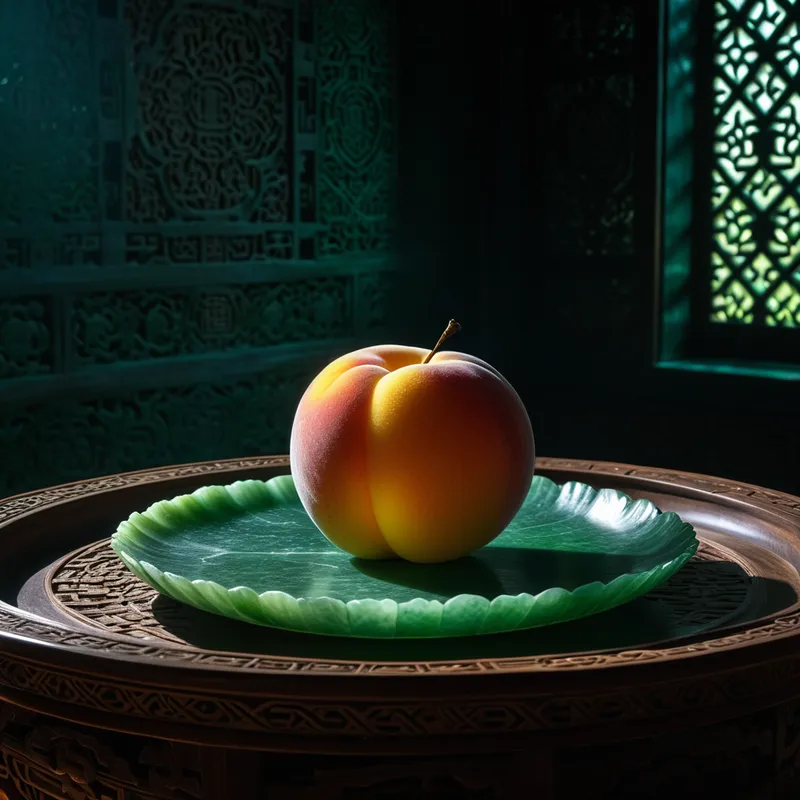
The air in the Garden hums with potency. The peaches glow with a soft, internal gold, and their scent is a promise that unravels the very concept of ending.
Yet, this immortality is not for the taking. It is a gift, bestowed only through sacred rite. When the celestial peaches are finally ripe, Xi Wangmu convenes the Pantao Hui, the Feast of the Peaches. Messengers are dispatched across the heavens. The August [Jade Emperor](/myths/jade-emperor “Myth from Chinese culture.”/), stellar deities, and the most virtuous of perfected immortals—those who have transcended the mortal coil through alchemy, meditation, or boundless good—are summoned.
The feast is an event of sublime order and profound hospitality. In the grand halls that overlook the Garden, deities and immortals partake of the celestial fruit, of dragon’s liver and phoenix marrow, and drink jade nectar. With each bite of the peach, their immortality is renewed; they are woven back into the fabric of the timeless. It is a cycle as regular and necessary as the orbits of the stars, a recalibration of the cosmic order through divine consumption.
To be uninvited is to remain subject to time’s flow. To be worthy of an invitation is to be acknowledged as one who has mastered the inner laws of the universe. The Garden does not defend itself with armies, but with the sheer, awe-inspiring authority of its keeper and the sublime, cyclical patience of its growth. The conflict here is not of swords, but of worthiness; the resolution is not a battle won, but a state of being confirmed. It is the story of a grace that must be earned, and a feast that marks not an end, but a perpetual beginning.
Cultural Origins & Context
The myth of Xi Wangmu and her peaches is woven from threads stretching back to the shamanistic and ancestral worship of early China. Her earliest depictions, found on Zhou dynasty bronzes and in texts like the Classic of Mountains and Seas, show her as a wild, half-human, half-beast deity presiding over plagues and punishments—a ruler of the mysterious, often fearsome west where the sun sets and souls journey.
Over centuries, through Daoist religious systematization and imperial patronage, her image was refined and elevated. By the Han dynasty, she had transformed into the majestic Queen Mother, a bestower of longevity and a central figure in the quest for immortality that obsessed emperors and commoners alike. Her peaches became the ultimate symbol of this quest. The myth was propagated through Daoist scriptures, popular literature like [Journey to the West](/myths/journey-to-the-west “Myth from Chinese culture.”/), and folktales, serving multiple societal functions: it validated the Daoist [pantheon](/myths/pantheon “Myth from Roman culture.”/), provided a divine model for imperial authority and patronage, and offered a narrative of hope—that through virtue, discipline, or divine favor, the ultimate human fear, death, could be transcended.
Symbolic Architecture
The [Peach](/symbols/peach “Symbol: A peach symbolizes fertility, sensuality, and sweetness, often reflecting abundance and joy.”/) Garden is not merely an orchard; it is a complete symbolic [universe](/symbols/universe “Symbol: The universe symbolizes vastness, interconnectedness, and the mysteries of existence beyond the individual self.”/). The [peach](/symbols/peach “Symbol: A peach symbolizes fertility, sensuality, and sweetness, often reflecting abundance and joy.”/) itself, even in common folklore, is a [symbol](/symbols/symbol “Symbol: A symbol can represent an idea, concept, or belief, serving as a powerful tool for communication and understanding.”/) of longevity, [marriage](/symbols/marriage “Symbol: Marriage symbolizes commitment, partnership, and the merging of two identities, often reflecting one’s feelings about relationships and social obligations.”/), and protection. In Xi Wangmu’s context, it becomes the ultimate [elixir of life](/symbols/elixir-of-life “Symbol: The Elixir of Life symbolizes immortality, rejuvenation, and the quest for perpetual vitality.”/), the [fruit](/symbols/fruit “Symbol: Fruit symbolizes abundance, nourishment, and the fruits of one’s labor in dreams.”/) of the [axis](/symbols/axis “Symbol: A central line or principle around which things revolve, representing stability, orientation, and the fundamental structure of reality or consciousness.”/) mundi (Kunlun).
The immortal peach is the fruit of perfected time—it represents not the denial of cycles, but their sacred culmination.
The three-thousand-[year](/symbols/year “Symbol: A unit of time measuring cycles, growth, and passage. Represents life stages, progress, and mortality.”/) cycles of flowering, fruiting, and ripening mirror the vast, patient rhythms of the [cosmos](/symbols/cosmos “Symbol: The entire universe as an ordered, harmonious system, often representing the totality of existence, spiritual connection, and the unknown.”/) and the slow, arduous work of inner [alchemy](/symbols/alchemy “Symbol: A transformative process of purification and creation, often symbolizing personal or spiritual evolution through difficult stages.”/). The Garden is a [temenos](/myths/temenos “Myth from Greek culture.”/), a sacred, walled [space](/symbols/space “Symbol: Dreaming of ‘Space’ often symbolizes the vastness of potential, personal freedom, or feelings of isolation and exploration in one’s life.”/) where the laws of the mundane world are suspended. Xi Wangmu, as its ruler, embodies the archetypal Sovereign who does not hoard power, but distributes it according to cosmic law and personal merit. Her feast is the [ritual](/symbols/ritual “Symbol: Rituals signify structured, meaningful actions carried out regularly, reflecting cultural beliefs and emotional needs.”/) that renews [the covenant](/symbols/the-covenant “Symbol: A sacred, binding agreement between parties, often with divine or societal significance, representing commitment, obligation, and mutual responsibility.”/) between the divine and the perfected, a [ceremony](/symbols/ceremony “Symbol: Ceremonies in dreams often symbolize transitions, rituals of passage, or significant life events.”/) that sustains the order of [heaven](/symbols/heaven “Symbol: A symbolic journey toward ultimate fulfillment, spiritual transcendence, or connection with the divine, often representing life’s highest aspirations.”/) itself.
Psychologically, the Garden represents [the Self](/myths/the-self “Myth from Jungian culture.”/) in its wholeness and timelessness. The peaches are the integrated fruits of a lifetime of conscious work—insights, [psychic wholeness](/symbols/psychic-wholeness “Symbol: A state of complete integration between conscious and unconscious aspects of the psyche, representing spiritual unity and self-realization.”/), and the hard-won “immortality” of a [personality](/symbols/personality “Symbol: Personality in dreams often symbolizes the traits and characteristics of the dreamer, reflecting how they perceive themselves and how they believe they are perceived by others.”/) that has transcended its petty conflicts. The [wall](/symbols/wall “Symbol: Walls in dreams often symbolize boundaries, protection, or obstacles in one’s life, reflecting the dreamer’s feelings of confinement or security.”/) is the [boundary](/symbols/boundary “Symbol: A conceptual or physical limit defining separation, protection, or identity between entities, spaces, or states of being.”/) of the [psyche](/myths/psyche “Myth from Greek culture.”/) that protects this nascent wholeness from the [chaos](/symbols/chaos “Symbol: In Arts & Music, chaos represents raw creative potential, uncontrolled expression, and the breakdown of order to forge new artistic forms.”/) of the unconscious or the distractions of the [persona](/symbols/persona “Symbol: The social mask or outward identity one presents to the world, often concealing the true self.”/).
The Dreamer’s Resonance
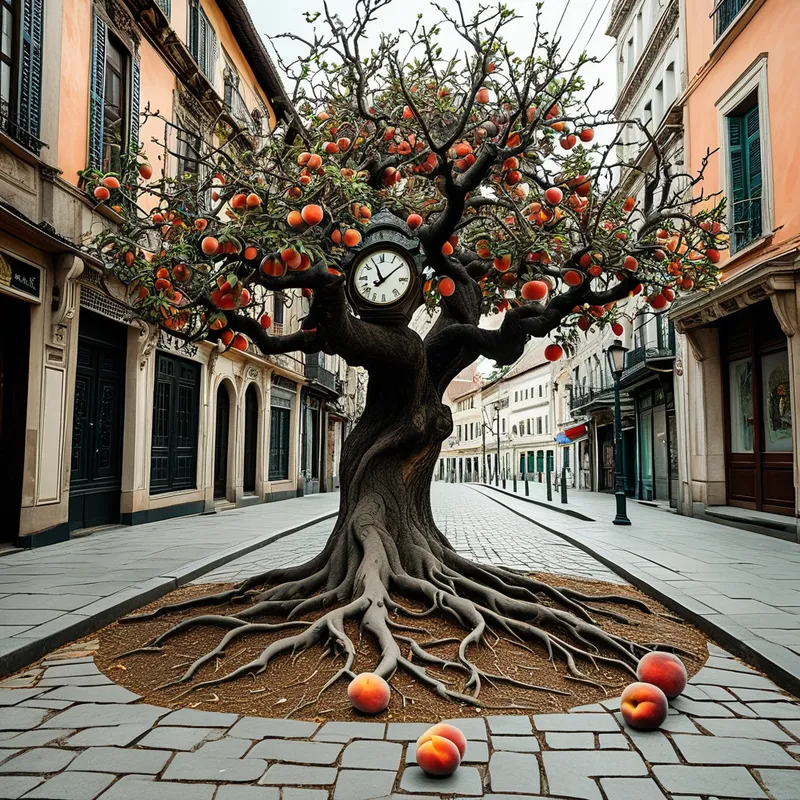
When this myth stirs in the modern unconscious, it rarely appears as a grand banquet. More often, a dreamer might find themselves in a forgotten, overgrown garden at the edge of their dream-city. They may discover a single, strangely luminous fruit on a gnarled tree. The potent feeling is one of recognition and opportunity, coupled with anxiety about being unworthy or missing the moment.
Somatically, this can feel like a quickening, a flutter in the chest or solar plexus—the body sensing a nutrient it desperately needs. Psychologically, this dream pattern emerges during periods of mid-life review, after a major accomplishment, or at the onset of a spiritual crisis. It signals that the psyche has, through long and often unconscious labor, produced something of immense value: a new level of integration, a creative idea fully formed, or the readiness to let go of an old identity. The dream asks: Do you recognize the fruit of your own long cycles? Will you partake, or let it rot on the branch, waiting for an external invitation that will never come?
Alchemical Translation
The individuation journey modeled here is not one of heroic conquest, but of sovereign cultivation and ritually sanctioned reception. Our inner Xi Wangmu is that fierce, discerning aspect of the psyche that guards our deepest potential. She allows nothing premature or unworthy to consume the fruits of our inner garden.
The first alchemical stage is the planting and the long waiting—the commitment to a path of self-knowledge, often feeling barren and fruitless for years. The second is the tending of the walls—establishing healthy boundaries, discernment, and self-respect that protect our developing core. The third is the recognition of ripeness—the somatic and intuitive knowing that a transformation is complete, that a peach of insight or wholeness is ready.
The final, crucial stage is the Feast of the Self. This is the conscious, celebratory act of partaking in your own transformation.
This is not narcissism, but a sacred ritual. It might be marking a transition with ceremony, integrating a shadow aspect and honoring the struggle it took, or simply sitting in deep acknowledgment of one’s own growth. To eat the peach is to fully metabolize the experience, to let it renew your psychic “immortality”—your sense of enduring, essential self beyond [the ego](/myths/the-ego “Myth from Jungian culture.”/)’s fluctuations. The myth teaches that immortality is not a static state, but a cyclical feast. We do not become whole once and for all; we must continually recognize, harvest, and ritually consume the fruits of our ongoing journey, at the invitation of our own inner sovereign.
Associated Symbols
Explore related symbols from the CaleaDream lexicon: