Wu Wei Myth Meaning & Symbolism
The myth of aligning with the Tao's natural flow, where supreme action arises from stillness and perfect harmony is found in non-forcing.
The Tale of Wu Wei
In the time before time had a name, when the sky was a bowl of fresh lacquer and the earth a soft, breathing clay, there lived a ruler who tore at his own hair. His name was King Li, and his kingdom was a masterpiece of his own striving. Canals were dug where no river wished to flow. Granaries were built taller than the mountains, yet they echoed with emptiness. Laws were carved into stone, so numerous they cast the land in perpetual shadow. The people moved like ants under a heavy foot, their backs bent, their spirits parched. The more the King did, the more his realm withered. Famine was his harvest; discord, his music.
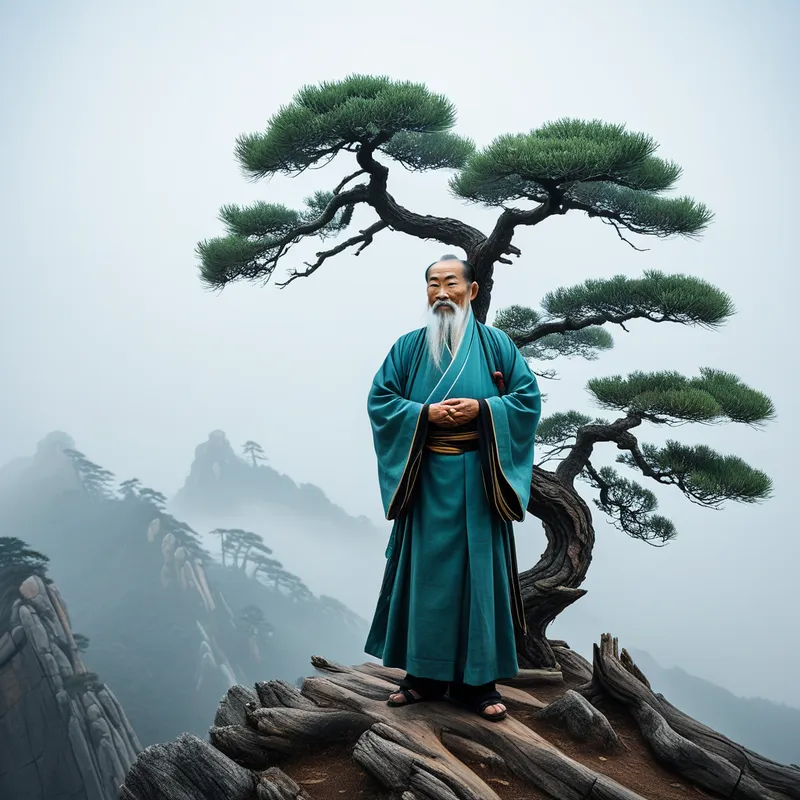
In his despair, he climbed the Kunlun, seeking the hermit Zhenren who was said to understand the whisper of clouds. He found no grand sage in a cave, but an old man by a stream, mending a fishing net with infinite patience. The net was torn in a hundred places.
“Master,” cried the King, his robes stained with the dust of effort. “My kingdom dies! I have commanded the rains to fall and they defy me. I have ordered the grain to grow and it mocks me. Tell me the great action I must take to save my people!”
The old man did not look up. His fingers moved, knotting the cord, following the break in the weave. He said nothing. For three days and nights, the King stood, repeating his pleas, listing his deeds, his voice growing hoarse with the effort of his asking. The hermit simply mended.
On the fourth dawn, as a mist rose from the stream, the King fell silent. Exhaustion had emptied him. He heard, for the first time, the water chuckling over stones. He saw the way the willow bent to trail its fingers in the current. He watched the hermit’s hands—they did not fight the net, nor force it. They simply joined where joining was needed.
A single leaf, golden and perfect, spiraled down from a ginkgo tree. It landed on the still surface of a deep pool beside the hermit, and concentric circles expanded outward, touching everything, moving everything, without a single drop of water striving to be a circle.
The King wept. He had not been answered with a secret. He had been shown a world.
He returned to his palace and dismissed his ministers. He walked into his over-planned gardens and let the weeds grow. He repealed the laws, not with a proclamation, but by ceasing to enforce them. He sat in his hall and did nothing the court recognized as action. At first, chaos seemed to bloom. Then, a strange rhythm emerged. Farmers, unshackled, began to read the soil and the sky again. Merchants found new paths, like water finding its course. The people, unburdened, remembered how to sing while they worked. The kingdom did not just recover; it began to flow. The canals, abandoned, became meadows where deer drank. True rivers, left to their own will, watered the fields. The granaries, now modest, were full.
The King, now simply a man named Li, finally understood. The greatest power was not in the hand that pushes the river, but in the body that learns to swim with it.
Cultural Origins & Context
The principle of Wu Wei is not a singular myth with named gods and a plotted epic, but the foundational, living breath of Taoist philosophy, crystallized in texts like the Daodejing and the Zhuangzi. Its “myth” is the accumulated wisdom of countless observations of the natural world—the way water wears away stone, the way seasons turn without decree, the way a tree grows toward the light without conscious intent.
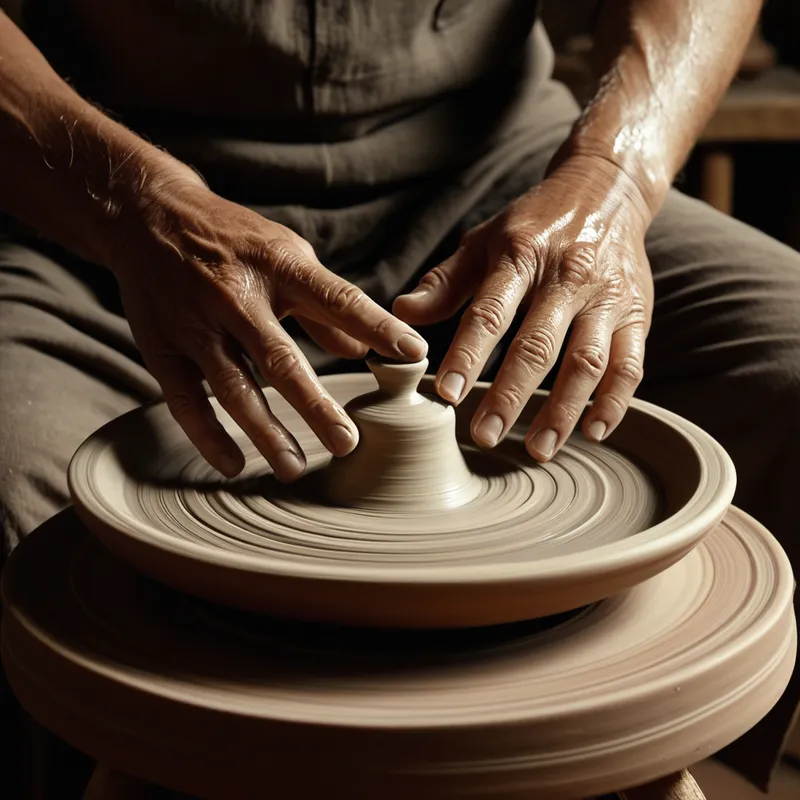
It was passed down not by bards in halls, but by hermits in mountains, by craftsmen at their wheels, and by physicians observing the body’s innate wisdom. Its societal function was revolutionary yet quiet: a corrective to the rigid, forceful Confucian structuredness that dominated ancient Chinese court life. It served as a guide for rulers, advising governance that follows the natural tendencies of the people, and for individuals, offering a path to personal efficacy and peace by harmonizing with the Tao.
Symbolic Architecture
At its core, the myth of Wu Wei symbolizes the psyche’s journey from the tyranny of the conscious ego to integration with the larger, self-regulating system of the unconscious—the personal Tao. King Li represents the ego in its identified state: the “doer” who believes willpower and conscious control are the sole sources of creation and order. His kingdom is his extended psyche and his life, crumbling under the weight of this misconception.
The Wu Wei state is not passivity, but a participatory awareness so attuned that action arises from the situation itself, not from a separate, forcing self.
The hermit is the archetype of the Senex, the embodiment of the Self. His mending is the symbolic act of psychosynthesis—the slow, patient work of joining disparate parts without violence. The leaf creating ripples is the ultimate symbol: a minute, effortless event that reorganizes the entire field. Psychologically, it represents the moment of insight, the subtle inner movement that realigns a life when the ego finally surrenders its frantic agenda.
The Dreamer’s Resonance
When this myth stirs in the modern unconscious, it often manifests in dreams of profound frustration within over-engineered systems. One may dream of being in a car with no brakes, hurtling down a highway they did not choose, or of fighting against a current in a murky river, muscles burning. Alternatively, the resolution may appear: a sudden ability to breathe underwater, or finding that a locked door opens when you simply lean against it.
Somatically, the individual is likely experiencing chronic tension, a feeling of “pushing a boulder uphill” in some life domain—career, relationship, creative project. The psyche is broadcasting the cost of ego-identification, of being fused with the inner “King Li” who strives against the innate grain of their own nature. The dream is an invitation to notice where effort has become strain, where control has become confinement, and to experiment with the somatic release of that grip.

Alchemical Translation
The alchemical process modeled here is the solve et coagula—dissolve and coagulate—applied to the psyche. King Li’s arduous climb and subsequent exhaustion represent the solve: the necessary dissolution of the ego’s rigid identity as the sole author of reality. This is a dark night, a feeling of futility and emptiness that precedes transformation.
The hermit’s silent demonstration and the vision of the leaf are the first stirrings of the coagula, the new coagulation. This is not a rebuilding by the old ego’s blueprint, but an emergence of a new ordering principle from the deeper Self.
Individuation is not a project to be completed, but a rhythm to be joined. Wu Wei is the art of hearing that rhythm and letting it move your feet.
For the modern individual, the alchemical translation is the shift from making things happen to letting things come. In therapy, it is the point where analyzing stops and being-with begins. In creativity, it is the “flow state” where the musician is played by the music. In life, it is the profound trust that when one aligns with their deepest nature—their personal Tao—action becomes graceful, effective, and surprisingly effortless. The triumph is not over an external dragon, but over the internal compulsion to wrestle the world into submission. The kingdom that flourishes is the integrated Self, governed not by force, but by the natural law of its own being.
Associated Symbols
Explore related symbols from the CaleaDream lexicon: