Writing on the Wall Myth Meaning & Symbolism
A disembodied hand writes a cryptic message on a palace wall, pronouncing the end of a king's reign and revealing the limits of human power.
The Tale of the Writing on the Wall
The air in the great hall was thick with the scent of spiced wine and hubris. King Belshazzar of Babylon, a thousand of his lords arrayed before him, had commanded a feast of such magnitude that the very stones of the palace seemed to sweat with excess. Gold gleamed not just on the walls, but in the hands of every reveler. And in those hands rested the ultimate blasphemy: the sacred vessels of gold and silver, plundered from the Temple in Jerusalem. They drank from them, toasting gods of gold and silver, bronze and iron, wood and stone—deaf, dumb, and blind idols.
Laughter roared like a beast, drowning out the whisper of conscience. The king, flushed with power and wine, felt the empire was an eternal edifice of his own making. But in the midst of the cacophony, a silence descended—a pocket of absolute stillness that began at the far end of the hall, near the plastered wall of the king’s palace. The laughter died in throats. Eyes widened.
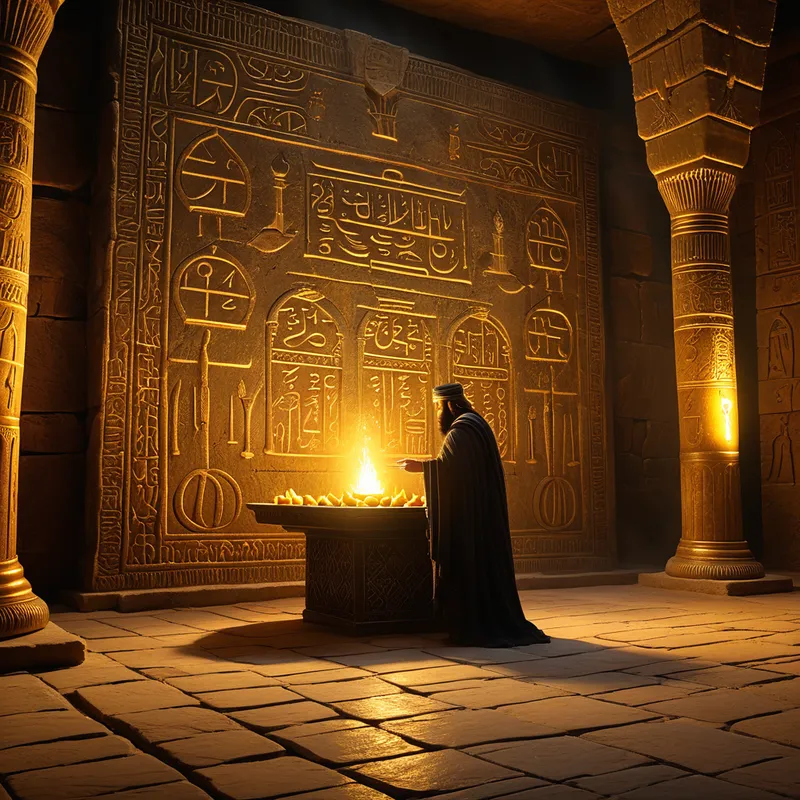
A hand appeared. Not a hand of flesh and blood, but a spectral, disembodied hand, fingers poised as if holding a stylus of pure light. And it wrote. Without sound, without ceremony, it inscribed words into the plaster. The characters burned with a cold, phosphorescent fire: MENE, MENE, TEKEL, PARSIN.
The king’s blood turned to ice in his veins. His knees knocked together, and the grandeur of his robes could not hide the sudden tremor of his limbs. The boastful revelry was shattered, replaced by a terror that seeped into the marrow of every soul present. The wise men of Babylon—the enchanters, the Chaldeans, the astrologers—were summoned. They stared at the writing, but its meaning was a sealed book to them. They could not read the writing or make known its interpretation. The king’s face grew paler; his offers of purple cloth, a chain of gold, and third-rank in the kingdom hung in the air, unanswered.
Then, the queen mother remembered a man from the days of Belshazzar’s grandfather, Nebuchadnezzar. A man in whom was the spirit of the holy gods. A man named Daniel. He was brought before the king, the promises of reward repeated. But Daniel’s eyes held no greed, only a profound and sorrowful clarity. He refused the gifts. Then, turning to the wall and the burning words, he spoke. And his voice was the voice of the sentence being passed.
Cultural Origins & Context
This tale is preserved in the fifth chapter of the Book of Daniel. While set during the final night of the Babylonian Empire (c. 539 BCE), scholarly consensus places its composition much later, during the Hellenistic period. It was a time of intense cultural pressure and persecution for the Jewish people, under the rule of the Seleucid king Antiochus IV Epiphanes. The story of Belshazzar, then, served as powerful resistance literature.
It functioned as a theological and political parable: no matter how mighty the empire that profanes the sacred and exalts itself, its time is numbered by a higher sovereignty. The story was told to reinforce communal identity and faith, asserting that the God of Israel was the true ruler of history, who humbles the proud and vindicates the faithful, even in exile. The cryptic Aramaic words—MENE, MENE, TEKEL, PARSIN—are units of weight (mina, shekel, and half-shekels), cleverly repurposed into a divine pun of judgment, a form of wisdom literature designed to be pondered and decoded by the faithful community.
Symbolic Architecture
At its core, the myth is an archetypal drama of Hubris and Nemesis. Belshazzar is not merely a historical king; he is the psychological embodiment of the inflated ego. He dwells in a palace of his own construction, believing his power, wealth, and intellect to be absolute. The profaning of the sacred vessels is the ultimate symbolic act of this inflation: he consumes the holy for his own mundane pleasure, failing to recognize any reality or authority beyond his own sphere.
The writing appears not in the private chamber of conscience, but on the public wall of the persona, for the crime of hubris is always a performance for the self, witnessed by the Self.
The Hand is the irruption of the transpersonal, the objective psyche, or the Divine, into the subjective world of the king. It is the sudden, undeniable appearance of a reality that cannot be bribed, reasoned with, or ignored. The words themselves are a perfect symbol of the Self’s communication: cryptic, numinous, and requiring translation by a mediating consciousness—the Sage, embodied by Daniel. Daniel does not bring the judgment; he merely interprets what is already, irrevocably, written. He is the function of consciousness that can bear to look at the shadow and speak its truth.
The Dreamer’s Resonance
When this myth stirs in the modern soul, it often manifests in dreams of unsettling messages. A dreamer may see unknown writing on a wall, a mirror, or a computer screen. They may receive a letter with incomprehensible text or hear a voice speaking a single, portentous word. The somatic feeling is one of chilling dread, a cold realization that something fundamental has been assessed and found wanting.
Psychologically, this marks a critical moment in what Carl Jung called the individuation process. The “feast of Belshazzar” represents a life phase where the ego has become overly identified with its achievements, status, or a rigid self-image. It has “profaned the sacred” by using inner gifts (creativity, intuition, spirit) solely for external validation or selfish gain. The writing is the psyche’s ultimatum: the current trajectory is unsustainable. The ego’s reign, in its present form, is over. The dream is the embodied experience of a psychic self-regulation so profound it feels like a divine sentence.

Alchemical Translation
The alchemical process mirrored here is Nigredo, the necessary darkening and dissolution of the old, inflated state. Belshazzar’s terror is the prima materia of transformation—the raw, humiliated awareness that one’s understanding of the world and oneself is catastrophically incomplete.
The hand writes not to destroy, but to initiate. The crumbling of the kingdom is the precondition for the birth of a consciousness that can hold paradox.
The modern individual’s “Daniel moment” is the courageous turn toward this inner writing. It is the decision to seek interpretation, to engage in therapy, journaling, or deep reflection to understand what the unconscious is declaring. To translate MENE: “God has numbered the days of your kingdom.” This is the realization of mortality and limit. TEKEL: “You have been weighed on the scales and found wanting.” This is the confrontation with one’s own shadow, the parts of the self denied or projected. PERES (the singular of PARSIN): “Your kingdom is divided and given to others.” This is the necessary de-integration of the ego-complex, making space for new, previously unconscious elements of the personality to come into the light.
That very night, the historical narrative tells us, Belshazzar was killed and his kingdom passed to the Medes and Persians. In the alchemy of the soul, this is not merely an end, but a transfer of authority. The kingdom of the blind ego is dissolved, so that the rule of the greater, more inclusive Self may begin. The writing was always there, on the wall of the soul. The feast of arrogance was simply the darkness against which its fire finally became visible.
Associated Symbols
Explore related symbols from the CaleaDream lexicon: