Witches' Sabbat Myth Meaning & Symbolism
A mythic gathering of witches and spirits in the wild, representing the psyche's confrontation with its own repressed, ecstatic, and transformative powers.
The Tale of Witches’ Sabbat
Listen, and hear the tale not told in daylight. When the church bells fall silent and [the hearth](/myths/the-hearth “Myth from Norse culture.”/)-fire burns low, a different call sounds. It is not heard with the ear, but felt in the marrow—a pull toward the wild places where the old roads end and the map becomes a dream.
She rises from her bed, or perhaps she never lay in it. The sleeping form is a husk, a courtesy left behind. Her true self slips through the keyhole, out the window, into the breath of the night. The land is asleep, but she is awake, anointed with the unguent of flight, a grease of soot and fat and herbs that whisper of the poison and the cure. [The world](/myths/the-world “Myth from Tarot culture.”/) tilts. The familiar field becomes a heath, the parish lane a path trod only by foxes and forgotten things. She mounts a staff, a broom, a pitchfork—any humble tool transformed—and is borne aloft on a wind that smells of damp earth and lightning.
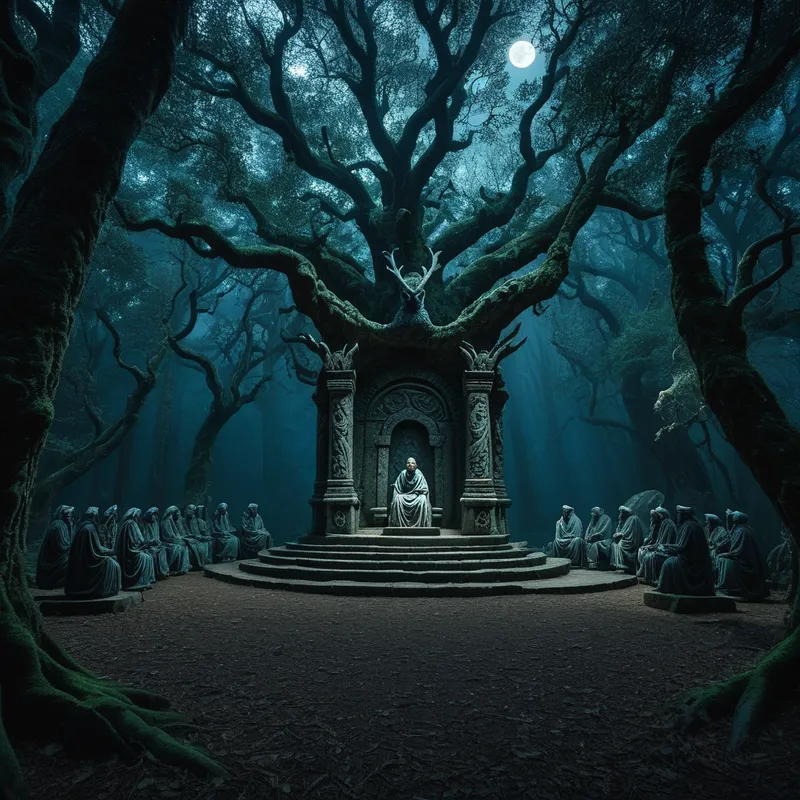
The gathering place is never the same, yet always known. A blasted heath beneath a gibbet’s creaking wood. A mountain summit where the clouds tear like gauze. A forest clearing where the oldest oak, the Gallow’s Tree, holds court. They arrive from all compass points—the wise woman from the village edge, the young maiden with restless eyes, the cobbler who hums odd tunes. They come as themselves, and as beasts: hares with knowing eyes, cats with too-intelligent gazes.
At the center of the throng is He. Not the horned god of the fields, but his shadow-brother, the Devil of the Sabbat. He is vast, cloaked in black, with the head of a goat or a stag, eyes like cold coals. He sits upon a stone, a throne of unworked earth. This is his liturgy. The newcomers approach, turn their backs to him, and renounce their baptism, their faith, their name—all the marks of the day-world. They kiss his fundament, a seal of the ultimate inversion. A new name is whispered, a secret one, for the night-only self.
Then, the music begins. No lute or pipe, but a drone from a bone, a rhythm from a skin stretched over a hollow log. The dance is no courtly measure. It is a spinning, a writhing, a convulsion of joy and terror intertwined. They dance back-to-back, a circle moving [widdershins](/myths/widdershins “Myth from Various culture.”/), against the sun, unraveling the orderly soul. The feast is laid: meat that tastes of nothing and everything, bread that leaves one hungrier. They consume [the shadow](/myths/the-shadow “Myth from Jungian culture.”/) of sustenance.
Here, all hierarchies of the waking world dissolve. The lord serves the swineherd. The priestess commands the knight. It is a kingdom of anti-structure, a sacrament of chaos. Stories are told—of healing herbs and blighted crops, of love philtres and curses. Knowledge, the forbidden kind that lives in the root and the venom, is passed hand to shadowy hand.
As [the moon](/myths/the-moon “Myth from Tarot culture.”/) begins her descent, the frenzy peaks and breaks. The pact is sealed, the energy spent. One by one, they slip away, returning along the spirit-roads as the first grey light threatens the east. They slide back into their sleeping forms, into their daytime names, carrying the memory of the Sabbat like a coal hidden in the heart—a secret fire that warms and burns, a taste of a freedom so absolute it is indistinguishable from damnation.
Cultural Origins & Context
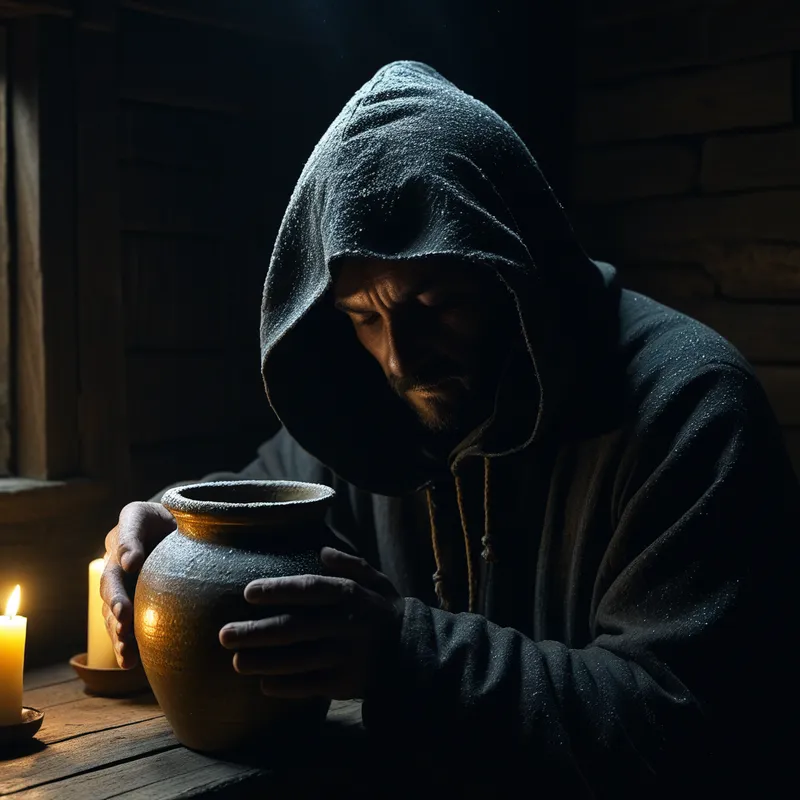
The myth of the Witches’ Sabbat is not a single story, but a composite nightmare and fantasy woven from the darkest threads of the late medieval and early modern European [psyche](/myths/psyche “Myth from Greek culture.”/). It emerged not from pagan practice, but from the interrogation chambers and theological treatises of the Burning Times. It was a story told about the accused, not by them—a narrative constructed by inquisitors, judges, and demonologists trying to give shape to their profound fear of secret conspiracy and spiritual rebellion.
The myth served a critical societal function: it made the invisible threat visible and punishable. It transformed the lonely, often marginalized figure of the village healer or the nonconformist neighbor into a soldier in a vast, inverted army of the Witches’ Sect. The Sabbat narrative provided a blueprint for confession, extracted under torture, that confirmed the authorities’ worst fears. It was passed down through chillingly detailed legal transcripts, woodcut illustrations in pamphlets, and sermons that painted the myth as a terrifying reality. This was a story of absolute Otherness, a dark parody of the Christian mass and feast, designed to galvanize communities against the internal enemy.
Symbolic Architecture
Beneath the [layer](/symbols/layer “Symbol: Layers often symbolize complexity, depth, and protection in dreams, representing the various aspects of the self or situations.”/) of demonological propaganda lies a profound symbolic [architecture](/symbols/architecture “Symbol: Architecture in dreams often signifies structure, stability, and the framing of personal identity or life’s journey.”/), a map of the psyche’s repressed territories. The Sabbat represents the ultimate gathering of the [Shadow](/symbols/shadow “Symbol: The ‘shadow’ embodies the unconscious, repressed aspects of the self and often represents fears or hidden emotions.”/)—all that is denied by the conscious, daylight self: wildness, [ecstasy](/symbols/ecstasy “Symbol: A state of overwhelming joy, rapture, or intense emotional/spiritual transcendence, often involving a loss of self-awareness.”/), rage, primal [knowledge](/symbols/knowledge “Symbol: Knowledge symbolizes learning, understanding, and wisdom, embodying the acquisition of information and enlightenment.”/), and bodily autonomy.
The Sabbat is the psyche’s forbidden festival, where everything exiled by the ego is invited to dance.
The [journey](/symbols/journey “Symbol: A journey in dreams typically signifies adventure, growth, or a significant life transition.”/) to the Sabbat symbolizes a descent into the unconscious, facilitated by the “flying ointment”—likely psychoactive plants—representing altered states of [consciousness](/symbols/consciousness “Symbol: Consciousness represents the state of awareness and perception, encompassing thoughts, feelings, and experiences.”/) necessary to access these [depths](/symbols/depths “Symbol: Represents the subconscious, hidden emotions, or foundational aspects of the self, often linked to primal fears or profound truths.”/). The Devil of the Sabbat is not a literal entity, but the archetypal personification of the rejected Self, the total [personality](/symbols/personality “Symbol: Personality in dreams often symbolizes the traits and characteristics of the dreamer, reflecting how they perceive themselves and how they believe they are perceived by others.”/) that includes the dark, instinctual, and transgressive elements the conscious mind refuses to acknowledge. Kissing his rear is the ultimate symbolic act of embracing the “low,” the despised, the excremental aspects of existence and psyche.
The widdershins dance is a [ritual](/symbols/ritual “Symbol: Rituals signify structured, meaningful actions carried out regularly, reflecting cultural beliefs and emotional needs.”/) of de-creation, unraveling the tightly wound [identity](/symbols/identity “Symbol: Identity represents the sense of self, encompassing personal beliefs, cultural background, and social roles.”/) of the [persona](/symbols/persona “Symbol: The social mask or outward identity one presents to the world, often concealing the true self.”/) to access the raw [material](/symbols/material “Symbol: Material signifies the tangible aspects of life, often representing physical resources, desires, and the physical world’s influence on our existence.”/) beneath. The chaotic feast and the inverted hierarchies symbolize the temporary [dissolution](/symbols/dissolution “Symbol: The process of breaking down, dispersing, or losing form, often representing transformation, release, or the end of a state of being.”/) of [the ego](/myths/the-ego “Myth from Jungian culture.”/)’s tyrannical order, allowing for a primordial, undifferentiated state of being where new potentials can form.
The Dreamer’s Resonance
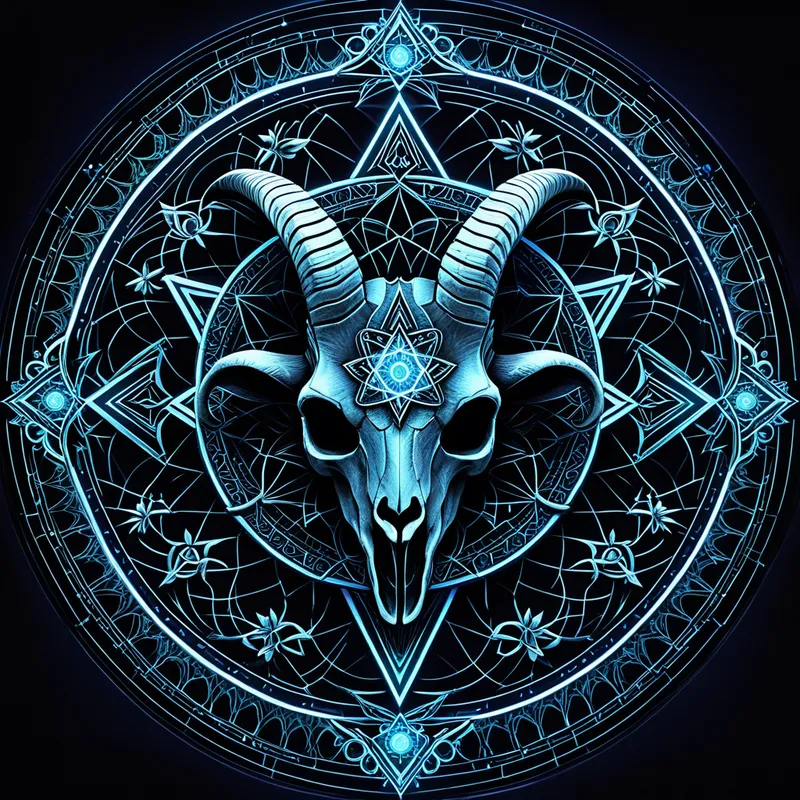
When this myth stirs in the modern dreamer, it signals a powerful uprising from the depths. To dream of a secret, ecstatic gathering in a wild place, of joining a frenzied dance, or of meeting a formidable horned or masked figure, is to experience the psyche’s demand for integration.
Somatically, one might awaken with a racing heart, a sense of wild energy, or profound disorientation—the body registering the shock of the unconscious breaking through. Psychologically, this dream pattern emerges at life thresholds where the established identity feels suffocating. It is the call of the repressed artist, the stifled rebel, the denied sensualist, or the intuitive knowledge deemed “unscientific.” The dream Sabbat is not an invitation to literal diabolism, but a stark presentation of everything one has been taught to fear and reject within oneself. The conflict in the dream mirrors the inner struggle between the ego’s need for control and the Shadow’s demand for recognition and expression.

Alchemical Translation
The myth of the Witches’ Sabbat models a radical, perilous, but essential stage of psychic alchemy: the [Nigredo](/myths/nigredo “Myth from Alchemical culture.”/), or blackening. This is the stage of dissolution, confrontation with the shadow, and descent into the chaotic [prima materia](/myths/prima-materia “Myth from Alchemical culture.”/) of the soul.
The conscious ego’s journey to the Sabbat is its own temporary death. It must renounce its baptized identity (its self-concept) and submit to the dark, horned lord of the total Self. The chaotic dance is the solve (dissolution), where all rigid structures of personality are broken down. This is not a moral failure, but a necessary disintegration.
To be made whole, one must first dare to attend the forbidden feast of one’s own fragments.
The [triumph](/myths/triumph “Myth from Roman culture.”/) of this myth, for the modern individual undergoing individuation, is not in staying at the Sabbat forever, but in returning. The witch goes back to her village, carrying the secret coal. The alchemical translation is this: one must consciously engage with the Sabbat energies—the wildness, the rebellion, the shadow-knowledge—and integrate them, rather than projecting them onto others or repressing them into neurosis. The goal is to bring the fire of that dark festival back into the daylight world, not as a destructive force, but as a source of unparalleled vitality, creative power, and profound self-acceptance. The rebel archetype is thus redeemed from mere destruction to become the necessary force that breaks the shell of the outgrown self, allowing a more complete, authentic, and potent individual to be born.
Associated Symbols
Explore related symbols from the CaleaDream lexicon: