Witches' Broom Myth Meaning & Symbolism
A myth of a celestial being who sweeps the cosmos, creating stars and storms, embodying the tension between order and chaos, creation and dissolution.
The Tale of Witches’ Broom
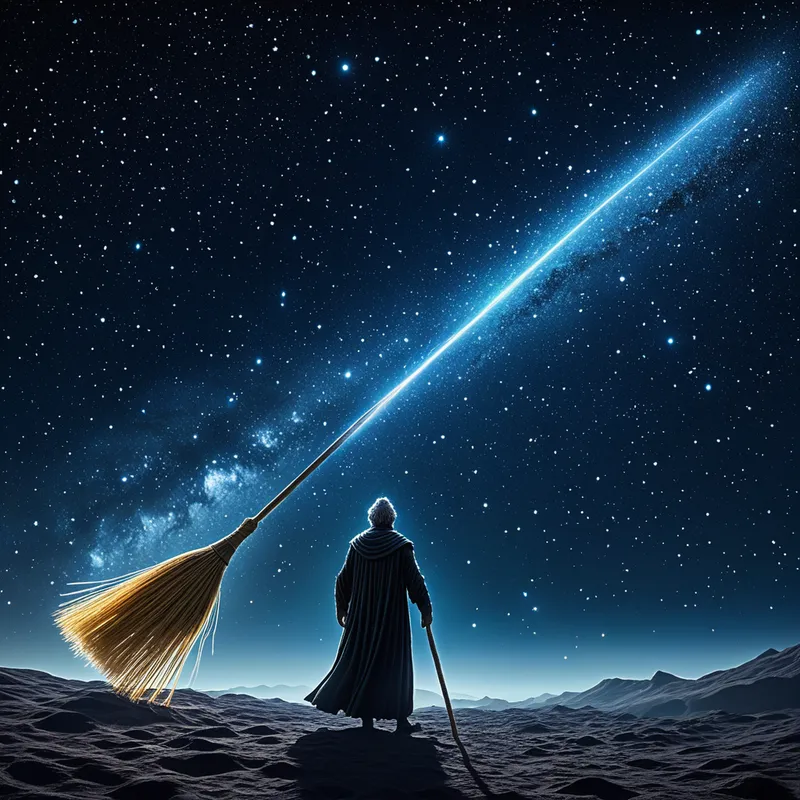
Listen. Before the names of gods were fixed in stone, when [the world](/myths/the-world “Myth from Tarot culture.”/) was a breath held in the dark, there was the Sweeper of the Skies. They were not a god of harvest or of hearth, but a keeper of the spaces in between. Their form was of shifting smoke and gathered light, and their tool was the Broom.
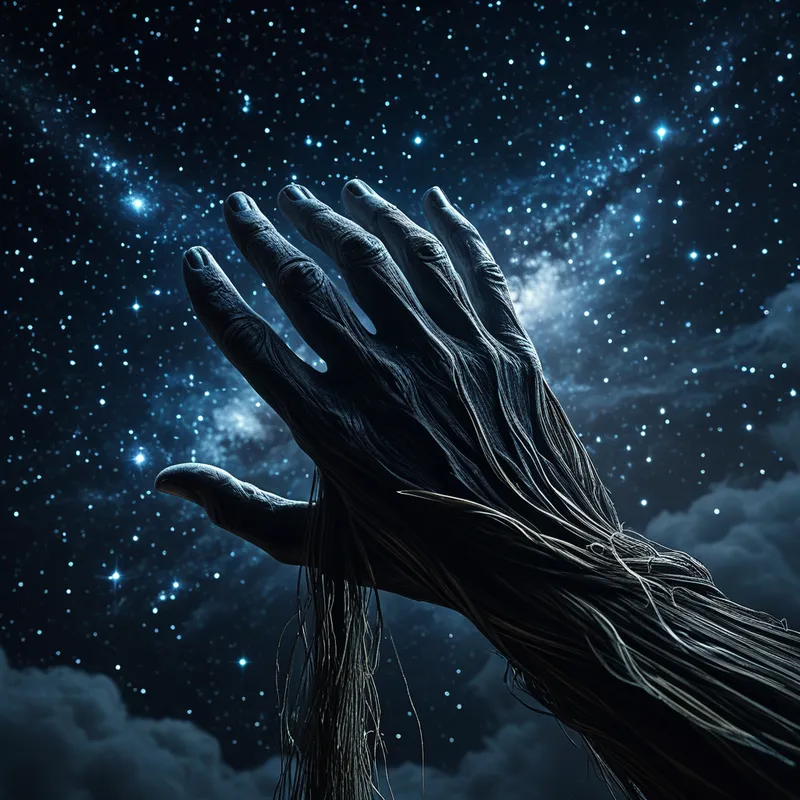
Each night, as the great cloak of twilight settled, the Sweeper would begin their work. From the eastern vault they would start, their broom—a vast, whispering [thing](/myths/thing “Myth from Norse culture.”/) woven from the tails of passing comets and strands of latent destiny—held in hands that were more like roots or river deltas. They did not sweep floors, but the very firmament. With long, patient strokes, they gathered the detritus of the day: the scattered sparks of unfulfilled wishes, the gossamer threads of broken promises, the heavy dust of forgotten deeds.
This cosmic lint they piled into great, swirling mounds in the corners of the heavens. And from these piles, pressed by the weight of eternity and stirred by the Sweeper’s breath, new things were born. Some mounds ignited into clusters of stars, singing their cold, bright songs. Others condensed into dark, pregnant clouds that would one day weep upon [the earth](/myths/the-earth “Myth from Hindu culture.”/). Yet others became the strange, wandering lights we call will-o’-the-wisps, lost between realms.
But the Sweeper’s task had a second edge. For the broom must also clear. To make space for the new, the old must be moved. Sometimes, a stroke would catch a star that had grown arrogant in its fixed place, sweeping it from its throne into [the abyss](/myths/the-abyss “Myth from Kabbalistic culture.”/), its light guttering into a memory. Sometimes, it would gather a constellation that had finished its story, bundling it away into the great celestial cupboard of ended things. The people below, looking up, would see a shooting star and whisper, “The Sweeper is at work.”
The Sweeper was neither cruel nor kind. They were necessity. They were the breath in and the breath out of the universe. Their rhythm was the rhythm of creation and dissolution, a silent, endless sweeping that kept the cosmos from becoming either a cluttered attic or a barren hall. They were the Witches’ Broom, the tool that cleansed by scattering, that created by destroying, that ordered by stirring chaos.
Cultural Origins & Context
The motif of the Witches’ Broom is not the property of a single tribe or nation, but a psychic archetype that has brushed against the consciousness of many. We find its echoes in [the star](/myths/the-star “Myth from Tarot culture.”/)-lore of nomadic peoples who watched [the Milky Way](/myths/the-milky-way “Myth from Greek culture.”/) and saw it as a path of scattered dust. We hear it in the tales of coastal fishermen who spoke of storm-witches riding the gales, their brooms stirring [the sea](/myths/the-sea “Myth from Greek culture.”/) into fury. It persists in the folklore of farming communities, where a peculiar, dense growth in a tree—a deformity called a “witch’s broom”—was seen as a place where the cosmic Sweeper had accidentally dropped a fragment of power.
This was a story told not to explain morality, but to explain process. It was narrated by elders under the open sky, a myth for astronomers and philosophers of the natural world. Its societal function was profound: to provide a cosmology that accepted destruction as part of creation’s cycle, to frame chaos not as an enemy but as the raw material of order. It taught that the universe requires maintenance, that even the heavens are not static, and that the agent of this maintenance operates beyond simple dichotomies of good and evil.
Symbolic Architecture
At its core, the myth of the Witches’ [Broom](/symbols/broom “Symbol: A broom symbolizes cleansing, order, and the act of removing negative influences from one’s life.”/) is a supreme [symbol](/symbols/symbol “Symbol: A symbol can represent an idea, concept, or belief, serving as a powerful tool for communication and understanding.”/) of the coincidentia oppositorum. The [broom](/symbols/broom “Symbol: A broom symbolizes cleansing, order, and the act of removing negative influences from one’s life.”/) itself is the ultimate [symbol](/symbols/symbol “Symbol: A symbol can represent an idea, concept, or belief, serving as a powerful tool for communication and understanding.”/) of this union. It is a tool of mundane order (sweeping [the hearth](/myths/the-hearth “Myth from Norse culture.”/)) wielded for cosmic [purpose](/symbols/purpose “Symbol: Purpose signifies direction, meaning, and intention in life, often reflecting personal ambitions and core values.”/) (sweeping [the sky](/myths/the-sky “Myth from Persian culture.”/)). It gathers and it scatters. It reveals (new stars) and it conceals (old constellations).
The broom does not ask if the dust is sacred or profane; its purpose is the movement itself, the sacred act of circulation.
The Sweeper represents the autonomous, transpersonal [psyche](/myths/psyche “Myth from Greek culture.”/)—what we might call the Self in its cosmic [aspect](/symbols/aspect “Symbol: A distinct feature, quality, or perspective of something, often representing a partial view of a larger whole.”/). This entity is not “us” in our ego [identity](/symbols/identity “Symbol: Identity represents the sense of self, encompassing personal beliefs, cultural background, and social roles.”/), but the larger psychic process within which our little lives are but a speck of [dust](/symbols/dust “Symbol: Dust often symbolizes neglect, forgotten memories, or the passage of time and life’s impermanence.”/) to be gathered or dispersed. The Sweeper is indifferent to individual [fate](/symbols/fate “Symbol: Fate represents the belief in predetermined outcomes, suggesting that some aspects of life are beyond human control.”/), concerned only with the balance and flow of the whole [system](/symbols/system “Symbol: A system represents structure, organization, and interrelated components functioning together, often reflecting personal or social order.”/). Psychologically, this represents the often-ruthless processes of the unconscious that dismantle outworn attitudes (sweeping away an old star) to make way for new potential (igniting a [nebula](/symbols/nebula “Symbol: Represents mystery, creation, and the beginnings of life, symbolizing the potential and possibilities inherent in the unknown.”/)), a process [the ego](/myths/the-ego “Myth from Jungian culture.”/) experiences as [crisis](/symbols/crisis “Symbol: A crisis symbolizes turmoil, urgent challenges, and the need for immediate resolution or change.”/) or [loss](/symbols/loss “Symbol: Loss often symbolizes change, grief, and transformation in dreams, representing the emotional or psychological detachment from something or someone significant.”/).

The Dreamer’s Resonance
When this myth stirs in the modern dreamer, it often manifests as dreams of frantic cleaning, of being compelled to organize a vast, cluttered, or shadowy space. You may dream of sweeping leaves in an endless hall, or brushing piles of unknown, glittering debris from a familiar room. The broom in the dream may feel impossibly heavy or ethereally light.
Somatically, this can correlate with a profound psychological process of digestion and release. The body may feel the need to purge—through tears, through movement, through deep rest—as the psyche attempts to “sweep” accumulated emotional or psychic detritus. You are undergoing a nocturnal shadow-work. The clutter in the dream is the unprocessed material of your life: unresolved grief, unexpressed anger, dormant talents, forgotten memories. The compulsive act of sweeping is [the Self](/myths/the-self “Myth from Jungian culture.”/)’s imperative to move this material, to not let it stagnate. The anxiety in the dream comes from the ego’s fear of what might be uncovered or swept away in the process.

Alchemical Translation
For the individual seeking individuation, the myth of the Witches’ Broom is a manual for psychic alchemy. The first, and most difficult, step is to identify with the Sweeper, not the speck of dust. This means shifting from a perspective of being acted upon by life’s chaos and losses, to recognizing oneself as an active participant in a necessary process of cosmic housekeeping.
The alchemical fire is not lit to destroy the base metal, but to separate it from its impurities; so the broom is not wielded to punish, but to distinguish the essential from the outworn.
Your life, your psyche, is the sky that needs sweeping. The “broom” is your conscious attention and your will to engage with your own process. You must learn to sweep your own inner firmament—to gather the scattered fragments of your experience (the massa confusa of alchemy) into piles where they can transform. This might look like journaling to consolidate thoughts, therapy to integrate trauma, or creative work to give form to chaos. Simultaneously, you must develop the courage to sweep away what has served its purpose: outdated self-concepts, finished relationships, completed projects. This is the [solutio](/myths/solutio “Myth from Alchemical culture.”/) (dissolution) and coagulatio (coagulation) of the soul.
The [triumph](/myths/triumph “Myth from Roman culture.”/) is not in achieving a sterile, empty space, but in mastering the rhythm itself—the endless, sacred cycle of gathering, transforming, and releasing. To become the Witches’ Broom is to become an agent of your own destiny, wielding the tool of consciousness to participate consciously in the universe’s eternal dance of order and chaos. You become, at last, both the sweeper and the swept, the creator and the clearing, fully engaged in the beautiful, necessary work of keeping your own soul in flow.
Associated Symbols
Explore related symbols from the CaleaDream lexicon: