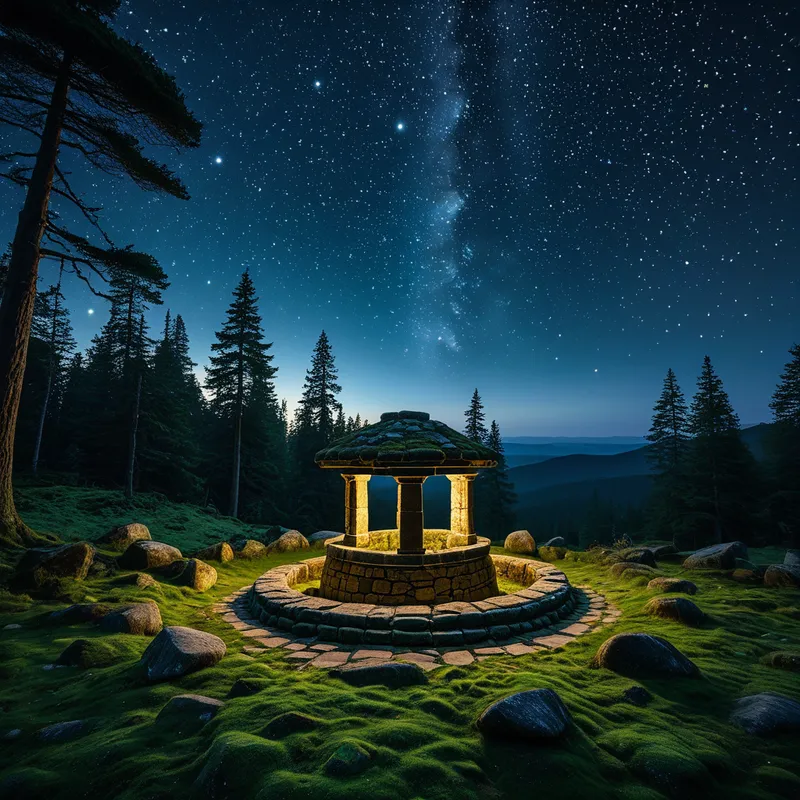
Wishing Wells & Stones Myth Meaning & Symbolism
An ancient tale of a spirit-bound well where a whispered wish, cast with a stone, echoes through the depths of the world and the human soul.
The Tale of Wishing Wells & Stones
Listen, and let the silence between the words speak. In the time before clocks, when the world was woven from story and shadow, there existed a place where the earth opened its mouth to drink the sky. It was a well, not built by mortal hands, but born where a tear from the World-Mother had fallen, striking the bedrock of reality. Its stones were not mere rock, but the solidified memory of that first sorrow and its subsequent hope.
The water within was blacker than a moonless midnight, yet it held the light of every star that had ever gazed upon it. This was the Well of Echoed Souls. It did not simply hold water; it held the space between a breath taken and a breath released—the fertile void where a wish is born.
The guardian was no towering giant or fiery dragon, but a presence felt as a deepening of the silence, a chill that was not cold, but awe. Some called her the Well-Watcher, a being woven from the echoes of all that had been offered. She had no face to see, but one perceived her in the perfect, still surface of the water, a reflection that showed not yourself, but the depth of your own longing.
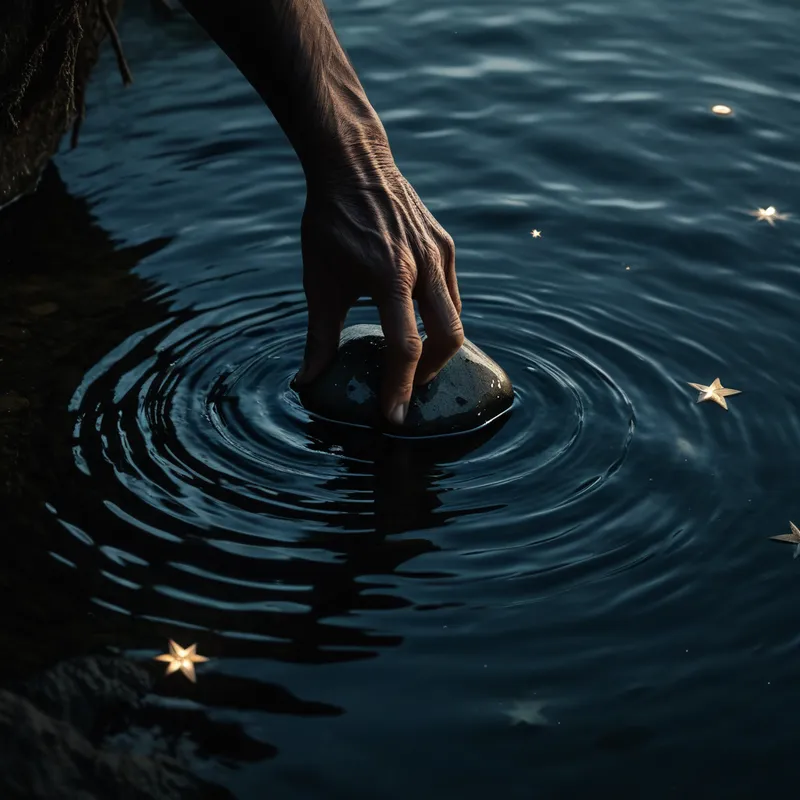
The ritual was simple, passed from weary traveler to hopeful child. You must approach with a stone, chosen not for its beauty, but for its fit—a stone that had known the caress of a river for a century, or one warmed in your palm until it forgot it was ever cold. You must hold it to your lips and breathe your deepest, most secret desire into its very core. Not a shout, but a whisper, for shouts are for the world of surfaces; whispers are for the world of depths.
Then, you must let it fall. Not drop, but release. The conflict was in that very moment—the clutch of the hand, the fear of the wish, the terror of its loss or the dread of its fulfillment. The stone would pierce the water’s mirror with a sound like a sigh, a plink that echoed not just in the shaft, but down through the roots of the world-tree and up into the vault of the heavens.
And then you waited. The rising action was the silence that followed, a silence so profound it became a presence. In that silence, the Well-Watcher listened. She heard not just the words of the wish, but the tremor in the voice, the history in the palm, the unspoken sacrifice tied to the desire. The stone sank, down past layers of forgotten time, past the bones of ancient beasts and the dust of crumbled kingdoms, until it came to rest in the soft mud of the origin.
The resolution was never seen, only felt. The water did not boil, nor did gold appear. The change was in the wisher. As they turned from the well, a part of their soul—the weight of the wish itself—remained behind, sunk with the stone. In its place, a space was carved within them, a hollow now filled with the quiet certainty of the well’s depth. The wish was no longer a frantic thought; it was now a seed planted in the underworld of the psyche, entrusted to the slow, sure alchemy of the deep. The answer would come, not as a thunderclap, but as a shift in the wind, a chance meeting, a quiet knowing—the well’s echo returning on the breath of the world.
Cultural Origins & Context
The motif of the wishing well, and its inseparable companion the wishing stone, is a true folkloric mytheme, appearing from the misty glens of Celtic Britain to the sun-baked villages of India, from the forests of Germany to the islands of Japan. It belongs not to one culture, but to the shared human geography of the sacred. Its origins are pre-literate, born in animistic worldviews where every spring, well, and pool was seen as an eye of the earth, a point of contact with chthonic powers—the genius loci or water deities.
The myth was not recited in grand halls but whispered at crossroads, taught by grandmothers to grandchildren at the village pump. Its societal function was multifaceted. Practically, it ritualized hope, providing a structured, tangible action in the face of life’s vast uncertainties—love, harvest, health, and fate. Psychologically, it externalized and contained anxiety; by depositing a wish into the literal abyss, one could mentally set it down and carry on. Spiritually, it reinforced a cosmology of reciprocity. The well was a mouth; to give it a stone (a piece of the earth) and a whisper (a piece of your spirit) was to engage in a sacred exchange. You gave something of substance to receive something of substance. The act maintained the balance between the human community and the unseen, nurturing world.
Symbolic Architecture
At its core, the myth is a profound map of the relationship between consciousness and the unconscious, between desire and manifestation.
The well is the unconscious itself—a dark, reflective, feminine space of infinite potential and unknown depth. To look into it is to confront the mystery of one’s own soul.
The wishing stone symbolizes the conscious ego’s desire, given form and weight. It is the focused intention, hardened by will and warmed by emotion. The act of whispering into it represents the infusion of psychic energy—libido—into that intention. Casting it away is the critical act of relinquishment. One cannot consciously control the processes of the deep; one must trust the depths to work upon the offering.
The Well-Watcher is the personification of the unconscious’s autonomous, orchestrating intelligence—what Jung might term the Self. She does not judge the wish by moral standards, but by its authenticity and its congruence with the whole psyche. The echoing silence after the stone’s fall is the period of incubation, where the wish is broken down and reconstituted in the alembic of the unconscious.
The water, both mirror and medium, represents the fluid, transformative substance of the psyche—the emotions and instincts that can both reflect truth and dissolve rigid forms.
The Dreamer’s Resonance
When this myth surfaces in modern dreams, it signals a psyche engaged in a profound somatic and psychological process: the gestation of a new potential. Dreaming of standing before a deep well often coincides with a life at a threshold—a career change, the beginning or end of a relationship, a creative endeavor.
The somatic feeling is one of vertigo mixed with anticipation—a pull from the depths. If the dreamer casts a stone, they are actively engaging with a deep-seated desire or need, initiating a process of inner alchemy. If the stone is too heavy to lift or slips from their hand, it may indicate resistance, fear of the wish’s implications, or a sense of being unworthy of the desire. A dry or polluted well reflects a feeling that the inner wellspring of creativity or vitality is blocked or contaminated. The appearance of the Well-Watcher, perhaps as a shadowy figure, a pair of eyes in the water, or simply an overwhelming feeling of being observed from below, marks the dreamer’s direct encounter with the autonomous, guiding power of the Self. This dream pattern is the psyche’s ancient ritual, playing out in the theater of the night, urging the dreamer to name their desire, offer it up, and prepare for the slow, sure work of transformation.

Alchemical Translation
The myth of the Wishing Well is a perfect model for the Jungian process of individuation, specifically the stage of transmutation. The conscious wish (the stone) is the prima materia—the leaden, burdensome, yet precious content of our lives that yearns for change.
The first alchemical operation is nigredo, the blackening. This is represented by the descent into the well’s darkness—the willingness to confront the shadowy, unknown depths of one’s own motivations and the potential consequences of one’s desire.
Whispering the wish is the solutio—dissolving the rigid ego-attachment to a specific outcome in the waters of the unconscious. Releasing the stone is the supreme act of surrender, the mortificatio or death of the wish as a ego-driven demand. It is planted like a seed to die to its old form.
The silent incubation in the well’s depths is the albedo, the whitening, the long, quiet purification and separation of the essential from the non-essential. The Well-Watcher is the inner alchemist, the spirit of Mercurius, who works in secret.
The eventual return of the wish, transformed into a new reality, is the rubedo, the reddening, the birth of the philosophical gold—not the literal fulfillment of a childish fantasy, but the emergence of a new attitude, a new level of psychological integration that was the true, hidden goal of the original longing. The wish was not granted; it was answered. The answer is always the Self, speaking back to the ego in the language of fate, synchronicity, and deepened being. The individual who completes this cycle learns the magician’s archetypal truth: true will is not about forcing the world to conform, but about aligning one’s conscious desires with the deep, orchestrating wisdom of the soul, and having the courage to cast the stone into the dark, trusting the water to give it back as life.
Associated Symbols
Explore related symbols from the CaleaDream lexicon: