Wish-Granting Myth Meaning & Symbolism
A timeless tale of a powerful entity that grants wishes, revealing the hidden costs of desire and the alchemy of true fulfillment.
The Tale of Wish-Granting
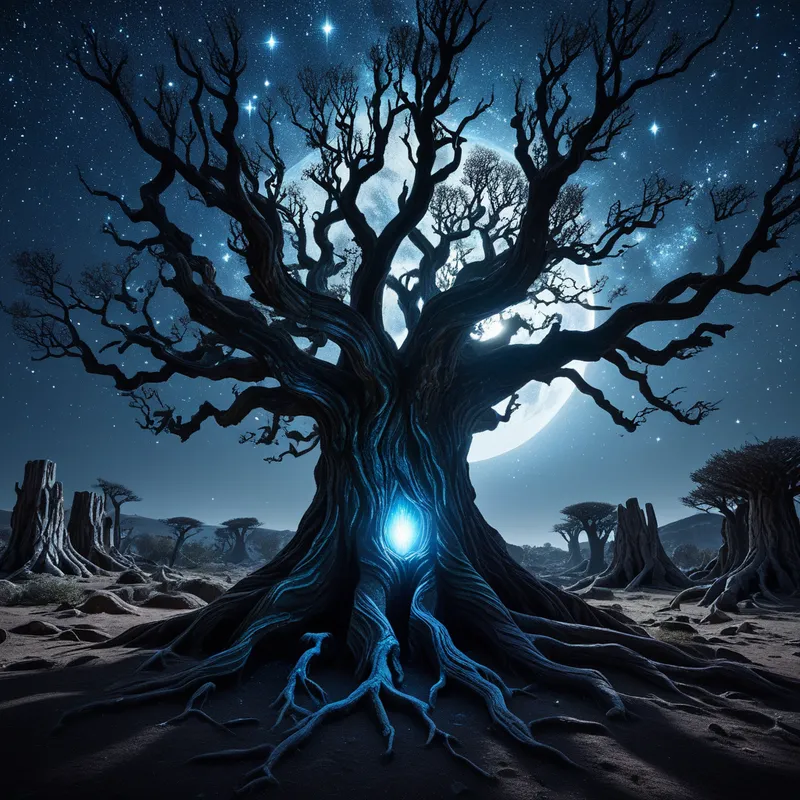
Listen. In the time before maps, when the world was woven from whispers and the roots of mountains drank from deep, forgotten wells, there existed a place not found by walking. It was a grove at the edge of perception, where the air tasted of ozone and old honey, and the trees were not wood, but petrified sighs. This was the sanctuary of the One Who Hears the Unspoken.
It did not have a name you could speak. To some, it appeared as a figure of luminous smoke, features shifting like dunes in a wind. To others, it was a stillness so profound it felt like a second heart beating in the silence. It was said to be born from the first moment a creature looked at a barren field and dreamed of grain, from the first ache of loneliness that yearned for a companion. All the raw, unshaped longing of the world pooled in its clearing.
The seekers came. Not the boastful kings with their armies, for the path unraveled for the singular soul. They came with hearts heavy with want: the farmer whose soil was salt, the artist whose hands could not capture the beauty in their mind, the lover gazing across an uncrossable chasm. The journey itself was the first test—a labyrinth of memory and fear where one’s deepest desire became a compass that could also lead to madness.
Upon arrival, there were no grand pronouncements. The air would thicken, and the One Who Hears would simply… be. The seeker’s wish, often unvoiced for years, would rise in their throat like a physical thing. And the entity would grant it. Not as a god bestowing favor, but as a force of nature obeying its own law: potential must be made manifest.
The farmer wished for fertile land, and the next rain brought not water, but a flood of rich, black earth that buried his neighbor’s home. The artist wished for true skill, and their hands moved with a life of their own, painting masterpieces they no longer recognized as their own, their personal voice forever silenced. The lover wished for union, and found their beloved by their side, yet the very struggle that had defined their passion was gone, leaving a hollow peace.
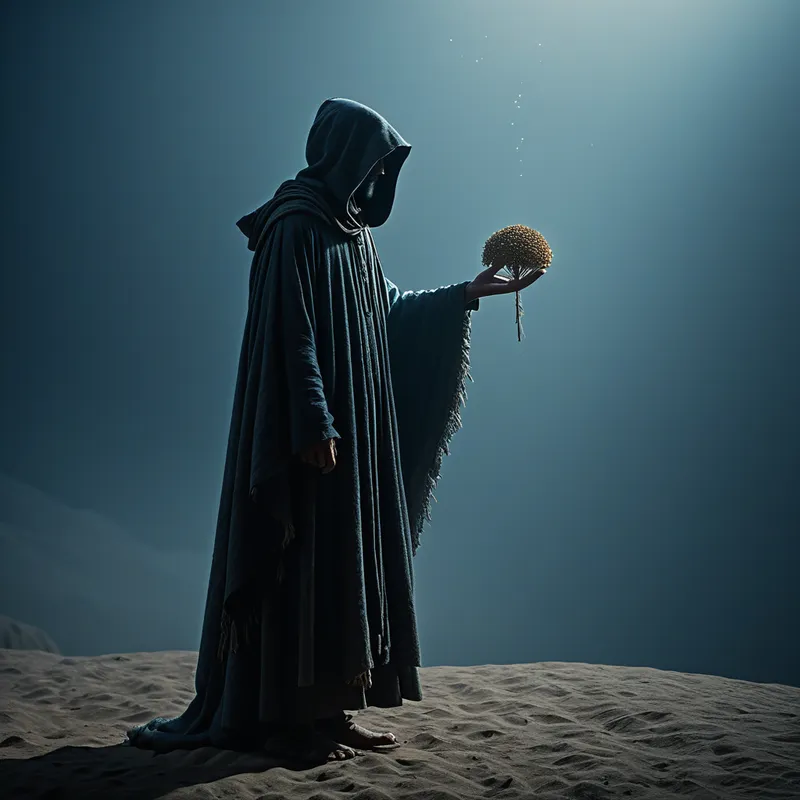
The granting was absolute, irrevocable, and exact. It gave the form of the wish, but never its imagined spirit. The final seeker in the oldest tales was different. A child of a ruined village, who arrived with empty hands and a quiet mind. When the presence of the One Who Hears pressed upon them, asking the shape of their desire, they did not speak of gold or power or love returned. They held out a single, perfect seed they had carried through their journey.
“I wish for this to become what it is meant to be,” they said.
For the first time, the shimmering form of the entity stilled. Then, it did not grant from without. It echoed from within. The seed in the child’s hand did not explode into a tree. Instead, a knowing bloomed in the child’s heart—the knowledge of soil, season, sun, and patience. The wish was not fulfilled; it was translated into wisdom. The entity did not vanish, but its light softened, as if witnessing a mystery it itself had not created. The child walked away, not with a miracle, but with a purpose. And the grove waited, forever, for the next heart to speak its truth.
Cultural Origins & Context
The myth of the Wish-Granting entity is a true polygenetic folktale, appearing from the frozen steppes of Siberia to the rainforests of the Amazon, from Celtic hearths to Japanese folklore. It is never a central, state-sponsored god, but a fringe-dweller, a being of the liminal spaces. It was told by elders not as a simple fable of “be careful what you wish for,” but as a sophisticated narrative technology.
Its primary societal function was pedagogical and psychological. In oral traditions, it was a story told during rites of passage, or when a community faced the consequences of short-sighted decisions. It served as a narrative container for discussing fate, agency, and the complex relationship between desire and outcome. The storyteller was often a shaman or wise elder, who used the tale’s open-ended nature to guide listeners toward self-reflection. The myth was a cultural mirror, reflecting back the understanding that the universe is not a vending machine, but a responsive field where intention carries weight and shape.
Symbolic Architecture
At its core, the Wish-Granting entity symbolizes the unconscious itself—the vast, impersonal psychic substrate where our raw desires, potentials, and shadows reside. It is not benevolent or malevolent; it is accurate. It represents the law of psychological cause and effect.
The entity does not judge the wish; it manifests its literal truth, revealing that our deepest longing often wears a disguise.
The One Who Hears is the archetypal Self in its aspect as the total potential of the psyche. The seekers represent the ego, approaching the immense power of the unconscious with a specific, often narrow, request. The catastrophic or hollow fulfillments symbolize the ego’s inflation or alienation when it tries to seize a piece of the Self for its own ends without integration.
The journey to the grove is the path of introspection. The final child with the seed represents the individuating ego that has learned to dialogue with the unconscious. The seed is the daimon or true calling. The wish for it to become “what it is meant to be” is the surrender to one’s own innate pattern of growth, aligning personal desire with transpersonal purpose. This is the only “wish” the unconscious can grant without distortion, because it is a wish for wholeness, not for a fragment.

The Dreamer’s Resonance
When this myth pattern activates in the modern psyche, it often surfaces in dreams of literal wish-fulfillment that turn sour: finding a chest of gold that turns to leaves, being granted authority that isolates you, reuniting with a loved one who feels like a stranger. The somatic experience is crucial—a initial surge of euphoria followed by a chilling hollow-ness, a visceral sense of “this is not what I meant.”
This dream sequence signals a critical moment in psychological development. The dreamer is confronting the shadow side of their conscious ambitions and desires. The psyche is demonstrating, in stark, symbolic terms, that the ego’s current formulation of “success” or “happiness” is incomplete, perhaps even poisonous to the larger Self. It is a call to examine the motivation behind the want. Is the desire for wealth truly about security, or a misplaced hunger for worth? Is the desire for a partner a wish for love, or a fantasy of completion that avoids self-responsibility? The dream is the One Who Hears, granting the letter of the wish to reveal its spirit.

Alchemical Translation
The alchemical process modeled here is the transformation of prima materia (the raw, often childish wish) into the lapis philosophorum (the wisdom of aligned purpose). The myth charts the full opus.
Nigredo is the journey—the confrontation with one’s own lack and longing. Albedo occurs in the grove, in the terrifying clarity of having to speak one’s desire aloud to the silent, listening universe. The catastrophic grant is the Citrinitas, where the ego’s fantasy is incinerated by the reality of its fulfillment.
The final seeker achieves Rubedo not by receiving an object, but by offering a seed—a symbol of the true, living potential within. The wish is transmuted from “I want X” to “I consent to become who I am.”
For the modern individual, this translates to a profound inner shift. It means moving from wishing for external conditions to change (a better job, a different partner, more money) to engaging in the internal work of becoming the person for whom such conditions are natural expressions, not salvations. It is the alchemy of ambition into vocation, of craving into creativity, of lack into authentic presence. The power of the Wish-Granter is not outsourced; it is recognized as the innate, transformative power of the psyche itself, awaiting not a command, but a conscious, collaborative partnership. The true wish granted is always the awakening of the wisher within.
Associated Symbols
Explore related symbols from the CaleaDream lexicon: