
Winter of the World Myth Meaning & Symbolism
A cosmic myth where the world enters a deep, sacred winter, holding the promise of renewal within a seed of ultimate sacrifice.
The Tale of Winter of the World
Listen. [The world](/myths/the-world “Myth from Tarot culture.”/) grows weary.
It is not a sudden [thing](/myths/thing “Myth from Norse culture.”/), but a slow sigh that begins in the bones of the mountains and the roots of the oldest trees. The sun, our golden father, begins his long journey away, his light growing thin and pale. The rivers, once singing with the stories of fish and stone, slow to a deep, contemplative murmur, then fall silent under a skin of clear, hard glass. [The wind](/myths/the-wind “Myth from Various culture.”/) no longer whispers through the grass; it now carries only the scent of cold stone and distant stars. This is the prelude to the Winter of the World.
In the time before this winter, the world was tended by the World-Tender, a being of slow thought and deep compassion, whose form was of living rock and flowing [water](/myths/water “Myth from Chinese culture.”/), whose breath was [the mist](/myths/the-mist “Myth from Celtic culture.”/) of dawn. The World-Tender walked the valleys and peaks, mending cracks in [the earth](/myths/the-earth “Myth from Hindu culture.”/), encouraging the sap to rise, and singing the stars to sleep each morning. But a great lassitude settled upon the Tender. The songs became heavy, the steps labored. The very essence of vitality was being drawn down, spent, like a lamp running out of oil.
The people saw this. They felt the growing silence. A council was called beneath the last great tree, whose leaves were turning to gold and falling not to the earth, but upward, vanishing into the grey sky. The wisest among them, a figure known only as the Listener-of-Roots, spoke with a voice like shifting gravel. “The Tender sleeps,” they said. “And in sleeping, invites the world to sleep with it. This is not an end, but a necessity. The world must dream to remember itself.”
But to dream, it must be made safe. The final fires of life and memory must be gathered and protected, lest they be scattered and lost in the long, cold dark. From every hearth, from every forge, from the last blooms of summer and the final exhalations of the great beasts, the people gathered the embers. They were not flames, but condensed essences: a shimmer of heat, a fragment of song, a memory of green.
The task fell to the Listener-of-Roots. Their journey was not across land, but into the heart of the growing stillness. They traveled to the Navel-of-the-World, a place that was not a mountain or a valley, but a profound quiet. There lay the World-Tender, now fully recumbent, a great range of a being covered in a delicate frost. In the Tender’s open, stony palm was a single, perfect seed, carved from obsidian and yet alive with a soft, [inner light](/myths/inner-light “Myth from Buddhist culture.”/).
The Listener approached, feeling their own breath crystalize in the air. They held out the gathered essence of the world’s fire—a swirling, mournful, beautiful light. They did not place it in the seed. Instead, with a gesture of ultimate surrender, they let it fall upon the sleeping form of the Tender itself. The essence sank into the stone, like water into parched earth, and for a moment, a network of golden veins glowed beneath the surface.
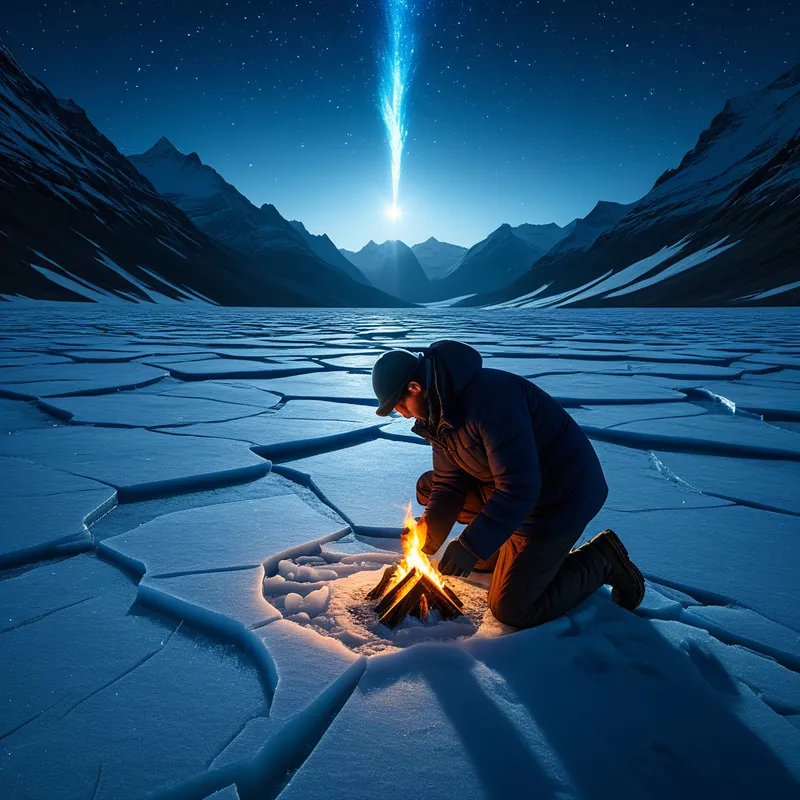
Then, the light faded. The final star winked out. The last sound—the Listener’s own heartbeat—was swallowed by the absolute quiet. The Winter had come. The World-Tender, nourished by the sacrifice of the world’s last warmth, curled protectively around the obsidian seed. The world was not dead. It was in a deep, sacred sleep, dreaming of all that was and all that could be, held in the eternal care of its slumbering guardian.
Cultural Origins & Context
The myth of the Winter of the World is not the property of a single tribe or nation, but a story that has emerged, in strikingly similar forms, from disparate cultures living in extreme northern and southern latitudes, and later, from philosophical traditions contemplating cosmic cycles. It is a story born from the direct, somatic experience of profound seasonal change—the palpable death of light and life for months on end—and elevated into a cosmological principle.
It was traditionally told not during the vibrant summer, but at the onset of the deepest cold, often around the winter solstice. The teller was not merely an entertainer but a keeper-of-the-threshold, often an elder or a shamanic figure. The telling was a ritual act, a way for the community to collectively acknowledge the harsh reality outside their walls and to participate, through narrative, in the sacred duty of preservation. Its societal function was one of profound reassurance and ethical instruction: it taught that dissolution is not annihilation, that conservation is an act of love, and that the community’s role is to steward the “embers” of culture, knowledge, and hope through the metaphorical winter.
Symbolic Architecture
At its core, the myth maps the necessary rhythms of any living [system](/symbols/system “Symbol: A system represents structure, organization, and interrelated components functioning together, often reflecting personal or social order.”/): expenditure must be followed by rest, [action](/symbols/action “Symbol: Action in dreams represents the drive for agency, motivation, and the ability to take control of situations in waking life.”/) by [incubation](/symbols/incubation “Symbol: A period of internal development, rest, or hidden growth before emergence, often associated with healing, creativity, or transformation.”/), [life](/symbols/life “Symbol: The symbol of ‘Life’ represents a journey of growth, interconnectedness, and existential meaning, encompassing both the joys and challenges that define human experience.”/) by a [period](/symbols/period “Symbol: Periods in dreams can symbolize cyclical patterns, renewal, and the associated emotions of loss or change throughout life.”/) of latent potential. The World-Tender represents the archetypal principle of nurturance pushed to its limit—the [Caregiver](/symbols/caregiver “Symbol: A spiritual or mythical figure representing nurturing, protection, and unconditional support, often embodying divine or archetypal parental energy.”/) who has given all it can and must, for the sake of all, fall into a restorative state. Its sleep is not [abandonment](/symbols/abandonment “Symbol: A dream symbol representing feelings of being left behind, isolated, or emotionally deserted, often tied to primal fears of separation and loss of support.”/), but a deeper, more concentrated form of holding.
The seed is not planted; it is held in stasis. The promise of life is not in growth, but in perfect, protected potential.
The Listener-of-Roots symbolizes the conscious ego that must confront the [reality](/symbols/reality “Symbol: Reality signifies the state of existence and perception, often reflecting one’s understanding of truth and life experiences.”/) of a necessary end. Their [journey](/symbols/journey “Symbol: A journey in dreams typically signifies adventure, growth, or a significant life transition.”/) is the ultimate act of letting go—not by destroying what remains, but by offering it back to the [source](/symbols/source “Symbol: The origin point of something, often representing beginnings, nourishment, or the fundamental cause behind phenomena.”/). The gathering of the “[embers](/symbols/embers “Symbol: Embers symbolize the remnants of transformation, signifying the potential for rebirth and the lingering presence of passion or unresolved issues.”/)” represents the psychological work of [integration](/symbols/integration “Symbol: The process of unifying disparate parts of the self or experience into a cohesive whole, often representing psychological wholeness or resolution of internal conflict.”/) at the end of a major life phase: gathering memories, lessons, and core identities before a period of inner transformation where the old self must dissolve. The [Winter](/symbols/winter “Symbol: Winter symbolizes a time of reflection, introspection, and dormancy, often representing challenges or a period of transformation.”/) of the World itself is the symbolic [landscape](/symbols/landscape “Symbol: Landscapes in dreams are powerful symbols representing the dreamer’s emotional state, personal journey, and the broader context of life situations.”/) of the unconscious in its quiescent, regenerative state.

The Dreamer’s Resonance
When this myth stirs in the modern [psyche](/myths/psyche “Myth from Greek culture.”/), it often manifests in dreams of profound stillness, quiet, and cold. One may dream of being in a vast, empty, beautifully desolate landscape—a frozen tundra, a silent, snow-blanketed city, or a house where all the clocks have stopped. There is no panic, only a deep, somber acceptance. The dreamer might find themselves carefully storing away precious objects in a vault of ice, or watching a loved one fall into a deep, enchanted sleep from which they cannot—and feel they should not—awaken them.
Somatically, this dream pattern correlates with periods of burnout, depression, or convalescence, but specifically of a kind that is recognized, at some level, as necessary. It is the psyche’s enactment of the wintering process. The feeling is not of hopelessness, but of a sacred pause. The psychological process is one of radical conservation of energy, withdrawal of projections, and a retreat into the core self. The dream is a message from the unconscious that it is time to stop doing and simply be, to allow the inner World-Tender to rest.

Alchemical Translation
The alchemical journey mirrored in this myth is the [Nigredo](/myths/nigredo “Myth from Alchemical culture.”/), not as a chaotic putrefaction, but as a deliberate, crystalline freezing. The process of psychic transmutation it models is the movement from exhausted nurturer to wise guardian of potential.
For the individual, the “world” that enters winter is often a cherished identity, a long-held career, or a foundational relationship—anything that has constituted one’s “vital landscape.” The onset of “winter” is the feeling of emptiness, meaninglessness, or emotional coldness that follows its end. The alchemical work is to consciously become both the Listener-of-Roots and the World-Tender.
One must first listen to the truth of the ending, gather the precious essences of what was learned and loved, and then consciously offer them up—not to an external god, but to the sleeping, deeper Self. This is the sacrifice of the ego’s attachments to the unconscious for safekeeping.
Then, one must endure the winter—the period of dormancy, depression, or fallow time. This is not passive waiting, but the active, if invisible, work of [the Self](/myths/the-self “Myth from Jungian culture.”/) reorganizing from the core. The obsidian seed—the new potential, the future self—is held in this dark, silent place. The promise of the myth is that this winter is not eternal. It is a phase in [the great work](/myths/the-great-work “Myth from Alchemical culture.”/). When the inner cycles turn, the Tender will stir, the seed will find its soil, and the dream of the world will become, once more, a living story. The individuated Self that emerges understands that care sometimes means holding the space for nothingness, so that true somethingness can be reborn.
Associated Symbols
Explore related symbols from the CaleaDream lexicon: