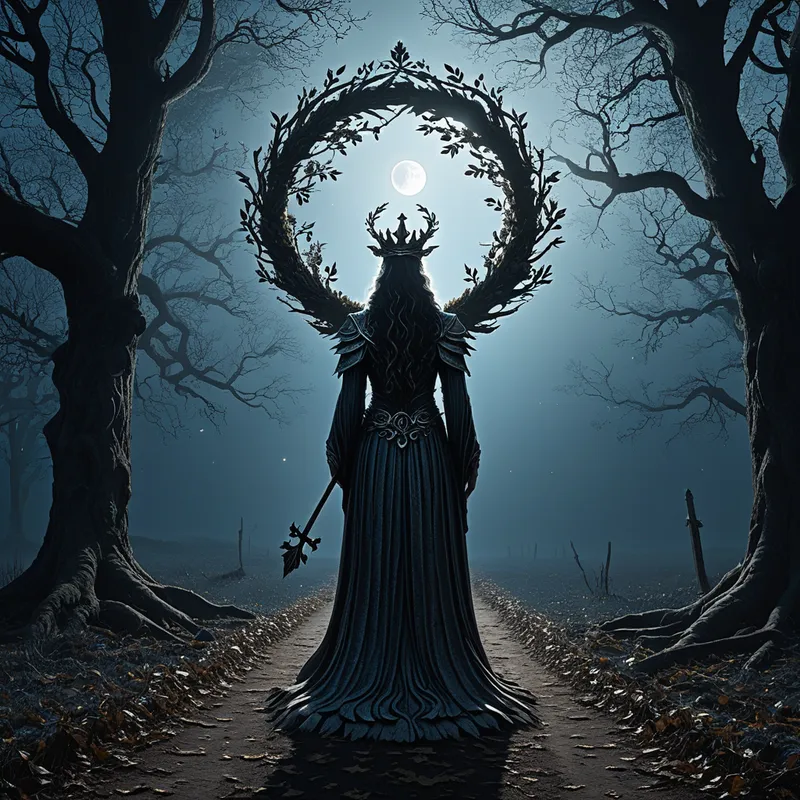
Widdershins Myth Meaning & Symbolism
A myth of the path against the sun, where the hero's forbidden journey through the underworld reveals the power of the unlit self.
The Tale of Widdershins
Hear now the tale not sung at noon, but whispered when the sun’s back is turned. In the first days, when the world was still wet from its making, all paths were laid down by the Great Wheel of the Sun. To follow its course—deosil—was to walk with life, with growth, with the expanding breath of creation. This was the Law.
But in the secret heart of things, where the roots of the Yggdrasil drink from waters no light can touch, there coiled another path. It was known as Widdershins. It was the way of the left hand, the track of the shadow, the spiral that turns inward against the great outward spin of the world.
The keeper of this path was not a devil, but a deity forgotten by the daylit hymns: Nyxal, the Weaver at the Loom’s Underside. While her sun-kindred wove tapestries of harvest and heroism, Nyxal worked the threads that were dropped, the colors that bled, the patterns that frayed. Her realm was the rich, black soil where fallen leaves become the forest anew.
Into this ordered world came a seeker named Kaelen. He was a child of the deosil way, yet he felt a hollowness in the constant celebration of light. He dreamed of roots, not branches. One twilight, driven by a longing he could not name, he stood at the sacred grove’s center and, with a heart pounding like a funeral drum, he turned. He placed his left foot first, and he walked against the sun.
The air grew thick and sweet with decay. The familiar birdsong ceased, replaced by the low hum of earthworms and the sigh of settling stones. The path descended, not into a pit of flames, but into a landscape of profound, velvety darkness where bioluminescent fungi were the stars, and silent, slow-moving rivers of clay were the roads. He met not monsters, but the shades of things unseen: the grief that was not mourned, the love that was not spoken, the rage that was swallowed. They were the court of Nyxal.
She awaited him at the spiral’s core, not on a throne, but seated upon a great, dormant seed. “You have broken the Law of the Sun,” she said, her voice like stone smoothing stone. “Why seek the unraveling?”
“To find what was woven out,” Kaelen replied, his own voice strange to him.
Nyxal smiled, a crack in the darkness. “Then you must dance with me. Not the dance of joining, but the dance of unmaking.” And she rose, and she began to move in a slow, deliberate spiral—widdershins. Kaelen mirrored her, each step a shedding. His pride, his name, his daylight history unraveled like thread from a spindle, leaving him bare, essential, a question without language.
In that naked core, he did not find death. He found the potential. The seed upon which Nyxal sat began to pulse with a deep, warm light. It was not the sun’s light, but the light that exists before the sun—the light of pure possibility. He had not gone to hell; he had gone to the womb of alternative becoming.
When he returned, climbing the spiral back to the world of sun, he was neither damned nor saintly. He was simply complete. The hollow in him was filled with the fertile dark. He walked now with the sun, but his shadow fell differently, knowing its own kingdom.
Cultural Origins & Context
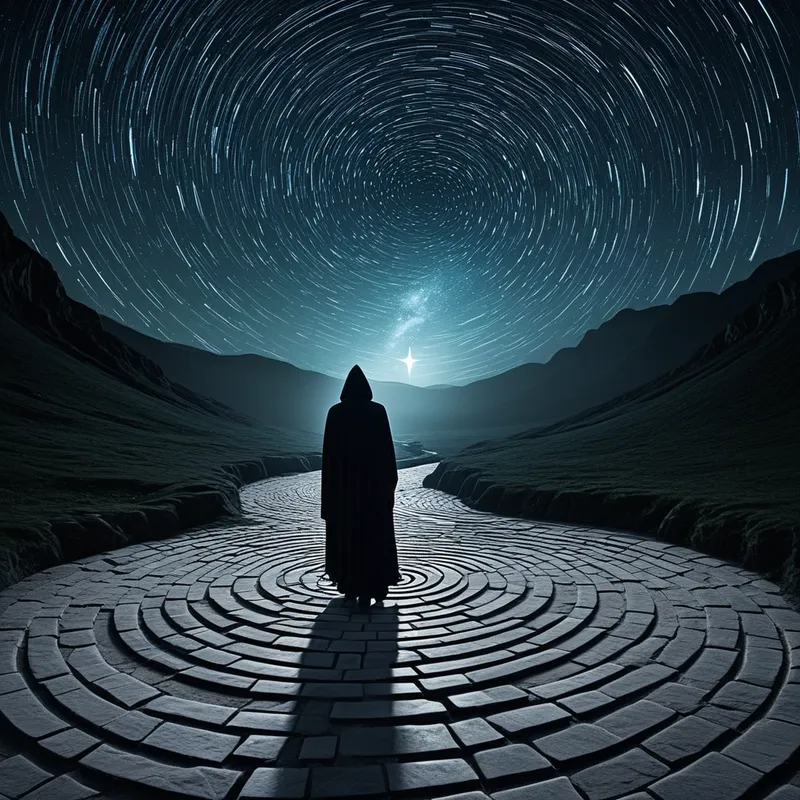
The concept of Widdershins is not the property of a single culture, but a persistent, shadow-side thread woven through the fabric of many European folk traditions. It appears in Scottish folklore, Germanic peasant custom, and Celtic ritual warnings. It was never the stuff of grand state epics, but of village wise-women, hedge-witches, and farmers who knew the land’s secrets. The myth was passed down not in parchment, but in prohibition: “Never circle a fairy ring widdershins.” “To walk around the church against the sun invites misfortune.” Its tellers were the elders who spoke in twilight, its function was one of primal boundary-setting.
This was a practical, metaphysical law. The sun’s path (deosil) was synonymous with blessing, growth, and reinforcing the community’s cosmic order. To move widdershins was to actively unravel that order. It was an invocation of the chthonic, a deliberate engagement with the forces of dissolution, decay, and the unconscious that underpin—and threaten—the conscious world. Societies that lived close to the land knew that for the field to bear grain, the old stalk must rot. The myth of Widdershins ritualized this dangerous, necessary truth.
Symbolic Architecture
At its core, Widdershins is the archetypal symbol of the necessary transgression. It represents the conscious choice to turn away from the collective, sanctioned path of consciousness (the solar ego) and to descend into the personal and collective unconscious.
The hero is not who climbs the sunlit mountain, but who dares to descend into their own unlit valley, for the summit of the mountain is built upon the depths of the valley.
The figure of Nyxal is not a temptress but a psychopomp of the depths. She is the personification of the anima/animus as it appears when one confronts the shadow—a guide who demands deconstruction. Her dance of unmaking is the symbolic process of ego-dissolution. The Kaelen figure is the nascent Self, the psychic totality, which cannot be formed while clinging solely to the persona crafted by the “sun’s law.” The dormant seed at the spiral’s core is the latent Self, the potential for rebirth that can only be activated after the old identity is composted in the dark.
The Dreamer’s Resonance
When the motif of Widdershins appears in modern dreams—walking backwards, a wheel spinning left, retracing steps in reverse—it signals a profound somatic and psychological process: the psyche’s imperative for regression in service of the ego. This is not regression to infantilism, but a strategic retreat.
The dreamer may be experiencing a feeling of stagnation, a “hollowness” in their daylight achievements, much like Kaelen. The dream is initiating a compensatory movement. To dream of moving widdershins is to feel the psyche beginning to de-integrate a too-rigid conscious attitude. It is the unconscious applying gentle, then insistent, pressure on the brakes of a life moving only “forward” by collective standards. Somatic sensations may accompany this: a feeling of grounding, heaviness, or a pull downward in the body, as if being drawn to sit with what has been buried. The dream is the first turn on the spiral path inward, preparing the dreamer for a confrontation with their own forgotten or rejected “threads.”
Alchemical Translation
The myth of Widdershins is a perfect allegory for the individuation process, specifically the nigredo stage. The conscious ego’s solar journey (deosil) is one of expansion and differentiation. But for wholeness, one must also undertake the counter-solar journey.
Individuation requires not just building the palace of the self, but willingly descending to survey its forgotten, flooded foundations.
The conscious decision to “walk widdershins” is the beginning of shadow-work. Kaelen’s dance of unmaking with Nyxal is the painful, liberating process of seeing through one’s own persona, acknowledging the grief, rage, and weakness one has disowned. This is the alchemical putrefactio, the dissolution of the old form in the dark prima materia of the soul.
The resolution is not in escaping the dark, but in the realization at the core: the seed of light-in-potential. This is the transition from nigredo to albedo (whitening), not by fleeing the dark, but by finding the illuminating spark within it. The return is the integration. The transformed individual does not reject the sunlit world but moves within it carrying the knowledge of the dark. They become a living crossroads, capable of true choice because they have met—and incorporated—the full spectrum of their own nature, deosil and widdershins alike. Their power is no longer borrowed from the collective sun, but generated from the completed circuit of their own being.
Associated Symbols
Explore related symbols from the CaleaDream lexicon: