Wicker Man Myth Meaning & Symbolism
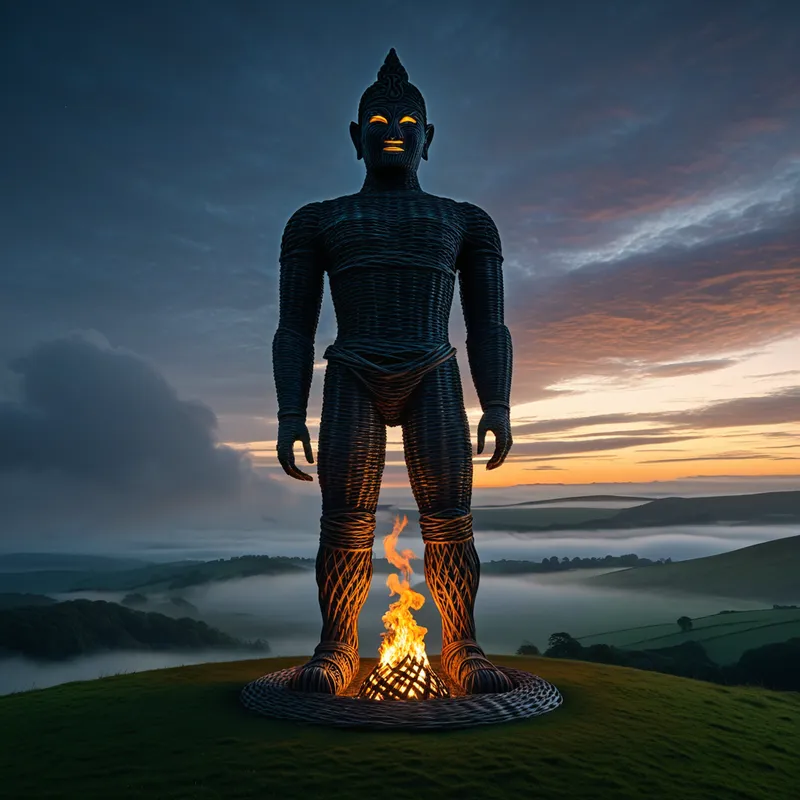
A colossal wicker effigy, filled with offerings, is set ablaze as a sacred sacrifice to ensure cosmic renewal and the tribe's survival.
The Tale of Wicker Man
Listen. [The wind](/myths/the-wind “Myth from Various culture.”/) does not just blow across the moor; it carries the memory of smoke. In the time when the oak was king and [the world](/myths/the-world “Myth from Tarot culture.”/) was woven from stories, there came the turning of the year when the sun hung low and weary. The life had fled from the fields, the cattle grew thin, and a deep cold settled in the bones of the people. The great wheel of [Samhain](/myths/samhain “Myth from Celtic culture.”/) was upon them, [the veil](/myths/the-veil “Myth from Various culture.”/) thin as mist.
The Druids, keepers of the old ways, read the signs in the flight of crows and the patterns of frost. The balance was broken. The tribe had taken from the land, and the land, in its silent majesty, demanded a reckoning. A debt was owed, a gift for a gift, to ensure the sun’s return and the green world’s rebirth.
And so they built him. Not from stone or wood, but from the supple, living willow, cut from the [sacred groves](/myths/sacred-groves “Myth from Celtic culture.”/). For days, the people worked, their breath fogging the chill air, their hands weaving a giant of wicker and withy. They shaped a colossal man, a hollow titan with a silent, staring face, its arms outstretched as if to embrace [the sky](/myths/the-sky “Myth from Persian culture.”/) or hold the very horizon. Into his vast, cavernous body they placed their offerings: sheaves of the last harvest, clay vessels of oil and mead, carvings of wood and bone. Some tales, whispered by firelight long after, speak of other, more terrible offerings—beasts, and in times of direst need, the condemned or the willing, given to the great hunger of the unseen world.
As the last light of the year bled from the sky, the tribe gathered on the high hill. Torches flickered like earthbound stars. The chief druid, clad in white robes, raised his hands to the darkening heavens, his voice a chant that was part plea, part command. He called upon the gods of the tribe, upon the Aos Sí, upon the forces that turn the seasons.
A torch was brought forward. The flame, a tiny, dancing [thing](/myths/thing “Myth from Norse culture.”/), was touched to the dry tinder at the giant’s feet. For a moment, nothing. Then a crackle, a sigh from the wicker lungs. A thread of orange light raced up a leg, then another. Fire bloomed in the hollow belly, consuming the gifts within. The giant began to glow from the inside out, a lattice of brilliant, terrible light against the deepening night. The heat washed over the people, a shocking warmth in the cold. Sparks flew upward, a thousand souls ascending to the black vault.
[The Wicker Man](/myths/the-wicker-man “Myth from Celtic culture.”/) burned. He burned not with the rage of destruction, but with the solemn purpose of transformation. He was a vessel, a doorway. All that was placed within him—the grain, the drink, the prayers, the life—was not destroyed, but translated. It became smoke and light, a fragrant, visible prayer rising to feed the slumbering sun, to appease the spirits of the land, to pay the debt.
They watched until the last ember died, until the giant was a silhouette of glowing ash that collapsed in upon itself with a soft roar. In that silence, heavy with the scent of burnt honey and willow, they felt it. Not a change they could see, but a shift in the fabric of things. The balance was restored. The contract was honored. The wheel could turn again. They walked back to their homes in the dark, knowing the sacrifice was complete, and that from this sacred ash, the new year would be born.
Cultural Origins & Context
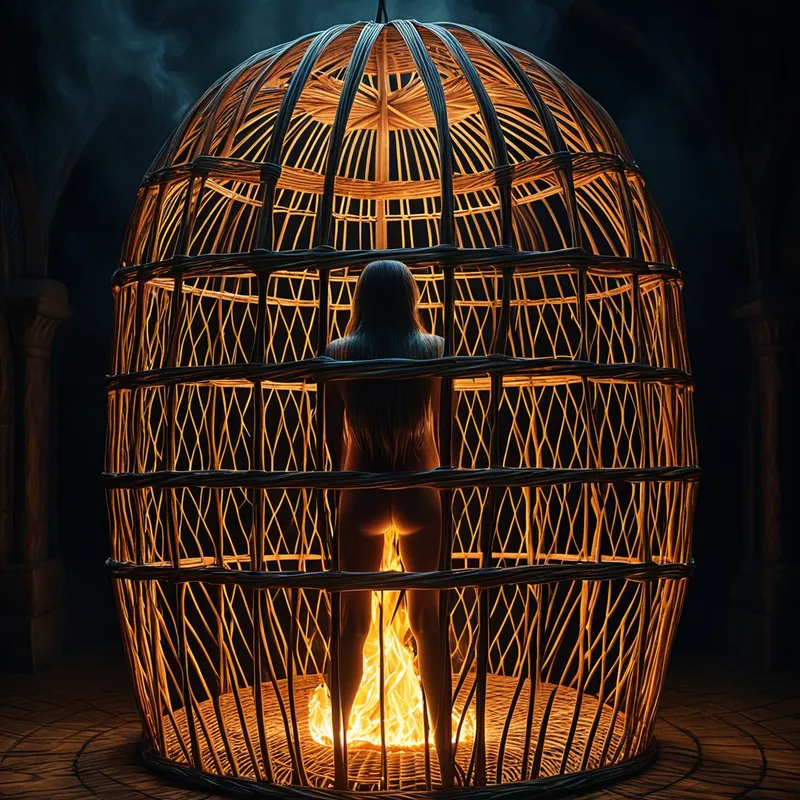
The figure we call the Wicker Man reaches us through a fractured lens, primarily from the pen of [Julius Caesar](/myths/julius-caesar “Myth from Roman culture.”/) in his Commentarii de Bello Gallico. Writing of the Gauls (Continental Celts), he describes a colossal effigy of woven wicker, its limbs filled with living men—criminals, prisoners of war, or others—which was then set ablaze as an offering to the gods. It is crucial to approach this not as a detached ethnographic fact, but as a Roman interpretation of a profound and likely terrifying ritual logic.
This was not mere brutality. In the Celtic worldview, the cosmos operated on a principle of sacred reciprocity. The community, the land, and [the Otherworld](/myths/the-otherworld “Myth from Celtic culture.”/) were in a constant, delicate exchange. Life was sustained by a cycle of giving and receiving. A failed harvest, plague, or impending war signaled a rupture in this contract. The ritual, likely occurring at a liminal time like Samhain, was an act of cosmic rebalancing. The Wicker Man served as a vessel and a messenger. It concentrated the community’s debt—its symbolic “life” in the form of offerings—into a single, potent form that could be transmuted by fire and delivered to the divine realm.
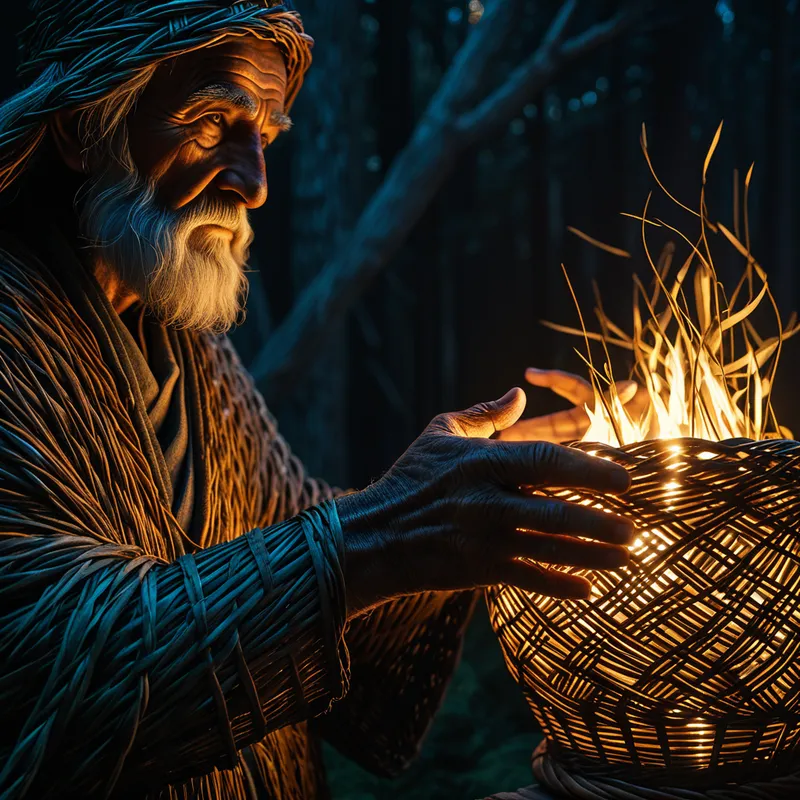
[The Druids](/myths/the-druids “Myth from Celtic culture.”/) were the architects of this terrifying symmetry. They were the intermediaries who could interpret the need for the rite and oversee its precise, solemn execution. The myth, therefore, was not just a story told but a ritual performed—a collective, somatic story where the entire tribe participated in the narrative of sacrifice and renewal. It was a myth enacted to ensure the continuation of the world itself.
Symbolic Architecture
At its core, the Wicker Man is an archetypal [symbol](/symbols/symbol “Symbol: A symbol can represent an idea, concept, or belief, serving as a powerful tool for communication and understanding.”/) of the [vessel](/symbols/vessel “Symbol: A container or structure that holds, transports, or protects something essential, representing the self, emotions, or life journey.”/) of transformation. It is not a god, but a [ritual](/symbols/ritual “Symbol: Rituals signify structured, meaningful actions carried out regularly, reflecting cultural beliefs and emotional needs.”/) technology—a man-made [structure](/symbols/structure “Symbol: Structure in dreams often symbolizes stability, organization, and the framework of one’s life, reflecting how one perceives their environment and personal life.”/) that becomes sacred through its [purpose](/symbols/purpose “Symbol: Purpose signifies direction, meaning, and intention in life, often reflecting personal ambitions and core values.”/).
The true sacrifice is not the destruction of a thing, but its change of state; from solid to smoke, from individual life to communal continuity, from earthly burden to ethereal gift.
Its wicker [construction](/symbols/construction “Symbol: Construction symbolizes creation, building, and the process of change, often reflecting personal growth and the need to build a solid foundation.”/) is key. Woven, it is strong yet full of holes; it contains yet it breathes. It represents the interconnectedness of the [community](/symbols/community “Symbol: Community in dreams symbolizes connection, support, and the need for belonging.”/) (each strand reliant on another) and the permeable [boundary](/symbols/boundary “Symbol: A conceptual or physical limit defining separation, protection, or identity between entities, spaces, or states of being.”/) between this world and the next. The fire is the alchemical agent. It does not merely destroy the contents; it liberates their essence, turning matter into [energy](/symbols/energy “Symbol: Energy symbolizes vitality, motivation, and the drive that fuels actions and ambitions.”/), offering into [prayer](/symbols/prayer “Symbol: Prayer represents communication with the divine or a higher power, often reflecting inner desires and spiritual needs.”/), [death](/symbols/death “Symbol: Symbolizes transformation, endings, and new beginnings; often associated with fear of the unknown.”/) into fertile ash for the future.
Psychologically, the myth maps the necessary [dissolution](/symbols/dissolution “Symbol: The process of breaking down, dispersing, or losing form, often representing transformation, release, or the end of a state of being.”/) of a rigid, outworn structure of [the self](/myths/the-self “Myth from Jungian culture.”/) or society. The “giant” is the old [identity](/symbols/identity “Symbol: Identity represents the sense of self, encompassing personal beliefs, cultural background, and social roles.”/), the accumulated debts, the stuck patterns, and the unintegrated shadows (represented by the condemned within). To avoid total psychic [famine](/symbols/famine “Symbol: A profound lack or scarcity, often of food, representing deprivation, survival anxiety, and systemic collapse.”/)—stagnation, depression, meaninglessness—this complex must be consciously offered up to a transformative fire. It is a ritual of release, where one must place parts of oneself into the symbolic wicker frame and let them burn, not knowing what, if anything, will remain.
The Dreamer’s Resonance
When this myth stirs in the modern unconscious, it rarely appears as a literal giant of wicker. Its pattern manifests in dreams of profound, necessary endings. One may dream of their house—the symbol of the self—being consumed in a controlled, almost ceremonial fire. They might stand inside it, watching walls burn but feeling no heat, only a profound release. Another may dream of burning old journals, photographs, or heirlooms, not in anger, but in a solemn ritual.
The somatic experience is key: a feeling of being hollowed out or filled with a burning light. There is often a deep anxiety leading up to the dream-image—the “cold of the tribe,” a sense of impending psychic winter. The burning itself, in the dream, brings not terror, but awe and a subsequent profound calm. This is the [psyche](/myths/psyche “Myth from Greek culture.”/) enacting its own Samhain. It is identifying what must be “given back” or released—an outdated ambition, a cherished grievance, a self-image that no longer serves—and subjecting it to the purifying flame of conscious attention. The dream is the inner Druid orchestrating a sacrifice for renewal.
Alchemical Translation
The journey of the Wicker Man is a master metaphor for the alchemical stage of calcinatio—reduction by fire. In the process of individuation, [the ego](/myths/the-ego “Myth from Jungian culture.”/) must encounter its own necessary sacrifices.
Individuation demands a Wicker Man. We must construct, with conscious intent, the form of what needs to die, fill it with all we cling to, and have the courage to light the match.
First, we must weave the form. This is the difficult, conscious work of identifying the complex—the “giant” pattern (e.g., chronic people-pleasing, toxic productivity) that looms over our inner landscape. We give it shape and name. Next, we make the offerings. We gather into this form all its manifestations: the memories, the behaviors, the emotions, the payoffs. We acknowledge the debt this pattern has incurred in our psychic ecology.
Then comes the sacrificial fire. This is not suppression or violent destruction, but the focused, sacred application of consciousness—the fire of honest self-reflection, therapeutic work, or a disciplined letting-go. We witness the burning. We allow the structure to collapse. This is the death of an old self, the [nigredo](/myths/nigredo “Myth from Alchemical culture.”/).
The final, and most crucial, stage is often forgotten: tending the ashes. The ritual does not end with the blaze. The cooled ash of the Wicker Man was likely gathered and scattered on fields as potent fertilizer. Psychologically, we must gather the insights, the released energy, the clarity born from the fire. This ash is the substance of the new. It holds the nutrients for the next phase of growth, the wisdom earned through the sacrifice. From this sacred, fertile ground, the soul’s new year—the albedo—can truly begin. We burn not to become nothing, but to become something else: transformed, lighter, and in right relationship with the depths of our own being.
Associated Symbols
Explore related symbols from the CaleaDream lexicon: