Whirlwind Woman Myth Meaning & Symbolism
A mythic figure of chaos and creation, Whirlwind Woman embodies the terrifying, necessary force that scatters the old to make way for the new.
The Tale of Whirlwind Woman
In the time before memory, when the world was young and the people were new upon it, there was a great stillness. The sun beat down upon the high plains, and the earth grew hard and thirsty. The rivers shrank to whispers, the grass browned and bowed, and in the villages, a silence fell—a silence not of peace, but of waiting. The people moved slowly, their prayers for rain rising like dust and falling back to the ground, unanswered.
Then, from the farthest edge of the horizon, a sound began. It was not the rumble of thunder, but a low, persistent hum, the sound of the earth itself sighing. A speck appeared, a blur against the shimmering heat. It grew, and with it grew the sound, becoming a roar, a shriek of moving air. It was the Whirlwind Woman.
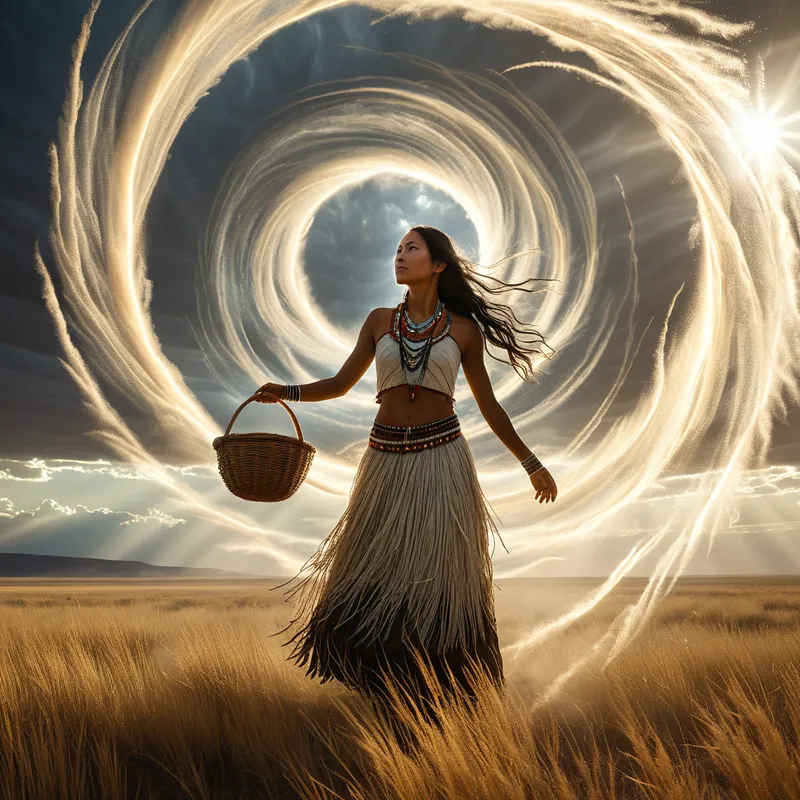
She did not walk; she danced. She was a column of furious motion, taller than the tallest pine, her body a spiraling tapestry of dust, dried leaves, and stolen light. Where her feet touched—though she had no feet, only a point of terrible contact—the earth was scoured clean. Rocks tumbled, bushes were ripped from their roots, and the careful order of the world was thrown into chaos. The people fled to their lodges, clutching their children, their hearts pounding a rhythm of pure terror. She was destruction incarnate, the end of all things settled and safe.
Through the villages she whirled, a deity of pure disorder. Storage racks shattered, drying meat was flung to the four directions, tools were scattered like seeds. She seemed mindless in her fury, a force of absolute negation. But as she spun through the last encampment, her eye—a flash of lightning in the dust—fell upon a single object. It was a simple, beautifully woven basket, sitting outside a lodge, empty.
In that moment, the roaring changed pitch. The chaotic spiral tightened, focused. The Whirlwind Woman reached down with a hand of gust and current, and she did not destroy the basket. She lifted it. And into this vessel, she began to pour not debris, but essence. She swept the last, precious seeds from the crushed grass into its bowl. She caught the fleeing sparks from a scattered fire. She gathered the very scent of the rain that had not yet fallen, and the memory of the green that had once been. The basket glowed, a humble vessel now holding a miniature cosmos of potential.
Then, as swiftly as she had come, she was gone. The roar faded to a murmur, then to silence. The people emerged, not to ruin, but to a strange, blank slate. The ground was leveled. The old, worn paths were gone. The air was clear and sharp. And in the center of the swept-earth clearing sat the basket, pulsing with a gentle, inner light.
From it, the first new shoots found their way. The scattered seeds, now blessed by chaos, took root in the freshly turned soil. The people, their old patterns erased, began to build anew, their eyes clearer, their purpose refined by the storm. They understood then that the Whirlwind Woman was not a mindless destroyer. She was the great sweeper, the necessary chaos that makes creation possible. She had not come to end their world, but to renew it.

Cultural Origins & Context
The myth of Whirlwind Woman finds its roots among various Plains and Southwestern tribal nations, including the Navajo (Diné), Pueblo, and Apache peoples. It is a story belonging to the oral tradition, passed down not in written texts but in the spoken word, often during the long nights of winter or in the teaching moments between elder and child. The storyteller was not merely an entertainer but a keeper of ecological and psychological wisdom, using the narrative to encode vital lessons about the environment and the human spirit.
Societally, this myth functioned as a profound explanatory and stabilizing narrative. In cultures deeply attuned to the cycles of drought and renewal on the arid plains, the whirlwind (or dust devil) was a common, powerful, and ambivalent phenomenon. It could destroy a camp in minutes, yet it also stirred the air, redistributed seeds, and signaled atmospheric change. The myth personified this force, giving it intention and, ultimately, a benevolent purpose. It taught that not all suffering is meaningless punishment; some chaos is a sacred, if terrifying, cleansing. It provided a framework for enduring hardship, assuring the community that dissolution could be the precursor to a more vibrant reorganization.
Symbolic Architecture
At its core, the myth presents chaos not as an enemy to be defeated, but as a divine, feminine actor in the cosmic order. Whirlwind Woman symbolizes the uncontrollable, eruptive force of life itself that periodically dismantles stagnant structures. She is the embodiment of the shadow of nature and psyche—feared, powerful, and utterly essential.
The basket is not spared in spite of the whirlwind, but because of it. It is the meeting point of chaos and vessel, where meaningless destruction becomes purposeful gathering.
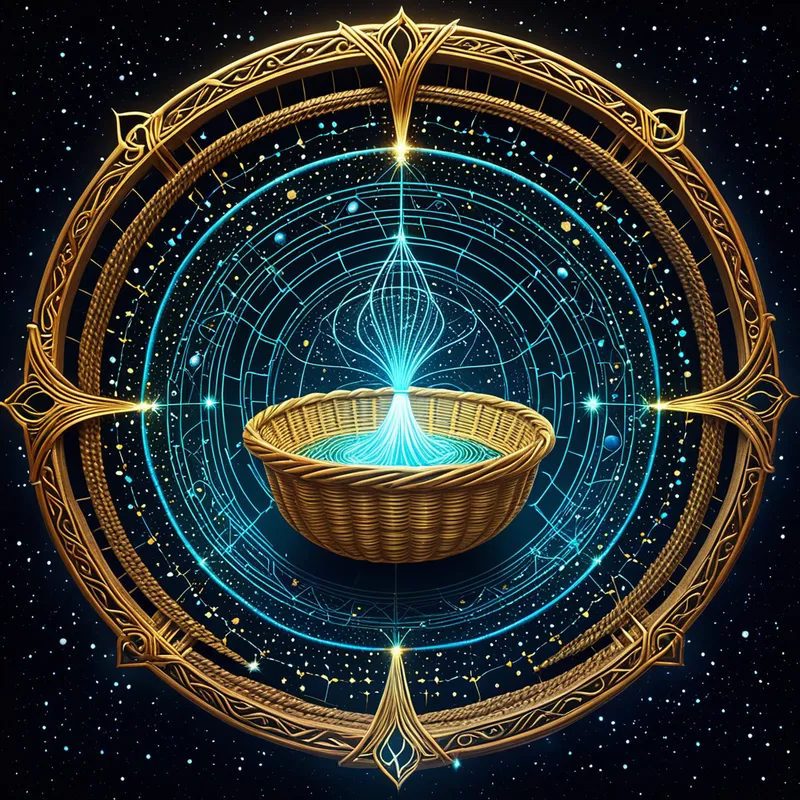
The basket is the pivotal symbol. It represents the prepared, receptive vessel of culture, tradition, or the individual ego-structure. Left alone, it sits empty. Only through the encounter with the chaotic, scattering force is it filled with the concentrated “seeds” of new life. The whirlwind does not create the seeds; it liberates them from their hiding places in the old, dead grass and delivers them to where they can grow. This is a profound metaphor for the psyche: our existing identity (the village) must sometimes be utterly disrupted for our latent potentials (the seeds) to be discovered and planted in fertile ground.
The Dreamer’s Resonance
When this mythic pattern stirs in the modern dreamer, it often manifests as dreams of terrifying, uncontrollable winds, tornadoes, or the sudden, complete dissolution of one’s home or familiar surroundings. The somatic experience upon waking is frequently one of anxiety, a racing heart, a feeling of being utterly uprooted.
Psychologically, this signals a profound process underway in the unconscious. The ego’s carefully constructed “village”—its career identity, relationship patterns, core beliefs, or self-narrative—is being targeted by a psychic force that seeks not its annihilation, but its necessary deconstruction. The dreamer is experiencing an encounter with their own inner Whirlwind Woman, the archetypal force of transformation that operates beyond the realm of conscious control or comfort. The fear is real, for the process is destructive to the current order of things. The dream asks: What in your life feels like it is being violently scoured away? And what empty, receptive “basket” do you have that might receive what is being gathered from the wreckage?
Alchemical Translation
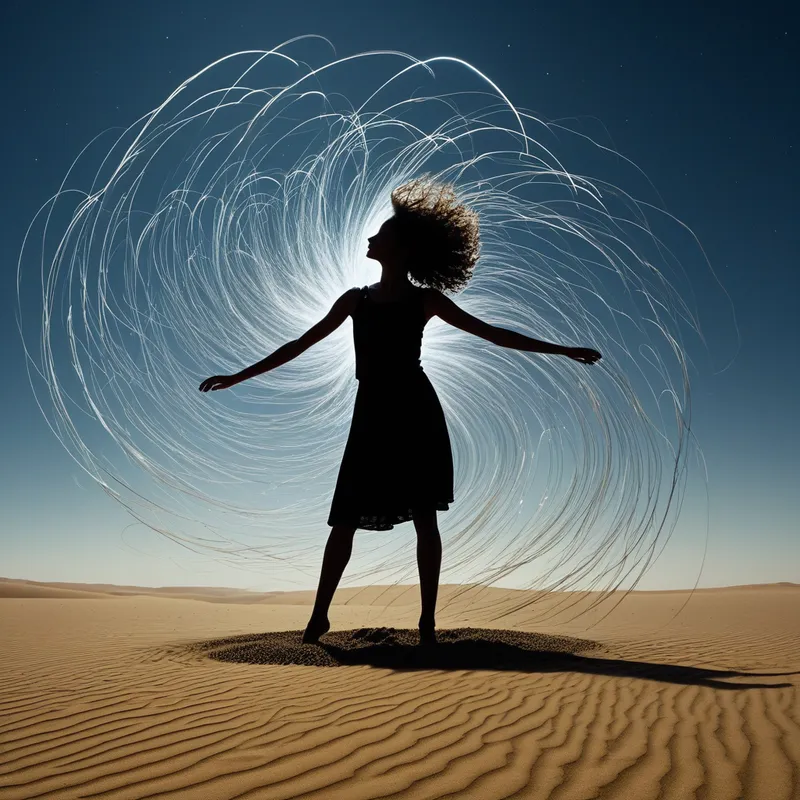
The journey of Whirlwind Woman is a perfect map for the alchemical stage of solutio followed by coagulatio. In the individuation process, we must all face our whirlwind—the emotional storms, life crises, depressions, or breakthroughs that dissolve our hardened, outmoded ways of being.
Individuation is not about building a stronger fortress against the storm, but learning to weave a basket capable of receiving the storm’s gift.
The modern individual often spends immense energy fortifying the “village” of the persona, resisting any chaotic influence. The myth instructs otherwise. The goal is not to stop the whirlwind—an impossible task—but to develop the basket: a conscious, receptive attitude. This is the vessel of the observing Self, the part of us that can witness the chaos without fully identifying with the destruction. The alchemical work is to hold that vessel steady in the storm, to trust that the scattering is meaningful, and to await the new seeds that will be deposited. The triumph is not in survival alone, but in the renewal that follows. We are reborn not from avoidance of chaos, but from a sacred collaboration with it, allowing the fierce, feminine spirit of change to clear the ground so a more authentic life can take root.
Associated Symbols
Explore related symbols from the CaleaDream lexicon: