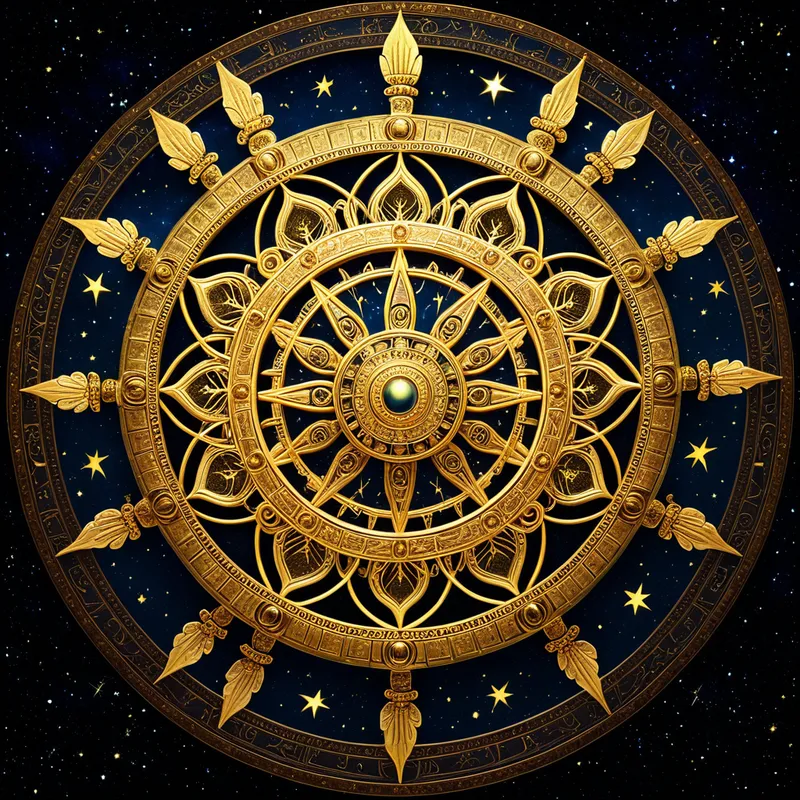
Wheel of Samsara Myth Meaning & Symbolism
The cosmic cycle of birth, death, and rebirth, driven by desire and karma, from which the soul seeks final liberation, or moksha.
The Tale of the Wheel of Samsara
Listen. Before the first word was spoken, before the first mountain rose from the primal waters, the Wheel was already turning. It spins not in the sky you see, but in the very marrow of existence, a great, groaning axis of time and tears, of laughter and loss. Its hub is the silent, watchful eye of Brahman. Its rim is the hard, unyielding boundary of all that is, was, and ever could be. And between them, along six terrible and beautiful spokes, the countless souls are carried.
They call it Samsara. To be caught in it is to know the perfume of a monsoon blossom and the stench of a funeral pyre in the same breath. It is to be a king upon a jeweled throne one lifetime, and a dog lapping at gutter-water the next. The force that spins the Wheel is Karma, an iron law written not on stone, but on the subtle body of the soul itself. Every deed, every desire, every whispered thought is a push upon the rim, setting the great disc in motion for another turn.
And who holds this dreadful, beautiful engine? It is Vishnu, or sometimes the fierce, dancing Shiva, in whose hair the cosmos burns and is reborn. But in the stories told by sages in forest clearings, it is often Yama, the stern king, who presides. His messengers, with eyes of fire, escort the newly dead. They travel a wind that smells of sandalwood and ashes, arriving at the hall of mirrors where every action of a life is reflected back without mercy or malice. Here, the account is tallied. The soul, weighed by its own deeds, is then cast back into the Wheel. It is drawn, like iron to a lodestone, to a new womb—a palace, a hovel, an animal’s den—that perfectly matches the density of its accumulated longings.
The Wheel knows no beginning. Its story is not one of a hero’s birth, but of a seeker’s awakening. It is the tale of a prince, Siddhartha, who looked beyond his palace walls and saw the Wheel’s three marks: old age, sickness, death. It is the tale of the warrior Arjuna, on a battlefield that was the Wheel made manifest, who despaired at the turning, until the voice of Krishna cut through the din: “You grieve for those who should not be grieved for. The wise do not mourn for the living or the dead.” The resolution is not an event, but a possibility whispered at the very center of the spin: Moksha. The shattering of the Wheel itself.
Cultural Origins & Context
The concept of Samsara is not a single myth with a fixed narrative, but a foundational metaphysical framework that permeates Vedic and post-Vedic thought. Its earliest seeds are found in the Upanishads, composed between 800 and 200 BCE, where sages engaged in profound dialogues about the nature of the self (Atman) and its relation to the cosmic whole. Here, the idea of repeated death and rebirth (punarmrityu) evolved into the full-blown doctrine of Samsara, intricately tied to the law of Karma.
This was not merely priestly philosophy; it was a societal and psychological engine. Passed down through guru-disciple lineages, epic poetry like the Mahabharata and Ramayana, and later through Puranic stories and devotional (bhakti) traditions, the Wheel provided a comprehensive explanation for life’s inequalities, sufferings, and joys. It offered both justice—one’s station is earned, not arbitrary—and immense hope: no condition, however exalted or wretched, is permanent. Its primary function was ethical and liberative, providing the “why” behind the prescribed duties (dharma) of caste and stage of life, all oriented toward the ultimate goal of stopping the Wheel.
Symbolic Architecture
The Wheel is the ultimate symbol of conditioned existence. Its circularity represents eternity without transcendence, a perfect system of cause and effect that is utterly inescapable by its own logic. The six spokes traditionally correspond to the six realms of possible rebirth: the divine (devas), the jealous (asuras), the human, the animal, the hungry ghosts (pretas), and the hell beings. These are not just physical places but psychological states.
The human realm is considered the most precious, not because it is the most pleasurable, but because it is the only one where the consciousness of the Wheel and the leverage to escape it are simultaneously present.
Karma is the physics of this universe. It is not fate, but an impeccable, impersonal accounting. Desire (trishna) is the fuel. Every action born of desire—even for heaven—weaves another thread in the binding net. The hub, the still point, symbolizes the transcendent Self (Atman) that is never touched by the turning, the witness consciousness. Liberation (Moksha) is the realization that one is the silent hub, not the spinning rim.
The Dreamer’s Resonance
When the Wheel of Samsara appears in modern dreams, it rarely manifests as a literal, mythological image. Instead, the dreamer experiences its pattern. This is the dream of the endless, monotonous commute where the roads keep changing but never lead home. It is the recurrent dream of being unprepared for a final exam for a class you never attended, life after life. It is the somatic sensation of running with immense effort on a treadmill that accelerates with your panic.
Psychologically, these dreams signal a profound encounter with what Jung called the psychic archetype of repetition-compulsion. The dreamer is stuck in a karmic loop of their own psyche, re-enacting core wounds, addictive behaviors, or relational patterns. The dream is the unconscious making the pattern visible, saying, “Look at this engine you are powering with your unseen desires and unresolved actions.” It is a call to self-observation, to become the witness of one’s own internal Wheel.

Alchemical Translation
The alchemical work modeled by the myth of Samsara is the ultimate individuation process: dis-identifying from the contents of the psyche to realize the Self that contains them. The modern seeker’s “karma” is their personal and ancestral history, their neuroses, and their compulsive identities—the “software” running their life.
The first translation is Awareness. One must map their personal wheel. What are the recurring themes, the triggers, the self-sabotaging loops? This is the practice of self-observation without judgment, akin to Yama’s record-keeping.
The second is Non-Attachment. This is not cold detachment, but the conscious relating to desires and outcomes without being defined by them. It is performing one’s duty (dharma) with excellence while relinquishing a stranglehold on the results. This slowly drains the fuel from the Wheel’s engine.
The goal is not to stop experiencing life, but to stop being processed by it. To move from being a passenger on the rim to abiding as the awareness at the center.
The final translation is Integration and Transcendence. The liberated being (jivanmukta) does not vanish. They continue to act in the world, but the Wheel no longer has a grip on them. Their actions arise from a place of wholeness, not lack. The alchemy is complete: the lead of compulsive, karmic existence is transmuted into the gold of conscious, liberated being. The Wheel spins on, but for them, its terrible music has become the silent hum of the absolute.
Associated Symbols
Explore related symbols from the CaleaDream lexicon: