Web of Wyrd Myth Meaning & Symbolism
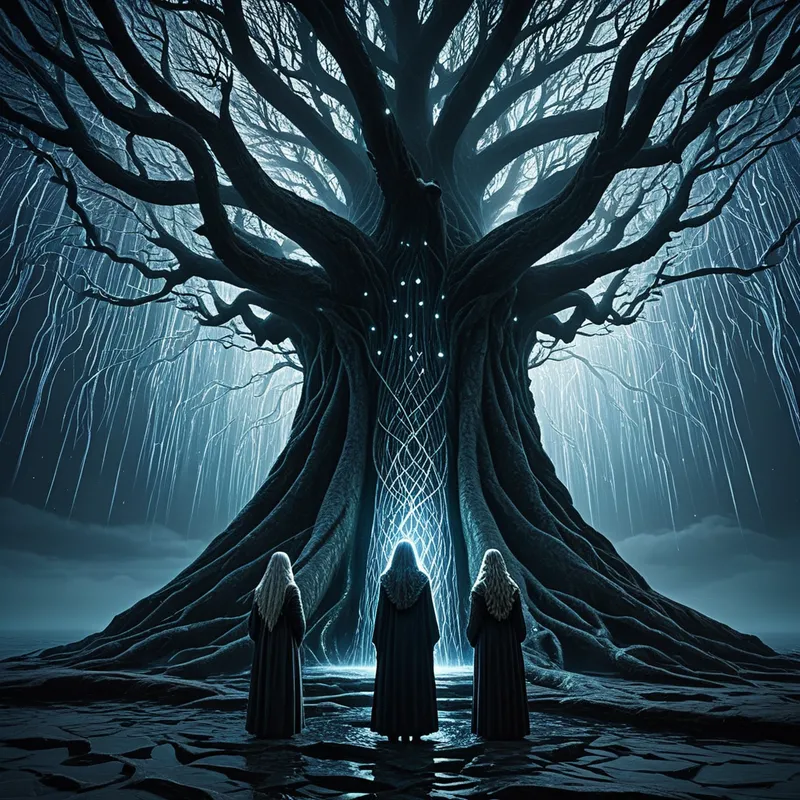
The cosmic tapestry woven by the Norns at the Well of Urd, connecting all past, present, and future events in an inescapable, shimmering pattern of fate.
The Tale of Web of Wyrd
Listen, and let your mind travel to the roots of the world. Not to the sunlit branches, nor the bustling realms of gods and men, but down, deep into the cold, silent dark where the great tree Yggdrasil drinks from waters older than memory. Here, at the Well of Urd, the air is thick with the scent of damp earth and ancient stone. The only light comes from the well itself, a liquid darkness that holds the shimmer of countless stars, a mirror to all that was and will be.
Here, three figures are forever at work. They are the Norns. Urd, whose name means “That Which Has Become,” her face a map of deep lines, remembering every fallen leaf, every uttered word. Verdandi, “That Which Is Becoming,” her gaze fixed on the swirling now, her hands never still. Skuld, “That Which Shall Be,” her eyes veiled, holding the shears that wait at the end of all things.
They do not speak. The only sounds are the drip of water from the well and the soft, relentless whisper of thread drawn from the void itself. Urd draws the thread from the well’s depths, a strand glistening with the moisture of memory. Verdandi takes it, her fingers measuring its tension, its place in the growing pattern. Skuld holds the length taut, her unseen eyes judging where the pattern must turn, or where it must be cut.
And what a pattern it is! It is not a flat cloth, but a living, breathing web that stretches from the roots through the trunk and into every branch of Yggdrasil. Its threads are the paths of gods—the gleam of Thor’s hammer, the cunning gleam in Loki’s eye. They are the lifelines of every man and woman, the flight of a sparrow, the growth of a blade of grass. Each event, each choice, each breath is a knot where threads cross. A shout in a hall echoes as a vibration here. A hero’s fall is a sudden, darkening pull on the weave.
The Norns work without pity and without malice. They are the weavers. The pattern is all. It is the Wyrd—the inescapable becoming of the cosmos. To look into the well is to see not a single future, but the immense, terrifying, and beautiful tapestry of all possible futures, all pasts, all presents, inextricably linked. It is the story of the world, written in threads of light and shadow, and it is being written still, with every pull of the spindle, every pass of the hand, at the silent well beneath the world.
Cultural Origins & Context
The concept of Wyrd is a cornerstone of the Norse worldview, far more profound than simple predestination. It emerges from a culture intimately acquainted with harsh climates, unforgiving seas, and the stark realities of life and death. In such a world, the idea that events were woven into a greater pattern provided both a terrifying sense of inevitability and a strange comfort—a framework that made the chaos of existence intelligible.
Our primary sources are the Poetic Edda and the Prose Edda. In the poem Völuspá (The Prophecy of the Seeress), the völva describes the Norns drawing water from the well to water Yggdrasil, an act that maintains cosmic order. While the exact phrase “Web of Wyrd” is a modern poetic encapsulation, the imagery of weaving fate is explicit. The Norns are called “those who shaped the laws of life,” and their craft is described in terms of carving runes on wood and, crucially, laying ørlög (primal layers or laws), the fundamental decrees of destiny.
This myth was not mere entertainment. It was a functional cosmology. It explained why the bravest warrior could fall to a stray arrow (his thread was cut), and why the gods themselves, for all their power, marched toward their doom at Ragnarök. The Web placed every being, from the highest Æsir to the lowest creature, within a single, interconnected system. It was a narrative tool for accepting hardship and understanding one’s role in a vast, impersonal, yet beautifully ordered universe.
Symbolic Architecture
The Web of Wyrd is perhaps the ultimate symbol of interconnectedness. It represents the universe not as a collection of separate objects, but as a dynamic network of relationships and events. Each thread is a life-path or an event-line, and each knot is a moment of decision, consequence, or confluence.
The Web does not dictate a single path; it displays the infinite relationships between all paths. To be woven in is to be given context, not a cage.
Psychologically, the three Norns model the structure of time and consciousness. Urd (Past) is the accumulated weight of memory, trauma, and heritage—the personal and collective unconscious that shapes us. Verdandi (Present) is the conscious ego, the “I” that acts and chooses within the moment, feeling the tension of the threads it holds. Skuld (Future) is the archetypal Shadow and the Self combined; it is the debt (skuld means “debt” or “guilt”) owed to our own potential, the unmanifested possibilities that both call to us and threaten the current order of our psyche. The shears represent the necessary endings, the sacrifices of old identities required for growth.
The web itself, often associated with the Valknut, symbolizes the paradoxical nature of fate: it is fixed in its overall pattern (the ørlög), yet fluid in its momentary expressions (our choices within the pattern). We are both the weaver and the thread, the artist and the medium, bound within a masterpiece we can never fully see.
The Dreamer’s Resonance
When the Web of Wyrd appears in modern dreams, it rarely manifests as a literal net. Instead, one might dream of impossibly complex networks—neural pathways merging with city maps, family trees made of light, or a sense of being physically connected by invisible strings to people and events far away. These are dreams of profound context.
Such a dream often surfaces during life transitions: a career change, the end of a relationship, a spiritual awakening. Psychologically, it signals the dreamer’s psyche grappling with the weight of interconnection. The somatic feeling is often one of being tugged—a pull from the past (Urd) in the form of old patterns resurfacing, a tension in the present (Verdandi) from current obligations, and a magnetic draw toward a frightening but compelling future possibility (Skuld). The dream is the unconscious mind’s way of saying, “You are not an isolated event. Your choices ripple, and the ripples of the world reach you.” It can feel claustrophobic (the net as trap) or awe-inspiring (the net as cosmic belonging), depending on the dreamer’s readiness to accept their embeddedness in a larger whole.
Alchemical Translation
The alchemical process mirrored in the Web of Wyrd is the stage of Coagulatio—the making solid, the revelation of pattern. In the journey of individuation, we begin in the Nigredo, the chaotic, unformed darkness of the well’s waters—our unexamined life. The work of the Norns is the work of the psyche itself, drawing this chaos into coherent form.
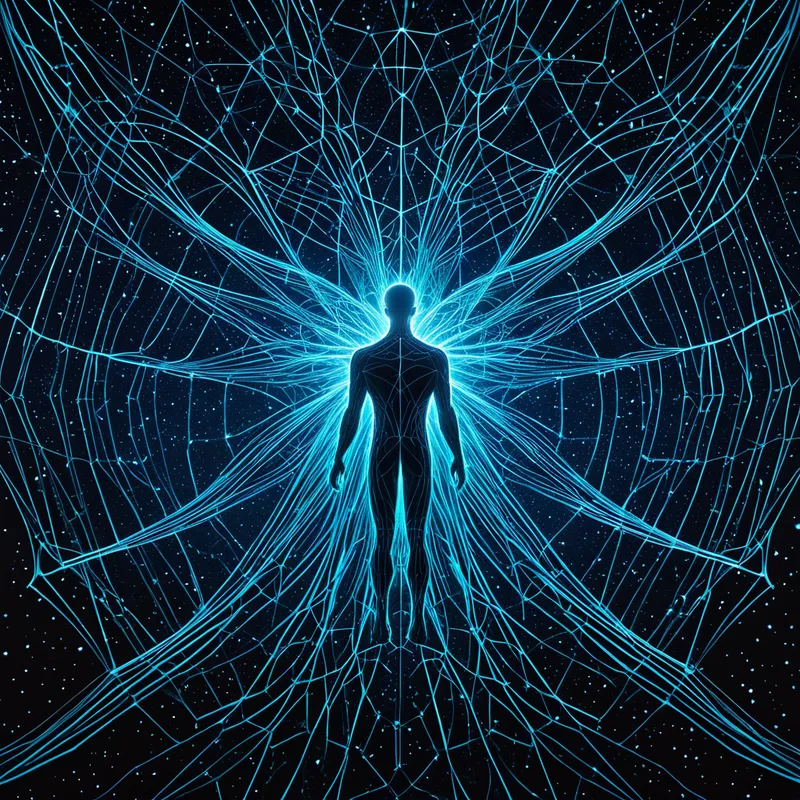
The goal is not to cut yourself free from the Web, but to become conscious of your unique node within it, to feel the threads as your own nervous system extended into the world.
First, we must confront Urd: we draw up our personal and ancestral past, acknowledging how its threads constrain and support us. This is shadow work. Then, we must engage Verdandi: we take conscious responsibility for our present actions, understanding that every choice tightens or loosens the weave around us. Finally, we must negotiate with Skuld: we face the shears of necessary endings—the death of outdated selves, the sacrifice of safe but limiting paths—to allow for the weaving of a new pattern aligned with the deeper Self.
The triumph is not in escaping fate, but in achieving a relationship with it. The modern individual’s “Ragnarök” is the collapse of an outworn worldview. Through this conscious engagement with our own weaving, we move from being passive thread to active participant. We learn that while the great pattern (the Self) is ordained, the texture, color, and local design of our strand (the ego’s expression) is ours to shape. We become, in a humble way, a Norn at our own well, weaving a life of meaning within the boundless, star-lit tapestry of existence.
Associated Symbols
Explore related symbols from the CaleaDream lexicon: