Wayfinding Myth Meaning & Symbolism
The ancient art of navigating vast oceans by reading stars, waves, and birds, embodying a deep trust in ancestral knowledge and the unseen world.
The Tale of Wayfinding
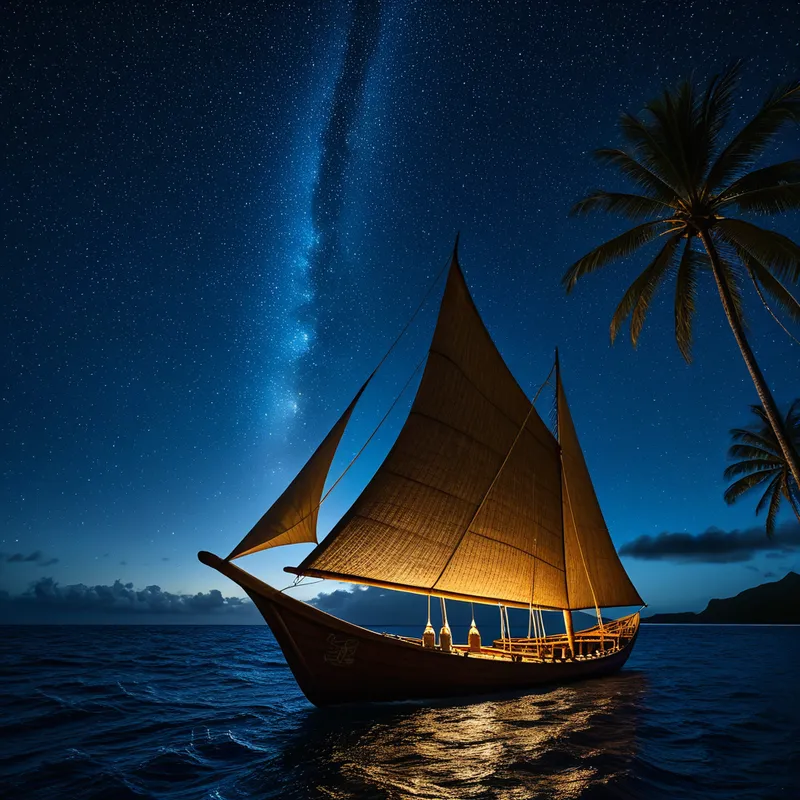
Listen. [The world](/myths/the-world “Myth from Tarot culture.”/) is not land. The world is ocean, a breathing, dreaming expanse of blue that stretches from the edge of yesterday to the rim of tomorrow. In the time before time, when the gods still walked the waves, the people knew only the circle of their island, its green mountains a prison of plenty. [The horizon](/myths/the-horizon “Myth from Various culture.”/) was a wall, and beyond it lay only Te Moana-nui-a-Kiwa, the great sea of Kiwa, a realm of whispers and monsters.
But in the blood of a few, a different song pulsed—a song of currents, a memory of stars not yet seen from their shores. This is the story of Kū, the one who stood. He was not the tallest or strongest, but when he slept, he dreamed in the language of the koekoeā, and when he waded in the lagoon, he felt the deep ocean swells in the lap of the tide against his knees.
One night, the old one, the kumu, called Kū to the canoe shed. The air smelled of cured sennit and fear. “The island groans under our feet,” the kumu said, his voice like dry coral. “The breadfruit trees whisper of a new land, a piko waiting to be found. But [the way](/myths/the-way “Myth from Taoist culture.”/) is written in [water](/myths/water “Myth from Chinese culture.”/) and fire. Do you have the eyes to see it?”
Kū said nothing. He looked up. [The sky](/myths/the-sky “Myth from Persian culture.”/) was a black bowl dusted with the crushed shells of a thousand ancestors. He did not see random sparks. He saw the moving house of [Hōkūleʻa](/myths/hklea “Myth from Polynesian culture.”/), [the star](/myths/the-star “Myth from Tarot culture.”/) of gladness, resting directly above their island. He saw the shark-toothed curve of Maui’s Fishhook rising from [the sea](/myths/the-sea “Myth from Greek culture.”/). The stars were not fixed; they were a great wheel, and their island was but a single spoke.
He built the waʻa kaulua with prayers in every lashing. He loaded it with sprouting coconuts, sleeping pigs, and silent courage. When he pushed off from the black sand beach, the wails of his family were swallowed by [the wind](/myths/the-wind “Myth from Various culture.”/). Then, there was only the hiss of the hull, the creak of the spar, and the immense, deafening silence of the deep.
Days bled into nights. The sun was a hammer; the stars, his only map. He learned to read the ocean’s skin—the long, rolling swell from the south, the confused chop where currents fought like gods. He watched the dance of the ʻiwa, knowing its evening flight pointed to land unseen. He tasted the salinity of the spray, smelled the faint fragrance of pua kenikeni on a wind that had kissed an island days away. He was not sailing on the ocean; he was listening to it.
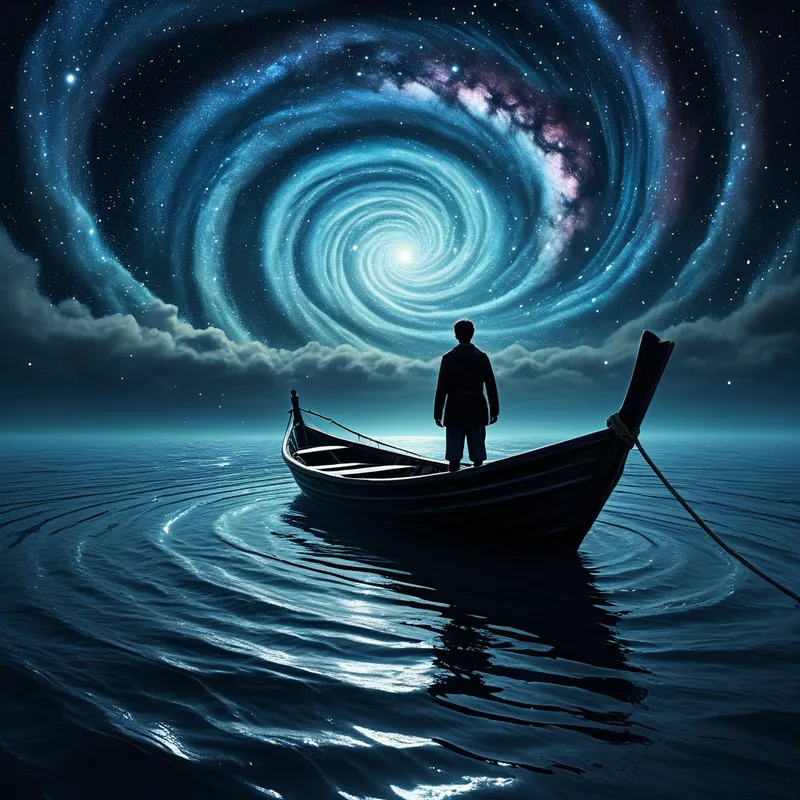
Then came the time of no stars, when the sky wept and the sea raged. The great wave, Ka ʻale nui, rose like a cliff of black water. In that roaring darkness, the memory of the firelight, the smell of earth, the sound of his child’s laugh—all threatened to dissolve. Despair, the true monster of the deep, wrapped around his heart. He could not see. He could not feel. He was lost.
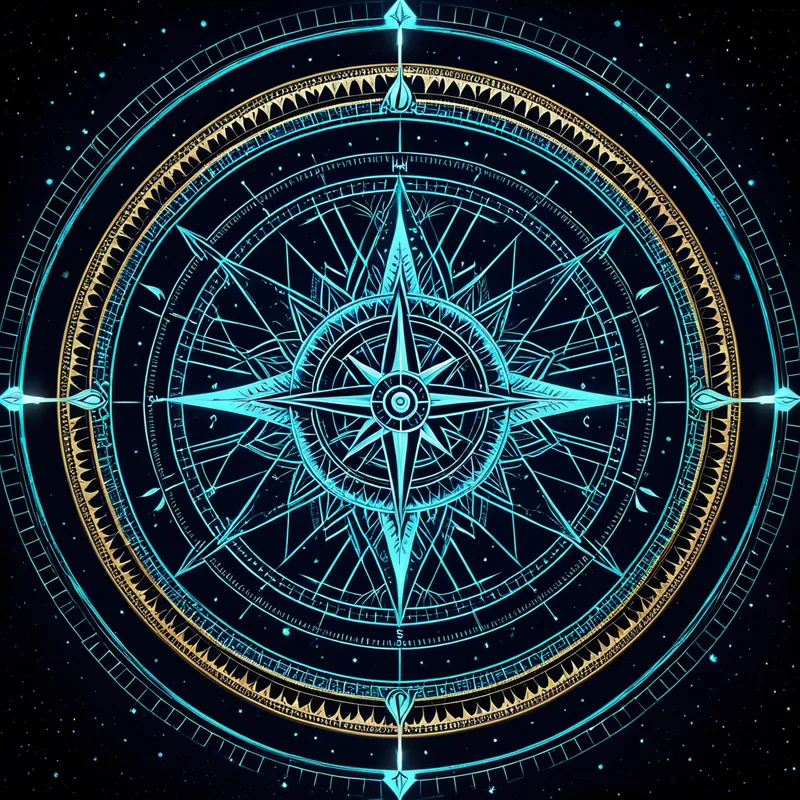
But Kū stood. He closed his eyes. He let go of seeing and reached for knowing. In the dark of his mind, he rebuilt [the star compass](/myths/the-star-compass “Myth from Polynesian culture.”/). He felt the persistent pull of the southern swell against his hip. He heard, beneath the storm’s scream, the high, guiding cry of a petrel. He held the image of the new land not as a hope, but as a memory of the future, a aha stretching taut from his chest to a shore he had never seen.
When the clouds tore apart, Kaʻulua blazed directly ahead, just where his memory had placed it. And on the wind, unmistakable, came the thick, sweet smell of wet forest loam. He had not been steering the canoe. The canoe, the stars, the birds, the swell—they had been steering him. He had simply remembered the way home.

Cultural Origins & Context
This is not a single myth with one hero, but the living, breathing cosmology of the Polynesian world. Wayfinding, or ʻike waʻa, is the foundational epic of an entire civilization. For over three millennia, these master navigators—the pwo of Micronesia, the kahuna hoʻokele of Hawaiʻi—settled the last vast frontier on Earth, discovering islands scattered across an area larger than any continent.
The myth was not told around a fire as a simple story; it was embodied, performed, and encoded. It was passed down through chants, koʻihonua, that memorized star paths and island sequences. It was carved into the physical and mental star compass, a cognitive map that organized the cosmos. The navigator was the library, the instrument, and the priest. His knowledge was the most sacred treasure of the people, for it held the routes to survival, connection, and identity—the kūʻauhau written in the waves.
Symbolic Architecture
At its core, Wayfinding is the ultimate myth of pilina—[relationship](/symbols/relationship “Symbol: A representation of connections we have with others in our lives, often reflecting our emotional state.”/) and trust. The [ocean](/symbols/ocean “Symbol: The ocean symbolizes the vastness of the unconscious mind, representing deeper emotions, intuition, and the mysteries of life.”/) is not a void to be conquered, but a conscious, communicative field, a kinesthetic text.
The hero’s journey is not into the unknown, but into a deeper layer of the known. The destination is not discovered; it is remembered.
The canoe represents the vulnerable yet resilient [vessel](/symbols/vessel “Symbol: A container or structure that holds, transports, or protects something essential, representing the self, emotions, or life journey.”/) of [the self](/myths/the-self “Myth from Jungian culture.”/) or the [community](/symbols/community “Symbol: Community in dreams symbolizes connection, support, and the need for belonging.”/), launched into the existential unknown. The stars are the fixed principles, the ancestral wisdom, and the higher [consciousness](/symbols/consciousness “Symbol: Consciousness represents the state of awareness and perception, encompassing thoughts, feelings, and experiences.”/) that provide orientation when all else is in [flux](/symbols/flux “Symbol: A state of continuous change, instability, or flow, often representing the impermanent nature of existence and experience.”/). The ocean swells are the deep, unconscious currents of [life](/symbols/life “Symbol: The symbol of ‘Life’ represents a journey of growth, interconnectedness, and existential meaning, encompassing both the joys and challenges that define human experience.”/)—the emotional, psychological, and instinctual patterns that move [beneath the surface](/symbols/beneath-the-surface “Symbol: A symbol of hidden depths and meanings, often exploring subconscious thoughts and feelings.”/) [chaos](/symbols/chaos “Symbol: In Arts & Music, chaos represents raw creative potential, uncontrolled expression, and the breakdown of order to forge new artistic forms.”/) of daily events. The migratory birds symbolize [intuition](/symbols/intuition “Symbol: The immediate, non-rational understanding of truth or insight, often described as a ‘gut feeling’ or inner knowing that bypasses conscious reasoning.”/), those fleeting glimpses of [guidance](/symbols/guidance “Symbol: The act of receiving or seeking direction, advice, or leadership in a dream, often representing a need for clarity, support, or a higher purpose on one’s life path.”/) that come from attunement to a larger [pattern](/symbols/pattern “Symbol: A ‘Pattern’ in dreams often signifies the underlying structure of experiences and thoughts, representing both order and the repetitiveness of life’s situations.”/).
The storm represents the necessary [dissolution](/symbols/dissolution “Symbol: The process of breaking down, dispersing, or losing form, often representing transformation, release, or the end of a state of being.”/) of [the ego](/myths/the-ego “Myth from Jungian culture.”/)’s sense of control. It is the “dark [night](/symbols/night “Symbol: Night often symbolizes the unconscious, mystery, and the unknown, representing the realm of dreams and intuition.”/) of the [soul](/symbols/soul “Symbol: The soul represents the essence of a person, encompassing their spirit, identity, and connection to the universe.”/)” where conventional [sight](/symbols/sight “Symbol: Sight symbolizes perception, awareness, and insight, representing both physical and inner vision.”/) (literal and metaphorical) fails. The [triumph](/myths/triumph “Myth from Roman culture.”/) is not in battling the storm, but in the profound surrender to a deeper, embodied [knowledge](/symbols/knowledge “Symbol: Knowledge symbolizes learning, understanding, and wisdom, embodying the acquisition of information and enlightenment.”/)—the shift from navigating by the signs to becoming one with the navigational [system](/symbols/system “Symbol: A system represents structure, organization, and interrelated components functioning together, often reflecting personal or social order.”/) itself.
The Dreamer’s Resonance
When this myth stirs in the modern dreamer, it often manifests as dreams of being lost at sea, of trying to read a map that keeps changing, or of searching for a specific, urgently needed island that remains just over the horizon. Somatic sensations include a feeling of being unmoored, adrift, or of rocking on unstable ground.
Psychologically, this signals a critical phase of disorientation in one’s life path. The conscious ego has lost its familiar landmarks—a career, a relationship, a belief system. The dream is not a warning of failure, but an initiation into a more profound mode of perception. The dreamer is being called to stop looking outward for a pre-charted map (societal expectations, logic alone) and to begin the arduous task of sensing the internal swells—the gut feelings, the somatic intuitions, the ancestral whispers of what truly aligns with their soul’s purpose. The terrifying vastness of the ocean in the dream is the equally vast potential of the unlived life.
Alchemical Translation
The alchemy of Wayfinding is the transmutation of anxiety into orientation, of isolation into profound connection. For the modern individual navigating the featureless sea of possibilities, information overload, and existential choice, the myth provides a non-linear model for individuation.
First, one must build the waʻa—cultivate a disciplined mind and a resilient body, [the vessel](/myths/the-vessel “Myth from Alchemical culture.”/) strong enough for the journey. Then, one must learn the star compass—identify one’s core, non-negotiable values and truths (the “fixed stars”) that will hold firm even in emotional storms.
The crucial alchemical work begins with the embrace of the storm, the willing entry into the cloud bank where the stars vanish. This is the descent into the unconscious, [the shadow](/myths/the-shadow “Myth from Jungian culture.”/) work, the period of depression or confusion where old identities dissolve.
Here, the navigator does not fight the darkness but becomes the dark. He turns his awareness inward, to the feeling of the swell against the hull, to the memory in the bones. The destination is forged not from wishful thinking, but from a cellular certainty.
The successful transit results in a fundamental psychic shift: the realization that you are not a separate self navigating a hostile world. You are a node within a living, intelligent network—connected by the aha of memory, instinct, and relationship to your own depths, your lineage, and the anima mundi, [the world soul](/myths/the-world-soul “Myth from Various culture.”/). You arrive at your new island—a stable, authentic state of being—not as a conqueror, but as one who has finally remembered how to listen, and in listening, has come home.
Associated Symbols
Explore related symbols from the CaleaDream lexicon: