Wayfinders Myth Meaning & Symbolism
The myth of master navigators who read stars, waves, and winds to voyage across the vast, trackless ocean, guided by ancestral memory.
The Tale of the Wayfinders
Listen. The ocean is not empty. It is a great, breathing memory.
In the time before time, when the world was a scattered garden of green islands adrift in the Moana, the people knew the shores of their birth but not the paths between. They lived in the embrace of their mountains and lagoons, while the great, star-strewn blackness of the open sea whispered of a terrifying, trackless mystery. It was a realm of Tangaroa, of endless blue and crushing depth, where a canoe could vanish as if swallowed by the sky.
Then came the first Pwo. It is said his sleep was not like other men’s. In his dreams, the stars did not stay fixed. They swam like luminous fish, drawing lines of light across the canopy of night. He heard the sigh of the ocean not as a single voice, but as a chorus—the deep groan of a distant swell, the chatter of a current against the hull, the hiss of a wind-shifted wave. He watched the birds, the Iwa, not just as creatures of the air, but as living arrows pointing to unseen land.
One night, under a sky pregnant with the Maui’s Fishhook, the dream became a command. The voice was not in his ears, but in his bones, in the salt of his blood that remembered the primordial sea. “The canoe is your body. The ocean is your breath. The stars are your ancestors’ eyes. To be still is to forget. To voyage is to remember.”
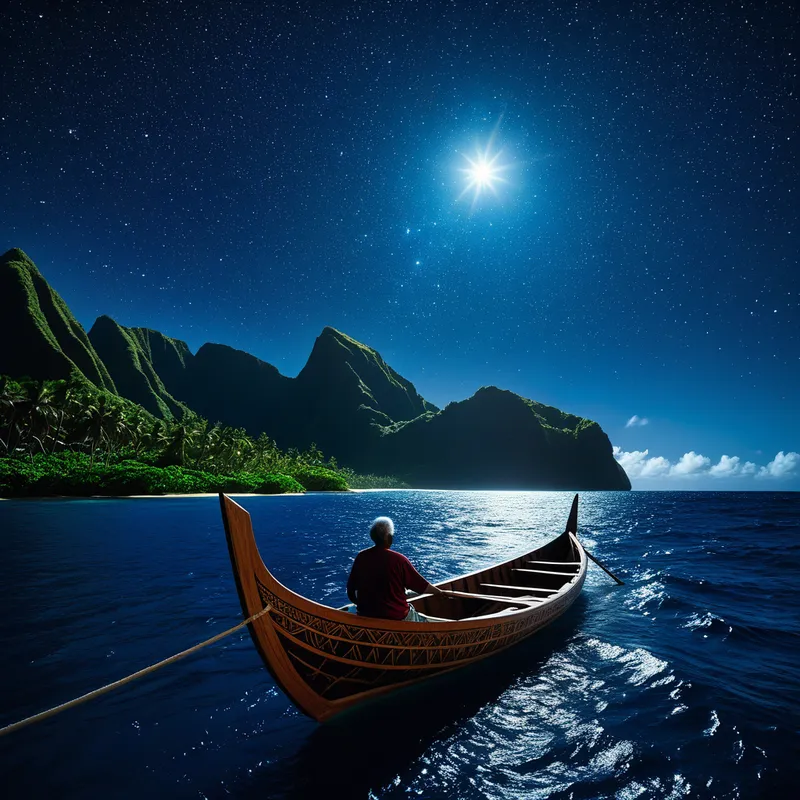
He built not just a canoe, but a vessel of knowing—a Waʻa, twin hulls bound for stability, a sail to catch the breath of the gods. He gathered the brave, the curious, those whose hearts echoed the pull of the horizon. They stocked the sacred Mā, filled gourds with fresh water, and offered prayers to Lono and Tangaroa.
They departed as the shore-dwellers wept, believing it a funeral. The Pwo stood at the stern, his hand on the steering paddle. He closed his eyes to see. He felt the lift and fall of the swell—the dance of the sea. He memorized this rhythm. He opened his eyes and found <abbr title=“The star Arcturus, the “star of joy"">Hōkūleʻa, the zenith star of their home, holding its place directly above. This was his anchor.
Days bled into nights. They sailed by the sun’s arc, by the color of the clouds, by the drift of seaweed. But the true path was woven at night. He lay on the deck, the canoe’s motion his only world. He built a map in his mind—a living, turning dome where Newe wheeled, where the <abbr title=“The “Bailer of Scorpius,” part of the Scorpius constellation”>Ka Makau Nui o Māui rose and set. He did not follow a star; he lived within a moving constellation of them, knowing his place by the angles between celestial fires.
When clouds veiled the sky, he navigated by the ocean’s voice—the pattern of interlacing swells from distant weather systems, each with its own signature. He watched the flight of the homing tern. He tasted the air for the faint, sweet smell of land blossoms carried on a current.
Doubt was a storm more dangerous than any squall. The crew saw only endless water. The Pwo felt the island long before it appeared—a slight change in the swell pattern, a gathering of certain birds at dusk. And then, on a morning when hope was thin as mist, a dark smudge grew on the horizon. Not a cloud, but a line of green. A new mountain, a new shore, a new chapter in the memory of the people.
He had not discovered land. He had remembered it. The ocean was not crossed; it was conversed with. And the first Pwo, standing on a new beach, knew the greatest secret: the destination was not the place. The destination was the way.
Cultural Origins & Context
This is not a single myth with one hero, but a living corpus of knowledge, a constellation of stories, chants, and techniques that formed the bedrock of Polynesian civilization. The Wayfinders, the Pwo or Kahuna Hoʻokele, were the supreme intellectuals and spiritual leaders of their communities. Their myth was not merely told; it was performed in the greatest act of human exploration prior to the space age—the deliberate settlement of the Pacific.
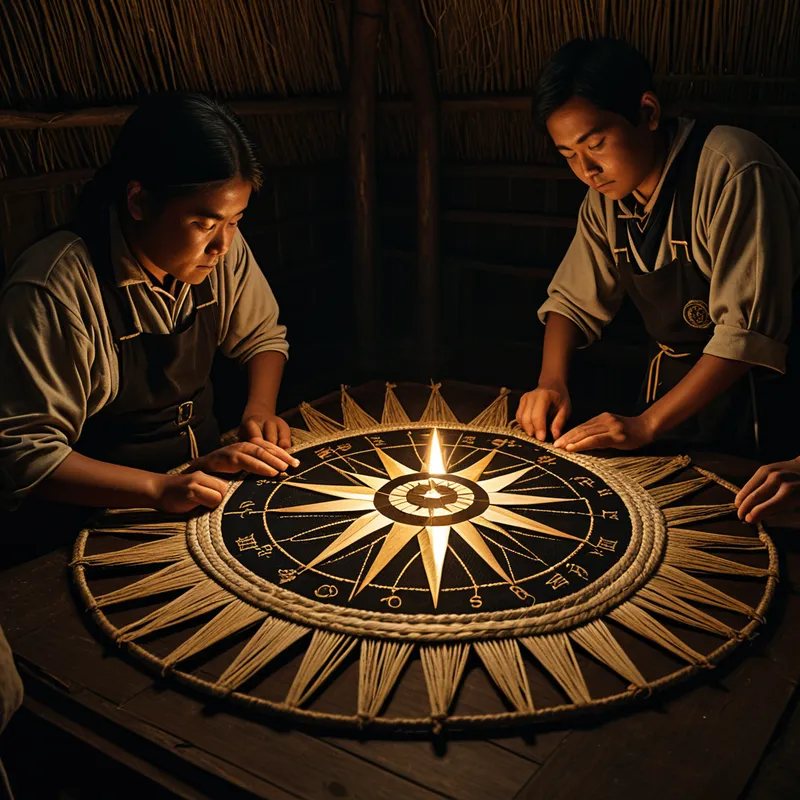
The knowledge was passed down through generations in strict, sacred apprenticeships, often within specialized schools or families. It was encoded in chants (Mele), in the intricate construction of the star compass, and in the tactile feel of the canoe. The mythic narrative was embedded in practice: every voyage was a re-enactment of the ancestral journeys of deities like Māui or the great migratory heroes from Hawaiki. Societally, the Wayfinder was the ultimate authority on the relationship between humanity and the cosmos, a living bridge between the practical needs of the community and the vast, animate intelligence of the natural world.
Symbolic Architecture
At its core, the myth of the Wayfinder is a profound map of consciousness. The Moana represents the unconscious itself—vast, deep, potentially chaotic, but filled with patterns and life. The canoe, the Waʻa, is the embodied psyche, the vehicle of the conscious self, fragile yet purpose-built for the journey.
The Wayfinder does not conquer the sea; he learns its language. He does not impose a map upon the world; he discovers the map that the world has woven into him.
The stars are not cold points of light, but the fixed points of cultural and ancestral memory—the guiding principles, values, and archetypes that provide orientation. The sun, wind, waves, and birds represent the somatic and intuitive intelligence—the constant, flowing data of the present moment that must be felt and interpreted. The destination, the island, symbolizes the emergent wholeness, the new state of being or understanding that coalesces from a successful negotiation with the unknown. The true enemy is not the storm, but panic—the loss of one’s internal compass, the severing from the felt sense of pattern and memory.
The Dreamer’s Resonance
When this myth stirs in the modern dreamer, it often manifests as dreams of being adrift at sea, of searching for a shore, or of trying to read a star map in a strange sky. One might dream of a teacher showing them how to feel the direction of the wind on their skin, or of a canoe that knows its own way.
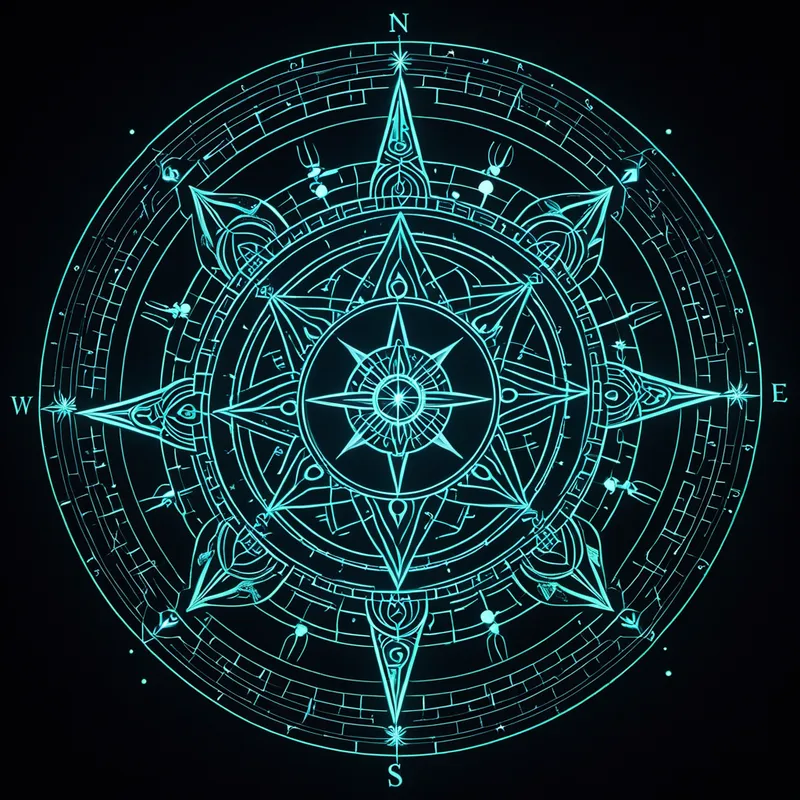
Psychologically, this signals a process of navigating a major life transition or a period of profound disorientation—a “dark night of the soul” where old landmarks (jobs, relationships, identities) have vanished. The somatic process is one of developing internal wayfinding. The dream-ego is being called to stop looking for external signs and instead to cultivate a deep, bodily attentiveness. It is learning to “feel the swell”—to detect the subtle emotional and energetic currents beneath the surface chaos of life. It is an invitation to consult one’s own “star compass”: the core values and inner truths that remain constant even when the emotional weather is overcast.
Alchemical Translation
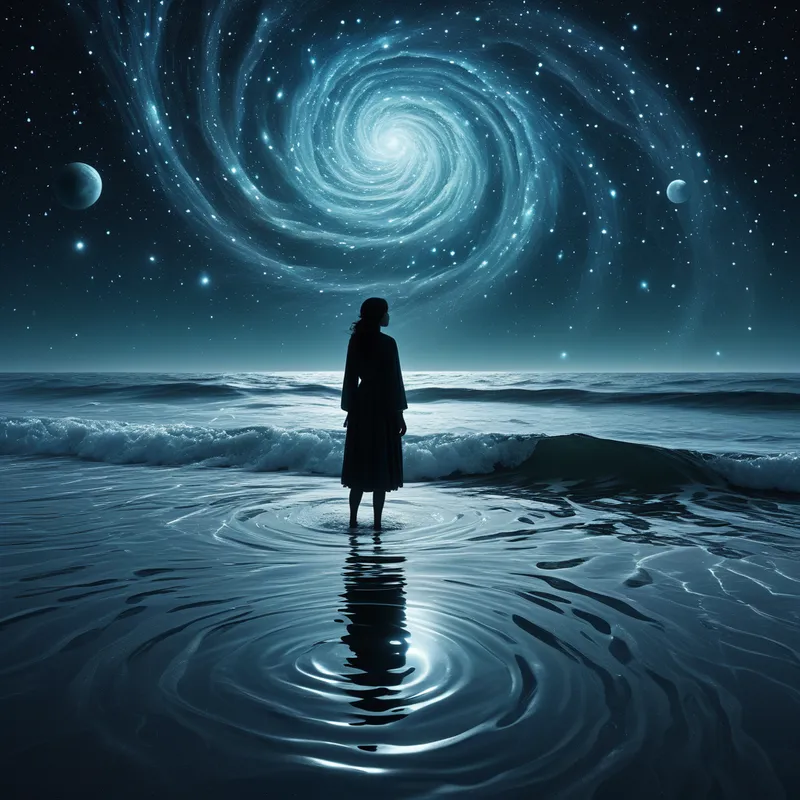
The Wayfinder’s journey is a masterclass in psychic individuation. The initial state is one of cultural consciousness—living safely on the known “island” of the persona and adopted values. The call to voyage is the stirring of the Self, the urge toward greater wholeness that necessitates venturing into the unconscious (the Moana).
The alchemical work happens in the middle of the ocean, in the nigredo of doubt and isolation. Here, the conscious mind (the crew) wants to turn back, to cling to the familiar. The navigator function, the connection between ego and Self, must hold firm. It engages in the sacred practice of synthesis: uniting the celestial (theoretical knowledge, archetypal patterns) with the oceanic (instinct, emotion, the body’s wisdom).
Individuation is not about reaching a predetermined destination. It is about becoming the one who can navigate. The goal is not to find the island, but to become the canoe, the ocean, and the star, all at once.
The successful voyage culminates not in the annihilation of the old self, but in its profound expansion. The navigator returns to community (or founds a new one) not just with resources, but with a transformed mode of being. He has internalized the cosmos. The psychic transmutation is complete when the individual no longer fears the unknown depths within or without, because they have learned to converse with them. They have achieved what the Polynesians called Kuleana—a sacred responsibility born of profound connection—to their own inner ocean and to the wider world they now know how to navigate.
Associated Symbols
Explore related symbols from the CaleaDream lexicon: