Vulture Peak Myth Meaning & Symbolism
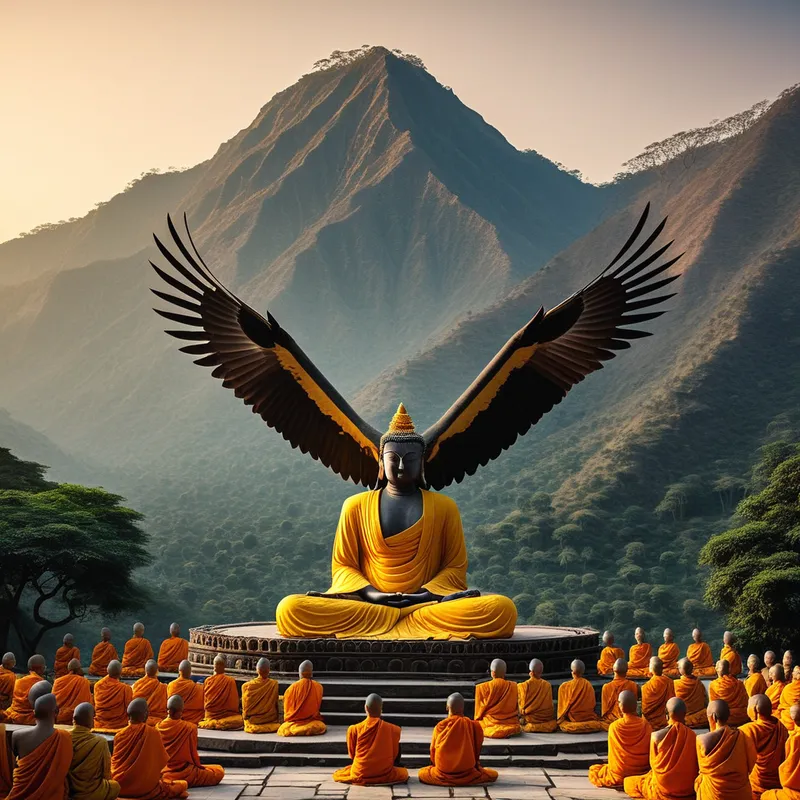
The Buddha delivers the Heart Sutra on a mountain shaped like a vulture, teaching the Bodhisattva Avalokiteshvara the wisdom of emptiness.
The Tale of Vulture Peak
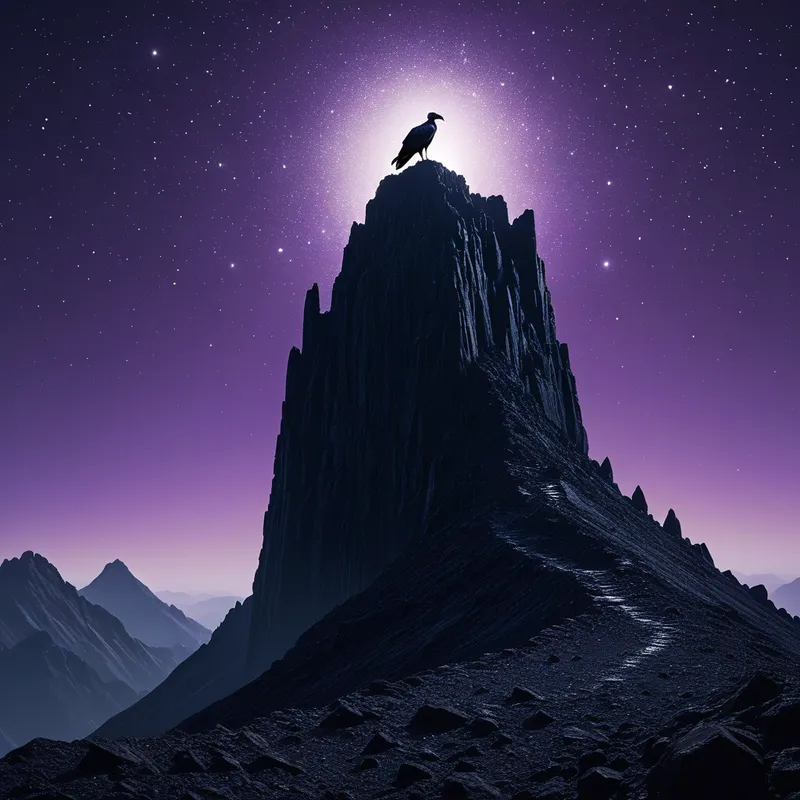
Listen. The air is thin here, a sharp, crystalline breath that carries the scent of cold stone and distant sandalwood. This is not a place for the faint of heart. It is a mountain that has forgotten it is stone, dreaming instead of wings. From the dusty plains below, pilgrims gaze upward and see it: Vulture Peak, a jagged throne of rock clawing at the sky, its silhouette a great raptor poised for flight.
On this day, the peak holds its breath. The usual chatter of monks, the rustle of robes, the murmur of sutras—all have fallen into a silence so deep it has its own sound. For the Awakened One, Shakyamuni Buddha, has entered a samadhi so profound it is named after the very ground of reality: the Samadhi of the Profound Illumination of All Dharmas. He sits, a still point in the turning world, carved from the same ancient rock as the mountain itself.
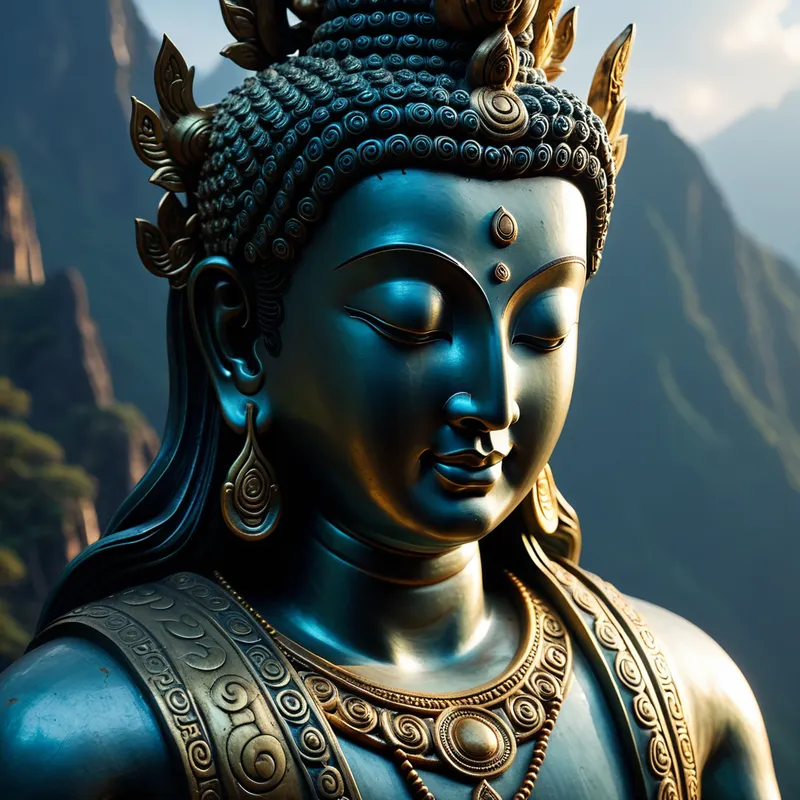
And then, from within that oceanic stillness, a question arises. It does not come from a disciple’s trembling lips, but from the heart of compassion itself. The great Bodhisattva, Avalokiteshvara, who hears the cries of the world, looks upon the Buddha in deep contemplation. He perceives the profound depth of the Buddha’s samadhi and sees the perfect opportunity. The question is not spoken; it is a resonance in the space between all beings. It concerns the very path to liberation, the Prajnaparamita.
The Buddha, from within his unshakeable concentration, perceives the Bodhisattva’s inquiry. A subtle smile touches his lips, not of mirth, but of ultimate recognition. He does not stir from his samadhi. Instead, his silent awareness becomes the answer. And through that awareness, he empowers the compassionate Avalokiteshvara to speak.
Then, the voice of Avalokiteshvara fills the sacred silence. It is a voice like a clear bell, ringing through the marrow of the mountain and the bones of the vast assembly—countless Bodhisattvas, monks, and celestial beings gathered on the ledges and floating in the ether. He speaks to the Buddha’s wisest disciple, Shariputra.
“Shariputra,” the voice begins, “form is emptiness, emptiness is form.” The words hang in the thin air, a paradox that cuts through all conceptual grasping. He unfolds the heart of wisdom: that no thing exists independently, that all phenomena are empty of a separate, permanent self. The five aggregates, the senses, the links of dependent origination—all are revealed in their essential voidness. There is no suffering, no cause of suffering, no cessation, no path. There is no wisdom, and no attainment.
With each declaration, the very fabric of reality on the peak seems to shimmer. The solid mountain, the seated Buddha, the listening disciples—all partake in a miraculous transparency. The teaching culminates in the great mantra, the spell that pierces illusion: “Gate Gate Paragate Parasamgate Bodhi Svaha.” Gone, gone, gone beyond, gone altogether beyond, awakening, hail!
As the final syllable fades into the wind, a profound peace settles, deeper than the silence that preceded it. The Buddha emerges from his samadhi and confirms the truth of Avalokiteshvara’s words. The assembly is shaken to its core, yet filled with a joy that has no object. The vulture-shaped mountain has witnessed not a feeding on carrion, but a feast on the nectar of ultimate reality.
Cultural Origins & Context
The narrative of the teaching at Vulture Peak is the seminal frame for the Prajnaparamita Sutras, a vast corpus of scriptures that form the philosophical bedrock of Mahayana Buddhism. Historically, Grdhrakuta is a real mountain located near Rajgir in modern-day Bihar, India, a frequent retreat for the Buddha and his sangha. Its distinctive shape naturally lent itself to its name and, later, to its potent symbolic weight.
The myth, particularly as the setting for the concise and immensely influential Heart Sutra, was not merely a geographical note. It served a crucial literary and devotional function. By anchoring this radical teaching of shunyata to a specific, awe-inspiring place associated with the Buddha’s physical presence, it granted the abstract philosophy both authenticity and tangibility. It was passed down orally by monastic communities and later meticulously transcribed, becoming a central liturgical text across China, Tibet, Korea, and Japan. The myth’s societal function was to model a paradigm shift—from the earlier, more individual-focused path to the Bodhisattva’s compassionate vow to attain wisdom for the benefit of all beings, a wisdom revealed in its most concentrated form on that windswept peak.
Symbolic Architecture
The myth is a perfect mandala of symbolic meaning. The Vulture itself is the primary alchemical symbol. Often associated with death and decay, here it is transfigured. The vulture is nature’s ultimate consumer of carcasses, a cleaner that returns the dead to the cycle. On the peak, it becomes the symbol of the wisdom that consumes the corpse of ignorance, that picks clean the bones of attachment, ego, and fixed views.
The highest wisdom does not shy away from decay; it alchemizes it into the sky.
The Peak represents the pinnacle of consciousness, the point where one transcends the duality of sacred and profane, form and emptiness. It is a liminal space—between earth and sky, humanity and divinity, speech and silence. The Assembly symbolizes the totality of the psyche—the celestial Bodhisattvas representing our highest potentials, the monks our disciplined practices, and even the silent Buddha our own deepest, witnessing Self.
The central dynamic between the Buddha in Samadhi and the Speaking Avalokiteshvara is perhaps the most profound symbol. It represents the two inseparable wings of enlightenment: transcendent wisdom (prajna) and active compassion (karuna). The Buddha, silent and unmoving, is pure, non-conceptual wisdom. Avalokiteshvara, moved by compassion for Shariputra (who represents the intellectual seeker), gives that formless wisdom a form—the Sutra. True wisdom spontaneously manifests as compassionate communication.
The Dreamer’s Resonance
When this myth stirs in the modern dreamer, it often signals a profound confrontation with the psyche’s own “emptiness.” One may dream of a terrifying, skeletal bird or a stark, insurmountable cliff. This is not a nightmare of external threat, but of internal deconstruction.
The somatic experience can be one of vertigo, of the ground falling away—the dissolution of a long-held identity (“I am a parent,” “I am successful,” “I am wounded”). The psychological process is the ego’s encounter with the Self, with the vast, impersonal ground of being that undermines all personal narratives. To dream of listening to a silent teacher on a high place, or of speaking truths that make the world transparent, indicates the active engagement of this process. The dreamer is not being attacked; they are being invited—terrifyingly—to the peak to have their most solid assumptions about reality dismantled by a compassionate, deeper intelligence within.
Alchemical Translation
The journey to and teaching on Vulture Peak is a master blueprint for psychic individuation. The first step is the Ascent—the often arduous, lonely climb out of the comfortable, known plains of the personal complex (the neuroses, the social persona) toward a more impersonal vantage point. This is the ego’s difficult service.
The climax is the Samadhi of the Self—the ego’s relative dissolution into the stillness of the deeper, archetypal Self (symbolized by the Buddha). Here, in that silence, the old structures of meaning are suspended.
The alchemical fire is not rage, but the cool, clear light of awareness that allows all forms to be seen through.
Then occurs the crucial Return and Articulation. The compassionate function of the psyche (Avalokiteshvara) must translate that silent, non-dual realization back into the language of the psyche’s other parts (the internal “Shariputra,” our rational mind). This is the “Heart Sutra” of the individual—the personal, lived understanding that “my suffering is empty, my self-concept is empty, yet compassion arises from that very emptiness.” The mantra “Gone, gone, gone beyond…” becomes the psychic algorithm for release from any identificatory thought or feeling. The transmutation is complete when the individual can dwell in the world of form, engaging fully, yet knowing themselves to be, like the Buddha on the peak, intimately one with the empty, luminous sky from which all forms momentarily arise.
Associated Symbols
Explore related symbols from the CaleaDream lexicon: