Vulcan's Net Myth Meaning & Symbolism
The smith-god Vulcan forges an unbreakable net to trap his wife Venus and Mars in their adultery, exposing the gods' hidden passions to all.
The Tale of Vulcan’s Net
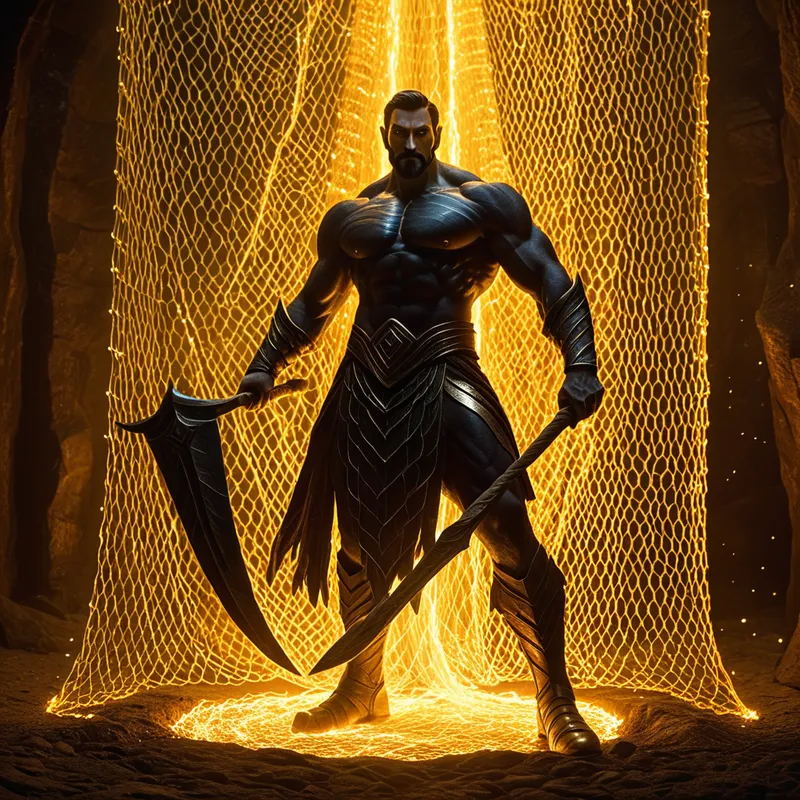
Hear now the tale of the unbreakable snare, the trap that shook the very foundations of Olympus. It begins not in the golden halls, but in the deep, resonant dark beneath a mountain, where fire is born and metal weeps. Here dwells Vulcan, the divine smith. His form is mighty, his hands that shape the thunderbolts of Jupiter and the shields of heroes, yet one foot is twisted, a legacy of a cruel fall from heaven. He is the maker, the architect of divine wonders, wedded to Venus, she who is born of sea-foam, whose very presence is a sigh of desire.
But in the house of the maker, a cold emptiness grew. The scent of the forge—of coal and ozone—could not mask the lingering perfume of myrrh and roses that was not his own. Whispers, carried by the lesser gods and the sighing winds, began to coil around Vulcan’s anvil. They spoke of his wife and Mars, the god of war’s brutal clamor. They told of stolen hours while Vulcan labored in his fiery deep, of passion meeting passion while the architect of wonders was blind.
The whispers became a certainty, a cold, hard knot in the smith’s chest, hotter than any furnace. But Vulcan’s rage did not erupt in flame; it cooled, it concentrated, it became a plan. His was not the fury of Mars, wild and blunt. His was the fury of the forge: precise, patient, transformative. He would not confront; he would demonstrate. He would craft not a weapon of destruction, but one of revelation.
For days and nights, the rhythmic clang of his hammer took on a new, feverish purpose. He drew not on common iron or bronze, but on the essence of binding itself. He spun threads finer than a spider’s silk, yet stronger than the chains that bound the Titan Prometheus. He wove them with spells of unmaking, so that no power, divine or mortal, could tear them. He crafted hinges and catches of impossible subtlety. What emerged from the smoke and fire was a net: a web of gleaming, almost invisible metal, a masterpiece of capture.
With the grim resolve of a god executing a perfect design, he carried his creation to his own marriage bed. He stretched the net with infinite care across the couch, attaching the fine threads to the bedposts and the rafters above, connecting them to a hidden mechanism. The trap was set. Then, he spread the word. He announced he was departing for his beloved isle of Lemnos, a journey of many days. The mountain forge fell silent.
As he knew they would, Venus and Mars, believing themselves unobserved, stole into the vacant chamber. In the moment of their embrace, the mechanism triggered. The net, living up to its maker’s genius, fell in a whispering cascade. It did not simply cover them; it conformed, wrapping every contour, binding wrist to wrist, ankle to ankle, in a grip as gentle as air and as final as fate. They were caught, utterly immobilized, not in violence, but in the very act of their passion, transformed into a living, shameful sculpture.
Then Vulcan returned. He did not burst in. He swung wide the great doors and called not to the trapped lovers, but to all Olympus. He summoned Jupiter, Juno, Mercury, Neptune—the entire pantheon. The gods gathered, and there, in the open doorway, was the proof: the glorious Venus and the fierce Mars, naked, entangled, and helpless in the glimmering web. A roar of laughter erupted from the gods, a sound of shock, mockery, and delight at the scandal. Only Neptune, perhaps feeling a pang of sympathy, or seeking to calm the discord, eventually persuaded Vulcan to release them. The net was withdrawn, and the lovers fled, seared not by fire, but by the relentless, unforgiving light of exposure. The forge-god had won not a battle, but an undeniable, public verdict.
Cultural Origins & Context
This myth comes to us primarily from the epic tapestry of Homer’s Odyssey, where the bard Demodocus sings the tale in the court of the Phaeacians. It is a story told by a poet to a heroic audience, a divine comedy that serves as a mirror and a relief. In the highly social, honor-based world of ancient Greece, and later Rome (where the names Vulcan, Venus, and Mars became standard), this myth functioned on multiple levels.
It was a cautionary tale about the dangers of hubris and secrecy, especially in matters of the oikos (household). Vulcan’s lameness made him a figure of potential mockery, yet his brilliant mind and skill overturned that expectation, punishing the arrogance of the beautiful and the powerful. The myth also served to explain the natural world: the rumble of volcanoes (Vulcan’s forge) and the sparks of conflict (Mars’s domain) were seen as reflections of this divine drama. Furthermore, it reinforced social norms around marriage and the severe consequences of adultery, while simultaneously satisfying a very human desire to see the mighty humbled. The gods’ laughter is crucial—it frames the event not just as a tragedy, but as the ultimate divine soap opera, making the remote Olympians relatable in their pettiness and passion.
Symbolic Architecture
At its heart, Vulcan’s Net is a profound symbol of conscious realization snaring unconscious compulsion. Venus and Mars represent raw, instinctual drives—love/desire and war/aggression—acting in secret, autonomous union. They are the shadow couple, the parts of the psyche that operate outside the ego’s control, often in contradiction to our stated values or commitments (represented by the marriage to Vulcan).
Vulcan, the Creator archetype, embodies the ego consciousness that feels wronged, excluded, and devalued. His lameness symbolizes a perceived weakness or inadequacy, often the very wound that drives creative mastery. He does not repress his knowledge of the betrayal; he crafts with it.
The net is not merely a trap; it is the manifest form of conscious insight, woven from the painful but precise knowledge of what is true.
The net itself is the central symbol. It is the pattern seen, the connection made, the inescapable logic of a revealed truth. It is the moment the unconscious complex is named, seen, and held immobile in the light of awareness. The laughter of the other gods represents the collective, objective perspective—once a secret is dragged into public view (the light of consciousness), its power to operate in the shadows is broken. It becomes subject to judgment, ridicule, or integration.
The Dreamer’s Resonance
When this myth stirs in the modern dreamscape, it rarely appears as literal gods in a net. Instead, one might dream of being inexplicably trapped in a room of one’s own making, or of discovering a partner in a compromising situation frozen in a beam of light. The somatic feeling is often one of paralysis combined with acute, hyper-real awareness—a shocking clarity.
Psychologically, this dream pattern signals the moment when a long-denied truth about a relationship (to a person, a habit, a part of oneself) can no longer be ignored. The “Vulcan” part of the dreamer—the diligent, perhaps wounded, crafting ego—has finished its work of observation and has set a psychic trap. The “net” is the realization itself, which now holds the “Venus/Mars” complex—the secret alliance of desire and aggression, infatuation and conflict—completely exposed. The dreamer is both Vulcan (the revealer) and, terrifyingly, one of the trapped lovers (the revealed). This is the psyche’s brutal, necessary theater to force a confrontation with a hidden dynamic that is causing inner discord or betrayal of the self.
Alchemical Translation
The alchemical journey modeled here is the transmutation of humiliation into illumination, and of passive suffering into active revelation. The initial state is the nigredo: the blackness of Vulcan’s forge, the dark suspicion, the feeling of being the crippled, cuckolded outsider. This is the raw, leaden material of pain.
The opus is the work at the forge. Vulcan does not dissolve in grief or rage; he focuses it. He becomes the alchemist, using the fire of his emotion to separate, refine, and recombine. His lameness, his wound, becomes the crucible. The net is the lapis, the philosopher’s stone of this operation—not a stone at all, but a perfect, conceived form born from the marriage of intense feeling and supreme skill.
The ultimate alchemy is not hiding one’s wound, but using its unique geometry to craft the tool that will liberate the truth.
The final stage is the rubedo, the reddening, often symbolized by exposure to the sun. Here, it is the exposure of the trapped lovers to the collective gaze of Olympus. The secret is roasted in the fire of public consciousness and becomes something else: a story, a resolved pattern, a lesson integrated. For the modern individual, the triumph is not vengeance, but sovereignty. It is the moment we stop being victims of unseen psychological forces (our own or others’) and become the architects of our own awareness. We release the need to hold others in the net of our blame, because the act of forging it has already freed us. The net, having served its purpose of revelation, can be withdrawn, leaving behind a self forged in the fires of difficult truth, now stronger and more conscious for the ordeal.
Associated Symbols
Explore related symbols from the CaleaDream lexicon: