Vulcan's Forge Myth Meaning & Symbolism
The myth of the crippled god Vulcan, who transforms his exile and pain into masterful creation within his volcanic forge, crafting divine weapons and artifacts.
The Tale of Vulcan’s Forge
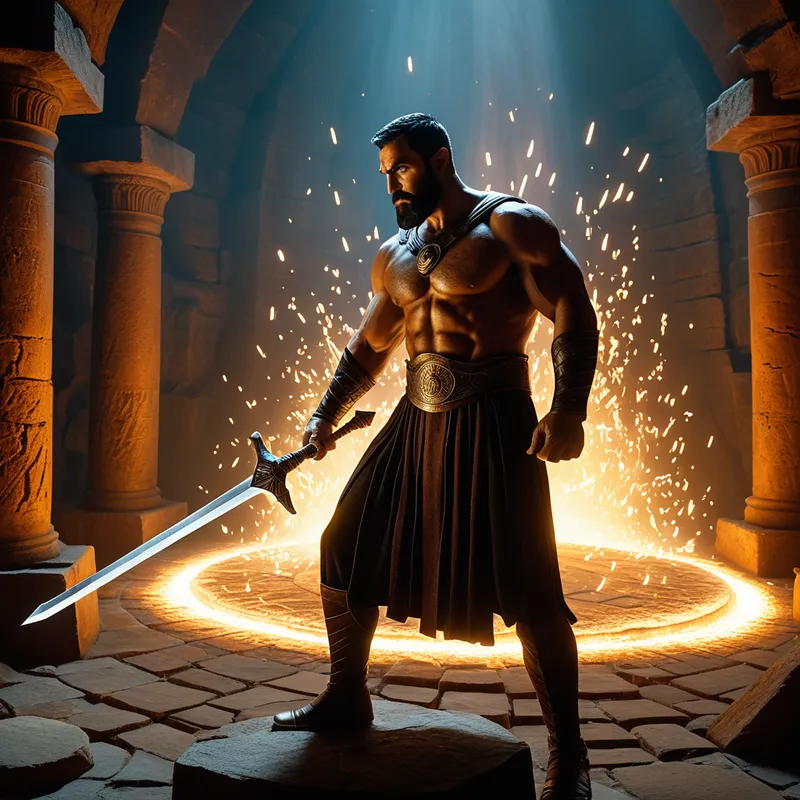
Beneath the serene order of Jupiter’s realm, in [the world](/myths/the-world “Myth from Tarot culture.”/)‘s deep, trembling bones, the mountain groaned. This was no ordinary rock. This was Aetna, or the fiery cliffs of Vulcania, where the air itself tasted of ash and potential. Here, in a cavern lit not by sun but by [the earth](/myths/the-earth “Myth from Hindu culture.”/)’s own bloody heart-light, worked the god whom heaven had cast out.
He was [Vulcan](/myths/vulcan “Myth from Roman culture.”/). His form was powerful, a smith’s broad shoulders and arms corded with muscle earned through eternal labor. Yet his gait was a painful shuffle, his leg twisted and lame—a permanent echo of his fall from Olympus, hurled down by his own mother, Juno, for being born imperfect. The rejection was his first ore, the shame his first fire.
And what a fire it was! Not the gentle hearth-flame of the home, but the primal, roaring bellows of creation and destruction. Cyclopes, giant one-eyed sons of the earth, served as his apprentices, their massive hands pumping the great leather bellows that made the heart of the mountain beat. The anvil, a slab of star-iron, rang with a sound that shaped fate itself.
Here, Vulcan forged the infrastructure of divine power. He crafted Jupiter’s thunderbolts, encapsulating raw authority. He shaped Minerva’s shield, a perfect circle of strategy and defense. He made the dazzling chariot of the sun-god, and the arrows of Cupid. Each artifact was a masterpiece, born from darkness and fury, gifted to a [pantheon](/myths/pantheon “Myth from Roman culture.”/) that dwelled in the light above.
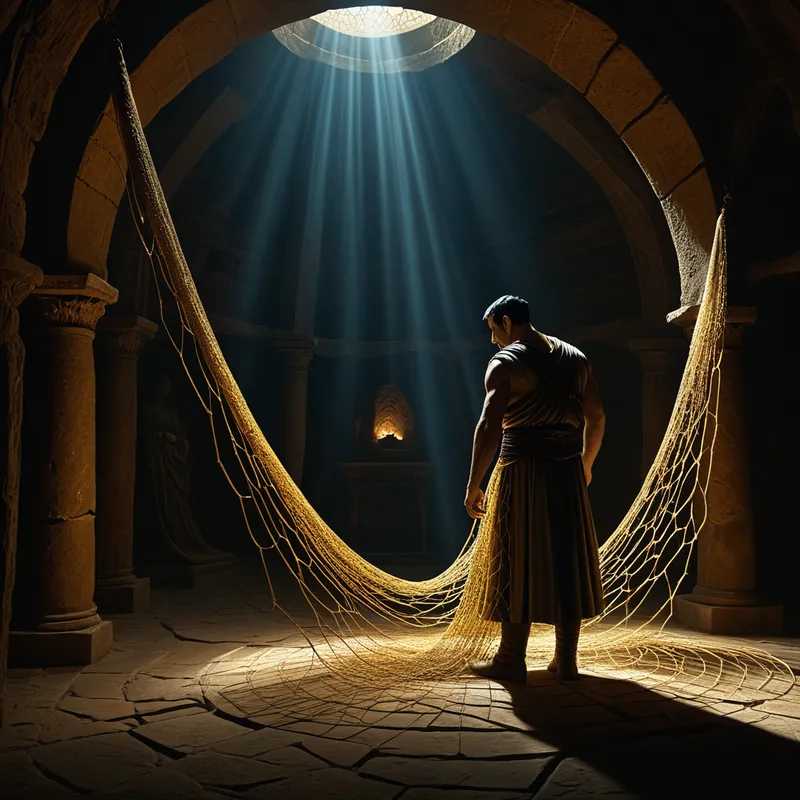
But the forge’s most cunning creation was born not from divine commission, but from a heart’s private inferno. Vulcan, bound in a political marriage to the goddess of beauty, [Venus](/myths/venus “Myth from Alchemical culture.”/), learned of her affair with the god of war, Mars. The betrayal was a new, searing heat. He did not rage to the heavens. He returned to his anvil.
With a craftsman’s cold, precise fury, he wove threads of bronze so fine they were invisible, crafting a net of unbreakable subtlety. He hung it above his own marriage bed. When the lovers next lay entwined there, the mesh descended, trapping them in a glittering, shameful embrace. Vulcan then called all the gods to witness. The laughter that echoed through Olympus was not at the trapped lovers alone, but at the crippled smith who, from his deep, dark place, had ensnared the very embodiments of beauty and strife. The forger of weapons had forged [justice](/myths/justice “Myth from Tarot culture.”/)—or perhaps revenge—from the raw material of his own humiliation.
Cultural Origins & Context
The figure of Vulcan (Velchans to the Etruscans) finds his roots in the most practical of human necessities: fire and craft. His worship was ancient, likely predating the full [Hephaestus](/myths/hephaestus “Myth from Global/Universal culture.”/) myth complex imported from Greece. The Romans, a profoundly pragmatic people, venerated Vulcan not as a lofty celestial figure but as a vital, chthonic force. His primary festival, the Volcanalia, held on August 23rd, was not a day of grand temple rites but of practical apotropaic magic. Small fish and other animals were thrown into communal bonfires—a sacrifice to placate the god of destructive fire and divert his power away from the grain stores and homes of Rome, which were perpetually at risk of conflagration.
His forges were located at sites of very real, geological power: volcanoes like Mount Etna and the volcanic islands near Sicily. This linked him directly to the terrifying and creative power of the earth itself. The myth was passed down and elaborated by poets like Vergil and Ovid, who wove the Greek narratives into the Roman tapestry. Societally, Vulcan represented the honored but often marginalized artisan class—essential to the state’s military and civic power (making weapons and infrastructure), physically marked by labor (his lameness), and operating in a sphere separate from, yet foundational to, the glittering world of politics, war, and beauty above.
Symbolic Architecture
At its core, the myth of Vulcan’s Forge is a profound map of the creative process born from woundedness. Vulcan is the archetypal Wounded Maker. His lameness is not merely a physical defect; it is the [symbol](/symbols/symbol “Symbol: A symbol can represent an idea, concept, or belief, serving as a powerful tool for communication and understanding.”/) of his fundamental otherness, his [exile](/symbols/exile “Symbol: Forced separation from one’s homeland or community, representing loss of belonging, punishment, or profound isolation.”/) from the “perfect” [realm](/symbols/realm “Symbol: The symbol of ‘Realm’ often signifies the boundaries of one’s consciousness, experiences, or emotional states, suggesting aspects of reality that are either explored or ignored.”/). This [exile](/symbols/exile “Symbol: Forced separation from one’s homeland or community, representing loss of belonging, punishment, or profound isolation.”/) is the precondition for his genius. He is forced [inward](/symbols/inward “Symbol: A journey toward self-awareness, introspection, and the exploration of one’s inner world, thoughts, and unconscious mind.”/) and downward, into the subconscious, volcanic [depths](/symbols/depths “Symbol: Represents the subconscious, hidden emotions, or foundational aspects of the self, often linked to primal fears or profound truths.”/) of the [psyche](/myths/psyche “Myth from Greek culture.”/).
The forge is the vas of the soul, the sealed vessel where base elements—pain, rejection, betrayal—are subjected to extreme pressure and heat to be transmuted.
The fire is ambivalent: it is the destructive rage of the spurned son and [husband](/symbols/husband “Symbol: In dreams, the symbol of a husband often represents commitment, partnership, and the dynamics of intimate relationships.”/), and it is the transformative [energy](/symbols/energy “Symbol: Energy symbolizes vitality, motivation, and the drive that fuels actions and ambitions.”/) of creation. The anvil is the resilient, enduring core of [the self](/myths/the-self “Myth from Jungian culture.”/) that can withstand repeated blows. The artifacts he creates—thunderbolts, shields, nets—are symbolic of psychic functions forged in adversity: the power of assertion (Jupiter’s bolt), the [capacity](/symbols/capacity “Symbol: A measure of one’s potential, limits, or ability to contain, process, or achieve something, often reflecting self-assessment or external demands.”/) for [defense](/symbols/defense “Symbol: A protective mechanism or barrier against perceived threats, representing boundaries, security, and resistance to external or internal challenges.”/) (Minerva’s [shield](/symbols/shield “Symbol: A symbol of protection, defense, and boundaries, representing personal security, resilience, and the need to guard against external threats or emotional harm.”/)), and the intricate, binding [insight](/symbols/insight “Symbol: A sudden, deep understanding of a complex situation or truth, often arriving unexpectedly and illuminating hidden connections.”/) that exposes hidden truths (the net).
Vulcan’s trapping of Venus and Mars is a masterful symbolic act. It represents the [moment](/symbols/moment “Symbol: The symbol of a ‘moment’ embodies the significance of transient experiences that encapsulate emotional depth or pivotal transformations in life.”/) when the wounded, introverted creative force (Vulcan) successfully constellates and exposes the unconscious, automatic [alliance](/symbols/alliance “Symbol: A formal or informal union between individuals or groups for mutual benefit, support, or protection.”/) between raw instinctual desire (Venus) and aggressive, unreflective [action](/symbols/action “Symbol: Action in dreams represents the drive for agency, motivation, and the ability to take control of situations in waking life.”/) (Mars). He [doesn](/symbols/doesn “Symbol: The word ‘doesn’ typically points to a lack or feeling of uncertainty regarding action or inactivity in one’s life.”/)’t destroy them; he displays their [nature](/symbols/nature “Symbol: Nature symbolizes growth, connectivity, and the primal forces of existence.”/), forcing [consciousness](/symbols/consciousness “Symbol: Consciousness represents the state of awareness and perception, encompassing thoughts, feelings, and experiences.”/) (the laughing gods) upon a previously unconscious complex.
The Dreamer’s Resonance
When the imagery of Vulcan’s Forge erupts in the modern dreamscape, it signals a profound somatic and psychological process of psychic metallurgy. The dreamer is not merely having a “creative” moment; they are in [the crucible](/myths/the-crucible “Myth from Alchemical culture.”/).
Somatically, this may coincide with feelings of deep pressure, heat, or constriction—a sense of being “in the fire.” There may be aches in the joints or limbs, echoing Vulcan’s lameness, symbolizing a felt sense of limitation or carrying an old wound. Psychologically, the dreamer is likely grappling with a core experience of rejection, inadequacy, or betrayal that feels foundational. The dream is not about the event itself, but about the unconscious, alchemical workshop that has been activated in response.
Dreaming of a hidden, fiery workshop suggests [the ego](/myths/the-ego “Myth from Jungian culture.”/) has stepped aside, and the deeper Self is at work below the surface of awareness. Finding a newly forged object in a dream—a key, a tool, a piece of jewelry—indicates the near-completion of this process: a new psychic structure, born of endured pressure, is ready to be integrated into conscious life.
Alchemical Translation
The journey of Vulcan is a precise model of the individuation process. It begins with the mortificatio: his violent rejection and fall from Olympus. The idealized, “perfect” self-image (the divine family) is shattered, and he is cast into [the underworld](/myths/the-underworld “Myth from Greek culture.”/) of his own shadow. This is not a tragedy but a necessity. The conscious personality must be humbled and dissolved for the work of the Self to begin.
His descent to the volcanic depths is the [nigredo](/myths/nigredo “Myth from Alchemical culture.”/), the blackening, the descent into the [prima materia](/myths/prima-materia “Myth from Alchemical culture.”/) of one’s own pain and isolation. Here, in the darkness, the first fire is lit. The subsequent labor at the forge is the albedo and citrinitas—the whitening and yellowing—the long, arduous work of purification and formation. Each blow of the hammer is a conscious engagement with the complex, a shaping of raw affect into usable form.
The ultimate goal is not to escape the forge, but to become its conscious master—to recognize that one’s deepest wound is the seat of one’s most unique creative power.
The crafting of the net represents the [rubedo](/myths/rubedo “Myth from Alchemical culture.”/), the reddening, the culmination. It is the creation of a sophisticated, conscious function (keen insight, cunning intelligence) from the base material of personal humiliation. This function does not act out rage directly but uses it as energy to create a structure that reveals truth and restores a kind of balance. The laughter of the gods is the final integration: the complex, once hidden and shameful, is brought to light and accepted into the broader psychic community. The crippled smith, through his work in the deep forge, becomes an indispensable architect of reality, transforming his exile into the very source of his sovereignty.
Associated Symbols
Explore related symbols from the CaleaDream lexicon: