Vomiting of the Ocean Myth Meaning & Symbolism
A cosmic churning of the ocean yields both poison and nectar, forcing the gods to confront a destructive power that must be swallowed and transmuted.
The Tale of Vomiting of the Ocean
Listen, and let [the world](/myths/the-world “Myth from Tarot culture.”/) grow still. For this is the tale of a time when the heavens grew weary and [the earth](/myths/the-earth “Myth from Hindu culture.”/) forgot its strength. The Devas had been drained, their immortality a fading memory, their sovereignty challenged by the ever-rising might of the Asuras. A great lassitude had fallen upon creation. In their desperation, they sought the counsel of [Vishnu](/myths/vishnu “Myth from Hindu culture.”/), who rested upon the coils of the endless serpent in the milky ocean of causality.
His voice was the sound of deep waters. “There is a way,” he said, “but it is a way of tremendous labor and terrible risk. At the bottom of the ocean of primordial milk lies Amrita. But to bring it forth, you must churn the ocean itself. And to do that, you will need the help of your enemies.”
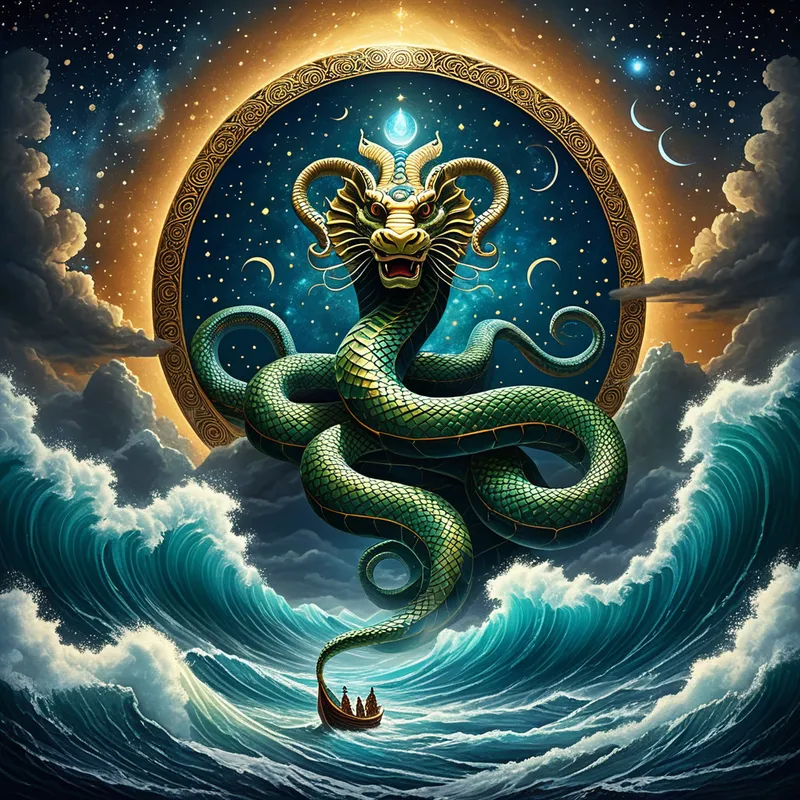
Thus began the grand and perilous alliance. The Devas and Asuras, sworn foes, agreed to a temporary truce. Their tool was the great mountain, Mandara. Their churning rope was the king of serpents, Vasuki. The Devas took the head of the serpent, the Asuras its tail. With groans that shook the foundations of the worlds, they began to pull, back and forth, causing the mountain to spin in the vast ocean.
But the mountain began to sink! Vishnu, in his compassion, took the form of a colossal turtle, [Kurma](/myths/kurma “Myth from Hindu culture.”/), and dove beneath the waves to bear the weight of the world upon his shell. The churning resumed—a cosmic tug-of-war that lasted for ages. The ocean, agitated beyond measure, began to vomit.
First came a deadly, suffocating smoke. Then a poison of such absolute virulence that it threatened to unmake all of creation in an instant. This was Halahala, a darkness so potent it could dissolve the bonds of reality. Panic seized gods and demons alike. They cried out to [Shiva](/myths/shiva “Myth from Hindu culture.”/), the great ascetic who dwells beyond fear.
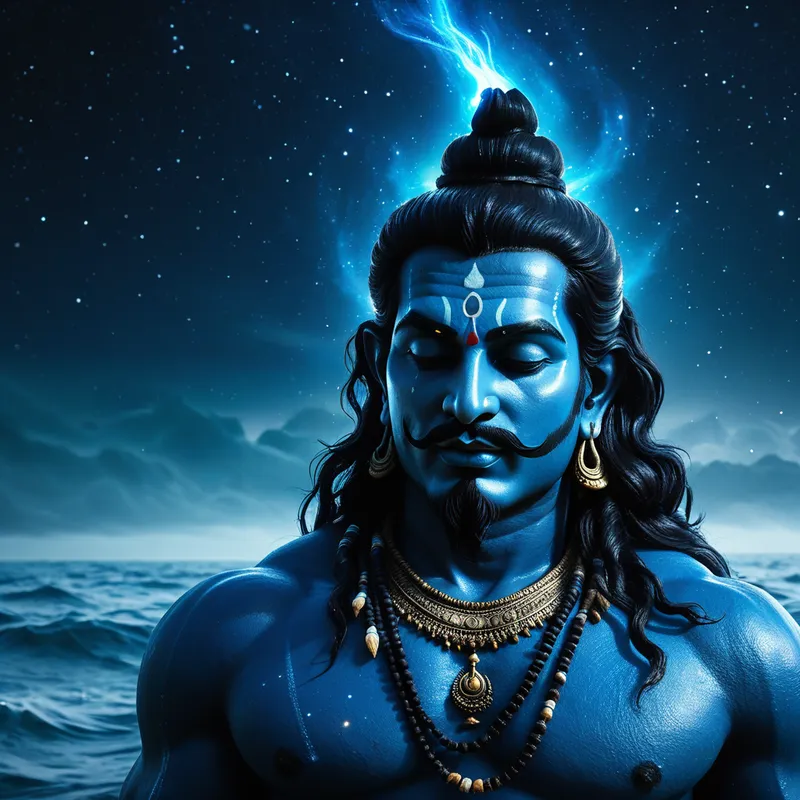
And Shiva, who contains all opposites within his being, simply smiled. As the black tide of annihilation rose to consume the cosmos, he gathered it in his hands. Then, to the awe and horror of all assembled, he brought it to his lips and drank. The poison burned, a fire to end all fires. But Shiva did not perish. His consort, Parvati, pressed her hand to his throat, containing the toxicity, staining it a permanent, luminous blue. Thus, he became Neelakantha, the one who holds destruction within his own body.
Only after this supreme act of containment did the ocean yield its wonders: the divine cow, [the moon](/myths/the-moon “Myth from Tarot culture.”/), the goddess of wine, the celestial physician, and finally, radiant and glorious, the pot of Amrita itself. The truce shattered in an instant over the prize, leading to a great celestial battle, but the world had been saved. Not by the nectar, but by the one who swallowed the poison.
Cultural Origins & Context
This myth, known as the [Samudra Manthan](/myths/samudra-manthan “Myth from Hindu culture.”/), is a cornerstone narrative within the vast corpus of Hindu Puranic literature. It appears in several major texts, including the Mahabharata and the Vishnu Purana. Its function was never merely explanatory but profoundly cosmological and ethical. Told by sages to kings and commoners alike, it served as a metaphysical map.
It explained the origin of celestial objects (the moon, the sun), divine beings, and precious things. More importantly, it modeled a cosmic order where creation is not a peaceful event but a violent, collaborative extraction. It placed the divine struggle not between absolute good and evil, but between forces of order (Devas) and expansive, chaotic power (Asuras), both of which are necessary for the work of the world. The myth reinforced the idea that the path to immortality (spiritual or societal) requires confronting and integrating the most toxic elements of existence, a task that often falls to the transcendent, transformative aspect of the divine.
Symbolic Architecture
The [ocean](/symbols/ocean “Symbol: The ocean symbolizes the vastness of the unconscious mind, representing deeper emotions, intuition, and the mysteries of life.”/) here is not merely [water](/symbols/water “Symbol: Water symbolizes the subconscious mind, emotions, and the flow of life, representing both cleansing and creation.”/); it is the Prakriti, the unconscious, churning potentiality of existence itself. The churning is the [agony](/symbols/agony “Symbol: Intense physical or emotional suffering, often representing unresolved pain, internal conflict, or profound transformation.”/) of [consciousness](/symbols/consciousness “Symbol: Consciousness represents the state of awareness and perception, encompassing thoughts, feelings, and experiences.”/), the [friction](/symbols/friction “Symbol: Friction represents resistance, conflict, or the necessary tension required for movement and transformation in dreams.”/) required to bring latent potentials into manifest [reality](/symbols/reality “Symbol: Reality signifies the state of existence and perception, often reflecting one’s understanding of truth and life experiences.”/).
The nectar of immortality is always found at the bottom of the cup of poison. One cannot be reached without first confronting the other.
The Devas and Asuras represent the eternal psychic polarity within the individual and the [cosmos](/symbols/cosmos “Symbol: The entire universe as an ordered, harmonious system, often representing the totality of existence, spiritual connection, and the unknown.”/): [spirit](/symbols/spirit “Symbol: Spirit symbolizes the essence of life, vitality, and the spiritual journey of the individual.”/) and matter, light and [shadow](/symbols/shadow “Symbol: The ‘shadow’ embodies the unconscious, repressed aspects of the self and often represents fears or hidden emotions.”/), restraint and desire. Their forced collaboration signifies that profound transformation cannot be achieved by one [aspect](/symbols/aspect “Symbol: A distinct feature, quality, or perspective of something, often representing a partial view of a larger whole.”/) of [the self](/myths/the-self “Myth from Jungian culture.”/) alone; [the ego](/myths/the-ego “Myth from Jungian culture.”/) (Deva) must enlist the power of the unconscious, instinctual drives (Asura). The sinking [mountain](/symbols/mountain “Symbol: Mountains often symbolize challenges, aspirations, and the journey toward self-discovery and enlightenment.”/) is [the ego](/myths/the-ego “Myth from Jungian culture.”/)‘s collapse under the [weight](/symbols/weight “Symbol: Weight symbolizes burdens, responsibilities, and emotional loads one carries in life.”/) of this endeavor, requiring the supportive, grounding [presence](/symbols/presence “Symbol: Presence in dreams often signifies awareness or acknowledgment of something significant in one’s life.”/) of [the Self](/myths/the-self “Myth from Jungian culture.”/) (Vishnu as Kurma).
But the central, shocking [symbol](/symbols/symbol “Symbol: A symbol can represent an idea, concept, or belief, serving as a powerful tool for communication and understanding.”/) is the Vomiting—the [eruption](/symbols/eruption “Symbol: A sudden, violent release of pent-up energy or emotion from beneath the surface, often representing transformation or crisis.”/) of Halahala. This is [the shadow](/myths/the-shadow “Myth from Jungian culture.”/), the repressed [trauma](/symbols/trauma “Symbol: A deeply distressing or disturbing experience that overwhelms the psyche, often manifesting in dreams as unresolved emotional wounds or psychological injury.”/), the psychic toxicity that must surface when we dare to agitate the [depths](/symbols/depths “Symbol: Represents the subconscious, hidden emotions, or foundational aspects of the self, often linked to primal fears or profound truths.”/) of our being in search of wholeness. It is the rage, [grief](/symbols/grief “Symbol: A profound emotional response to loss, often manifesting as deep sorrow, yearning, and a sense of emptiness.”/), and fear we have buried. Shiva’s act is the ultimate [archetype](/symbols/archetype “Symbol: A universal, primordial pattern or prototype in the collective unconscious that shapes human experience, behavior, and creative expression.”/) of containment and [transmutation](/symbols/transmutation “Symbol: A profound, alchemical process of fundamental change where one substance or state transforms into another, often representing spiritual evolution or personal metamorphosis.”/). He does not reject the poison; he ingests it, neutralizes it through his own transformative essence, and wears its [mark](/symbols/mark “Symbol: A ‘mark’ often symbolizes identity, achievement, or a defining characteristic in dreams.”/) as an [ornament](/symbols/ornament “Symbol: An ornament often symbolizes celebration, beauty, and the adornment of life during special occasions.”/). The blue [throat](/symbols/throat “Symbol: Represents communication, expression, and the transmission of thoughts.”/) is the [symbol](/symbols/symbol “Symbol: A symbol can represent an idea, concept, or belief, serving as a powerful tool for communication and understanding.”/) of the [capacity](/symbols/capacity “Symbol: A measure of one’s potential, limits, or ability to contain, process, or achieve something, often reflecting self-assessment or external demands.”/) to hold unbearable [tension](/symbols/tension “Symbol: A state of mental or emotional strain, often manifesting physically as tightness, pressure, or unease, signaling unresolved conflict or anticipation.”/) without being destroyed by it.
The Dreamer’s Resonance
When this myth stirs in the modern unconscious, it often manifests in dreams of overwhelming, toxic emergence. The dreamer may find themselves by a sea vomiting black sludge, or in a room filling with a suffocating, dark gas. There may be a sense of a necessary but terrifying collaboration with a disliked or feared figure (an Asura). The somatic experience is one of deep anxiety, nausea, or constriction in the throat—a direct echo of Halahala.
Psychologically, this signals a critical phase of shadow-work. The ego has begun a profound process of “churning”—perhaps through therapy, a life crisis, or deep introspection—and the initial yield is not insight or peace, but the raw, undigested poison of the past. The dream is not a warning to stop, but an affirmation that this horrific emergence is part of the prophesied process. The question the dream poses is: Where is your Shiva? Where in your [psyche](/myths/psyche “Myth from Greek culture.”/) is the capacity to hold, contain, and transform this toxicity without letting it annihilate you or spill out to destroy your world?
Alchemical Translation
The individuation journey modeled here is not a gentle path to enlightenment. It is the Samudra Manthan of the soul. The first step is recognizing the “loss of immortality”—a feeling of existential depletion, a life that has lost its vitality and meaning. The ego (Deva) must then make the humbling pact with the shadow (Asura), acknowledging that the power it needs lies in what it has rejected.
The churning is the active engagement with the unconscious through imagination, active dialogue, and bearing the tension of opposites. The inevitable “vomiting” is the eruption of neurosis, old wounds, and destructive patterns as they come to the surface. This is the critical juncture. The common impulse is to flee, to reject this poison, to project it onto others or suppress it again.
The alchemical secret is that the poison, when fully consciously ingested and held, becomes the very substance of the philosopher’s stone. It is the prima materia of transformation.
The “Shiva function” is the development of a witnessing consciousness, a transcendent inner space that can observe the toxicity without identifying with it. It is the act of “swallowing”—fully accepting the reality of this darkness as part of oneself, without judgment or panic. This containment allows the poison to be metabolized. The blue throat—the Neelakantha state—is the achieved state where one’s vulnerability (the throat) becomes one’s greatest strength, marked by the wisdom of survived dissolution.
Only after this ordeal can the true treasures emerge: creative inspiration (the divine cow), soothing beauty (the moon), healing wisdom (the physician), and the ultimate prize—not an external potion, but the integrated, immortal Self (Amrita) that was hidden within the depths all along. The myth teaches that wholeness is not the absence of poison, but the divine capacity to wear its blue stain as a crown.
Associated Symbols
Explore related symbols from the CaleaDream lexicon: