Völva's Tapestry Myth Meaning & Symbolism
A seeress weaves the fates of gods and men on a cosmic loom, revealing the intricate, unbreakable threads that bind all existence.
The Tale of Völva’s Tapestry
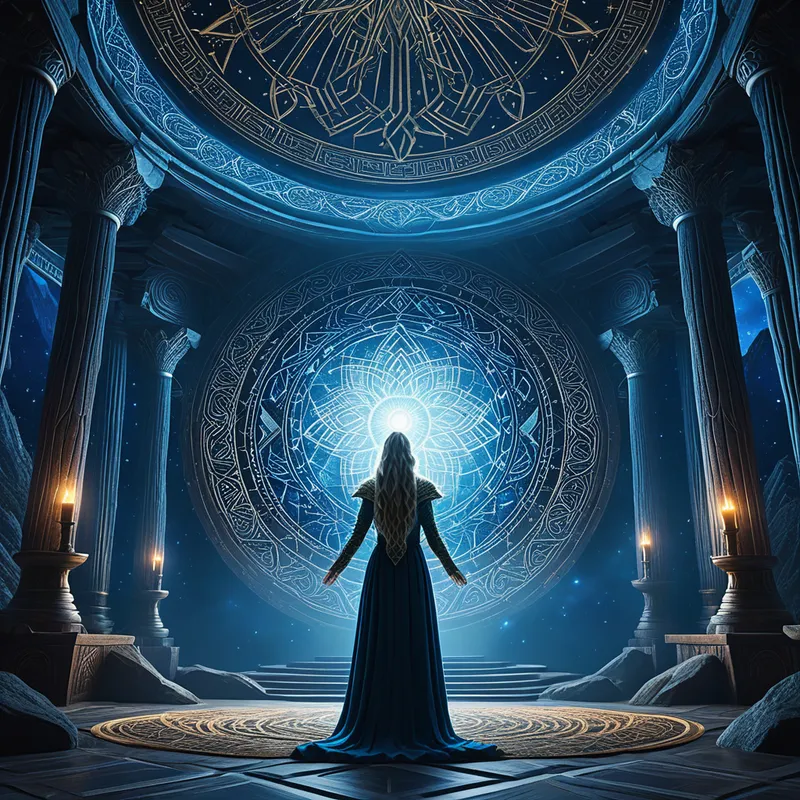
Listen, and hear the whisper of the warp and the song of the weft. In the time before memory, when the mists of [Ginnungagap](/myths/ginnungagap “Myth from Norse culture.”/) still clung to the bones of [the world](/myths/the-world “Myth from Tarot culture.”/), there lived a [Völva](/myths/vlva “Myth from Norse culture.”/) older than the mountains. She did not dwell in the golden halls of Asgard nor in the deep mines of the dvergr. Her hall was the high, wind-scoured crag, her roof the vault of stars, her hearth a single, undying ember plucked from the heart of [Muspelheim](/myths/muspelheim “Myth from Norse culture.”/).
Her name is lost, for names are for things that have beginnings, and she seemed to have always been. She was the Keeper of the Loom. Before her stretched not wood and cord, but the very stuff of potential—threads spun from the breath of the Ymir, from the first frost, from the spark of thought in Odin’s mind. This was the ørlög—the primal layer, the unalterable ground of being.
One day, a shadow fell across her work. It was Odin Allfather, his single eye burning with a hunger no mead could quench. He had given an eye at [Mímisbrunnr](/myths/mmisbrunnr “Myth from Norse culture.”/), had hung nine nights on [Yggdrasil](/myths/yggdrasil “Myth from Global/Universal culture.”/), but the sight of the tapestry stole his breath. “Seeress,” he said, his voice the rumble of distant thunder. “I see the threads of my sons, of Thor and Höðr. I see the binding of [Fenrir](/myths/fenrir “Myth from Norse culture.”/) and the death of Baldr. Is this all fixed? Are we but puppets on your strings?”
[The Völva](/myths/the-vlva “Myth from Norse culture.”/) did not look up. Her shuttle, carved from the rib of a long-dead giant, flew. “I weave the ørlög, Allfather. The great tree’s roots, the serpent’s coil, the first sunrise and the last. This is the pattern laid at the dawn.”
“But the smaller threads,” Odin pressed, pointing to a vibrant, twisting strand of gold that wove through the grey of a mortal king’s life. “This choice, this betrayal, this moment of courage? Who guides these?”
A ghost of a smile touched the Völva’s lips. “The loom is fixed. The warp is ørlög. But the weft…” She held up her hands, and Odin saw that between her fingers were not one, but countless shuttles, each a different hue. “The weft is hamingja. It is the thread you spin with every action, every oath, every silent thought. You cannot break the warp, but with your will, you choose the color, the texture, the pattern of the weft that crosses it. You weave your own glory and your own ruin into the greater cloth.”
Odin watched, his eye tracing a single red thread—his own—as it intertwined with others, strengthening some, straining others, creating a knot of terrible, beautiful complexity around the image of the great wolf, Fenrir. He saw that his own actions, his fears and his strategies, were the very weft that tightened the bindings of fate he sought to avoid. He had come seeking a secret to escape the pattern, and found instead that he was its most diligent co-creator. In silence, he bowed his head, not in defeat, but in awe-stricken understanding. The Völva’s hands never ceased their motion, weaving the immutable with the chosen, the fate of gods with the deeds of men, in an endless, breathtaking tapestry.
Cultural Origins & Context
The figure of the Völva was a potent and respected reality in the Norse world, not merely a mythological fancy. These were women who operated outside the conventional social structure, traveling between settlements to perform seiðr. Their prophecies, delivered in a state of ecstatic trance, were sought for crucial decisions on war, harvest, and leadership.
The specific motif of the weaving Norn or Völva is deeply embedded in the poetic and archaeological record. The [Norns](/myths/norns “Myth from Nordic culture.”/)—Urðr, Verðandi, and [Skuld](/myths/skuld “Myth from Norse culture.”/)—are said to weave [the fates](/myths/the-fates “Myth from Greek culture.”/) of men at the well of Urðr beneath Yggdrasil. This myth likely evolved from, and was transmitted by, the very völur who saw their craft as a sacred, cosmological act. The story served a societal function far beyond entertainment; it was a metaphysical map. It explained the tension between predetermined destiny (ørlög) and personal agency (hamingja), a central anxiety in a culture that valued heroic action yet lived under the stark shadow of an inescapable [Ragnarök](/myths/ragnark “Myth from Norse culture.”/).
Symbolic Architecture
At its core, the myth presents a profound model of [reality](/symbols/reality “Symbol: Reality signifies the state of existence and perception, often reflecting one’s understanding of truth and life experiences.”/) as an interwoven fabric. The Loom represents the fixed [structure](/symbols/structure “Symbol: Structure in dreams often symbolizes stability, organization, and the framework of one’s life, reflecting how one perceives their environment and personal life.”/) of existence—the laws of [physics](/symbols/physics “Symbol: Physics in dreams represents the desire to understand life’s fundamental rules, patterns, and predictable outcomes through playful exploration.”/), the circumstances of our [birth](/symbols/birth “Symbol: Birth symbolizes new beginnings, transformation, and the potential for growth and development.”/), the unchangeable past. This is the warp.
The warp is the given, the bones of the world. To struggle against it is to break oneself upon it.
The weft, however, is the dynamic principle of [consciousness](/symbols/consciousness “Symbol: Consciousness represents the state of awareness and perception, encompassing thoughts, feelings, and experiences.”/) and [choice](/symbols/choice “Symbol: The concept of choice often embodies decision-making, freedom, and the multitude of paths available in life.”/). It is the thread we actively pass through the fixed structure. Each [decision](/symbols/decision “Symbol: A decision in a dream reflects the choices one faces in waking life and can symbolize the pursuit of clarity and resolution.”/), each [relationship](/symbols/relationship “Symbol: A representation of connections we have with others in our lives, often reflecting our emotional state.”/), each act of courage or cowardice is a colored strand that crosses the warp, creating the unique, emergent [pattern](/symbols/pattern “Symbol: A ‘Pattern’ in dreams often signifies the underlying structure of experiences and thoughts, representing both order and the repetitiveness of life’s situations.”/) of a [life](/symbols/life “Symbol: The symbol of ‘Life’ represents a journey of growth, interconnectedness, and existential meaning, encompassing both the joys and challenges that define human experience.”/). The Völva herself symbolizes the witnessing consciousness that perceives both layers simultaneously—the impersonal [fate](/symbols/fate “Symbol: Fate represents the belief in predetermined outcomes, suggesting that some aspects of life are beyond human control.”/) and the personal [story](/symbols/story “Symbol: The symbol of ‘Story’ represents the narrative woven through our lives, embodying experiences, lessons, and emotions that shape our identities.”/). She is not a puppeteer, but the ultimate artisan, demonstrating how the two are inseparable.
Odin’s [journey](/symbols/journey “Symbol: A journey in dreams typically signifies adventure, growth, or a significant life transition.”/) to her loom is the archetypal [quest](/symbols/quest “Symbol: A quest symbolizes a journey or search for purpose, fulfillment, or knowledge, often representing life’s challenges and adventures.”/) for forbidden [knowledge](/symbols/knowledge “Symbol: Knowledge symbolizes learning, understanding, and wisdom, embodying the acquisition of information and enlightenment.”/). His shock mirrors our own when we confront the uncomfortable [truth](/symbols/truth “Symbol: Truth represents authenticity, honesty, and the quest for knowledge beyond mere appearances.”/) that our freedom exists within a [framework](/symbols/framework “Symbol: Represents the underlying structure of one’s identity, emotions, or life. It signifies the mental or emotional scaffolding that supports or confines the self.”/) of limitation, and that our attempts to avoid fate often weave its pattern more tightly.
The Dreamer’s Resonance
When this myth surfaces in modern dreams, it often manifests during periods of feeling trapped by circumstance—a job, a relationship, a health diagnosis. The dreamer may find themselves before a vast, incomprehensible machine (a modern translation of the loom) or tangled in threads. They may be trying to cut a specific thread (a desire to escape a fate) or frantically trying to re-weave a section that has gone wrong (an attempt to undo the past).
Somatically, this can feel like a constriction in the chest or a literal heaviness, as if weighed down by invisible bonds. Psychologically, this is the process of confronting one’s personal ørlög—the inherited traumas, cultural conditioning, and biological givens that form the warp of one’s life. The dream is an invitation from the unconscious to stop trying to flee the loom and instead to pick up the shuttle. The anxiety is not about the pattern’s existence, but about the dreamer’s perceived powerlessness to contribute to it.
Alchemical Translation
The alchemical process modeled here is the coniunctio oppositorum—[the sacred marriage](/myths/the-sacred-marriage “Myth from Various culture.”/) of opposites. In the [psyche](/myths/psyche “Myth from Greek culture.”/), this is the integration of the conscious ego (Odin, the willful hero) with the objective psyche, [the Self](/myths/the-self “Myth from Jungian culture.”/) (the Völva, the timeless witness). The fixed warp represents the Senex principle: structure, order, limitation, and time. The flowing weft represents the Puer principle: possibility, energy, creativity, and impulse.
Individuation is not the destruction of the loom, but the conscious, creative act of taking up one’s own shuttle.
The modern individual’s “hero’s journey” is not to slay [the dragon](/myths/the-dragon “Myth from Chinese culture.”/) of fate, but to sit before it, as Odin did, and see its true nature. The transmutation occurs in the moment of realization: my limitations are not my prison, but the very framework upon which I can create meaning. My hamingja, my luck and character, is the active ingredient. The alchemical gold is the uniquely patterned life that emerges when we stop raging against the unchangeable warp and instead pour our fullest, most authentic will into the weft of our daily choices. We become, at last, co-weavers at the edge of the world, our small, bright threads forever part of the immense and terrible beauty of the whole.
Associated Symbols
Explore related symbols from the CaleaDream lexicon: