Völva's Spindle Myth Meaning & Symbolism
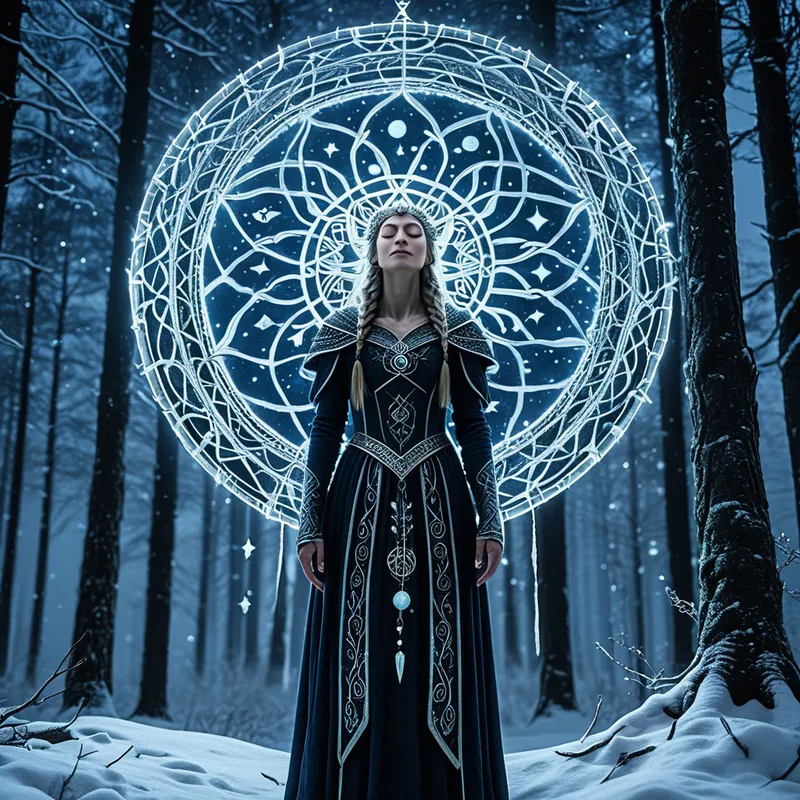
A seeress spins the threads of destiny at the foot of the World Tree, weaving the fates of gods and mortals into a single, unbreakable tapestry.
The Tale of Völva’s Spindle
Listen, and hear the whisper in the roots of the Yggdrasil. Hear the groan of ice on the primeval well, and the sigh of the wind through skeletal branches. In that place where time is not a river but a deep, still pool, she sits. The Völva. Her cloak is the grey of forgotten mist, her hair the white of the first winter frost. She does not see with the eyes in her head, for they are rolled back, gazing into the well of ørlög—the layers of law laid down before the worlds were born.
Before her, the raw stuff of existence drifts like nebular clouds: not wool, but the potential of all things—the scream of a newborn jotun, the silent growth of a seed in dark earth, the first thought of a god, the last breath of a hero. With hands that have known the touch of fire and ice, she gathers this nebulous matter. Her spindle, carved from the bone of a beast that swam before the sun, is cold and heavy. She sets it spinning.
A hum begins, a vibration older than song. The spindle draws the potential into itself, twisting chaos into thread. A strand of brilliant gold emerges—the life of a mighty king, his deeds shining. But into it, she spins a thread of iron-grey, the thread of his pride and his coming fall. A strand of deep blue, the love of a mother for her child, is woven with a filament of blood-red, the thread of sacrifice. She does not choose. She perceives. Her fingers merely guide what already is, pulling the threads from the well of Urðr and weaving them onto the shaft of Verðandi.
The threads multiply, a river of light and shadow flowing from her hands. They do not tangle, for each finds its place in the vast tapestry that is slowly revealed not on a loom, but in the very air around her. You see cities rise in silver threads, and fall in threads of ash. You see the Bifröst shimmer, and you see the dark runes of Ragnarök being spun into its very fabric. The great serpent Jörmungandr is a coiling, endless thread of venomous green. The great wolf Fenrir is a snarling knot of black and crimson strands, growing tighter.
And the gods? Even Odin, who gave his eye for wisdom, rides on a thread he did not spin. He can see its path, feel its pull, but he cannot break it. The Völva works on, her face a mask of timeless knowing, of burden and necessity. The spindle turns. The tapestry grows. It is not a story with an end, but a living pattern, breathing with the rhythm of the turning worlds. The final thread is not yet spun, for it is always now that is being woven from the raw stuff of what was and the impending shape of what shall be.
Cultural Origins & Context
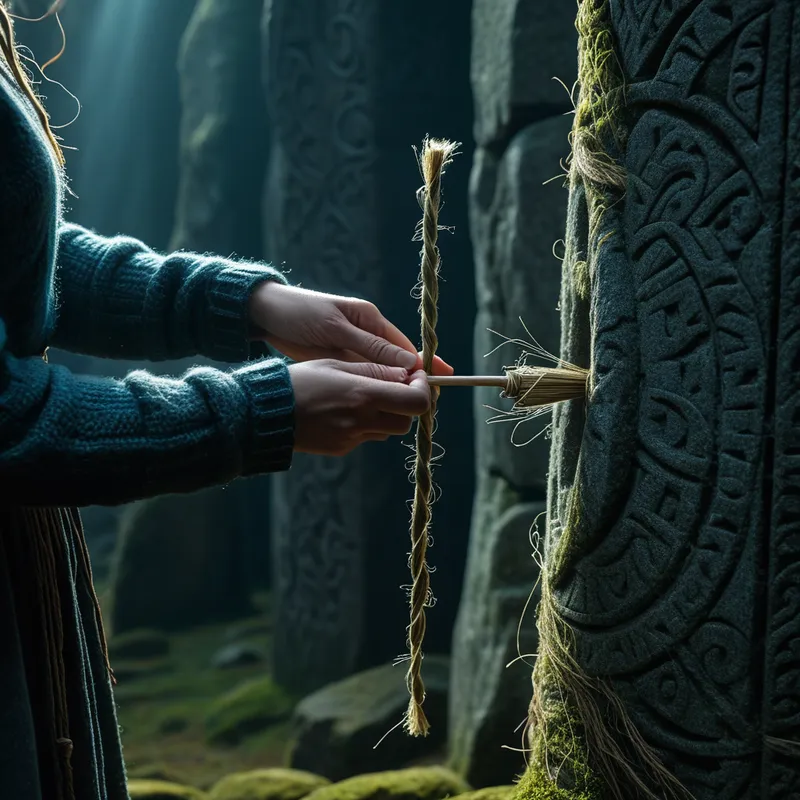
The figure of the Völva was not merely a character in myth, but a potent social and spiritual reality in the Norse world. These were women of power, often traveling alone or with an escort, who practiced seiðr—a form of prophecy and magic that involved entering trance states to perceive the hidden layers of reality. The myth of her spindle is the cosmological projection of her societal role: the one who discerns and articulates fate.
This narrative is woven from fragments found primarily in the Völuspá (“The Prophecy of the Seeress”) and supported by other eddic sources. In Völuspá, the seeress is summoned by Odin to recount the history and future of the worlds. Her narration is the framework of the poem, suggesting that the very cosmology of the Norse people was understood and transmitted through the voice and vision of the Völva. The spindle is her tool, the instrument of her sight. It represents the active process of fate—not as a static, written decree, but as a continuous act of creation and binding.
The myth functioned as a foundational explanation for the nature of reality. It presented a universe governed by impersonal, weaving forces—the Norns—who were distinct from, and ultimately more powerful than, the gods themselves. This created a cultural psychology of profound fatalism, but also of immense courage. If one’s thread was already spun, then the measure of a life was not in altering its length, but in the quality and honor with which one lived it, making the pattern of one’s strand glorious within the greater tapestry.
Symbolic Architecture
The spindle is the axis mundi of this myth, the central pole around which reality organizes itself. It is not a tool of making in the creative, generative sense of a builder. It is a tool of manifestation, of drawing the implicit into the explicit.
The spindle does not create the thread; it reveals the thread that was always there, hidden within the unformed mass of possibility.
The raw material—the nebulous wool—symbolizes the undifferentiated unconscious, the primal chaos of Ginnungagap, and the collective potential of all lives and events. The act of spinning is the act of consciousness itself, of bringing discrete, linear experience (the thread) out of the nonlinear, simultaneous potential of the unconscious. The Völva, then, is the archetype of the objective psyche, the Self that perceives the totality of an individual’s or a culture’s pattern without personal bias or desire.
The resulting tapestry is the manifest world—Midgard—and the interconnected web of ørlög. Each thread is an individual life, a lineage, an idea, but it has no meaning in isolation. Its meaning, its strength, and its weakness are defined entirely by its relationship to every other thread in the weave. The dark threads of failure, death, and Ragnarök are not mistakes; they are essential to the structural integrity and beauty of the whole. The myth asserts that destruction is woven into the pattern of creation from the very beginning.
The Dreamer’s Resonance
When the motif of Völva’s Spindle appears in modern dreams, it signals a profound encounter with the psyche’s own fate-making machinery. The dreamer is not merely reviewing their past or anxieties about the future; they are standing at the point where their personal narrative is being actively spun from the raw material of their instincts, complexes, and unlived potentials.
To dream of watching the spindle spin may indicate a period of fateful introspection, where one feels their life’s direction is being determined by forces beyond their ego’s control—a career change, the end of a relationship, a calling. To dream of holding the spindle, however, is a potent symbol of taking active, conscious responsibility for one’s own weaving. The somatic feeling is often one of immense weight and dizzying motion in the hands, coupled with a strange, detached clarity. The dreamer may feel both powerful and terrified, realizing they are spinning their own thread from a mass of chaotic emotions and memories.
Dreams of tangled or broken threads speak to a psychological crisis of meaning—a feeling that one’s life narrative has become incoherent or severed. Conversely, dreaming of a brilliantly colored, strong thread suggests alignment with one’s deep purpose. The appearance of the Völva herself, the impassive weaver, often represents the emergence of a non-egoic, guiding intelligence from the unconscious, a inner sage who sees the larger pattern the ego cannot.
Alchemical Translation
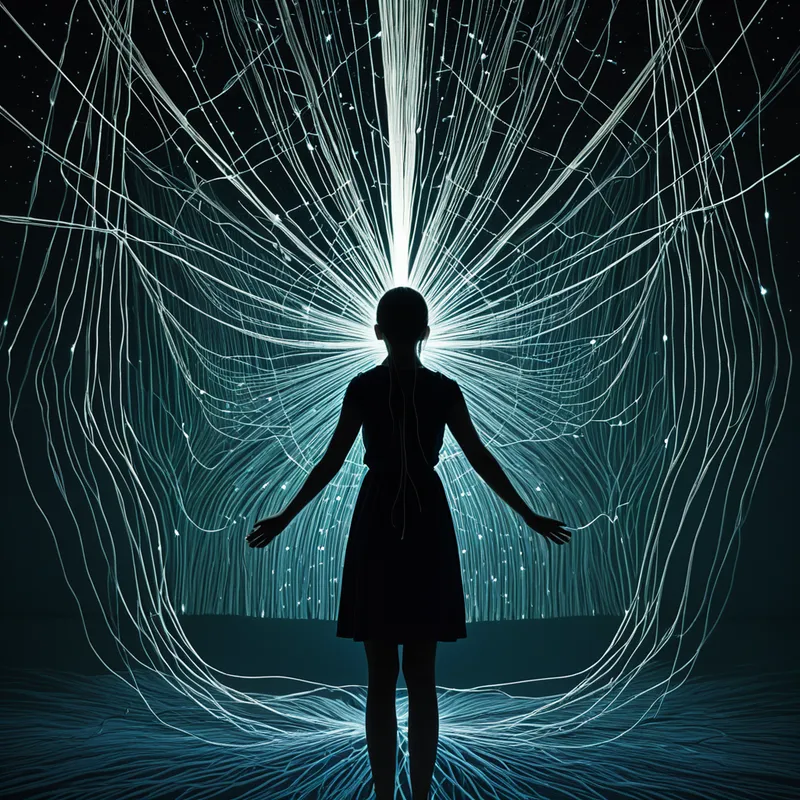
For the modern individual, the myth of the spindle models the alchemical process of individuation—the journey toward wholeness by integrating the unconscious into consciousness. The ego initially identifies with a single, small strand of the tapestry: “my story,” “my will,” “my plan.” The first stage of the work is to recognize that this strand is not self-spun; it is woven from the inherited ørlög of family, culture, and trauma—the raw wool we did not choose.
The alchemical operation is to take up the spindle of consciousness and begin, with great effort, to re-spin one’s own thread from the same raw material, introducing the gold of awareness into the twist.
This is the “opus,” the great work. It involves gathering the nebulous contents of the personal and collective unconscious—the dreams, the shadows, the forgotten talents, the ancestral pains—and, like the Völva, submitting them to the turning, integrating motion of conscious reflection. We spin our complexes into insight, our fate into destiny. We do not change the fundamental material (our core nature, our past), but we change its form and its relationship to the whole.
The triumph is not in escaping the tapestry, but in seeing one’s place within it and weaving with intention. To become the Völva of one’s own psyche is to achieve the “sage” archetype: to hold the tension between the impersonal fate of the thread and the personal responsibility of the weaver. One realizes that the spindle turning in one’s soul is the same spindle that turns the stars. The individual thread, consciously spun, becomes a vital, luminous contribution to the grand, terrible, and beautiful pattern of being. The final transmutation is understanding that to know your thread is to know yourself, and in that knowing, you touch the weave of the world.
Associated Symbols
Explore related symbols from the CaleaDream lexicon: