Völva's Distaff Myth Meaning & Symbolism
A myth of the seeress whose spinning distaff holds the threads of fate, challenging even the gods with the unyielding patterns of wyrd.
The Tale of Völva’s Distaff
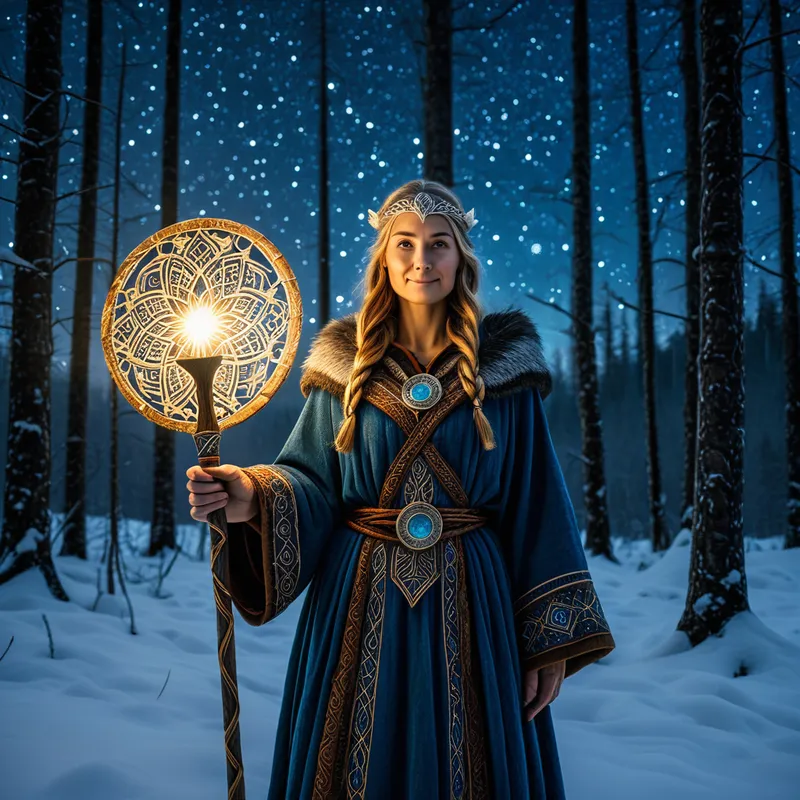
Listen. The wind does not just blow through the pines; it carries whispers from the roots of the Yggdrasil. The snow does not merely fall; it is the ash from the forge of time. And in the deep folds of Midwinter, when the sun is a memory and the world holds its breath, she walks. She is the Völva. Her cloak is the color of raven wings at midnight, her staff not of travel, but of knowing—a distaff of ancient yew, carved with runes that drink the starlight.
She comes not to a hall of men, but to a clearing where the veil is thin. No fire is lit, yet a cold, blue light emanates from the bundle of fibers in her hand—not wool, but the raw stuff of wyrd. She sits upon her seiðhjallr, and the very air stills. The spirits of the land, the landvættir, fall silent. The distant howl of a wolf ceases mid-cry.
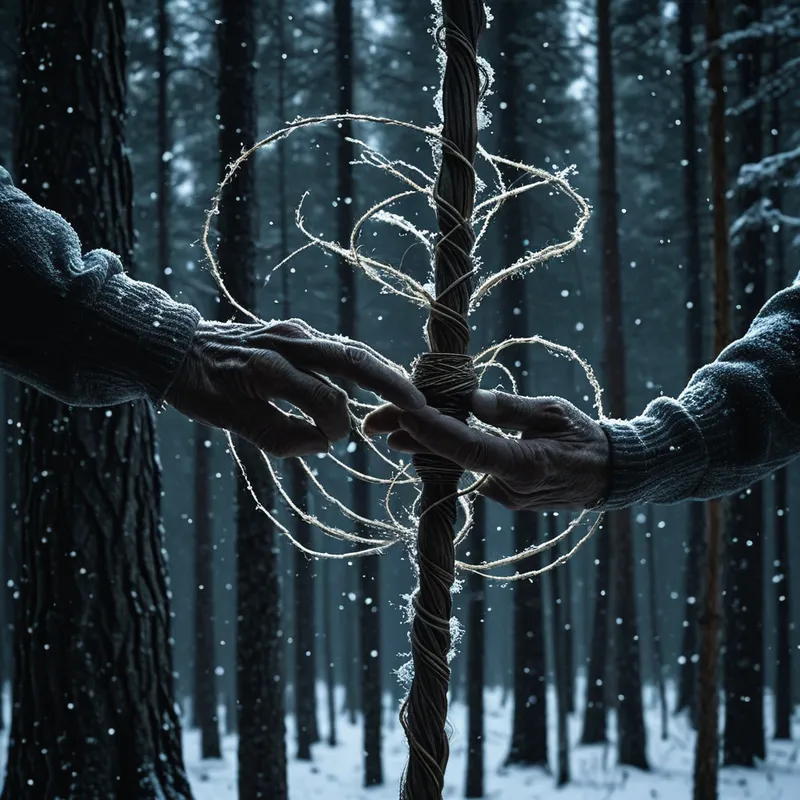
Her fingers, gnarled like old roots, begin their work. To spin is to pull the future from the chaos of the past. Each pull of the thread is a breath, a life begun. Each twist is a choice, a turn of fate. She does not look at her work; her eyes are rolled back, white as the snow, seeing the tapestry of all that is and will be. She sees the golden hair of Baldr, and the thread shines with a heartbreaking brilliance. Then she sees the shadow—a thread of mistletoe, slender, overlooked, dark as malice. She tries to guide her fingers, to cast that thread aside, but her hands move of their own accord, bound by a law older than the gods themselves. The dark thread is woven in, inextricable.
She sees the Fenrir growing, its thread a thick, snarling cord of rage and iron. She sees the Jörmungandr, a loop without end, poisoning the seas of fate. The distaff trembles in her hand. The gods themselves, from their high seat in Asgard, feel the shudder in the web. Odin, who gave his eye for a drink from the Mímisbrunnr, knows this tremor. It is the sound of destiny being fixed, not made.
The Völva’s chant rises, a sound like stone grinding on stone, like ice cracking over a deep river. She speaks of the end and the beginning—of Ragnarök, where sun and moon will be swallowed and stars will fall from the sky. She names the fates of gods and giants alike. Her distaff is no longer just wood and fiber; it is the axis of the world, the spindle around which all time turns. And then, as the first grey light of a dawn that feels years away touches the horizon, the vision breaks. The threads fade from her hands. The distaff is once more simple yew. She rises, older than when she sat down, her knowledge a weight in her bones. She walks back into the forest, leaving behind only the imprint of her seat in the snow and the echo of a truth too vast for any heart but hers to hold.
Cultural Origins & Context
The figure of the Völva was a powerful and ambivalent reality in the Norse world. She existed outside the typical social structures of hearth and hall, a traveling practitioner of seiðr. This mythic motif of the spinning prophetess is crystallized primarily in the Old Norse poem Völuspá (“The Prophecy of the Seeress”), where a Völva is summoned by Odin himself to recount the history and future of the cosmos. Her distaff is the tool of her vision. In a society where textile work was the domain of women and a fundamental economic and symbolic activity, the act of spinning was deeply metaphorically charged. The Völva’s distaff, therefore, transforms a domestic tool into an instrument of cosmic revelation. These stories were likely preserved and performed by skalds and storytellers, serving not as entertainment alone, but as a sacred mapping of reality—a way to confront the harsh, fatalistic architecture of the Norse cosmos, where even the gods are subject to wyrd.
Symbolic Architecture
The myth presents a profound symbolic system centered on the act of weaving fate. The Völva herself is the personification of unconscious, ancestral knowledge. She is not a goddess, but a human(ish) conduit to the foundational patterns of existence. Her distaff is the axis of consciousness, the fixed point around which the chaotic raw material of potential (the fibers) is organized into coherent thread—into manifest reality and linear time.
The distaff does not create the thread; it provides the form around which destiny spins itself into being.
The crucial, terrifying element of the myth is her compelled action. She sees the tragic fate of Baldr but cannot stop its weaving. This encapsulates the Norse understanding of fate: it is not random, nor is it purely predetermined by capricious gods. It is a pattern being continuously woven from choices and actions, a pattern so vast and interconnected that to pull one thread (even a dark one) is to unravel the entire tapestry. The Völva’s role is to see and to speak the pattern, not to alter it. She represents the moment of witnessing the inevitable structures of one’s own psyche or life path—the shadow that is inextricably part of the whole self.
The Dreamer’s Resonance
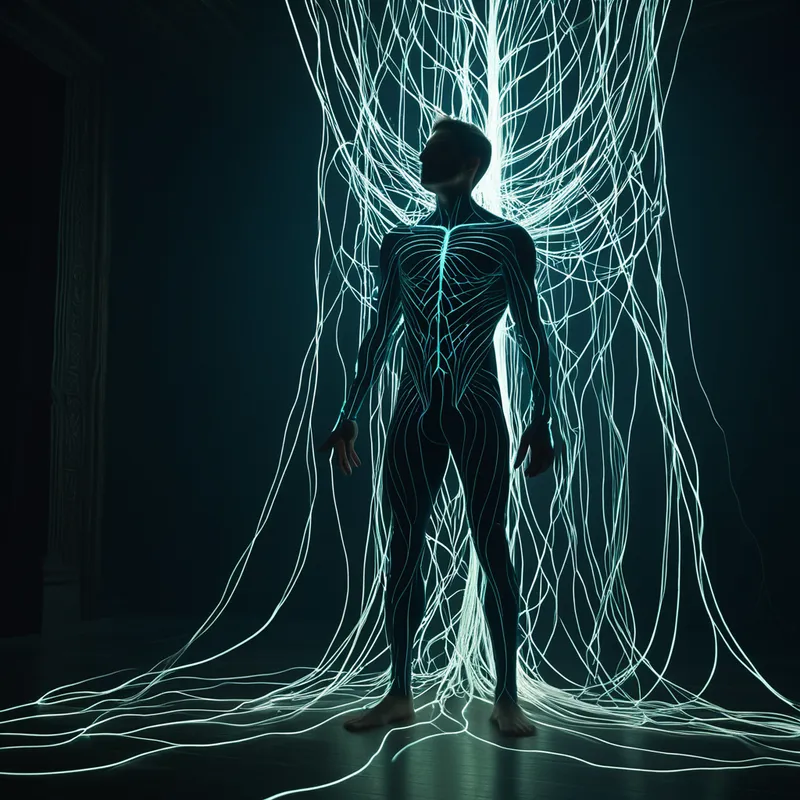
When this myth stirs in the modern unconscious, it often manifests in dreams of being shown a fixed pattern, a map, or a woven tapestry that details one’s own life. The dreamer may feel a somatic sense of awe mixed with dread—the “weight in the bones” the Völva carries. One might dream of finding an old, intricate spindle or loom, or of seeing the threads of one’s relationships as literal, glowing filaments. The psychological process here is the confrontation with personal wyrd: the recognition of the deep, often unconscious, patterns that govern behavior, relationship choices, and life trajectories. It is the psyche’s way of presenting the “script” it has been following. The emotional tone—whether of resignation, terror, or solemn acceptance—indicates the dreamer’s current relationship to these discovered patterns. The dream is an invitation to move from being an unwitting actor in the pattern to becoming its conscious witness.
Alchemical Translation
The individuation process modeled here is not one of heroic victory over fate, but of sacred alignment with it. The modern individual’s “distaff” is the core of the Self—the central, organizing principle of the personality around which the complex threads of persona, shadow, anima/animus, and archetypal influences spin.
The alchemical work is not to cut the dark thread, but to understand its necessity in the complete pattern of the Self.
The first stage is the Völva’s Journey: turning away from the collective “hall” of external expectations and descending into the solitary clearing of self-inquiry. The second is the Seating Upon the High Seat: assuming the authority to look inward, to engage in deep introspection or meditation, despite the fear of what one might see. The third and most critical is the Spinning of the Vision: holding steady as the unconscious reveals its contents—the golden potentials (Baldr) and the poisonous, overlooked shadows (the mistletoe). The triumph is in the endurance of this sight without turning away, in the chanting of the truth of one’s own nature, however difficult. The final stage is the Return, Weighted with Knowledge: integrating this vision into conscious life. One does not become a master of fate, but a respectful partner to it. The individual learns to hold their own distaff—their centered Self—knowing they spin within a larger tapestry, finding meaning not in controlling the weave, but in understanding its profound, unbreakable beauty and necessity.
Associated Symbols
Explore related symbols from the CaleaDream lexicon: