Völva's Circle Myth Meaning & Symbolism
A seeress, a circle of power, and a vision of the world's end that demands a sacrifice of self to hold the pattern of fate.
The Tale of Völva’s Circle
Listen, and let the fire’s crackle become the whisper of wind through the pines of [Yggdrasil](/myths/yggdrasil “Myth from Global/Universal culture.”/). In a time when the boundary between worlds was thin as birch bark, there lived a [Völva](/myths/vlva “Myth from Norse culture.”/) named Rúna. She was not born of gods, but of the deep earth and the high, cold stars. Her sight was not a gift, but a burden she carried like a heavy cloak.
One winter, when the sun fled and the [Jötnar](/myths/jtnar “Myth from Norse culture.”/) breathed ice across the land, a silence fell upon the gods. Odin, the One-Eyed, whose thirst for knowledge was a ravenous beast, felt the pattern of ørlög fraying at the edges. A great shadow was gathering, a question even the Well of [Mimir](/myths/mimir “Myth from Norse culture.”/) could not answer. He sought the one who walked between the threads.
He found Rúna in a sacred grove, the air thick with the scent of damp soil and iron. She did not bow. “You come for a seeing,” she stated, her voice the sound of stone grinding stone. “The price is the vision itself. To look into the heart of the unraveling is to be woven into its pattern.”
Odin agreed, offering a ring of power. She refused. “Your gold is meaningless here. Stand there, and be silent. Do not cross the line.”
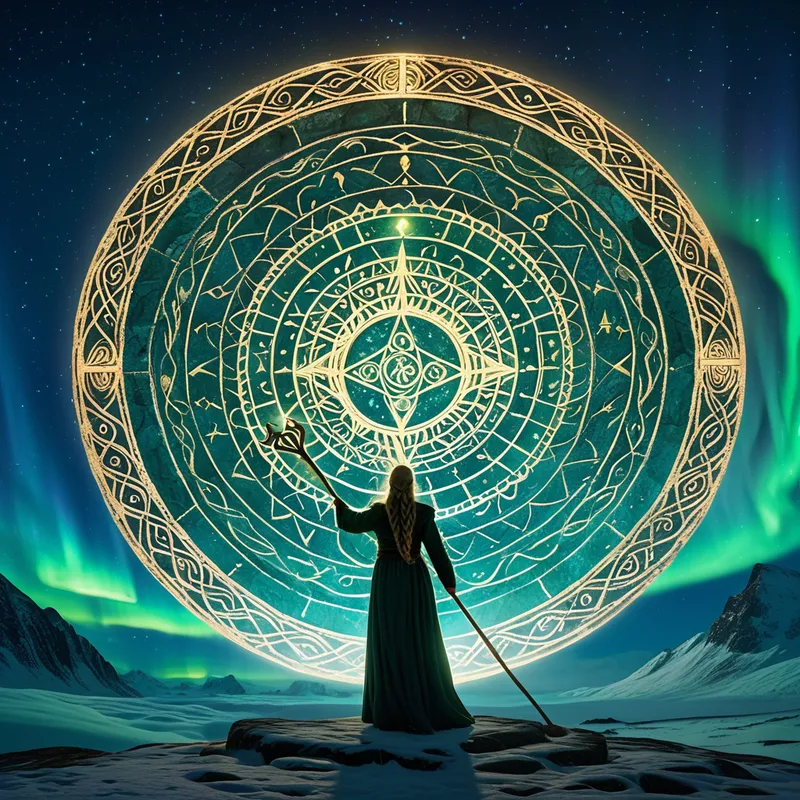
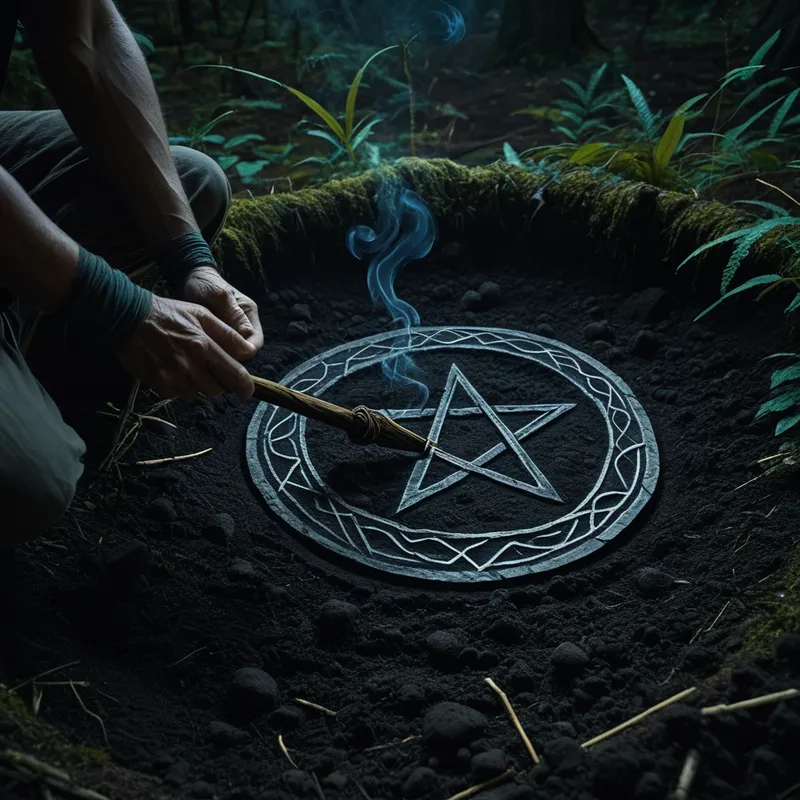
With her staff of ash, she began to walk. Not in a random path, but in a deliberate, widening spiral. As she walked, she chanted names—names of winds, names of rivers, names of stars long dead. With each circuit, she pressed her staff into [the earth](/myths/the-earth “Myth from Hindu culture.”/), scoring a line into the dark soil. The line began to smolder, then glow with a cold, blue-white light. She walked until the circle was complete, a perfect ring of searing luminescence in the clearing’s heart. Inside that circle, [the world](/myths/the-world “Myth from Tarot culture.”/) changed. The grove faded, replaced by the echoing vault of space and the shimmering, tangled web of fate.
Rúna stepped into the center. She raised her arms, and her body grew rigid. Her eyes, open wide, saw not the grove, not Odin, but the terrible tapestry of all that was and would be. She saw the birth of monsters, the breaking of oaths, the final, glorious, and desolate battle of [Ragnarök](/myths/ragnark “Myth from Norse culture.”/). She saw the great wolf [Fenrir](/myths/fenrir “Myth from Norse culture.”/) unbound, the serpent [Jörmungandr](/myths/jrmungandr “Myth from Norse culture.”/) rising, and the fire of [Surtr](/myths/surtr “Myth from Norse culture.”/) consuming the roots of Yggdrasil.
The vision poured into her, a flood of fire and ice. To hold it, to give it form for Odin’s ear, she had to contain it within the circle. The glowing lines flared, containing the psychic cataclysm. But the circle was not just a barrier; it was a lens, and she was its focal point. The knowledge burned through her. When the vision passed, the light of the circle died. Rúna slumped to her knees within the charred ring, her hair turned white, her eyes now seeing the present world as a faint, ghostly echo overlaid with the indelible scars of the future. She spoke the prophecy in a hollow voice, each word a stone dropped into a well. Odin received his answer, his face grim. [The Völva](/myths/the-vlva “Myth from Norse culture.”/) had paid the price. The circle had held the vision, but it had also etched the end of all things permanently onto her soul. She became the living vessel of the pattern she was meant only to observe.
Cultural Origins & Context
The figure of the Völva was a profound and respected reality in the Norse world, documented in sagas like the Völsunga saga and most famously in the poem Völuspá. She was a itinerant seeress, often traveling from community to community with a retinue. Her power, seidr, was a form of magic deeply associated with fate, prophecy, and altering the threads of reality. While practiced by some gods like Odin (who was criticized for engaging in this “unmanly” art), it was predominantly a feminine domain.
The ritual of casting a circle, as depicted in our tale, is an extrapolation grounded in archaeological and literary evidence. Seidr rituals often involved a high seat (seidhjallr), chanting (galdr), and entering a trance state. The circle is a cross-cultural archetype of ritual containment and sacred space—a vé in Old Norse—separating the mundane from the numinous. In a worldview where unseen forces were ever-present, creating a defined space to safely interface with them was not just mystical practice; it was a necessary technology of the soul. The myth of Völva’s Circle, while not a singular recorded story, synthesizes these elements into a narrative that captures the essential danger and solemnity of the seeress’s role: to serve as the community’s conduit to ørlög, knowing full well the cost of such communion.
Symbolic Architecture
At its [heart](/symbols/heart “Symbol: The heart symbolizes love, emotion, and the core of one’s existence, representing deep connections with others and self.”/), Völva’s Circle is a myth about the container and the contained, the knower and the known. The circle itself is the ultimate [symbol](/symbols/symbol “Symbol: A symbol can represent an idea, concept, or belief, serving as a powerful tool for communication and understanding.”/) of wholeness, [boundary](/symbols/boundary “Symbol: A conceptual or physical limit defining separation, protection, or identity between entities, spaces, or states of being.”/), and focus.
The circle is not a wall to hide behind, but a crucible in which the raw chaos of potential is transformed into the coherent pattern of knowledge.
The Völva represents the conscious [psyche](/myths/psyche “Myth from Greek culture.”/) daring to confront the unconscious in its totality—not just [the personal unconscious](/myths/the-personal-unconscious “Myth from Jungian Psychology culture.”/), but the collective, transpersonal [realm](/symbols/realm “Symbol: The symbol of ‘Realm’ often signifies the boundaries of one’s consciousness, experiences, or emotional states, suggesting aspects of reality that are either explored or ignored.”/) of archetypes and primordial patterns (the [prophecy](/symbols/prophecy “Symbol: A foretelling of future events, often through divine or supernatural means, representing destiny, fate, and hidden knowledge.”/) of Ragnarök). Her staff is her directed will and her [connection](/symbols/connection “Symbol: Connection symbolizes relationships, communication, and bonds among individuals.”/) to the [axis](/symbols/axis “Symbol: A central line or principle around which things revolve, representing stability, orientation, and the fundamental structure of reality or consciousness.”/) of the world, Yggdrasil. The [ritual](/symbols/ritual “Symbol: Rituals signify structured, meaningful actions carried out regularly, reflecting cultural beliefs and emotional needs.”/) chant and walking are the disciplined, rhythmic practices that prepare [the ego](/myths/the-ego “Myth from Jungian culture.”/) for its [dissolution](/symbols/dissolution “Symbol: The process of breaking down, dispersing, or losing form, often representing transformation, release, or the end of a state of being.”/) and reformation.
The terrifying [vision](/symbols/vision “Symbol: Vision reflects perception, insight, and clarity — often signifying the ability to foresee or understand deeper truths.”/) of the end of all things symbolizes the psyche’s encounter with its own [shadow](/symbols/shadow “Symbol: The ‘shadow’ embodies the unconscious, repressed aspects of the self and often represents fears or hidden emotions.”/) on a cosmic scale—the inevitable dissolution of all constructs, all identities, all that the ego holds dear. The circle’s brilliant light holding back this flood represents the fragile, yet essential, [strength](/symbols/strength “Symbol: ‘Strength’ symbolizes resilience, courage, and the ability to overcome challenges.”/) of the conscious mind and its symbolic structures (ritual, [language](/symbols/language “Symbol: Language symbolizes communication, understanding, and the complexities of expressing thoughts and emotions.”/), art) which allow us to process the unbearable without being utterly annihilated by it. The Völva’s transformation—her whitened [hair](/symbols/hair “Symbol: Hair often symbolizes identity, power, and self-expression, reflecting how we perceive ourselves and how we wish to be perceived by others.”/), her dual [sight](/symbols/sight “Symbol: Sight symbolizes perception, awareness, and insight, representing both physical and inner vision.”/)—is the permanent [mark](/symbols/mark “Symbol: A ‘mark’ often symbolizes identity, achievement, or a defining characteristic in dreams.”/) of this encounter. She gains ultimate [knowledge](/symbols/knowledge “Symbol: Knowledge symbolizes learning, understanding, and wisdom, embodying the acquisition of information and enlightenment.”/) but loses her simple humanity. She becomes the embodied [tension](/symbols/tension “Symbol: A state of mental or emotional strain, often manifesting physically as tightness, pressure, or unease, signaling unresolved conflict or anticipation.”/) between [fate](/symbols/fate “Symbol: Fate represents the belief in predetermined outcomes, suggesting that some aspects of life are beyond human control.”/) and freedom.
The Dreamer’s Resonance
When this myth stirs in the modern dreamer, it often manifests as dreams of powerful, charged circles: a circle drawn in sand that must not be broken, a ring of [standing stones](/myths/standing-stones “Myth from Celtic culture.”/) that hums with energy, a round room with a single door. The dreamer may find themselves compelled to stay within the circle or terrified of what lies outside it. There is a profound somatic sense of pressure, of a boundary holding back immense force.
Psychologically, this signals a critical stage in confronting a core, perhaps lifelong, complex or a buried trauma. The “circle” is the temporary container of the therapeutic space, the journal, the trusted relationship, or the dreamer’s own burgeoning self-awareness that makes looking at the wound possible. The “vision” is the traumatic memory or the shocking insight about one’s own patterns breaking into consciousness. The dreamer is the Völva, undergoing the process. The fear is that seeing this truth will destroy them, will “burn them out.” These dreams acknowledge the real danger of psychological work—the old self does die in the process. But the circle, when maintained with respect and discipline, allows for a managed revelation, not a catastrophic fragmentation.
Alchemical Translation
The alchemical process mirrored in Völva’s Circle is the [solve et coagula](/myths/solve-et-coagula “Myth from Alchemical culture.”/)—dissolve and coagulate. The old, ignorant self (the Völva before the ritual) must be dissolved in the acid bath of truth (the vision of Ragnarök). This is the [nigredo](/myths/nigredo “Myth from Alchemical culture.”/), the blackening, the despair of seeing things as they truly are, in all their brokenness and destined ends.
Individuation is not about becoming perfect, but about becoming whole, and wholeness necessarily includes embracing one’s own destined end, one’s mortality, and the shadow that makes the light visible.
The circle is the vas, the sealed vessel of [the alchemist](/myths/the-alchemist “Myth from Various culture.”/), without which the dissolving matter would be lost. It is the enduring structure of [the Self](/myths/the-self “Myth from Jungian culture.”/) (with a capital S), the psychic integrity that holds while the ego is dismantled. The prophecy spoken at the end is the coagula, the new substance formed from the ashes. It is not a “happy ending,” but a coherent narrative. The Völva’s whitened hair symbolizes the albedo, the whitening—she is purified, but also chilled, distant, carrying a wisdom that separates her from ordinary life.
For the modern individual, the myth maps the journey from seeking comfort to seeking meaning, even when that meaning is hard. It teaches that to gain true wisdom—about oneself, one’s relationships, one’s place in the cosmos—one must willingly enter [the sacred circle](/myths/the-sacred-circle “Myth from Various culture.”/) of introspection, call up the darkest visions, and hold the tension within the container of one’s own commitment to truth. The [triumph](/myths/triumph “Myth from Roman culture.”/) is not in avoiding the burn, but in speaking the truth it reveals, even with a scorched soul. One becomes, like the Völva, a steward of the pattern, able to see the weave of fate in the tapestry of daily life, and bear the responsibility of that sight.
Associated Symbols
Explore related symbols from the CaleaDream lexicon: