Vishnu's Dream Myth Meaning & Symbolism
The universe is the dream of the sleeping god Vishnu, a cosmic illusion from which all beings must awaken to their true nature.
The Tale of Vishnu’s Dream
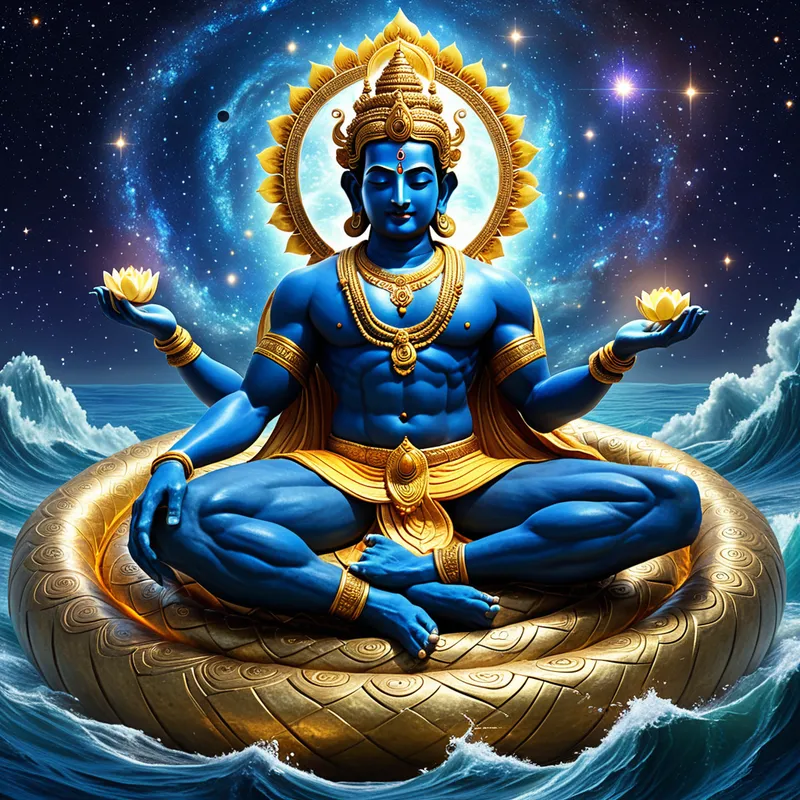
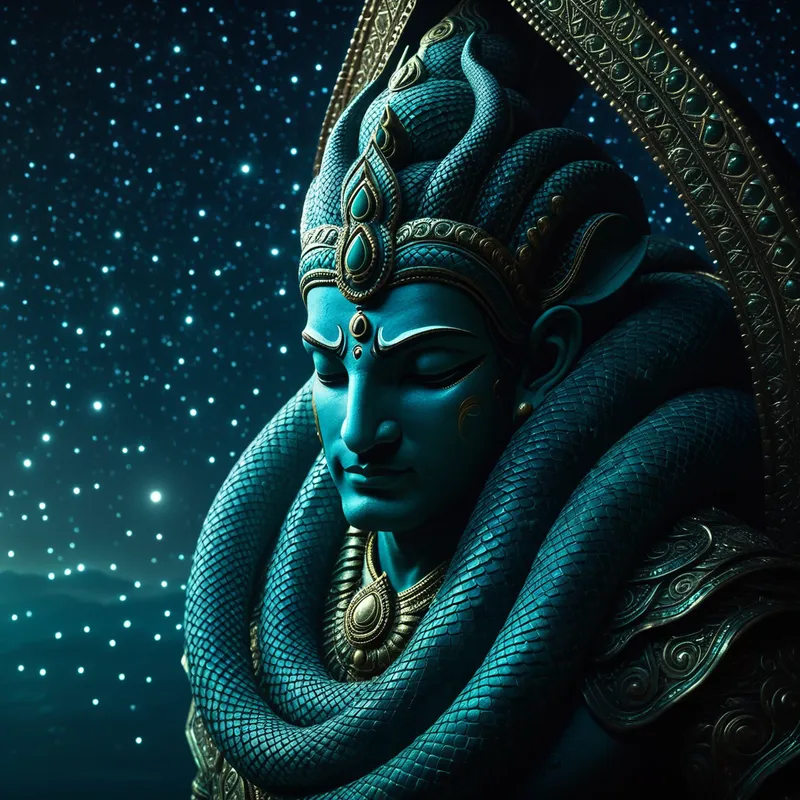
In the beginning, there was neither time nor space, only a boundless, silent ocean of potential. Not a drop of [water](/myths/water “Myth from Chinese culture.”/), but the very essence of possibility, dark and deep and still. Upon this infinite sea, the great serpent Ananta [Shesha](/myths/shesha “Myth from Hindu culture.”/) floated, its coils stretching into eternity. And upon this living bed of endlessness, the preserver, [Vishnu](/myths/vishnu “Myth from Hindu culture.”/), reclined in a state of divine sleep—Yoga Nidra.
His form was the color of a rain-laden cloud at twilight, a deep, tranquil blue. He was adorned with the symbols of the cosmos, yet his eyes were closed in perfect repose. This was not the sleep of oblivion, but the conscious dreaming of a god. From the stillness of his being, a universe began to stir.
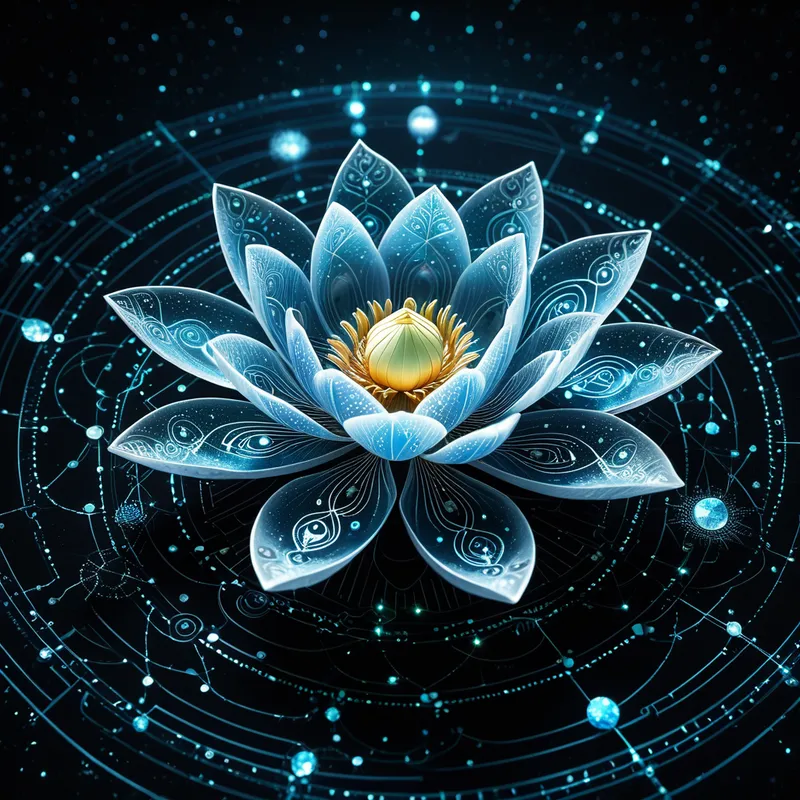
As he dreamed, a soundless vibration hummed within the cosmic waters. From the navel of the sleeping Vishnu, a stem of light emerged. It grew, reaching upward through the darkness, until it blossomed into a resplendent [lotus](/myths/lotus “Myth from Hindu culture.”/), its petals unfolding like the dawn of creation. And seated within that radiant flower was Brahma, the four-faced architect of form. With a breath, Brahma began his work. From [the lotus](/myths/the-lotus “Myth from Hindu culture.”/) stem, the realms took shape: the heavens, the earths, the netherworlds. Stars were scattered like seeds, mountains rose from the deep, and the first stirrings of life—gods, demons, humans, and creatures of every kind—filled the burgeoning dream.
The dream unfolded in vast cycles. Brahma created, Vishnu sustained the dream-reality through his avatars, and in time, [Shiva](/myths/shiva “Myth from Hindu culture.”/) would dance the universe back into dissolution. Wars were fought in the heavens, sages meditated in forests, kings ruled and fell, oceans were churned for nectar—all of it vivid, all of it real to the dream-beings within it, all of it a play of consciousness upon the screen of the god’s mind.
And then, after an acon measured in the lifetimes of Brahma himself, the dance of Shiva would conclude. The dream would begin to fade. Worlds dissolved back into their elemental states, beings returned to their unmanifest source, and the great lotus would slowly close its petals, withdrawing its stem back into the navel of the sleeping god. The cosmos contracted into a single point of potential, held in the breath of Vishnu. The serpent bed remained, the dark waters were still once more. The dream was over… until the next exhalation of the divine, when the lotus would bloom again, and a new universe would be dreamed into being.
Cultural Origins & Context
The myth of Vishnu’s Dream is woven into the fabric of Vedic and Puranic cosmology. It is not a single story from one book, but a profound cosmological concept elaborated in texts like the Mahabharata, the Vishnu Purana, and the Bhagavata Purana. It was passed down by storytellers (sūtas) and sages (rishis) at royal courts and in forest hermitages, serving a function far beyond entertainment.
This myth provided an answer to the ultimate questions: Where did this all come from? What is reality? What is our place in it? It framed existence itself as Maya, the creative power of the divine that makes the unreal appear real. This was not a dismissal of [the world](/myths/the-world “Myth from Tarot culture.”/) as meaningless, but an elevation of it as a sacred, intentional manifestation. The myth established a cosmic timescale that dwarfed human concerns, offering both humility and a profound sense of security—the entire drama of life is held within the conscious sleep of a benevolent, sustaining presence.
Symbolic Architecture
At its [heart](/symbols/heart “Symbol: The heart symbolizes love, emotion, and the core of one’s existence, representing deep connections with others and self.”/), Vishnu’s Dream is a master [metaphor](/symbols/metaphor “Symbol: A figure of speech where one thing represents another, often revealing hidden connections and deeper truths through symbolic comparison.”/) for [consciousness](/symbols/consciousness “Symbol: Consciousness represents the state of awareness and perception, encompassing thoughts, feelings, and experiences.”/) itself. Vishnu represents the ultimate, unchanging [reality](/symbols/reality “Symbol: Reality signifies the state of existence and perception, often reflecting one’s understanding of truth and life experiences.”/) (Brahman in its personal [aspect](/symbols/aspect “Symbol: A distinct feature, quality, or perspective of something, often representing a partial view of a larger whole.”/)), the ground of all being. His dream is the phenomenal [universe](/symbols/universe “Symbol: The universe symbolizes vastness, interconnectedness, and the mysteries of existence beyond the individual self.”/)—the entire [spectrum](/symbols/spectrum “Symbol: A continuum of possibilities, representing diversity, transition, and the full range of existence from one extreme to another.”/) of manifested [reality](/symbols/reality “Symbol: Reality signifies the state of existence and perception, often reflecting one’s understanding of truth and life experiences.”/), from the physical to the mental.
The dreamer is not separate from the dream; the dream is the substance of the dreamer’s own mind.
The [serpent](/symbols/serpent “Symbol: A powerful symbol of transformation, wisdom, and primal energy, often representing hidden knowledge, healing, or temptation.”/) Ananta Shesha, whose name means “the endless one,” symbolizes the infinite time and [space](/symbols/space “Symbol: Dreaming of ‘Space’ often symbolizes the vastness of potential, personal freedom, or feelings of isolation and exploration in one’s life.”/) upon which the [drama](/symbols/drama “Symbol: Drama signifies narratives, emotional expression, and the exploration of human experiences.”/) of existence unfolds. The primordial waters are the unmanifest potential, the [quantum](/symbols/quantum “Symbol: Represents fundamental uncertainty, interconnectedness, and the collapse of possibilities into reality. It signifies the observer’s role in shaping existence.”/) field of all possibilities. The lotus growing from Vishnu’s navel is the [emergence](/symbols/emergence “Symbol: A process of coming into being, rising from obscurity, or breaking through a barrier, often representing birth, transformation, or revelation.”/) of ordered creation from the unified [source](/symbols/source “Symbol: The origin point of something, often representing beginnings, nourishment, or the fundamental cause behind phenomena.”/); the navel is the center, the point of [connection](/symbols/connection “Symbol: Connection symbolizes relationships, communication, and bonds among individuals.”/) between the unmanifest and the manifest. Brahma, born from that lotus, represents the creative intellect that gives specific form and name to the possibilities within the dream.
The cyclical creation and [dissolution](/symbols/dissolution “Symbol: The process of breaking down, dispersing, or losing form, often representing transformation, release, or the end of a state of being.”/) speaks to the very [nature](/symbols/nature “Symbol: Nature symbolizes growth, connectivity, and the primal forces of existence.”/) of psychological reality: thoughts, feelings, and personal identities arise, have their lifespan, and dissolve back into the unconscious, only to be replaced by new formations. The entire myth maps the process of [perception](/symbols/perception “Symbol: The process of becoming aware of something through the senses. In dreams, it often represents how one interprets reality or internal states.”/): an eternal subject (Vishnu) projects an object (the universe) out of itself, experiences it, and eventually re-absorbs it.
The Dreamer’s Resonance
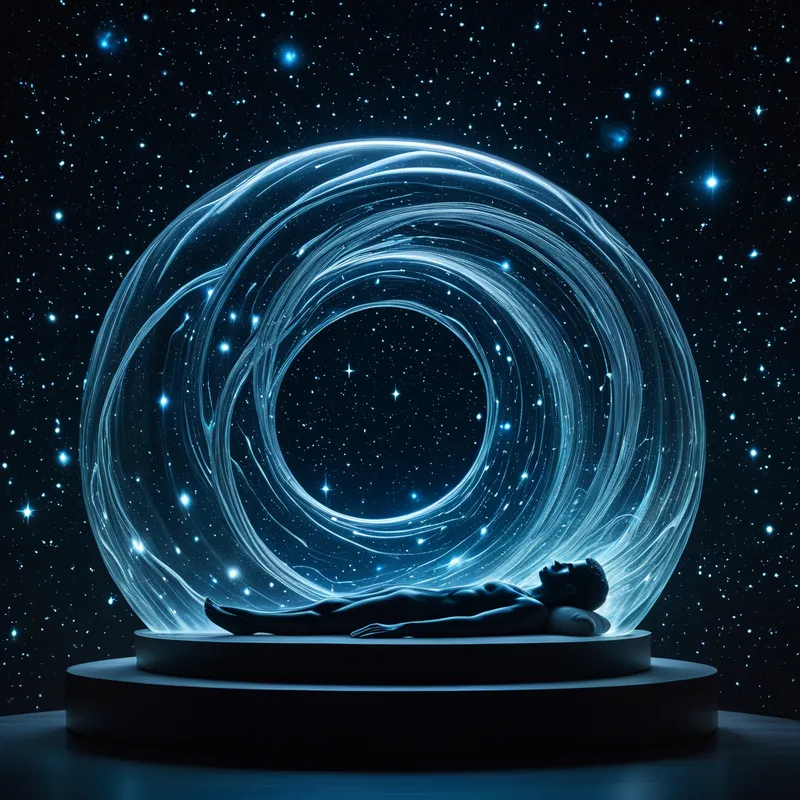
When this mythic pattern stirs in the modern [psyche](/myths/psyche “Myth from Greek culture.”/), it often manifests in dreams of profound disorientation and revelation. One might dream of discovering that their entire life is a play on a stage, or that their city is a intricate model inside a vast, dark room. There is a somatic sense of groundlessness, of the familiar becoming translucent and insubstantial.
Psychologically, this signals a crucial process: [the ego](/myths/the-ego “Myth from Jungian culture.”/)’s confrontation with the fact that it is not the ultimate dreamer, but a dreamed character. This is the beginning of what is often called a spiritual awakening or a profound paradigm shift. The individual is experiencing the first cracks in their constructed reality, sensing the larger “sleeping” consciousness—the personal or collective unconscious—that hosts their identity. It can be terrifying (a dissolution of the known self) and simultaneously awe-inspiring (a connection to something immense). The process involves navigating the truth that one’s most solid convictions, traumas, and achievements are, in the grandest sense, part of a narrative. The task is not to reject life as pointless, but to engage with it from a new, more fluid and less anxious perspective: the perspective of the dreamer within the dream, slowly becoming aware of the Dreamer.
Alchemical Translation
The individuation process, the journey toward psychic wholeness, is perfectly modeled by this myth. It begins with the individual completely identified with the dream—that is, with their [persona](/myths/persona “Myth from Greek culture.”/), their personal history, and the collective norms. This is the state of being a character in Brahma’s bustling creation, believing the drama to be absolutely real.
The first alchemical step is the [nigredo](/myths/nigredo “Myth from Alchemical culture.”/), the darkening. This is the moment of disillusionment, where the constructed world reveals its fragility. It corresponds to the faint intuition of Vishnu asleep—the sense that there is a consciousness prior to one’s personal story. The seeker must, like the universe dissolving into the lotus stem, let go of rigid identifications.
To awaken, one must first fully consent to be the dream, and in that full participation, discover the one who is dreaming.
The sustaining middle phase is the work of albedo and citrinitas, the whitening and yellowing. Here, one learns to live within the dream with wisdom. This is the path of [Karma Yoga](/myths/karma-yoga “Myth from Hindu culture.”/) and Bhakti Yoga: engaging in life with duty and love, but without the binding belief that you are solely the actor. You become a conscious participant, sustaining the dream beautifully without being enslaved by it. This is Vishnu’s preserving role, embodied within the individual.
The culmination, the [rubedo](/myths/rubedo “Myth from Alchemical culture.”/) or reddening, is the awakening within the dream. It is not an escape from life, but a radical change in the center of gravity. The individual realizes their essential nature (Atman) is none other than the dreamer’s consciousness (Brahman). The lotus of personal identity is seen to grow from the navel of a vast, tranquil self. The drama of life continues—Brahma creates, Shiva dissolves—but one rests on the serpent of eternity, identified with the blue-skinned sleeper who hosts it all. The struggle transmutes from “who am I in this story?” to “I am the space in which all stories appear.” The dream is not negated; it is redeemed, seen for what it always was: a divine, playful manifestation of your own deepest being.
Associated Symbols
Explore related symbols from the CaleaDream lexicon: