Vishnu's Cosmic Order Myth Meaning & Symbolism
The timeless myth of Vishnu, the Preserver, who descends to restore cosmic balance when chaos threatens the sacred order of existence.
The Tale of Vishnu’s Cosmic Order
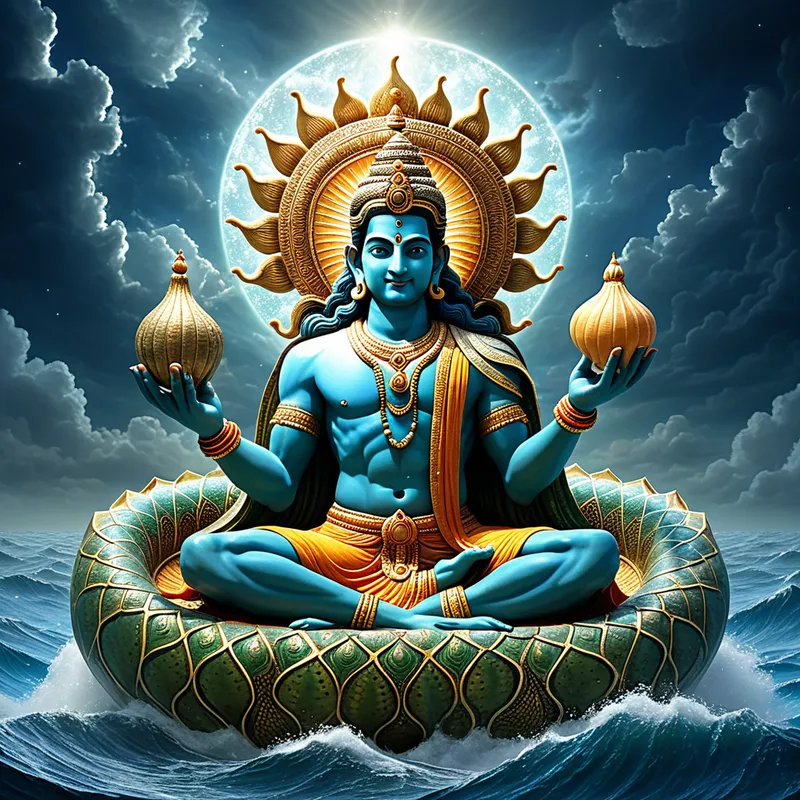
Listen. In the beginning, before time was measured, there was only the sound—Aum—vibrating in the boundless dark. From this sound arose the great ocean of causality, and upon its endless waters, coiled in infinite loops, slept Shesha, the world-serpent. And upon Shesha’s mighty hoods rested He, Vishnu, the dreamer of worlds. His sleep was not emptiness, but a profound attention. Within the lotus of his navel, the universe blossomed and turned.
This is the Order: Dharma. It is the rhythm of the seasons, the turn of the stars, the balance of giving and receiving, truth and consequence. It is the sacred pattern woven into the fabric of all that is.
But listen closer. For a shadow grows in the heart of the pattern. From the fervor of creation and the ashes of dissolution, ambition is born. A great power, a Daitya or an Asura, rises. Through fierce tapas—austerities that scorch the earth and bend the ear of the cosmos—they gain a boon. They become invincible to gods and men, to day and night, to all weapons forged. Drunk on this might, they forget the Order. They proclaim themselves the center. The cosmos groans. The earth withers under the weight of their ego. The heavens tremble. Dharma, the delicate balance, tilts toward chaos.
It is then that the dreamer stirs.
A sigh escapes the lips of Vishnu, a sigh that becomes a wind across the ocean of causality. The celestial sages, the Saptarishis, feel the tremor in the pillars of space. They raise their voices in a lament that is also a prayer. It travels across the layers of reality, from the mortal realm of Bhuloka to the highest abodes.
And Vishnu opens his eyes. His gaze holds no anger, only a deep, inevitable resolve. The Preserver must act. The Order must be restored. But how to defeat what cannot be defeated? Not by matching force with greater force, but by fulfilling the pattern itself. The boon, born of cosmic law, contains its own flaw—a loophole woven by dharma itself.
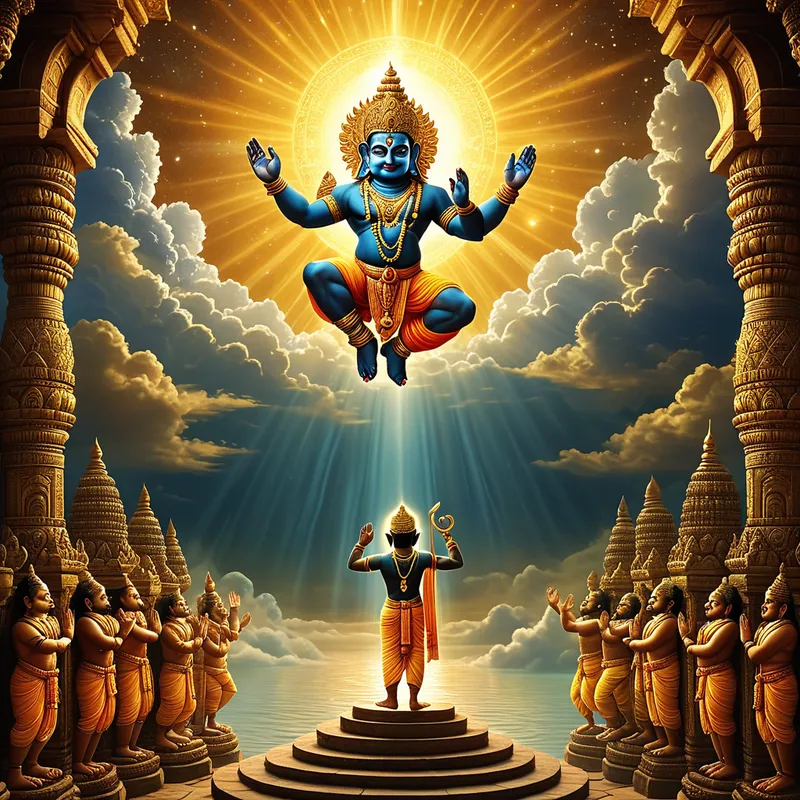
So, Vishnu descends. He takes a form perfectly designed to unravel the chaos. Perhaps he becomes a magnificent wild boar, Varaha, diving into the primordial waters to lift the drowned earth on his tusks. Or a fierce man-lion, Narasimha, emerging from a pillar at twilight—neither day nor night—to confront a tyrant who could not be killed indoors or out. Or, most cunning of all, a dwarf Brahmin, Vamana, who approaches the generous but arrogant demon king Bali and asks for a simple gift: land measured by three paces.
The king laughs, agrees. And the dwarf grows. His first step covers the earth. His second strides across the heavens. With no place left for the third pace, the king, in a moment of shocking humility, offers his own head. Vishnu’s foot rests upon it, not in annihilation, but in subjugation. The cosmic balance is restored not through destruction, but through a sacred trick, a divine play—a Lila—that honors the letter of the law to realign its spirit.
The shadow recedes. The waters of life flow again. The wheel of Dharma turns, smooth and true. And Vishnu, his task complete, returns to his serpent-bed. He closes his eyes. Not in ignorance, but in watchful sleep, listening forever for the next sigh of the world tilting out of balance, ready to dream the solution into being once more.
Cultural Origins & Context
This is not one story, but a pattern—the very heartbeat of a vast mythological tradition. The concept of Vishnu’s cosmic order is the narrative engine of Dashavatara, his ten primary descents, chronicled across millennia in texts like the Mahabharata, the Puranas, and especially the Vishnu Purana. These stories were not mere entertainment; they were the sacred technology of a culture, transmitted by storytellers (Kathakas), priests, and wandering sages at crossroads and temple courtyards.
Their societal function was multifaceted. They were cosmological maps, explaining the periodic nature of time (Yugas) and the inevitable cycles of order and disorder. They were moral compasses, illustrating the subtle and complex nature of Dharma, which is not simplistic good versus evil, but often about correcting imbalances of power, pride, and entitlement. The demon kings are rarely pure evil; they are often great devotees or beings of immense power who simply overstep, who forget they are part of a larger whole. The myth thus served as a warning to earthly rulers and a reassurance to the populace: no tyranny, no matter how absolute, falls outside the jurisdiction of a deeper, restorative justice.
Symbolic Architecture
At its core, this mythic pattern is a profound drama of psychic self-regulation. Vishnu represents the Self—the central, organizing principle of the psyche in Jungian terms, which exists beyond the ego. He is not the busy, conscious “I,” but the deeper, abiding totality of the personality that seeks harmony and integration.
The Preserver does not create the world anew, nor does he destroy it. He mends the tapestry from within the weave.
The ocean upon which he rests is the unconscious itself—the dark, fertile, chaotic waters of potential from which all forms of consciousness emerge. Shesha, the serpent, symbolizes the endless cycles of time and the latent energy (Kundalini) that supports existence.
The “demon” or disruptive force is the inflated ego, or a complex that has grown monstrous through one-sided development. The “boon” it wins is symbolic of a talent, an obsession, or a defense mechanism that becomes so powerful it seems invincible, throwing the entire inner world into disequilibrium. Depression, manic ambition, paralyzing fear—these are the modern Asuras, ruling their psychic kingdoms with absolute, isolating power.
Vishnu’s descent, the Avatar, is the emergence of a reconciling symbol from the Self. It is the unexpected insight, the dream image, the sudden humility, or the creative solution that arrives precisely to address an otherwise intractable inner conflict. It works not by direct opposition (which would only strengthen the complex), but by outflanking it, by introducing a new perspective that the ego-complex did not and could not foresee.
The Dreamer’s Resonance
When this mythic pattern stirs in the modern dreamer, it often manifests as dreams of overwhelming, seemingly unstoppable forces. You might dream of a tidal wave, a monstrous figure ruling a dark castle, or a machine that has grown sentient and oppressive. These are the Asuras of the personal psyche. The somatic feeling is one of profound helplessness and cosmic dread—the Dharma of your inner world is off-kilter.
Conversely, or subsequently, you may dream of a surprising helper: an unassuming animal that guides you, a door appearing in a solid wall, or receiving a simple, potent gift from a humble figure. This is the avatar energy emerging. The psychological process is one of the Self initiating a correction. The dream ego is not the hero; it is often the witness, or like King Bali, the one who must make the offering of surrender. The resolution in the dream brings not a feeling of heroic victory, but of deep, quiet relief and rightness—a sigh of rebalancing. The dreamwork here involves identifying what inflated attitude or one-sided complex (the “boon”) has led to the inner tyranny, and what humble, unexpected quality (the “avatar”) is being presented to restore wholeness.

Alchemical Translation
The alchemical journey mirrored in Vishnu’s myth is the process of moving from identification with the ego-complex (the demon king) to alignment with the Self (the cosmic order). Our initial state is often one of “boon”-possession: we over-identify with our intellect, our persona, our trauma, or our ambition, believing it makes us invincible, only to find it isolates us and drains the life from our inner and outer worlds.
Individuation is the ego’s willing submission to the third pace of Vishnu—the step that grounds us not in our claimed territory, but in the reality of the greater Self.
The “descent” of the avatar is the crucial, often painful, phase of the nigredo, the darkening. It is the recognition that our old, one-sided mode of being is unsustainable. The avatar’s strange, loophole-exploiting method represents the transcendent function—the symbol that arises from the unconscious to bridge the irreconcilable opposites (order/chaos, ego/Self).
The final stage is not the destruction of the complex, but its integration. Bali is not killed; he is made the ruler of the netherworld, a necessary part of the cosmos now kept in its proper place. Psychically, this means the potent energy that was tied up in the tyrannical complex is redeemed and put to service in the larger economy of the Self. The inflated ego is humbled, not annihilated, becoming a steward of its own domain rather than a usurper of the whole.
Thus, to live in accordance with Vishnu’s cosmic order is to cultivate the inner vigilance of the Preserver. It is to learn to rest upon the serpent of our own deep, cyclical nature, to listen for the sighs of imbalance within, and to trust that from that deepest center, the perfect, paradoxical, and healing form will emerge to guide us back to wholeness. Our task is not to become Vishnu, but to recognize his Lila in the unfolding drama of our own lives.
Associated Symbols
Explore related symbols from the CaleaDream lexicon: