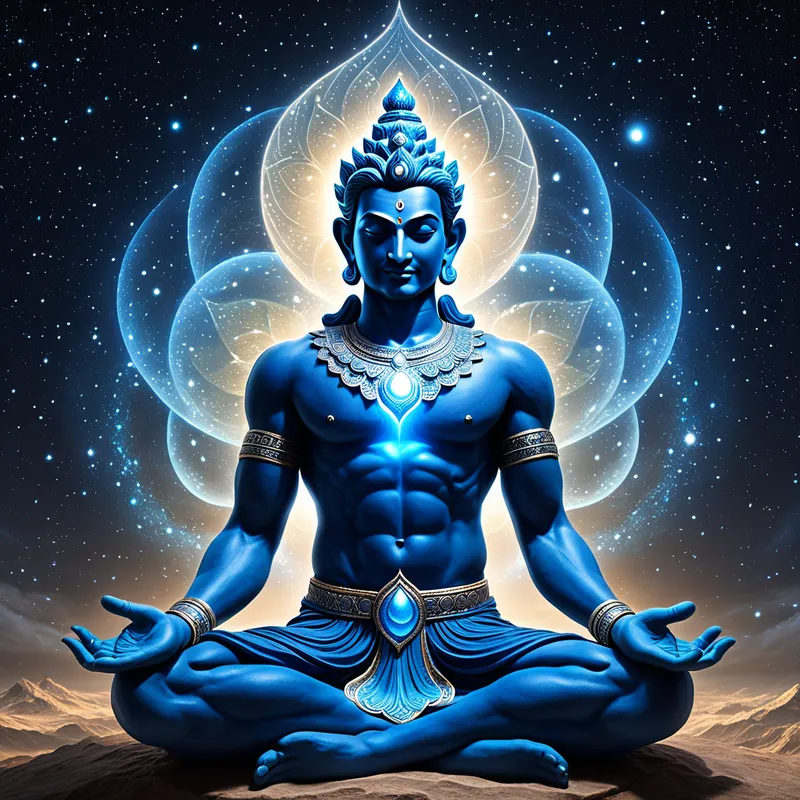
Vishnu's Cosmic Form Myth Meaning & Symbolism
A warrior prince, granted a divine vision, beholds the entire universe within the body of the god Vishnu, shattering his limited perception of reality.
The Tale of Vishnu’s Cosmic Form
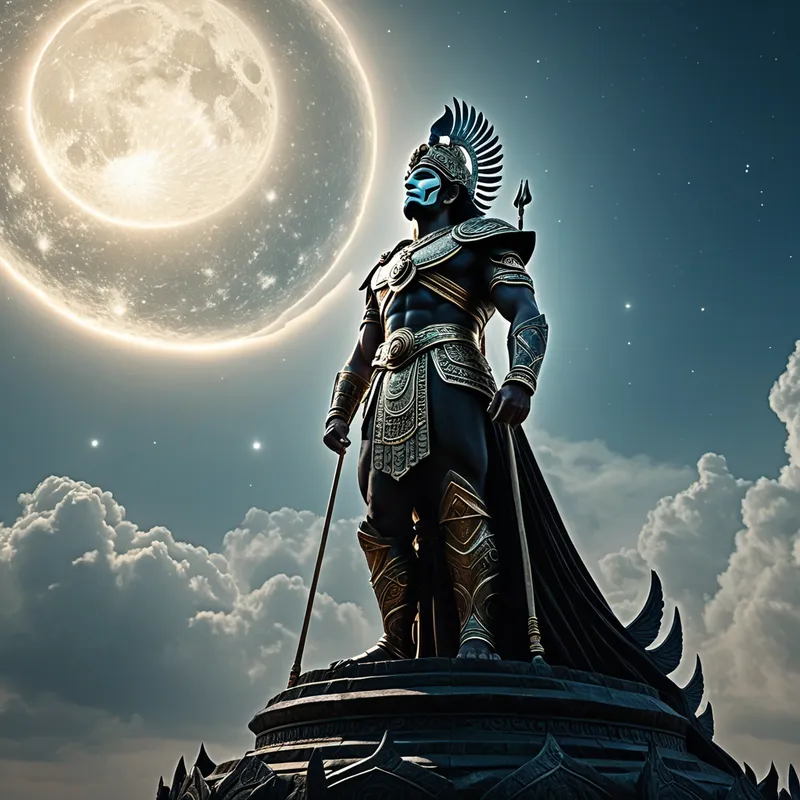
The air on the field of Kurukshetra was thick with the silence before the storm. Not a bird sang. The very earth seemed to hold its breath, caught between two vast armies—the Pandavas and the Kauravas—poised to unleash a river of blood for the sake of a kingdom. In the no-man’s-land between them stood a single chariot, its banner fluttering. Upon it, the peerless archer Arjuna slumped, his mighty bow, the [Gandiva](/myths/gandiva “Myth from Hindu culture.”/), slipping from his grasp. His heart was a battlefield fiercer than the one before him. He saw not enemies, but grandfathers, teachers, and kinsmen. His duty as a warrior warred with his duty as a human. His vision blurred with despair.
He turned to his charioteer, his friend, the prince [Krishna](/myths/krishna “Myth from Hindu culture.”/). “I will not fight,” he declared, his voice breaking. “What is a kingdom won over the bodies of those we love? I see only sin.”
Krishna, serene amidst the gathering doom, began to speak. His words were not of mere comfort, but of the eternal law, of duty, of the soul that cannot be slain. Yet Arjuna’s grief was a fortress. Seeing his disciple’s mind still clouded, Krishna offered a gift beyond philosophy, a vision beyond words. “Since you think me a mere mortal,” he said, his tone shifting from teacher to sovereign of reality, “behold my supreme form.”
Then, [the world](/myths/the-world “Myth from Tarot culture.”/) peeled away.
Where Krishna stood, a brilliance erupted—not of light, but of Being itself. The familiar form of the prince dissolved into the Virata [Purusha](/myths/purusha “Myth from Hindu culture.”/), the Cosmic Person. Arjuna’s eyes widened, then strained against the impossible. He saw within that one Form all the worlds, all of time, all of existence. He saw the sun and moon as eyes, the directions as ears. He saw the devouring maw of countless mouths, flaming with the fires of dissolution, swallowing entire armies of warriors who rushed like rivers into an oceanic doom. He saw the [Trimurti](/myths/trimurti “Myth from Hindu culture.”/) and all the devas paying homage. He saw the past, present, and future, all happening at once within the divine body.
Terror, pure and primordial, seized him. His hair stood on end. He stammered, his hands clasped in frantic prayer. “O Lord of the universe! I see all beings rushing headlong into your terrible mouths… I am afraid! Please, show me again your gentle, four-armed form!” The vision was too vast, too raw, too utterly shattering of his limited sense of self and world.
And as suddenly as it appeared, the cosmic form coalesced back into the familiar, smiling Krishna, standing calmly in [the chariot](/myths/the-chariot “Myth from Tarot culture.”/). The ordinary world rushed back in, but it could never be ordinary again. Arjuna, humbled and transformed, bowed his head. His despair was incinerated in that cosmic furnace of vision. He was ready to act, not from confusion, but from a terrifying, clarified understanding of his place in the divine play.
Cultural Origins & Context
This myth is the narrative heart of the Bhagavad Gita, a text that is itself a portion of the immense epic, the Mahabharata. Composed and compiled over centuries, likely between the 5th century BCE and 2nd century CE, the Gita represents a synthesis of Vedic ritualism, Upanishadic philosophy, and devotional theism. It was not merely a story for entertainment, but a shastra—a teaching scripture.
Traditionally, the myth was passed down orally by sages and later by storytellers who would recite the epic in public gatherings. Its societal function was multifaceted: it provided a theological foundation for the concept of avatara, it offered a philosophical justification for righteous action (dharma) in the face of moral complexity, and it served as a powerful meditative tool. To contemplate the Virata Purusha was to attempt to grasp the nature of the absolute, to see the unity behind the bewildering diversity of the world. It was a myth designed to induce a paradigm shift, moving the seeker from a fragmented view of reality to an integrated one.
Symbolic Architecture
The Cosmic Form is the ultimate [symbol](/symbols/symbol “Symbol: A symbol can represent an idea, concept, or belief, serving as a powerful tool for communication and understanding.”/) of the [psyche](/myths/psyche “Myth from Greek culture.”/) made [universe](/symbols/universe “Symbol: The universe symbolizes vastness, interconnectedness, and the mysteries of existence beyond the individual self.”/), and the universe recognized as [psyche](/myths/psyche “Myth from Greek culture.”/). Arjuna’s [crisis](/symbols/crisis “Symbol: A crisis symbolizes turmoil, urgent challenges, and the need for immediate resolution or change.”/) is the [human](/symbols/human “Symbol: The symbol of a human represents individuality, complexity of emotions, and social relationships.”/) crisis: the [paralysis](/symbols/paralysis “Symbol: A state of being unable to move or act, often representing feelings of powerlessness, fear, or being trapped in waking life.”/) that comes from seeing the world as a collection of separate, conflicting parts—[friend](/symbols/friend “Symbol: A friend in dreams often represents companionship, connection, and the desire for social support, reflecting aspects of our interactions and relationships in waking life.”/) versus foe, duty versus love, [life](/symbols/life “Symbol: The symbol of ‘Life’ represents a journey of growth, interconnectedness, and existential meaning, encompassing both the joys and challenges that define human experience.”/) versus [death](/symbols/death “Symbol: Symbolizes transformation, endings, and new beginnings; often associated with fear of the unknown.”/). Krishna’s [revelation](/symbols/revelation “Symbol: A sudden, profound disclosure of truth or insight, often through artistic or musical means, that transforms understanding.”/) dissolves these artificial boundaries.
The Cosmic Form is the dream the universe is having of itself, and the moment you see it, you realize you are both the dreamer and a figure within the dream.
Arjuna represents the individual ego, the “I” that feels separate and responsible. The battlefield of Kurukshetra is the field of human life, the [arena](/symbols/arena “Symbol: An arena symbolizes a space for competition, public scrutiny, or performing under pressure.”/) where our inner conflicts (dharma-kshetra) are played out. Krishna, the charioteer, is the guiding Self, the inner divinity that steers the [vehicle](/symbols/vehicle “Symbol: Vehicles in dreams often symbolize the direction in life and the control one has over their journey, reflecting personal agency and decision-making.”/) of the [body](/symbols/body “Symbol: The body in dreams often symbolizes the dreamer’s self-identity, personal health, and the relationship they have with their physical existence.”/)-mind. The revelation of the Cosmic Form is [the ego](/myths/the-ego “Myth from Jungian culture.”/)’s shocking confrontation with the totality of [the Self](/myths/the-self “Myth from Jungian culture.”/)—a totality that includes not only creation and [beauty](/symbols/beauty “Symbol: This symbol embodies aesthetics, harmony, and the appreciation of life’s finer qualities.”/) but also destruction and [terror](/symbols/terror “Symbol: An overwhelming, primal fear that paralyzes and signals extreme threat, often linked to survival instincts or deep psychological trauma.”/). The devouring mouths symbolize the inevitable processes of time and change, which [the ego](/myths/the-ego “Myth from Jungian culture.”/) fears as annihilation. The [vision](/symbols/vision “Symbol: Vision reflects perception, insight, and clarity — often signifying the ability to foresee or understand deeper truths.”/) forces [the ego](/myths/the-ego “Myth from Jungian culture.”/) to relinquish its limited [perspective](/symbols/perspective “Symbol: Perspective in dreams reflects one’s viewpoints, attitudes, and how one interprets experiences.”/) and acknowledge its participation in a [pattern](/symbols/pattern “Symbol: A ‘Pattern’ in dreams often signifies the underlying structure of experiences and thoughts, representing both order and the repetitiveness of life’s situations.”/) far grander than its personal desires and fears.
The Dreamer’s Resonance
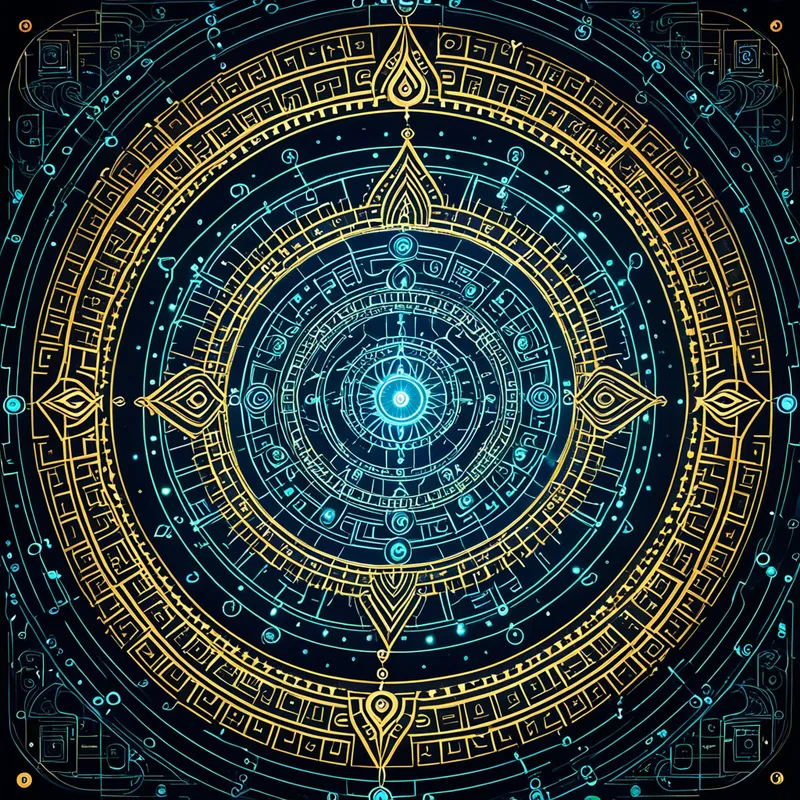
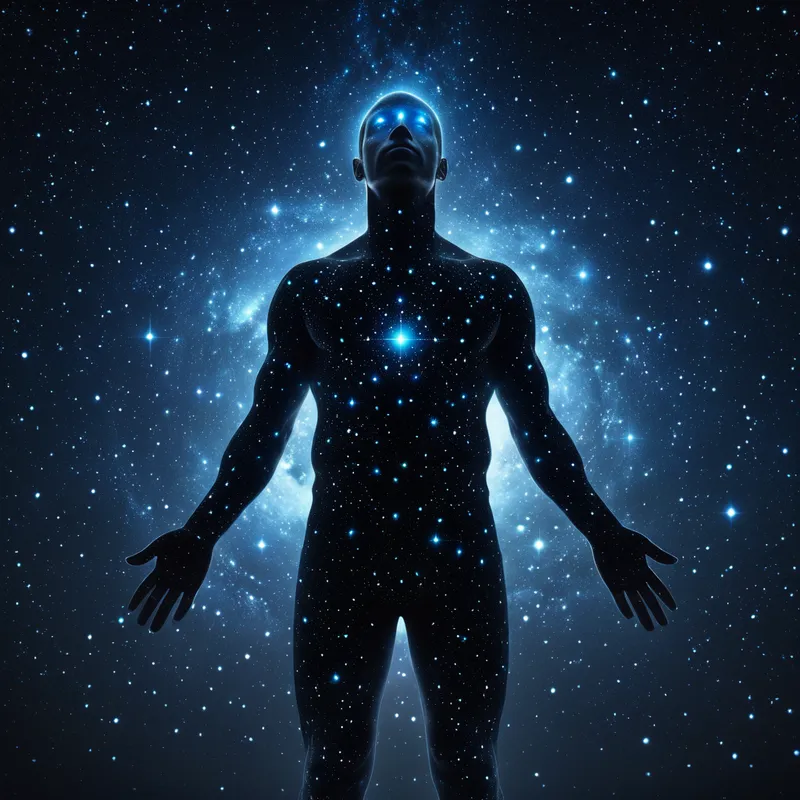
When this mythic pattern stirs in the modern unconscious, it often manifests not as a literal vision of a multi-armed deity, but as dreams of overwhelming scale and integration. One might dream of their own body becoming vast and containing landscapes, or of looking into a mirror to see a galaxy in place of their head. Another may dream of a single, all-encompassing pattern—a [mandala](/myths/mandala “Myth from Buddhist culture.”/), a neural network, a root system—that explains everything.
Somatically, this can feel like a vertiginous expansion, a loss of bodily boundaries, accompanied by awe and deep anxiety. Psychologically, this signals a critical juncture in the process of individuation. The dreamer’s conscious attitude is being overwhelmed by contents of [the collective unconscious](/myths/the-collective-unconscious “Myth from Jungian culture.”/)—the archetype of the Self in its full, non-human magnitude. It is the psyche’s way of forcing a death of the old, cramped identity. The terror Arjuna felt is the ego’s rightful fear of its own relativization. The dream is an invitation, or a demand, to stop identifying solely with the small, personal story and to begin to acknowledge the transpersonal forces that move through one’s life.
Alchemical Translation
The alchemical process mirrored here is the [Nigredo](/myths/nigredo “Myth from Alchemical culture.”/) giving way to the Albedo—the blackening of the old ego leading to its whitening or purification through a shocking revelation. Arjuna’s despair is [the Nigredo](/myths/the-nigredo “Myth from Alchemical culture.”/), [the dark night of the soul](/myths/the-dark-night-of-the-soul “Myth from Christian Mysticism culture.”/) where all previous meanings collapse. Krishna’s discourse is the beginning of the Albedo, the intellectual washing, but it is insufficient. The direct, visionary experience of the Cosmic Form is the necessary transmutation.
For the modern individual, this myth models the journey from fragmentation to wholeness. We all have our personal “Kurukshetra”—a career crossroads, a relational breakdown, an inner moral conflict. We identify with our position, our tribe, our pain. The alchemical translation asks us to find the inner “charioteer,” the observing consciousness that is not entangled in the conflict.
The work is to allow the personal crisis to become so acute that it forces a revelation of the transpersonal pattern within it.
This is not about bypassing the conflict (“everything is an illusion, so nothing matters”), but about engaging in it from a place of profound connection. Like Arjuna, after the vision, we must pick up our Gandiva bow—our unique skills and duties—and act. But we act not from the fragile ego, defending its small territory, but as a conscious participant in a cosmic drama. We see the “enemy” not as an alien other, but as another necessary aspect of the whole pattern. The [triumph](/myths/triumph “Myth from Roman culture.”/) is not victory in battle, but the integration of the terrifying, awe-inspiring totality of existence into one’s conscious life. One becomes, in a humble human way, a vessel through which the cosmic form can glimpse itself.
Associated Symbols
Explore related symbols from the CaleaDream lexicon: