Vishnu on Shesha Myth Meaning & Symbolism
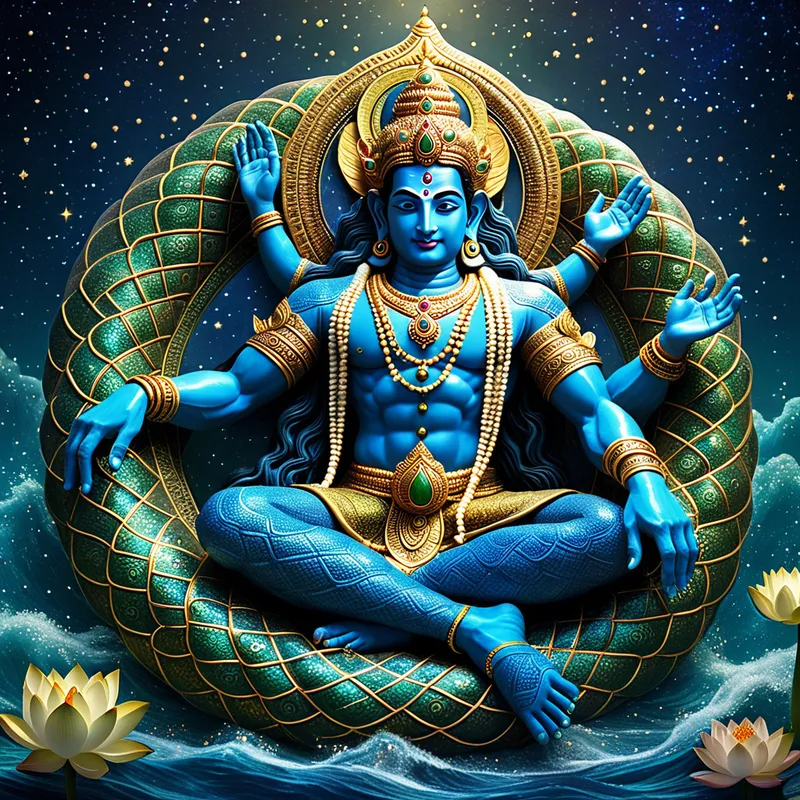
The supreme deity Vishnu rests upon the infinite serpent Shesha in the cosmic ocean, dreaming the universe into being between cycles of creation and dissolution.
The Tale of Vishnu on Shesha
Listen. In the beginning that is not a beginning, and at the end that is not an end, there is the Garbhodaka. An ocean of cause, dark and profound, without shore or horizon. Its waters are not [water](/myths/water “Myth from Chinese culture.”/), but potential itself—silent, still, and waiting.
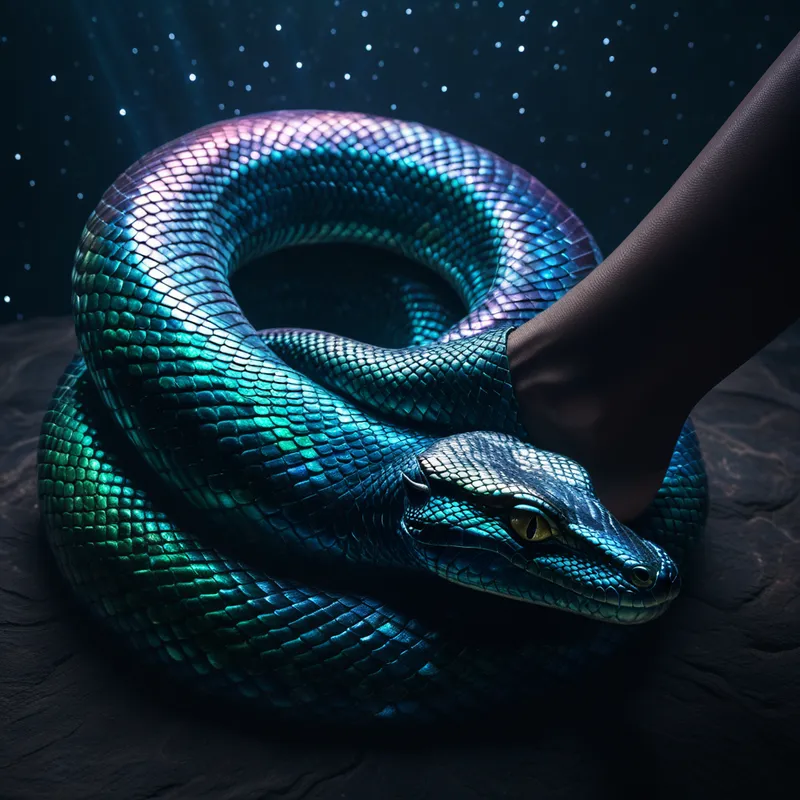
Upon this boundless deep, a bed is prepared. Not of earth or stone, but of a living coil. This is Ananta [Shesha](/myths/shesha “Myth from Hindu culture.”/), whose name means “The Endless Remainder.” His body is vast, glimmering with the cold light of a thousand stars yet unborn. His thousand hoods rise like a celestial canopy, each a universe of quiet thought, shielding the darkness from a light that has not yet been commanded to shine.
And upon this living coil rests He. [Vishnu](/myths/vishnu “Myth from Hindu culture.”/), the all-pervading. His skin is the blue of infinite space, of the deepest ocean trench. He is adorned, yet his adornments seem part of the cosmic fabric. He reclines in the posture of supreme rest, Anantasayana. One hand supports his head. Another rests upon his thigh. The others hold his divine emblems—the conch, the discus, the mace, [the lotus](/myths/the-lotus “Myth from Hindu culture.”/)—but they are dormant, symbols of power at peace.
His eyes are closed. He is not asleep as mortals sleep. He is in Yoga Nidra, the yogic sleep of cosmic awareness. In this state, the universe that was has been dissolved into its essence, and the universe that will be is a dream forming in [the womb](/myths/the-womb “Myth from Various culture.”/) of his consciousness.
From the center of his being, from his navel, a stem of light emerges. It grows, piercing the stillness of the causal waters, and at its apex, it blossoms. A single, radiant [lotus](/myths/lotus “Myth from Hindu culture.”/). And upon this lotus, Brahma is seated. With the opening of the [lotus](/myths/lotus “Myth from Hindu culture.”/) petals, Brahma opens his eyes. He looks upon [the void](/myths/the-void “Myth from Buddhist culture.”/), hears the divine breath of Vishnu, and receives the mandate. The dream is given form. The cycle of Srishti begins anew.
This is the moment. Not of frantic creation, but of creation born from perfect rest. Not of struggle, but of manifestation emerging from profound containment. Vishnu does not act. He is. And in his being, upon the endless coil of Shesha, all time and space are cradled, dreamed, and sustained until the hour of dissolution returns them once more to the silent ocean.
Cultural Origins & Context
The image of Vishnu Anantashayana is one of the most ancient and enduring in Hindu tradition. Its earliest textual mentions are found in the Vedas, where the serpent Shesha is linked to the residue of the universe. The myth was fully elaborated in the Itihasas and the Puranas, particularly the Vishnu Purana and [Shiva](/myths/shiva “Myth from Hindu culture.”/) Purana.
This was not merely a story for priests. It was a cosmic diagram, a [mandala](/myths/mandala “Myth from Buddhist culture.”/) for the culture’s imagination. It was told by sages in forest retreats, sculpted in towering temple shikharas at sites like Deogarh, and painted in vibrant colors for village festivals. Its function was multifaceted: to explain the cyclic nature of time ([Yugas](/myths/yugas “Myth from Hindu culture.”/) and Kalpas), to illustrate the supremacy of divine consciousness over inert matter, and to provide a model for the ideal state of a ruler or yogi—power held in perfect, peaceful equilibrium, sustaining [the world](/myths/the-world “Myth from Tarot culture.”/) not through force, but through serene, unwavering presence.
Symbolic Architecture
The myth is a profound map of cosmic and psychological order. Every element is a living [symbol](/symbols/symbol “Symbol: A symbol can represent an idea, concept, or belief, serving as a powerful tool for communication and understanding.”/).
Vishnu represents pure, conscious [awareness](/symbols/awareness “Symbol: Conscious perception of self, surroundings, or internal states. Often signifies awakening, insight, or heightened sensitivity.”/)—[the Self](/myths/the-self “Myth from Jungian culture.”/) that is unchanging, eternal, and the [source](/symbols/source “Symbol: The origin point of something, often representing beginnings, nourishment, or the fundamental cause behind phenomena.”/) of all manifestation. His blue color signifies the infinite and the immeasurable, like [the sky](/myths/the-sky “Myth from Persian culture.”/) or the deep [ocean](/symbols/ocean “Symbol: The ocean symbolizes the vastness of the unconscious mind, representing deeper emotions, intuition, and the mysteries of life.”/). His reclining [posture](/symbols/posture “Symbol: Posture in dreams represents one’s stance in life, social presentation, and inner confidence or submission. It reflects how one carries themselves through challenges and relationships.”/) is the ultimate [paradox](/symbols/paradox “Symbol: A contradictory yet true concept that challenges logic and perception, often representing unresolved tensions or profound truths.”/): total relaxation coupled with total governance.
Ananta Shesha, the endless [serpent](/symbols/serpent “Symbol: A powerful symbol of transformation, wisdom, and primal energy, often representing hidden knowledge, healing, or temptation.”/), symbolizes the primordial substance of the [universe](/symbols/universe “Symbol: The universe symbolizes vastness, interconnectedness, and the mysteries of existence beyond the individual self.”/)—time, matter, and [energy](/symbols/energy “Symbol: Energy symbolizes vitality, motivation, and the drive that fuels actions and ambitions.”/)—in its potential, unmanifest state. He is the [foundation](/symbols/foundation “Symbol: A foundation symbolizes the underlying support systems, values, and beliefs that shape one’s life, serving as the bedrock for growth and development.”/), the support, and the [residue](/symbols/residue “Symbol: What remains after a process or event; traces left behind that persist beyond the original occurrence.”/). His thousand hoods represent the infinite multiplicity of the world, all held within the single [consciousness](/symbols/consciousness “Symbol: Consciousness represents the state of awareness and perception, encompassing thoughts, feelings, and experiences.”/) of the deity. The [serpent](/symbols/serpent “Symbol: A powerful symbol of transformation, wisdom, and primal energy, often representing hidden knowledge, healing, or temptation.”/) often depicted as floating on the waters completes the [triad](/symbols/triad “Symbol: A grouping of three representing spiritual unity, divine completeness, and cosmic balance across many traditions.”/): Consciousness (Vishnu) rests upon Substance (Shesha), which floats upon the Causal Waters of Potential.
The universe is not built upon a pillar of stone, but upon a coil of latent power, dreaming beneath the feet of awareness.
The Cosmic Ocean (Garbhodaka) is the unconscious itself—the formless, fertile void from which all forms arise and into which they dissolve. The Lotus emerging from Vishnu’s navel is the awakened world of name and form, born from the center of being. Brahma seated upon it is the creative intellect, the faculty that gives specific shape to the dream of consciousness.
Psychologically, this is an [image](/symbols/image “Symbol: An image represents perception, memories, and the visual narratives we create in our minds.”/) of the integrated [psyche](/myths/psyche “Myth from Greek culture.”/). [The ego](/myths/the-ego “Myth from Jungian culture.”/) (Brahma, the [creator](/symbols/creator “Symbol: A figure representing ultimate origin, divine power, or profound authorship. Often embodies the source of existence, innovation, or personal destiny.”/) of our personal world) is not the master, but an agent arising from and dependent upon the deeper Self (Vishnu), which itself rests in harmonious [relationship](/symbols/relationship “Symbol: A representation of connections we have with others in our lives, often reflecting our emotional state.”/) with the vast, often serpentine, powers of the personal and [collective unconscious](/symbols/collective-unconscious “Symbol: The Collective Unconscious refers to the part of the unconscious mind shared among beings of the same species, embodying universal experiences and archetypes.”/) (Shesha and the Ocean).
The Dreamer’s Resonance
When this mythic pattern stirs in the modern dreamer, it often signals a profound phase of psychic consolidation and incubation. It is not a dream of action, but of being.
To dream of floating on dark, calm waters suggests a surrender to the unconscious, a release from the ego’s frantic doing. To sense or see a great serpent coiled beneath you in the deep speaks to making contact with the immense, instinctual, and potentially transformative energy of the psyche—the Self—as a supportive foundation, not a threat. The feeling is one of immense, quiet support from the deepest layers of your being.
This dream pattern emerges when the conscious mind is exhausted from creation, struggle, or preservation. The psyche is calling for a return to the causal waters, to Yoga Nidra. It is the somatic experience of laying down a burden you didn’t know you were carrying. The conflict here is the ego’s resistance to rest, its fear that if it stops “doing,” everything will fall apart. The resolution the dream offers is the revelation that a deeper, wiser order holds everything together, and that from true rest, a more authentic and potent creativity (the lotus) can emerge.
Alchemical Translation
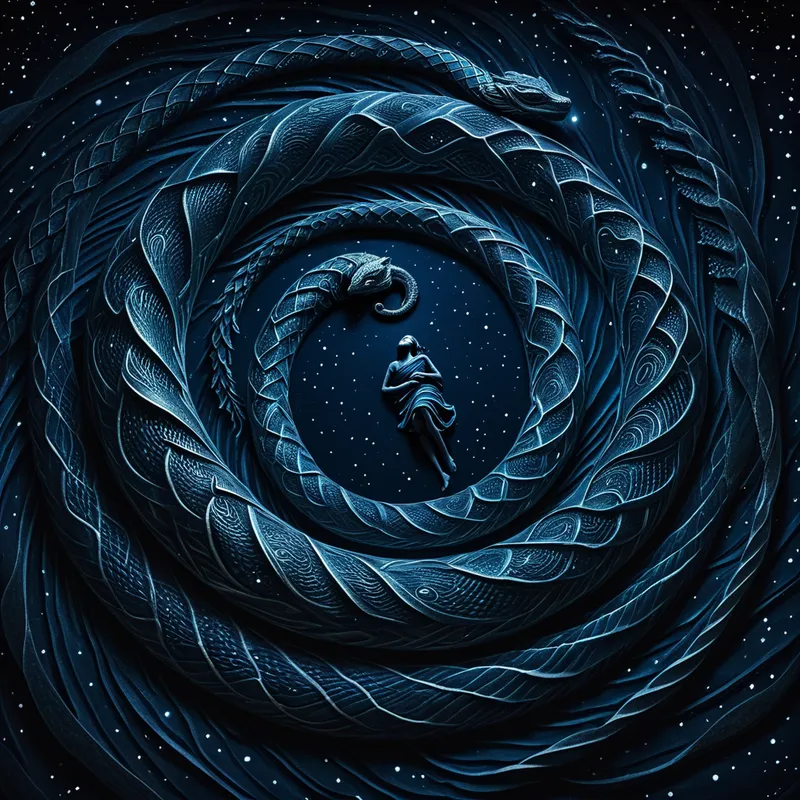
The alchemical process mirrored here is not the fiery calcination, but the gentle, watery stage of [solutio](/myths/solutio “Myth from Alchemical culture.”/)—dissolving back into [the prima materia](/myths/the-prima-materia “Myth from Alchemical culture.”/) to be reformed. In Jungian terms, it is a critical phase of individuation: the conscious ego’s humble recognition of and alignment with the Self.
The modern individual is perpetually in the role of Brahma, tasked with creating a life, a career, an identity. We burn out trying to sustain the creation through sheer will. The myth instructs us to first become Vishnu. To learn the art of conscious rest, of reclining upon the serpent of our own latent energies and unresolved complexes (Shesha). This is not passive collapse, but active, aware containment.
The supreme alchemy is to turn the lead of exhaustion into the gold of renewal, not by adding heat, but by descending into the supportive darkness.
The struggle is to trust the coil beneath us—to trust that our instincts, our bodily wisdom, our unconscious patterns, when approached not with fear but with serene authority, can become a stable foundation. The [triumph](/myths/triumph “Myth from Roman culture.”/) is the blossoming of the lotus: a new phase of life, creativity, or understanding that emerges organically, without strain, from this state of integrated being. We transmute chaos into order not by controlling the waves, but by finding the immutable stillness that lies at the heart of the ocean, and from that center, dreaming our world anew.
Associated Symbols
Explore related symbols from the CaleaDream lexicon: