Viracocha Walks into the Sea Myth Meaning & Symbolism
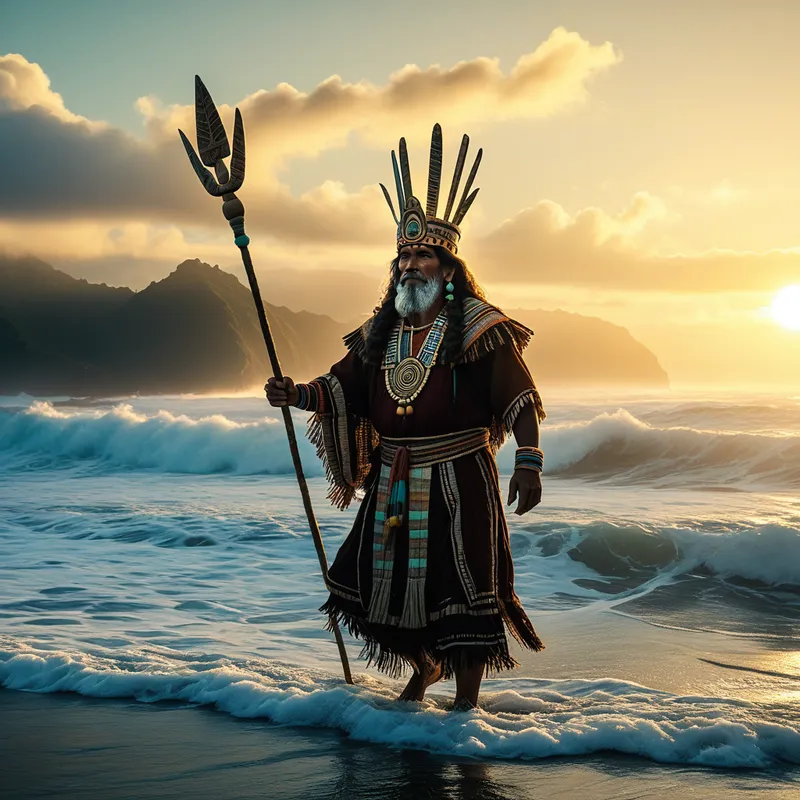
The creator god Viracocha, his work of ordering the world complete, walks westward into the Pacific Ocean, vanishing into the primordial waters.
The Tale of Viracocha Walks into the Sea
Listen. The world was new, and the breath of the Pachacamac still hummed in the stones. The mountains had been raised, the valleys carved. The rivers had been taught their songs, and the people, shaped from clay and given life, had been shown the arts of civilization: the turning of the soil, the weaving of cloth, the laws of community. The one who walked among them, the teacher, the shaper, was called [Viracocha](/myths/viracocha “Myth from Incan culture.”/). He wore a simple tunic, carried a staff of authority, and his countenance held the light of the first dawn.
He walked the length of the Tawantinsuyu, from the high, wind-scoured plains where the condors wheeled, down through the terraced green lungs of the mountains, to the edges of the great, murmuring forest. Wherever he went, he set things in order. He quelled rebellions not with armies, but with words that carried the weight of cosmic truth. He healed rifts between tribes, reminding them of their shared origin in the dark, fertile earth. His work was one of instruction, of imprinting the divine pattern onto the raw material of the world.
Yet, as the generations of men began to walk the paths he had laid, a profound solitude settled upon him. His task was complete. The world could now turn without his hand directly upon the wheel. A longing, vast and deep as the sky, stirred within him. It was a call not from the land, but from beyond it.
He turned his face to the west, where the great water, Mamacocha, met the sky. Without ceremony, without a final speech to the kings or priests, he began to walk. The people gathered on the cliffs and shores, watching in silence as their maker departed. He did not age, he did not falter. He walked across the water as if it were solid ground, his form outlined against the dying sun.
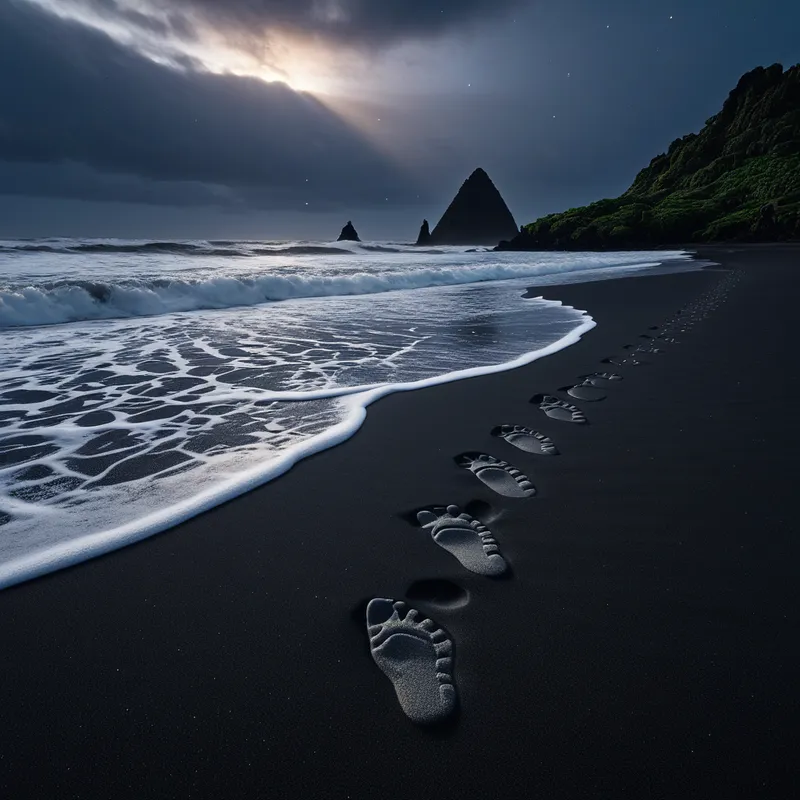
The air grew thick with salt and the scent of distant, unknown depths. The waves did not break around him; they parted, or they became as mist. He walked further, the last light gilding his shoulders, until the horizon swallowed the silhouette of his staff. He did not look back. He walked into the embrace of the primordial waters from which all things first emerged, dissolving his individual form back into the boundless, creative potential. He left no tomb, no sacred relic—only the perfectly ordered world behind him, and the eternal mystery of his departure ahead. The sea closed over the path he had taken, leaving only the whisper of the wind and the endless rhythm of the waves as his final testament.
Cultural Origins & Context
This powerful narrative originates from the Andean world, particularly within the cosmology of the Inca Empire and the cultures that preceded it. The myth was not a singular, fixed text but a living oral tradition, passed down by amautas (wise teachers and philosophers) and recited during important rituals and royal genealogical recitations. Its primary function was ontological: it explained the origin of order (ayni) and the nature of the creator.
Viracocha’s departure was not seen as an abandonment, but as the final, necessary act of creation. By returning to the chaotic, feminine source (Mamacocha), he ensured the cycle remained complete. He became immanent rather than present; his wisdom was encoded in the landscape and social laws, not housed in a temple. This reflected the Incan worldview where divinity was inseparable from the natural and social order. The myth also served a political purpose, legitimizing the Inca Sapa (emperor) as Viracocha’s earthly representative, the steward of the order the god had established before his transcendent withdrawal.
Symbolic Architecture
The myth is a masterclass in symbolic [depth](/symbols/depth “Symbol: Represents profound layers of consciousness, hidden truths, or the unknown aspects of existence, often symbolizing introspection and existential exploration.”/). Viracocha represents the archetypal principle of [consciousness](/symbols/consciousness “Symbol: Consciousness represents the state of awareness and perception, encompassing thoughts, feelings, and experiences.”/) that brings form out of [chaos](/symbols/chaos “Symbol: In Arts & Music, chaos represents raw creative potential, uncontrolled expression, and the breakdown of order to forge new artistic forms.”/). His staff is the [axis](/symbols/axis “Symbol: A central line or principle around which things revolve, representing stability, orientation, and the fundamental structure of reality or consciousness.”/) mundi, the connecting pillar between the heavens, the [earth](/symbols/earth “Symbol: The symbol of Earth often represents grounding, stability, and the physical realm, embodying a connection to nature and the innate support it provides.”/), and the [underworld](/symbols/underworld “Symbol: A symbolic journey into the unconscious, representing exploration of hidden aspects of self, transformation, or confronting repressed material.”/). His walking across the [water](/symbols/water “Symbol: Water symbolizes the subconscious mind, emotions, and the flow of life, representing both cleansing and creation.”/) signifies mastery over the unconscious, the primordial waters of the psyche.
The ultimate act of the creator is not to remain as a statue to be worshipped, but to vanish into the very fabric of creation.
The West is the land of the setting sun, symbolizing completion, [death](/symbols/death “Symbol: Symbolizes transformation, endings, and new beginnings; often associated with fear of the unknown.”/), and the [realm](/symbols/realm “Symbol: The symbol of ‘Realm’ often signifies the boundaries of one’s consciousness, experiences, or emotional states, suggesting aspects of reality that are either explored or ignored.”/) of the ancestors. His [journey](/symbols/journey “Symbol: A journey in dreams typically signifies adventure, growth, or a significant life transition.”/) westward is the journey of the setting sun, which must “die” in the [ocean](/symbols/ocean “Symbol: The ocean symbolizes the vastness of the unconscious mind, representing deeper emotions, intuition, and the mysteries of life.”/) to be reborn the next day. Thus, his walking into the sea is a sacred sacrifice that ensures the continuity of the cosmic cycle. He sacrifices his personal, manifest form to become the unmanifest potential that allows for perpetual renewal. The [ocean](/symbols/ocean “Symbol: The ocean symbolizes the vastness of the unconscious mind, representing deeper emotions, intuition, and the mysteries of life.”/) is both tomb and [womb](/symbols/womb “Symbol: A symbol of origin, potential, and profound transformation, representing the beginning of life’s journey and the unconscious source of creation.”/).
Psychologically, Viracocha embodies the guiding consciousness that structures the inner world. The “work” he completes is the arduous [task](/symbols/task “Symbol: A task represents responsibilities, duties, or challenges one faces.”/) of building a coherent ego, establishing inner laws, and integrating complexes. The final walk into the sea represents the ego’s ultimate surrender—not to annihilation, but to a greater, transpersonal [reality](/symbols/reality “Symbol: Reality signifies the state of existence and perception, often reflecting one’s understanding of truth and life experiences.”/). It is the point where the consciously constructed self realizes it is a temporary manifestation of a deeper, boundless Self.
The Dreamer’s Resonance
When this myth stirs in the modern dreamer, it often signals a profound transition in the psyche’s lifecycle. To dream of walking into an ocean or a vast body of water, especially with a sense of purpose rather than fear, can mirror Viracocha’s journey.
Somatically, one might feel a release of tension, a literal “walking away” from burdens, or a deep pull toward solitude and introspection. Psychologically, this dream pattern emerges when a major life chapter—a career, a relationship, a long-held identity—has reached its natural conclusion. The conscious mind has done its work; it has built, ordered, and maintained. Now, the unconscious, symbolized by the sea, calls for a dissolution of that specific form.
The dreamer is not regressing. They are undergoing a necessary apocatastasis—a return to the source. This can feel like a crisis, a midlife unraveling, or a spiritual calling. It is the psyche’s demand to sacrifice the god you have become (the successful persona, the wise leader, the capable caregiver) to the greater mystery, to make room for a new, unknown form of being to emerge from those same creative depths.

Alchemical Translation
In the alchemy of individuation, Viracocha’s myth maps the final stages of the opus magnum. The initial stages (nigredo, albedo, citrinitas) are the hard work of ordering the world: facing the shadow, refining the personality, and achieving a degree of enlightened consciousness. Viracocha’s civilizing journey represents this.
The final stage, rubedo (the reddening), is not a further brightening, but a sacred marriage with the source. This is Viracocha walking into the sea. It is the coniunctio of the solar, masculine principle of order (Viracocha) with the lunar, feminine principle of chaos and potential (Mamacocha).
Individuation is not about building a perfect, static self. It is about becoming fluid enough to return to the source without losing the wisdom of the journey.
For the modern individual, this translates to the ultimate psychological sacrifice: relinquishing identification with one’s own achievements, insights, and spiritual attainments. It is the sage who burns his own books, the healer who dissolves her own method, the leader who walks away from his throne. This is not failure, but the pinnacle of integrity. It allows the psychic energy bound up in maintaining a “completed” self-image to be freed, returning to the unconscious to fuel the next, unimaginable cycle of growth. One becomes, like Viracocha, a silent, ordering presence in one’s own life and the lives of others, not from a place of egoic control, but from a state of surrendered participation in the endless dance of creation and return.
Associated Symbols
Explore related symbols from the CaleaDream lexicon:
- Ocean — Represents the boundless, primordial unconscious and the feminine creative source (Mamacocha) into which consciousness (Viracocha) willingly returns to complete the cosmic cycle.
- Journey — Symbolizes the lifelong process of creation, ordering, and ultimately, the transcendent voyage back to the origin, which is the core narrative arc of the myth.
- Sacrifice — The central act of the myth; the voluntary surrender of a manifested, powerful form for the greater good of the cyclical renewal of the world and the psyche.
- Sun — Represents Viracocha as the solar, ordering principle, and his westward journey mirrors the sun’s setting, a necessary “death” for rebirth.
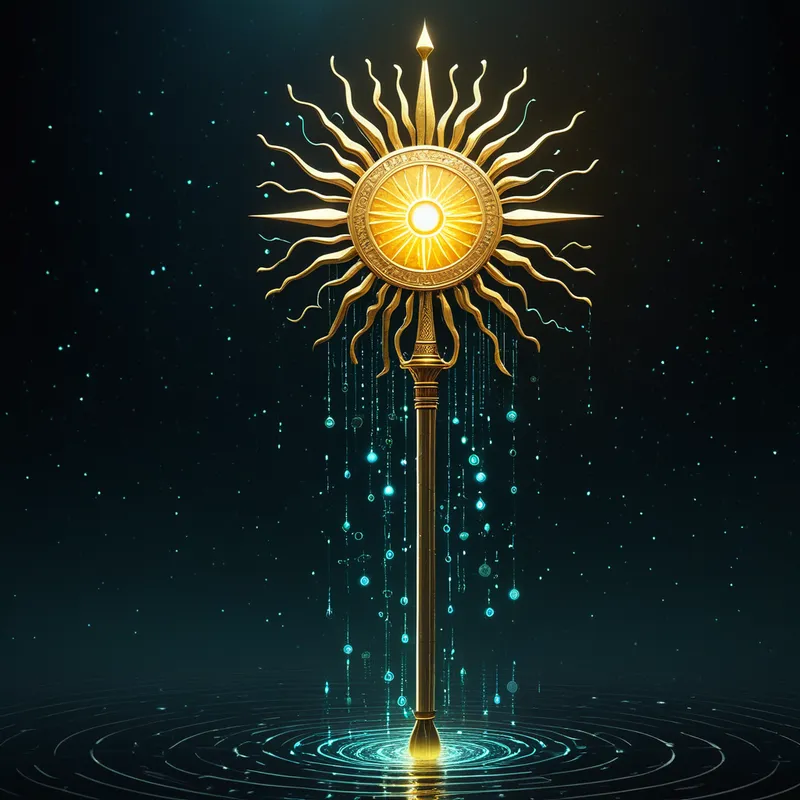
- Staff — The axis mundi, a symbol of divine authority, connection between realms, and the tool used to shape and order the world before its surrender.
- Mountain — Symbolizes the ordered, stable world Viracocha creates and leaves behind, the antithesis of the fluid, chaotic sea he enters.
- God — Embodies the archetype of the creator and orderer who transcends his own creation, moving from an active to an immanent state of being.
- Rebirth — Implicit in the act of dissolution; Viracocha’s vanishing into the sea is not an end, but a guarantee of the world’s and the soul’s perpetual renewal.
- Dream — The myth itself functions as a collective dream, and its personal resonance occurs when the individual psyche dreams of its own completion and return.
- Destiny — The ineluctable pull Viracocha feels toward the sea represents the soul’s call to fulfill its deepest, transpersonal purpose beyond earthly achievements.
- Cascading Waterfall into Ocean — A dynamic symbol of the inevitable, graceful return of all individual streams of consciousness and effort back to the unified, vast source.