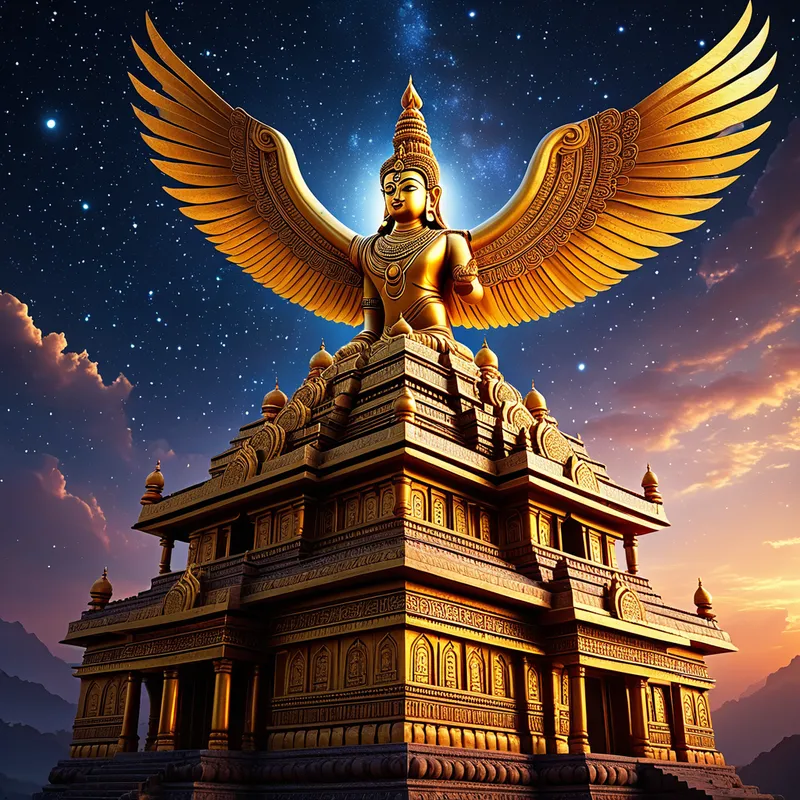
Vimāna Myth Meaning & Symbolism
Mythic celestial chariots, piloted by gods and heroes, representing the ascent of consciousness and the divine technology latent within the human psyche.
The Tale of Vimāna
Hear now, a tale not of earth, but of the spaces between. In the age when gods walked with men and the veil between worlds was thin as morning mist, there sailed the skies wonders beyond mortal ken—the Vimāna.
It began with a rumble in the bones of the world, a vibration felt in the roots of the Meru. The heavens, a tapestry of indigo and fire, would tear open. Not with violence, but with the solemn grace of a lotus unfolding at dawn. From that rent would emerge a shape—sometimes a chariot of blazing gold, drawn by lions of pure energy; sometimes a palace of floating marble and pearl, its spires piercing the clouds; other times a craft of unknown metal, humming with a song that silenced the winds.
The great Indra, wielder of the thunderbolt, commanded the mightiest of these sky-ships, the Airavata. He would descend to the field of righteous war, where the fate of epochs hung in the balance. There stood Arjuna, the archer-prince, his soul heavy with the duty of kin-slaying. The air grew thick, charged with ozone and destiny. Then, a light—not of sun or star—descended. It was Krishna, not on a horse, but standing calmly upon a chariot that hovered a hand’s breadth above the bloodied soil. This was no ordinary cart; it was the divine Vimāna given form, its banner the emblem of Hanuman, its wheels timeless, its purpose transcendent. “Mount, O Savyasachin,” Krishna’s voice was both a whisper and a command that echoed in the hollows of the soul. As Arjuna stepped aboard, the earth fell away. They ascended not through air, but through layers of perception, from the gross realm of clashing armies to the subtle realm of eternal truth. The Vimāna was their vessel for this most profound of journeys.
Elsewhere, in the celestial city of Amaravati, the architect of the demons, Maya Danava, built Vimānas of such cunning and power they could travel to the worlds of men, gods, and ancestors at will. These crafts were living paradoxes—machines of sublime art, powered by mantra and mercurial essence, capable of rendering invisibility or unleashing weapons of ultimate fire, the Astras. They were the ultimate conveyance, carrying heroes to win boons from the gods, sages to council in starry courts, and sometimes, the prideful to their ruin, for to pilot a Vimāna required not just skill, but a heart aligned with Dharma. To steer a vehicle of the gods, one must first navigate the inner cosmos.

Cultural Origins & Context
The myth of the Vimāna is woven deeply into the vast textual tapestry of Hindu culture, appearing with vivid detail in epics like the Mahabharata and Ramayana, as well as in later Shilpa Shastras and Puranas. These were not mere background elements but central plot devices, narrated by bards and sages to kings and commoners alike. Their function was multifaceted. On one level, they concretized the cosmology of a multi-layered universe (Lokas), providing a “vehicle” for the narrative to traverse between the earthly, celestial, and infernal realms. They amplified the grandeur of the gods and the stature of epic heroes, visually and symbolically elevating them above the mundane.
The descriptions, often precise and technical—speaking of layered decks, enclosed cabins, energy sources like mercury and “sun crystals,” and their ability to move at the speed of thought—served a profound cultural purpose. They blurred the line between the miraculous and the technological, suggesting a sacred science, a Vidya, where material advancement was inseparable from spiritual purity. The Vimāna was a cultural dream of transcendence, a testament to the belief that the highest human aspiration was not to conquer earth, but to master the principles of the cosmos itself and ascend.
Symbolic Architecture
At its core, the Vimāna is a supreme symbol of the vehicle of consciousness. It represents the integrated psyche—the anthropos or Purusha—that can navigate the different strata of reality. Its intricate, often palace-like structure mirrors the complex architecture of the Self.
The Vimāna is the psyche made manifest: a crafted vessel designed not for escape, but for conscious traversal of the inner cosmos.
The materials—gold, crystal, fiery metals—speak of a consciousness refined and transmuted. The pilot, whether god, sage, or worthy hero, represents the ego that has aligned itself with a higher, guiding principle (the Krishna within). The journey itself is the process of Sadhana: leaving the familiar ground of consensus reality (the battlefield of Kurukshetra), ascending through the turbulence of personal emotion and collective karma, to gain a panoramic, divine perspective. The famed weapons (Astras) it carries are not merely for destruction, but symbolize the focused, disciplined powers of the mind and spirit that can be deployed once one has achieved such a vantage point. The Vimāna thus negates the dichotomy between spirit and technology; it is divine technology, the inherent capability of the awakened soul to operate according to the laws of a deeper reality.
The Dreamer’s Resonance
When the image of a Vimāna glides into the modern dreamscape, it often signals a critical phase of psychic expansion. The dreamer may be experiencing a somatic sensation of lifting, vibration, or humming—a literal feeling of being “elevated” out of a stagnant life situation or a confining pattern of thought.
Psychologically, this dream motif arises when the conscious mind is being called to integrate a more transcendent perspective. The dream-Vimāna might appear broken and grounded, indicating a feeling that one’s higher potential or spiritual aspirations are currently inoperable, requiring repair through introspection and realignment. It may appear as a silent, hovering presence outside a window, representing an invitation from the Self that feels awe-inspiring yet intimidating. To dream of piloting one, especially with fear or clumsiness, reflects the ego’s struggle to handle newfound insights or responsibilities that come with personal growth. Conversely, dreaming of soaring smoothly in a Vimāna signifies a harmonious alignment where one’s actions are effortlessly guided by a deeper wisdom, granting a liberating overview of one’s life path.
Alchemical Translation
The myth of the Vimāna provides a powerful blueprint for the alchemical process of individuation—the forging of a coherent, autonomous Self. The first step is the nigredo, the recognition of being earthbound, mired in the “battlefield” of internal conflicts and external pressures. The call to board the Vimāna is the call to engage in the transformative work.
Individuation is the construction of one’s own Vimāna: a conscious vessel built from the raw materials of experience, refined in the fires of introspection, and piloted by the alliance of ego and Self.
The albedo, the whitening, is the purification and study required. This is the meticulous “craft” described in the texts: learning the mantras (controlling the inner dialogue), understanding the energies (mercury representing the volatile mind, sun crystals representing concentrated awareness), and building the structure through discipline (Sadhana). The rubedo, the reddening or culmination, is the successful launch—the moment when the psyche becomes operational as a vehicle for transcendence. One is no longer a passive victim of psychic weather (moods, complexes) but an active navigator. The final stage, the cauda pavonis, is the panoramic view from altitude. Like Arjuna receiving the vision of the universal form, the individual sees their personal drama within the context of the greater cosmic pattern. The struggle is not erased, but its meaning is transfigured. The modern seeker builds their Vimāna not of metal and fire, but of integrated insight, ethical action, and awakened perception, achieving the ultimate freedom: the ability to consciously travel the landscapes of one’s own soul and the world, guided by the inner charioteer.
Associated Symbols
Explore related symbols from the CaleaDream lexicon: