Vilcanota Sacred River Myth Meaning & Symbolism
A myth of a celestial river's descent, born from divine sorrow and rage, becoming the sacred artery of the Inca Empire and a mirror for the human soul.
The Tale of Vilcanota Sacred River
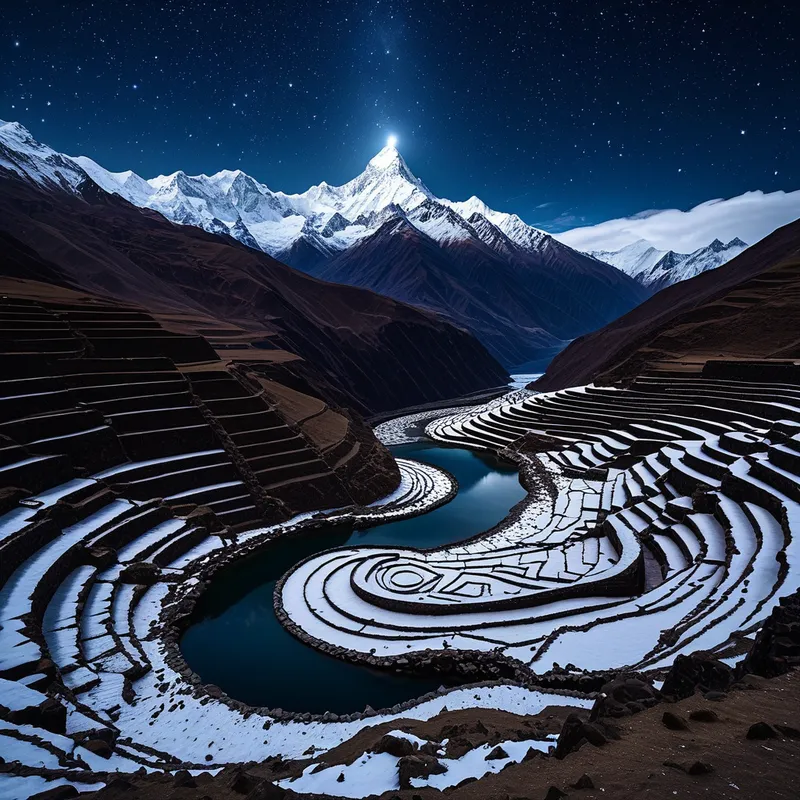
Listen, and let the high wind carry the story. Before the first Sapa Inca walked the earth, when the world was young stone and cold air, the sky was a closer thing. Inti blazed his path with fierce, fatherly love, and Mama Quilla followed, her face a basin of soft, silver light. But a shadow fell between them—a silence born of a grief so deep it cracked the vault of heaven. For their children, the stars, were dying, falling one by one from the sky, consumed by a great, formless hunger from the void below.
Mama Quilla’s sorrow was not a quiet thing. It was a tempest held within. She turned her face from Inti’s warmth and gazed down upon the Kay Pacha, a barren, thirsty land. Her grief, cold and immense, condensed. It began as a mist, then a frost, then a torrent of frozen tears that did not fall but flowed. From the very crown of the world, from the glacial heart of the mightiest peak, her tears began to move. They were not water as we know it, but liquid moonlight, charged with the potency of her divine despair.
This river of silver grief did not gently seek a path. It carved one. With the relentless patience of eternity, it sliced through granite, grumbled through deep canyons, and shattered rock. Its song was a lament, a roar of maternal rage and loss that shook the foundations of the mountains. The earth itself trembled, fearing this celestial wound. But as the river descended, a miracle occurred. The friction of its passage—the grinding against stone, the embrace of the soil—began to warm the divine tears. The cold, sharp grief of the Moon softened.
Where the river’s touch fell, life remembered. Barren dust drank and became fertile loam. Seeds long dormant in the dark earth stirred and split, sending forth green tendrils. The river’s banks grew lush with coca and papa. It gave the land a spine, a rhythm. Animals came to its shores to drink, and in its clear, now-warming waters, they saw not just their reflection, but a reflection of the sky from whence it came. The river had transformed. No longer solely an expression of divine sorrow, it became the land’s lifeblood, its sacred artery. It was named Vilcanota, and it whispered a new truth: from the deepest wound can flow the greatest sustenance.

Cultural Origins & Context
The Vilcanota, known in its lower reaches as the Urubamba, was not merely a geographical feature to the Inca; it was a theological and social axis mundi. This myth originates from the Cusco Region, where the river’s course defined the sacred valley, the fertile cradle of the empire. It was a story told by Amautas and Haravicus, not as mere folklore, but as a foundational narrative explaining the origin of fertility itself.
The tale served multiple societal functions. It established a divine pedigree for the landscape, making the river a direct descendant of the celestial gods, thus sanctifying every community along its banks. It provided an etiological explanation for the river’s origin in glacial melt and its life-giving properties. Most importantly, it modeled a core Andean principle of reciprocity (Ayni). The river gave life (water, fertility), and in return, the people offered reverence, rituals, and sacrifices to maintain the cosmic balance. The myth taught that the source of the community’s survival was born from a celestial, emotional cataclysm, intertwining human fate with the passions of the gods.
Symbolic Architecture
At its [heart](/symbols/heart “Symbol: The heart symbolizes love, emotion, and the core of one’s existence, representing deep connections with others and self.”/), the myth of the Vilcanota is a profound [alchemy](/symbols/alchemy “Symbol: A transformative process of purification and creation, often symbolizing personal or spiritual evolution through difficult stages.”/) of [emotion](/symbols/emotion “Symbol: Emotion symbolizes our inner feelings and responses to experiences, often guiding our actions and choices.”/) and matter. The [river](/symbols/river “Symbol: A river often symbolizes the flow of emotions, the passage of time, and life’s journey, reflecting transitions and movement in one’s life.”/) symbolizes the necessary [journey](/symbols/journey “Symbol: A journey in dreams typically signifies adventure, growth, or a significant life transition.”/) of raw, unconscious psychic content—here, divine [grief](/symbols/grief “Symbol: A profound emotional response to loss, often manifesting as deep sorrow, yearning, and a sense of emptiness.”/) and rage—into a form that nourishes [consciousness](/symbols/consciousness “Symbol: Consciousness represents the state of awareness and perception, encompassing thoughts, feelings, and experiences.”/) and culture.
The unexpressed emotion is a glacier in the soul; expressed and channeled, it becomes the river that irrigates the psyche.
Mama Quilla represents the archetypal feminine, the container of deep, cyclical, and often hidden emotions. Her tears are not weakness but an immense, transformative power. The Kay Pacha—the earthly [realm](/symbols/realm “Symbol: The symbol of ‘Realm’ often signifies the boundaries of one’s consciousness, experiences, or emotional states, suggesting aspects of reality that are either explored or ignored.”/)—symbolizes the field of embodied [life](/symbols/life “Symbol: The symbol of ‘Life’ represents a journey of growth, interconnectedness, and existential meaning, encompassing both the joys and challenges that define human experience.”/) and consciousness. The river’s violent carving [action](/symbols/action “Symbol: Action in dreams represents the drive for agency, motivation, and the ability to take control of situations in waking life.”/) mirrors the often-painful process of bringing deep feeling to the surface, of allowing it to shape us. The resulting [fertility](/symbols/fertility “Symbol: Symbolizes creation, growth, and abundance, often representing new beginnings, potential, and life force.”/) signifies the creative potential unlocked when we honor and guide our deepest emotional currents, rather than damning them. The river becomes a Camac, a living entity that connects the celestial (Hanan Pacha) with the earthly, acting as a [conduit](/symbols/conduit “Symbol: A passage or channel that transfers energy, information, or substance from one place to another, often hidden or structural.”/) for sacred [energy](/symbols/energy “Symbol: Energy symbolizes vitality, motivation, and the drive that fuels actions and ambitions.”/).
The Dreamer’s Resonance
When this myth stirs in the modern dreamer, it often manifests as dreams of powerful, ambivalent water. One might dream of a Raging River Flood threatening to sweep everything away—this is the unprocessed grief or rage, the “glacial tears” breaking loose. Alternatively, one might dream of discovering a Moonlit River in an unexpected place, feeling a pull to drink from it or follow its course. This is the call to engage with this deep emotional current.
Somatically, the dreamer may experience sensations of coldness in the chest (the frozen grief) or a roaring in the ears (the river’s lament). Psychologically, they are navigating the process of “thawing” a long-held emotional freeze. The dream is the psyche’s attempt to initiate the river’s journey—to move a static, painful emotional complex from the high, isolated peaks of repression down into the valleys of feeling and integration, where it can finally nourish the personality instead of poisoning it.
Alchemical Translation
For the individual on the path of individuation, the Vilcanota myth is a masterful map of psychic transmutation. The process begins with the recognition of one’s own “Mama Quilla”—the inner figure, often from the anima/animus or the Self, who holds a vast, frozen sorrow or anger, perhaps from personal or ancestral trauma. This is the prima materia, the leaden, cold weight in the soul.
The alchemical work is not to stop the river of feeling, but to consent to its course, to become both the canyon it carves and the fertile plain it creates.
The “carving of the canyon” is the difficult, often abrasive work of therapy, shadow work, or creative expression—allowing the emotion to flow through the resistant bedrock of old habits and defenses. This stage feels destructive, as old structures of the personality are worn away. The miracle of warming, where the river becomes life-giving, symbolizes the moment of integration. The raw emotion, once expressed and witnessed, loses its destructive chill. It transforms into compassion, artistic inspiration, deeper empathy, or the resilience to nurture oneself and others. The individual becomes like the sacred valley: shaped by the flow of their own deepest experiences, now a fertile ground for a more authentic, connected life. The river is no longer other; it is the very flow of the individuating Self.
Associated Symbols
Explore related symbols from the CaleaDream lexicon:
- River — The central symbol of transformative flow, representing the journey of emotion, consciousness, and life force from a celestial source to nourish the earthly realm.
- Water — The element of emotion, the unconscious, and purification; in this myth, it begins as frozen grief and transforms into the fluid of life.
- Mother — Embodied by Mama Quilla, representing the archetypal source of deep, generative, and sometimes overwhelming emotional power.
- Mountain — The place of origin, the lofty, isolated peak where powerful forces are born and held, symbolizing the heights of the unconscious or spiritual aspiration.
- Healing — The core promise of the myth’s resolution, where a wound (divine grief) becomes the source of sustenance and vitality for an entire world.
- Grief — The prima materia, the raw, divine substance that must undergo the river’s journey to be transmuted from a freezing weight into a flowing grace.
- Journey — The essential narrative arc, depicting the necessary movement from a state of static, painful containment to dynamic, integrative flow.
- Sacrifice — Implicit in Mama Quilla’s outpouring, representing the necessary “loss” or expression of a part of the self to generate a greater, life-giving whole.
- Light — The silver, lunar light of Mama Quilla that infuses the water, symbolizing the consciousness and sacred quality that can be carried within even the darkest emotions.
- Rebirth — The fertility of the riverbanks, signifying the new life, creativity, and psychological structures that emerge after the transformative flood has passed.
- Shadow — The “formless hunger” that consumes the stars and the initial, destructive potential of the unchanneled river, representing the unintegrated aspects of the psyche that must be faced.
- Tears — The specific, potent form of the divine water, representing emotion made tangible, the first crucial release that initiates the entire transformative process.