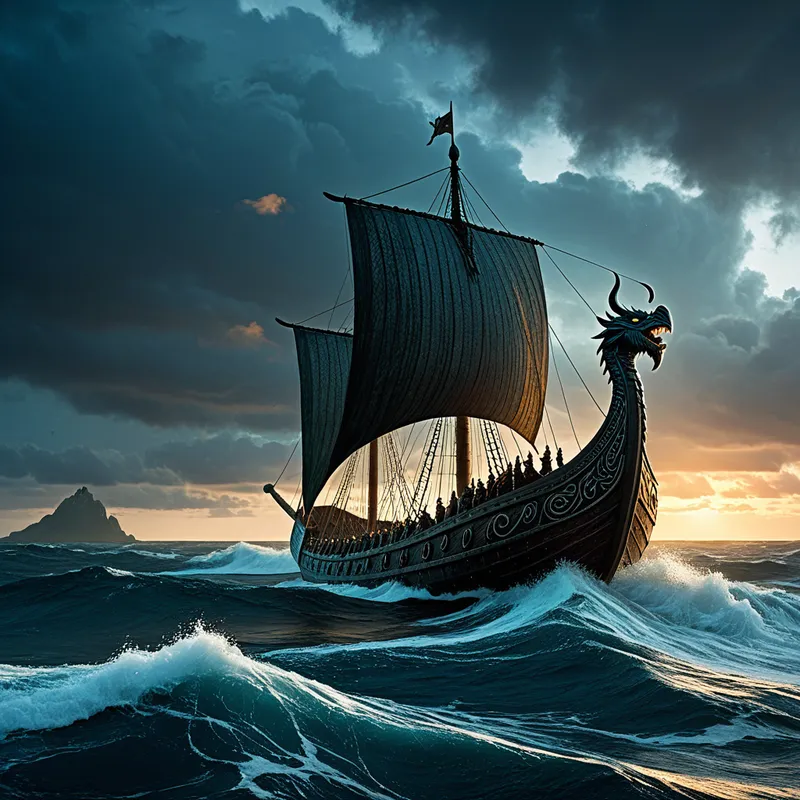
Viking Raids Myth Meaning & Symbolism
A saga of longships breaching the known world, driven by the Norns' threads and Odin's hunger, where men become myth in the clash of sea, steel, and wyrd.
The Tale of Viking Raids
Listen. The wind does not whisper here; it screams a name across the salt-foam. It screams from the Valhalla, where the All-Father paces the golden floor, his single eye burning with a hunger no feast can sate. He hungers for knowledge, for the mead of poetry, for every scrap of story yet to be written in the blood and fire of Midgard. And below, in the fjords where the water is black as obsidian and cold as a Jötunn’s heart, the men hear it.
They are farmers, carvers, fathers. But in their longhouses, the beams groan with the same wind. They look at their fields, then at the gray horizon where the world ends. They feel the pull—not of greed, but of a deeper current. It is the current of Wyrd, spun by the Norns at the foot of the Yggdrasil. Their thread is taut, pointing seaward.
So they drag the serpent-ship, the Drakkar, from its bed of pine needles. Its oak bones remember the forest’s fury; they will now learn the sea’s. They chant as they row, a low thunder that is a prayer to Njörðr for passage, and to Thor for strength. For days, there is only the rhythm of oars, the heave of chests, the vast, indifferent circle of the ocean. Men are reduced to breath and blisters, their old lives sanded away by salt and monotony.
Then, the smell changes. Salt gives way to peat smoke and turned earth. The lookout’s cry is a blade slicing the silence. A coastline, soft and undefended, curls in the dawn light. The prayer ends. The roar begins. It is not a roar of rage, but of transformation. As the prow grinds onto the foreign sand, the farmer sheds his skin. The man who stepped onto the ship is gone, drowned in the crossing. What rises from the benches is something else—a figure of saga, a bringer of chaos, an instrument of Odin’s will.
They move like the wind they rode, a howling, focused storm. There is the crash of doors, the clang of unfamiliar church bells—a sound like shattered sky—the shriek of metal on metal. It is not a battle of armies, but a violent, intimate harvest. They take the glittering things: the silver crosses, the gem-studded books. But they also take something invisible: the terror they sow, the stories that will race ahead of them, turning their names into legends and their ships into monsters in the minds of those who remain.
And then, as suddenly as they came, they are gone. Back to the embrace of the gray sea, their ship heavier with gold and lighter with innocence. They do not look back at the smoke rising. They look ahead, to the telling. For around the fire in the longhouse, the skald will take the raw ore of their violence and forge it into a song. The raid is not complete until the story is told. The man who was a monster becomes a hero in the weaving of words. He has sailed off the map of the known world and returned with a new name, etched not just in memory, but in the very fabric of Wyrd. He has fed the ravens, and in doing so, has fed his own soul to eternity.
Cultural Origins & Context
The myth of the Viking Raid is not a single story from the Eddas, but the overarching narrative etched into the cultural bone of the Norse people from the late 8th to the 11th century. It was passed down not as a dry chronicle, but as saga—literally, “what is said.” Around the longfire, the skald would weave accounts of real expeditions into a tapestry of fate, divine will, and heroic archetype. These stories functioned as societal software.
They justified and glorified a necessary economic and social pressure valve—venturing outward for wealth, land, and prestige in a landscape with limited resources. But more profoundly, they mapped a spiritual journey. The raid was a rite of passage. A young man’s identity was forged not in static inheritance, but in dynamic action beyond the horizon. To “go a-viking” was to actively seek one’s Wyrd, to place oneself in the hands of the gods and the waves. The stories told upon return served to integrate the chaotic, often traumatic, experience of violence and plunder back into the community’s moral and cosmic order, transforming raw act into legendary deed.
Symbolic Architecture
At its core, the raid myth is about the violent, necessary breach of a boundary. The known world—the farm, the fjord, the community—is a psychological container. It represents the ego, the familiar self, the conscious identity.
The longship is the vehicle of the seeking psyche, carrying the dormant self across the threshold of the unknown.
The open sea is the unconscious—vast, chaotic, full of monsters (Jörmungandr) and the favor of capricious gods. The distant shore is the “other,” the shadowland where the treasures (unintegrated aspects of the self, potential, vitality) are kept, often guarded by a foreign order (the monastery, representing a different spiritual framework). The act of raiding is a brutal form of assimilation. The hero does not negotiate with this other; he takes from it by force what he needs to augment his own power and status back home.
The pivotal symbol is the return. A raid without return is a psychic death, a dissolution in the chaos. The successful return, laden with treasure and tales, symbolizes the integration of the shadow. The plundered gold is the psychic energy captured from the encounter with the other, now brought back to enrich and empower the original identity, which is now forever changed.
The Dreamer’s Resonance
When this myth stirs in modern dreams, you are not dreaming of historical reenactment. You are dreaming of a profound internal pressure. To dream of standing at the prow of a ship headed into a fogbank, or of suddenly finding yourself part of a fierce, focused group “taking” something from a symbolic institution (a school, an office, a sterile building), signals a powerful uprising of the exploratory, acquisitive, and potentially disruptive archetype.
Somatically, it may follow feelings of stagnation, of being trapped in the “farm” of your current life. Psychologically, it marks the soul’s imperative to raid its own unexplored coasts. The violence in the dream can mirror the inner violence required to break a pattern, to seize a talent you’ve kept “monasterized” behind walls of doubt or convention, or to claim autonomy from an internalized, foreign authority. The anxiety in the dream is the terror of the sea-crossing—the fear of ego-dissolution. The exhilaration is the call of the undiscovered self.
Alchemical Translation
The alchemical journey of individuation mirrors the raid saga perfectly. The nigredo, the blackening, is the long, arduous crossing—the dissolution of the old persona in the dark sea of the unconscious. The raid itself is the separatio and fermentatio—a violent, chaotic engagement with the shadow, the rejected and foreign parts of the self and the world. It is messy, dangerous, and ethically ambiguous.
The plundered treasure is the aurum philosophicum, the philosophical gold: not material wealth, but the hard-won insight, strength, or creative power retrieved from the depths.
The return voyage is the coagulatio—the solidification of the new, more complex self. But the final, crucial stage is the telling by the fire. This is the coniunctio, the integration. The raw experience must be shaped into narrative, into meaning. The modern individual must become their own skald, weaving the chaotic events of their life—their personal raids, failures, and retrievals—into a coherent life-story. Without this act of conscious storytelling, the treasure remains mere loot, and the raider remains a traumatized outcast. With it, the cycle completes: the explorer returns home, but home is now a different place, because the explorer is forever changed.
Associated Symbols
Explore related symbols from the CaleaDream lexicon: