Viking Explorers Myth Meaning & Symbolism
The myth of restless voyagers sailing beyond the world's edge, driven by a sacred hunger for the undiscovered, embodying the eternal human quest.
The Tale of Viking Explorers
Listen. The fire is low, the mead is sweet, and the wind outside the hall carries the salt of the far sea. I will tell you of the hunger that lives in the marrow of certain men, a hunger not for gold or glory alone, but for the edge of the world itself.
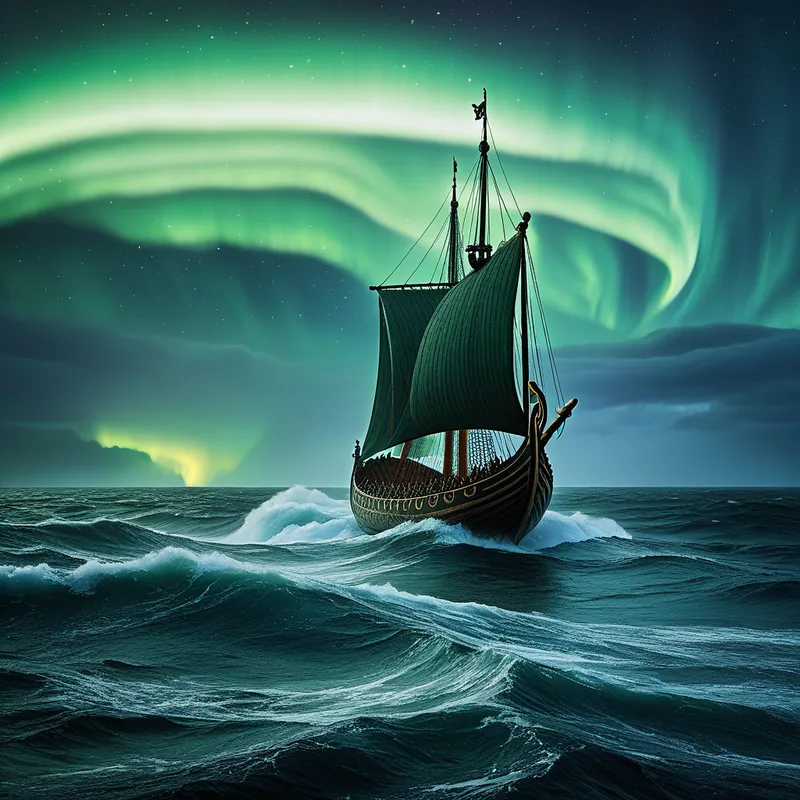
In the days when the Yggdrasil was young and its roots drank from deeper wells, there were those who listened not to the whispers of the hearth, but to the scream of the gale. They were the children of Njörðr, their hearts tuned to the rhythm of the waves. Their homes were the longships—creaking, tar-scented dragons of oak, with sails that drank the wind like thirsty ghosts. They knew the known waters: the whale-roads of the North Sea, the fjords where mountains plunged into black depths.
But they dreamed of Útgarðr—the lands beyond the fence, the places not marked on any chart carved in wood or memory.
So they turned their prows west, into the belly of the setting sun, where the sea-curtain was said to fall into the abyss. They sailed for days where the sun was a pale coin in a milk-white sky, and for nights where the Bifröst danced like a promise of madness. Salt crusted their beards. Their hands bled on the oars. They followed the flight of birds that knew no land, and trusted the strange, sun-warmed stone that could find light in cloud.
And they found edges. Not the world’s end, but its new skin. They found a land of fire and ice, Ísland, where steam rose from the earth’s wounds and glaciers groaned like sleeping giants. They pushed further, to a land of green so deep it hurt the eyes, Vinland, where grapes grew wild and the skraelings watched from the woods with eyes older than Óðinn’s ravens.
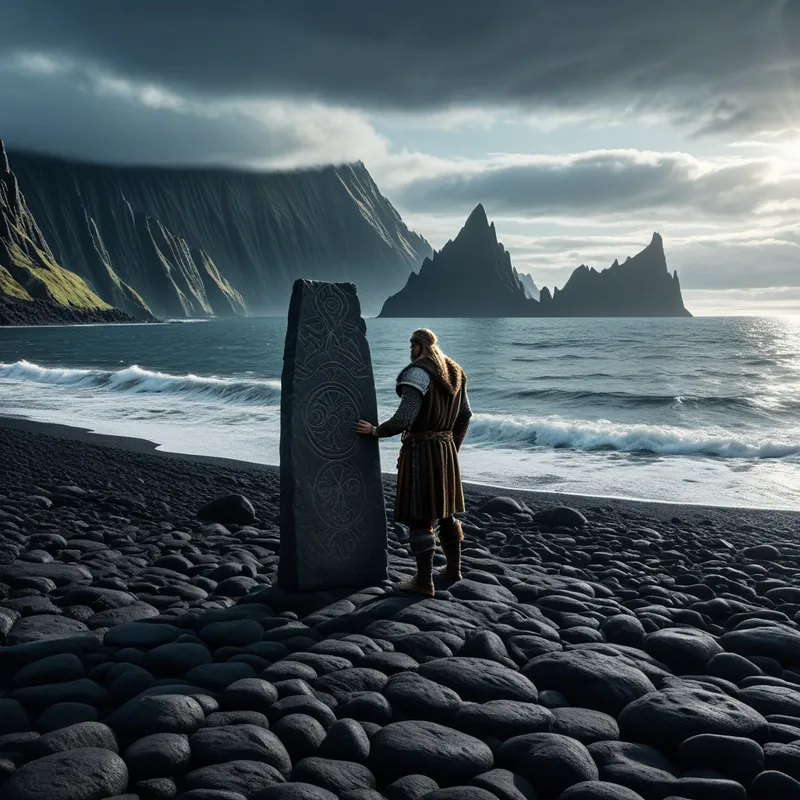
They did not always conquer. Sometimes, they merely stood on a strange shore, the smell of unknown pine in their nostrils, the taste of a new river on their tongues. They raised a cairn of stones, not as a claim, but as a witness. We were here. We saw this. Then the wind would change, or the dreams would come again—dreams of a mist-shrouded coast further still, of a sea that was not water but milk, of a horizon that forever receded. And so they would sail on, the known world a fading memory at their backs, their souls tethered only to the next unknown wave.
Cultural Origins & Context
This is not a single myth, but a tapestry woven from countless sagas, runic inscriptions, and the silent archaeology of settlement. It was born in the crucible of the Viking Age (c. 793–1066 CE), a period defined by mobility, expansion, and a profound relationship with the sea. The stories of explorers like Erik the Red and his son Leif Erikson were preserved in Iceland centuries later, told in longhouses during the dark winters.
These narratives served multiple functions. They were practical histories, recording navigation routes and resources. They were political tools, legitimizing claims to new lands. But at their core, they were existential maps. In a cosmology where the world was destined to end at Ragnarök, exploration was a defiant act of meaning-making. It was the assertion that before the end, there could always be another beginning, another shore. The storyteller, the skáld, was not just an entertainer but a keeper of the exploratory impulse, reminding listeners that their identity was forged not just in the homeland, but in the act of leaving it.
Symbolic Architecture
The Viking Explorer is the archetypal embodiment of the psyche’s journey beyond the ego’s fortified shores. The longship is the vehicle of consciousness, fragile yet daring, designed to navigate both the surface storms and the deep, unconscious currents. The “world’s edge” is not a geographical line but the boundary of the known self.
To sail past the edge of the map is to willingly enter a state of útiseta—sitting out—a ritual of seeking vision beyond the comfort of the familiar mind.
The sólarsteinn (sunstone) is a profound symbol: the intuitive faculty that can perceive guidance (the sun) even when it is obscured by the clouds of doubt, fear, or dogma. The new lands discovered—Iceland’s geothermal fury, Vinland’s fertile mystery—represent new psychic territories: the raw, untamed energies and the potential for new life that emerge when one dares the journey. The act of raising a cairn is crucial; it is not colonization, but the marking of a new level of consciousness, a testament to the journey itself being the destination.
The Dreamer’s Resonance
When this myth stirs in modern dreams, it often manifests as dreams of vast oceans, unknown roads, or preparing for a profound journey. The dreamer may be packing a bag with strange items, standing on a dock waiting for a ship, or looking at a map with places that don’t exist. Somatic sensations often accompany this: a feeling of restlessness in the limbs, a tightness in the chest that is not anxiety but anticipation.
Psychologically, this signals that the conscious ego has become too confined. The “homeland” of one’s current identity—a job, a relationship, a belief system—feels constricting. The unconscious is sending forth the Explorer archetype to scout new possibilities. The dream is an invitation, or perhaps a demand, to venture into uncharted internal territory: to explore a repressed talent, a forgotten passion, or a shadow aspect of the personality that holds vital energy. The fear in the dream is the fear of the hafvilla—being lost at sea—which translates to the modern fear of losing one’s identity, purpose, or sanity in the process of change.
Alchemical Translation
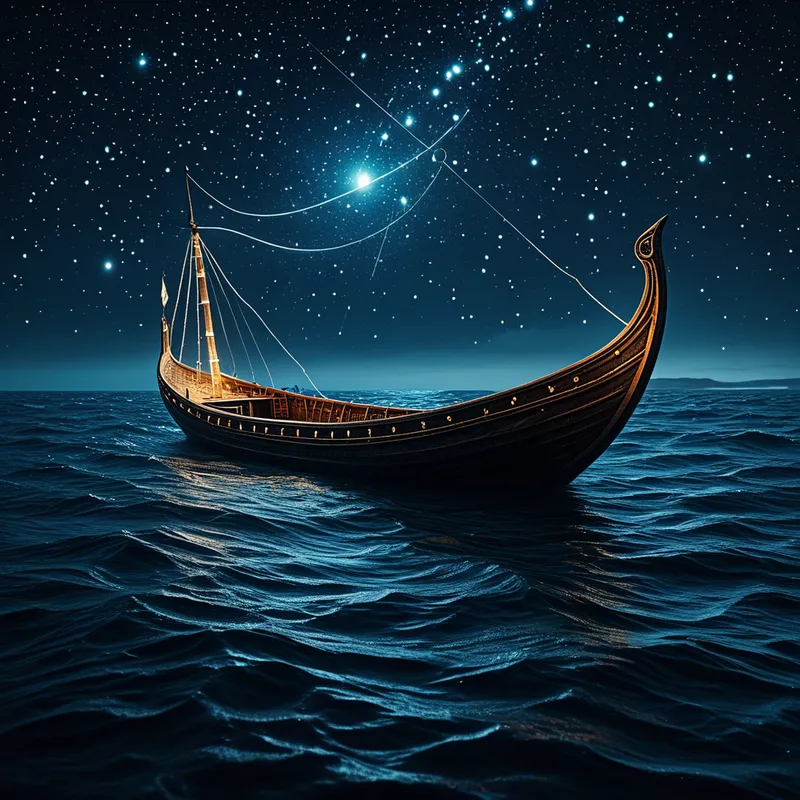
The alchemical process mirrored here is Solutio—dissolution. The fixed, solid elements of the personality (the safe harbor, the known coast) must be dissolved in the primal waters of the unknown. The longship voyage is the opus, the great work of individuation, where the explorer-hero submits to a process larger than himself.
The true discovery is not a new land, but a new relationship to the sea—to the boundless, unconscious matrix from which all life and meaning emerge.
The modern individual engages in this alchemy whenever they consciously choose a path of authentic discovery over one of security. This could be leaving a soul-crushing career to pursue art, ending a stagnant relationship to face solitude, or deconstructing a rigid worldview. The “storms” encountered—doubt, criticism, failure—are the nigredo, the blackening, necessary for purification. The moment of sighting a new shore is the albedo, the whitening, a glimpse of new psychic order. Ultimately, the cycle does not end. The true alchemical gold forged is not a final state of rest, but a perpetual coniunctio—a marriage between the will to explore and the wisdom to integrate, making the seeker at home in the eternal journey itself. The explorer returns to the homeland not to stay, but to gather supplies for the next voyage, now understanding that the center is wherever the questing heart finds its next horizon.
Associated Symbols
Explore related symbols from the CaleaDream lexicon: