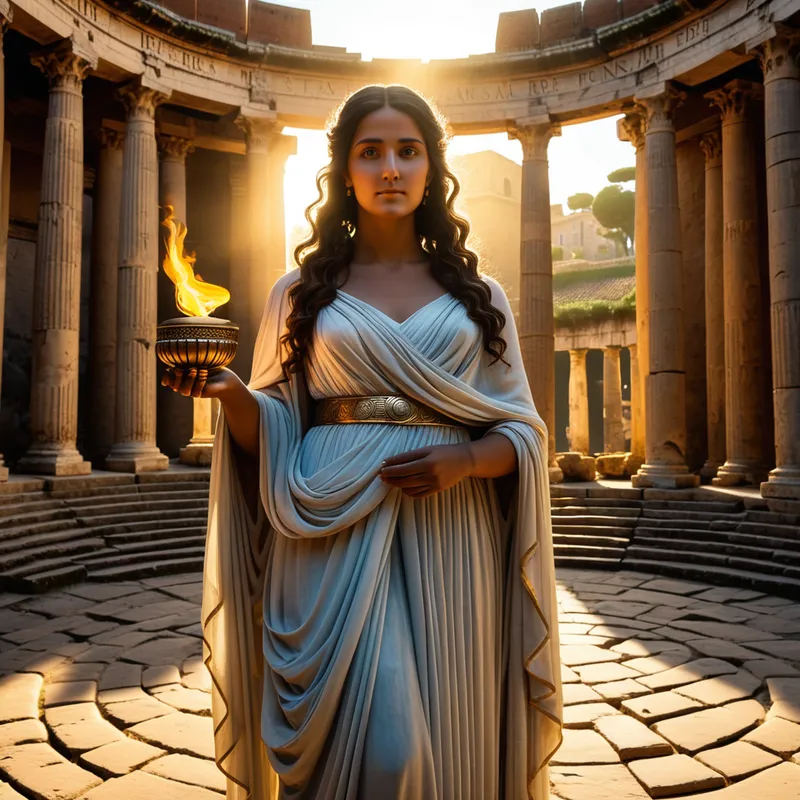
Vesta / The Vestal Flame Myth Meaning & Symbolism
The sacred hearth fire of Rome, tended by the Vestal Virgins, representing the unbroken center of home, state, and soul.
The Tale of Vesta / The Vestal Flame
Before the first stone of the Forum was laid, before the legions marched, there was the Fire. It did not roar with conquest, nor crackle with drama. It simply was—a quiet, breathing heart in the center of the dark.
Listen.
In the beginning, there was only the household. A family huddled against the cold, the wild, the unknown. Their survival was a small, flickering light on a clay hearth. This was the domain of Vesta. She was not depicted in grand statues, for she was the hearth itself. Her presence was the warmth on the skin, the smell of baking bread, the circle of safety where stories were told and vows were made. She was the first and the last; the alpha and omega of the Roman soul.
From this humble, vital center, a city was born. And a city, they knew, was merely a great household. So the sacred flame of Vesta was brought from the first king’s home to the very heart of what would become Rome. A temple was built, not as a house for a statue, but as a house for the Fire itself. A circular shrine, echoing the round hut of the primordial ancestors, its doorway facing east to greet the sun. Here, the public hearth of all Rome burned.
But a flame left untended dies. So the city chose its most sacred daughters: the Vestal Virgins. Chosen as young girls from noble families, they were released from their fathers’ power and given a duty higher than marriage or motherhood. For thirty years, they lived within the Atrium Vestae. Their hair was cut and hung upon a sacred tree. They wore the simple white stola and the headdress of the ancient Roman bride, forever wedded to the city itself.
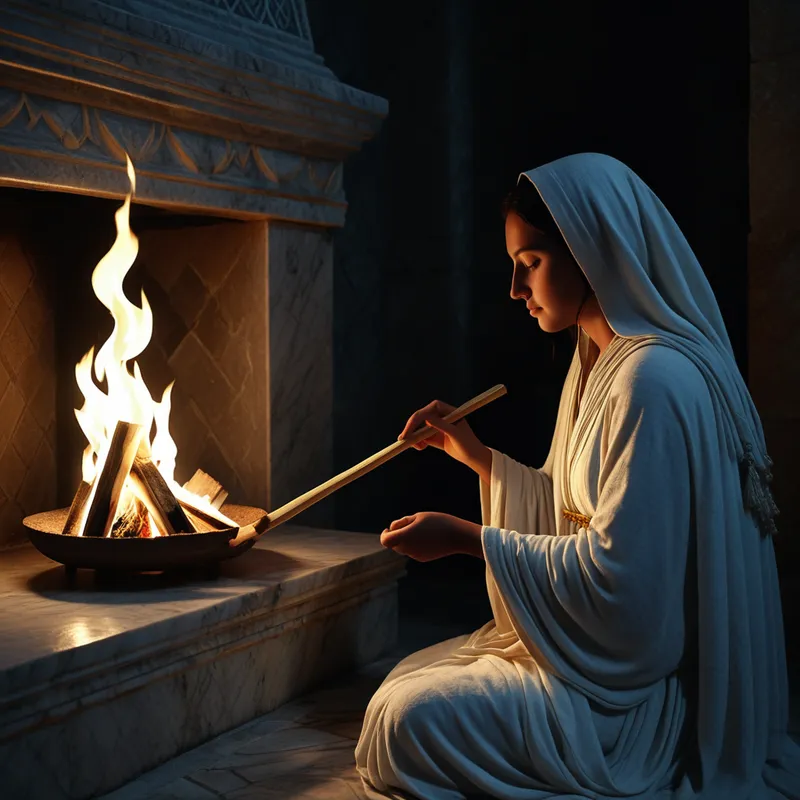
Their task was absolute, their vigil unending. They drew pure water from a sacred spring. They prepared the mola salsa for state rituals. And always, always, they tended the Flame. They fed it only sacred wood, never letting its glow dim. To let it die was the ultimate piaculum, an omen of doom for Rome itself. The fire’s health was Rome’s health; its continuity was Rome’s destiny.
And if a Vestal broke her vow of chastity, the offense was not merely moral—it was a metaphysical poison, a crack in the foundation of the world. The flame would falter. The punishment was burial alive within the Campus Sceleratus, for she had betrayed the inner sanctum of the collective soul. Her life, given to sustain the center, was reclaimed by the earth.
Yet, when her service was complete, a Vestal emerged into a world of unparalleled honor and freedom, a living embodiment of the sacred center she had preserved. For as long as her flame burned, Rome stood. It was a silent pact, a breath held for a thousand years, from the clay huts on the Palatine to the marble majesty of empire. The story is not one of battle, but of vigil. Not of a hero’s journey out, but of a priestess’s steadfast gaze inward, ensuring the hearth of the world never grew cold.
Cultural Origins & Context
The cult of Vesta was arguably the oldest and most fundamental in Roman religion. Her origins are pre-Roman, reaching back to the Indo-European reverence for the hearth fire as the animating spirit of the household. In Rome, this private cult was brilliantly translated into a public, state religion. The Aedes Vestae was not just a temple; it was the symbolic hearth of the city-state, its penus (inner storeroom) holding the sacred talismans of Rome’s fate, including the legendary Palladium.
The myth was not a narrative told in epic verse, but a ritual lived daily. It was passed down through the meticulous, silent actions of the Vestals themselves and the annual public festivals like the Vestalia. During this time, the inner sanctum was opened to married women, and the Vestals performed rites so ancient their meaning was sometimes obscured, yet their power was unquestioned.
Societally, its function was profound. The Vestal Flame was the literal and spiritual anchor of pax deorum (the peace of the gods). The Vestals, existing in a liminal state outside patria potestas (paternal power) and free from traditional female roles, were living symbols of the city’s inviolable core. Their purity guaranteed the state’s stability. The mythos of Vesta thus served as the psychological and religious bedrock upon which the vast, often chaotic, expansion of Roman identity was built.
Symbolic Architecture
At its core, the myth of Vesta and her flame is an archetypal map of the sacred center. It is not a myth of becoming, but of being. The flame symbolizes the immutable, vital essence—of the self, the family, the community, the cosmos.
The hearth is the axis mundi of the domestic world; the Vestal flame is the axis mundi of the civic soul. To tend it is to acknowledge that all order radiates from a silent, burning center.
The round temple is a profound symbol. With no cult statue, its emptiness points to the numinous, invisible presence at the heart of things. It represents the inner sanctum of the psyche, the Self, which must be kept inviolate from the chaos of the outer world. The Vestal Virgins themselves symbolize the conscious ego’s role as the guardian of this center. Their chastity is not merely sexual, but a symbol of psychological integrity—a commitment not to be distracted or “penetrated” by outer compulsions, personal desires, or collective anxieties that would pollute the sacred inner space.
The dire consequence of letting the flame die, or of the Vestal’s “fall,” represents the catastrophic psychic state when one loses connection to this inner essence. It is a descent into meaninglessness, where the individual or the culture is unmoored, adrift without a central organizing principle.
The Dreamer’s Resonance
When this myth stirs in the modern dreamer, it often signals a profound process of centering or a crisis of desecration. To dream of a sacred, eternal flame in a domestic or institutional setting points to a somatic need to reconnect with one’s core vitality and purpose. The dreamer may be feeling scattered, over-extended, or “burned out” in the profane sense, and the psyche is presenting the antidote: a return to the essential, nourishing fire within.
Dreams of being a guardian of such a flame, or of anxiously trying to relight one that has gone out, speak directly to the responsibility of self-care and the maintenance of one’s inner sanctuary. The somatic sensation is often one of deep, anxious tension in the core of the body—a felt sense that something fundamental is threatened.
Conversely, dreams that involve the violation of a sacred inner space—a hearth defiled, a temple broken into—may indicate that the dreamer has allowed external pressures, toxic relationships, or their own shadow elements to invade and pollute their psychological center. This can manifest as somatic symptoms of illness, chronic fatigue, or a pervasive sense of being “unclean” or spiritually homeless. The psyche is sounding the alarm that the custodian has fallen asleep at her post.
Alchemical Translation
The alchemical process modeled here is not the dramatic solve et coagula (dissolve and coagulate) of other myths, but the meticulous, lifelong labor of the Athanor—the sealed furnace that maintains a constant, gentle heat for the Great Work. The individuation journey reflected in Vesta’s myth is the work of establishing and maintaining the temenos, the sacred precinct of the Self.
The ultimate alchemy is not in the creation of gold, but in the preservation of the flame. The transmutation is from chaos to cosmos, achieved through unwavering attention.
The modern individual begins this work by identifying their own “sacred flame”—their core values, innate gifts, or sense of authentic being. The “Vestal” within is the part of the ego that vows to protect this essence above all else. This requires a form of sacred “chastity”: the discipline to say no to distractions, the integrity to not prostitute one’s essence for external validation, and the courage to create boundaries that keep the inner sanctuary pure.
The “fuel” we feed this flame is our conscious attention, our practices of reflection, and our engagement with what truly nourishes the soul. The “temple” is the life structure we build around this center—our home, our routines, our chosen community. The labor is daily, humble, and often invisible. Yet, through this steadfast tending, the scattered elements of the psyche (prima materia) are gradually warmed, ordered, and unified around the central, eternal fire. The triumph is not an epic victory, but the quiet, unshakable knowledge of being centered, whole, and connected to the enduring source of one’s own life and, by extension, to the continuity of life itself. One becomes, like the retired Vestal, a sovereign keeper of the mystery, having earned the freedom that comes from a lifetime of sacred duty to the inner truth.
Associated Symbols
Explore related symbols from the CaleaDream lexicon: