Vesta and the Vestal Virgins Myth Meaning & Symbolism
The sacred fire of the state, guarded by six chosen women, whose purity was the bedrock of Rome's covenant with the divine.
The Tale of Vesta and the Vestal Virgins
Listen, and hear the story not of thunder or war, but of a quiet, steady light in the heart of the world. Before the legions marched, before the Senate debated, there was a whisper in the dark, a need for a center that would hold. The gods had given Rome much, but what is a kingdom without a home? What is a people without a hearth?
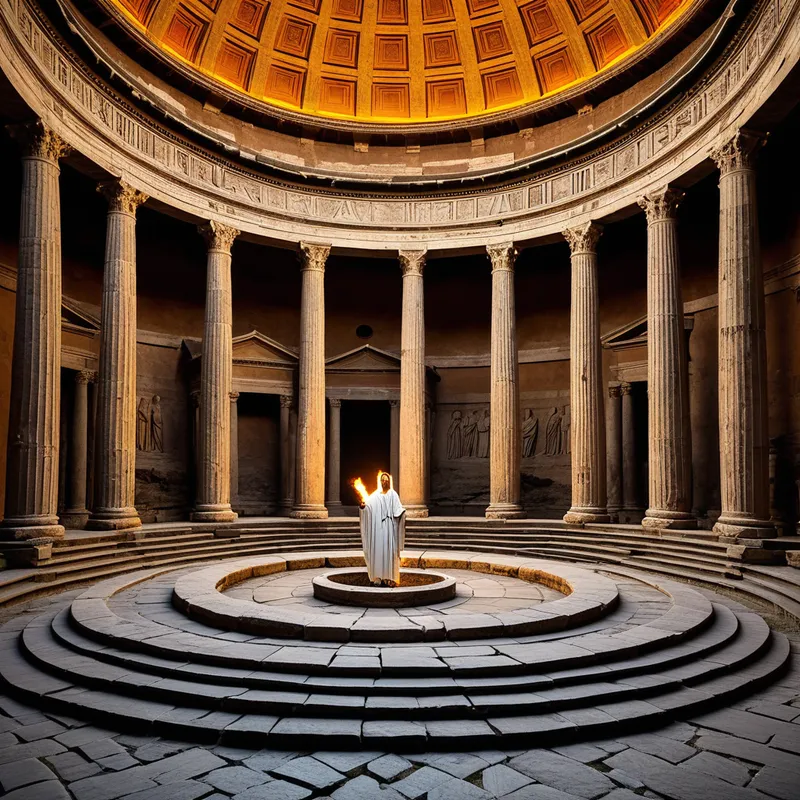
From the first spark struck by the founder Romulus, a covenant was made. The divine flame of Vesta would be kept alive, not in a grand temple of statues, but in a round house like the first hut of the Latins. Its door faced east, greeting the sun that fed the fire within. And to tend this flame, the city would choose its daughters.
Six girls, between six and ten years old, of noble birth and flawless body, were taken from their families in a solemn procession. They entered the Atrium Vestae, a sacred enclosure beside the Forum, and their childhood ended. For thirty years, they would belong not to a man, but to Vesta. They donned the white stola and the headdress of a matron, though they were to remain virgins. Their hair was cut and hung upon the ancient Lotus Tree.
Their days were a ritual of purity. They drew water from a sacred spring, never letting the vessel touch the earth. They prepared the sacred grain offering, the mola salsa. But their supreme duty, their sacred terror, was the fire. It must never go out. They fed it with precious wood, watched it through the night, shielded it from errant winds. The flame was the city’s soul, its pneuma; its continuity was Rome’s continuity. To let it die was to invite famine, invasion, the unraveling of the world.
The conflict was not of monsters, but of breath and shadow. The greatest threat was not from without, but from within—the failure of vigilance, the wavering of faith, the human flaw. The punishment for a Vestal who broke her vow of chastity was burial alive outside the city walls, for she had allowed a foreign fire to pollute the sacred one. The city would cleanse itself of the profanation. Yet, if a condemned Vestal met the Pontifex Maximus on her way to the tomb and he absolved her, it was a sign from Vesta herself. Such miracles were rare, a tremor in the fabric of the real.
For thirty years, they served. Then, they were free. They could marry, though few did, for who would wed a woman who had been the bride of a goddess? They were given a pension, immense honor. But they often chose to remain within the order’s walls, near the flame they had nurtured from girlhood to maturity. Their service ended, but the fire, and the story, burned on.
Cultural Origins & Context
The cult of Vesta was not merely a religious institution; it was the psychological and political bedrock of the Roman state. Its origins are archaic, predating the Republic, reaching back to the primordial Indo-European veneration of the hearth-fire as the living spirit of the household, the familia. Vesta herself had no statue—she was the fire. This abstraction speaks to her foundational nature; she was not a personality to be petitioned, but a condition to be maintained.
The myth was not a narrative told in epic verse, but a living ritual performed daily. It was passed down through the meticulous, silent actions of the Vestals and the oversight of the pontifical college. Its societal function was one of symbolic binding. The Vestals’ virginity was not about sexual morality in a modern sense, but about absolute autonomy and containment. They belonged to no patriarchal family line, thus they could embody the whole city. Their purity ensured the purity of the state’s covenant with the gods. In times of crisis, the Senate’s first question was often: Is the sacred fire of Vesta still burning?
Symbolic Architecture
At its core, this myth is an elaborate, profound symbol of the psyche’s need for a sacred, inviolable center. The hearth is the axis mundi of the personal and collective world.
The flame is not passion, but presence. It is the undying witness at the core of being, the silent “I am” that must be tended lest consciousness itself gutter out.
The Vestales represent the ego’s capacity for devoted service to this inner sanctum. Their thirty-year service maps onto the human journey: the maiden (first decade) is chosen, the mother/nurturer (second decade) tends the flame, the elder/crone (third decade) becomes its guardian and wisdom-keeper. Their virginity symbolizes a psychological state of wholeness and self-containment, a space not penetrated by the chaos of external compulsions or identifications.
The terrifying penalty for a Vestal who “allowed the fire to go out” or broke her vow is the shadow side of this symbolism. It represents the catastrophic psychic disintegration that occurs when the sacred inner center is abandoned or profaned—when one’s core integrity is sacrificed for outer validation or transient desire. The live burial is a stark image of the soul entombed by its own betrayal.

The Dreamer’s Resonance
When this myth stirs in the modern dreamer, it often signals a critical phase of inner consolidation or a warning of its neglect. Dreaming of a sacred, enclosed fire suggests a need to identify and protect one’s vital essence—a creative spark, a core value, a fragile new sense of self. The dreamer may be in a life stage requiring focused devotion (the “30-year service”) to a calling, often at the expense of other social or relational roles.
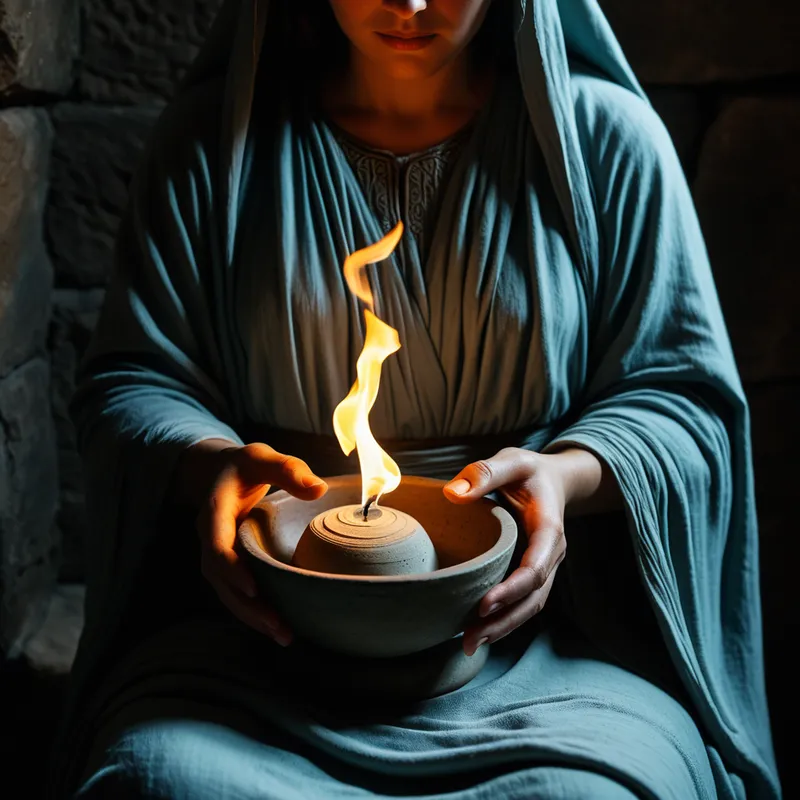
Dreaming of a Vestal figure—a serene, autonomous woman in white tending a flame—can appear when the dreamer, regardless of gender, is integrating a capacity for self-containment and spiritual self-sufficiency. Conversely, dreams of a dying fire, a darkened temple, or being pursued for a ritual failing point to a profound anxiety. The dreamer may feel they have “broken their vow”—compromised their integrity, abandoned a deep promise to themselves, or allowed the distractions of the world to extinguish their inner light. The somatic feeling is often one of coldness, emptiness, or a chilling dread of being “walled in” by the consequences of their own actions.
Alchemical Translation
The alchemical process mirrored here is coagulatio—the condensation of spirit into a lasting, sacred form. The raw, wandering fires of instinct and desire (the prima materia) must be gathered, contained, and transformed into a stable, eternal flame. The Vestal’s service is the opus of individuation: a voluntary, rigorous discipline applied to the soul’s central mystery.
The ultimate transmutation is not of lead into gold, but of temporal life into timeless meaning. The Vestal, through her service, does not become the flame; she becomes the temple that houses it.
For the modern individual, the myth calls for the identification of one’s own “sacred fire.” What is the non-negotiable principle, the creative source, the inner truth that gives your life continuity and meaning? The “Vestal vow” is the conscious commitment to tend that above all else. The “purity” required is not moral perfection, but the integrity of attention—guarding the flame from the “profane winds” of cynicism, distraction, and collective pressures.
The final freedom offered after thirty years is the alchemical reward. It represents the stage where the disciplined service becomes the natural state of being. The fire is so integrated, so self-sustaining, that the rigid vows of the novice are no longer needed. The individual emerges not just free, but as a sovereign keeper of their own eternal hearth, capable of carrying that sacred, contained light out into the world without it being extinguished. They have built an inner Rome that cannot fall.
Associated Symbols
Explore related symbols from the CaleaDream lexicon: