Vessel of Transformation Myth Meaning & Symbolism
A myth of a divine artisan who shatters a perfect vessel to forge a greater one, embodying the sacred necessity of destruction for true creation.
The Tale of Vessel of Transformation
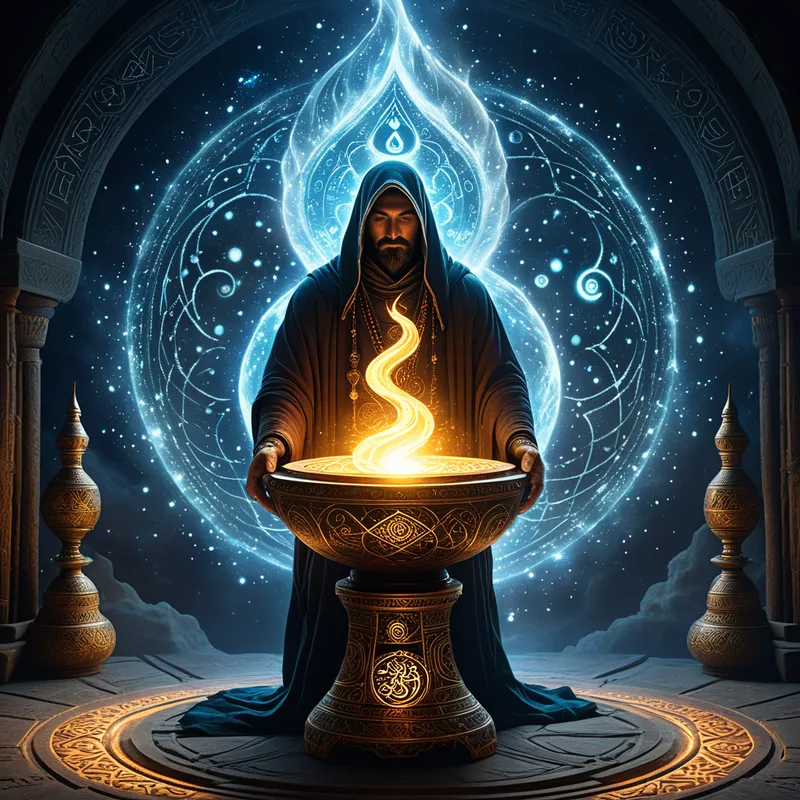
In the time before time, when the substance of [the world](/myths/the-world “Myth from Tarot culture.”/) was still a thought in the mind of the [Prima Materia](/myths/prima-materia “Myth from Alchemical culture.”/), there existed an artisan of the cosmos. Some called this entity the Opifex, the Maker-Whose-Hands-Are-Fire. The Opifex dwelt not in a palace, but in [the crucible](/myths/the-crucible “Myth from Alchemical culture.”/) of potential itself, a realm where light pooled like liquid gold and silence hummed with unspoken forms.
From the chaos of unshaped elements, the Opifex gathered the [quintessence](/myths/quintessence “Myth from Alchemical culture.”/): the clarity of mountain air, the patience of stone, the memory of deep earth, and the yearning of the first flame. For an acon, the artisan worked, not with hammer and chisel, but with intent and breath. The substance was sung into being, coiled and folded upon itself until, from the forge of stars, it emerged—the First Vessel.
It was a [thing](/myths/thing “Myth from Norse culture.”/) of unbearable beauty. Its surface held the map of unborn galaxies; its curves echoed the orbits of planets yet unnamed. It was perfect. It was whole. It contained, in its flawless form, the entire promise of creation. The Opifex placed it upon the altar of [the void](/myths/the-void “Myth from Buddhist culture.”/), and it shone, a solitary beacon of completed work.
And the Opifex was pleased. Yet, in the deep wells of divine consciousness, a disquiet stirred. [The Vessel](/myths/the-vessel “Myth from Alchemical culture.”/) was complete, but it was static. It could hold, but it could not become. Its perfection was its prison. A profound sorrow, the sorrow of a creator who sees the limit of their creation, filled the interstellar spaces.
With a resolve that shook the foundations of potential, the Opifex reached out. Not to adorn, but to annihilate. The divine hands, still glowing from the act of creation, closed around the First Vessel. There was no anger, only a terrible, loving necessity. A single, resonant note filled the cosmos—the sound of sacred fracture.
The Vessel shattered. Not into mere debris, but into a million spinning fragments, each a glittering shard containing a sliver of the original wholeness. They flew apart like a new-born constellation, a storm of broken light. The perfect form was gone, dissolved into chaotic, radiant dust.
Then began the second work. From [the sea](/myths/the-sea “Myth from Greek culture.”/) of fragments, the Opifex began to gather. Not to simply reassemble, but to re-member. A shard of memory was fused with a spark of yearning. A piece of patience was wound with a filament of flame. The artisan worked now with the scars of the breakage, incorporating the fractures into the new design. The process was infinitely more complex, a weaving of loss into the very fabric of being.
When the final seam was sealed, a new vessel stood where the first had been. It was not “perfect.” It was marked, traceries of gold and obsidian filling the lines of its shattering, like a map of its own ordeal. But it pulsed with a dynamic, living light. It could receive, but it could also transform. It could contain darkness without breaking, and hold light without claiming it. This was the Vessel of Transformation. And from its open mouth, the first song of an evolving universe was breathed into the waiting dark.
Cultural Origins & Context
This myth finds its roots not in a single culture, but in the esoteric heart of the Western alchemical tradition, spanning from Hellenistic Egypt through the Medieval and Renaissance periods. It was never a single, standardized tale but a core narrative principle transmitted through cryptic texts, symbolic engravings, and oral teachings within guilds and hermetic circles. Figures like the legendary [Hermes Trismegistus](/myths/hermes-trismegistus “Myth from Greek culture.”/) were its purported sources.
It was a “master myth” for initiates, passed down not to the public but to those undergoing the practical and spiritual work of alchemy itself. Its societal function was interior and pedagogical. It served as a metaphysical map for [the alchemist](/myths/the-alchemist “Myth from Various culture.”/)‘s own laboratory work—where the “vessel” was the literal alembic or crucible—and, more importantly, for the parallel process of spiritual refinement, the [Magnum Opus](/myths/magnum-opus “Myth from Alchemical culture.”/). The myth encoded the terrifying yet necessary stages of the work ([Nigredo](/myths/nigredo “Myth from Alchemical culture.”/), Albedo, etc.) into a memorable, soul-stirring story, assuring the practitioner that the despair of dissolution (solve) was a prelude to the joy of a higher coherence (coagula).
Symbolic Architecture
The myth is a dense [tapestry](/symbols/tapestry “Symbol: The tapestry represents interconnected stories, creativity, and the weaving of personal and collective experiences into a cohesive narrative.”/) of interlocking symbols. The Opifex represents the transcendent Self, the guiding archetypal force of wholeness that orchestrates the [psyche](/myths/psyche “Myth from Greek culture.”/)‘s evolution. The First [Vessel](/symbols/vessel “Symbol: A container or structure that holds, transports, or protects something essential, representing the self, emotions, or life journey.”/) symbolizes the initial, naive state of [the ego](/myths/the-ego “Myth from Jungian culture.”/)—a constructed [identity](/symbols/identity “Symbol: Identity represents the sense of self, encompassing personal beliefs, cultural background, and social roles.”/) that appears whole and competent but is brittle, unable to accommodate the full [spectrum](/symbols/spectrum “Symbol: A continuum of possibilities, representing diversity, transition, and the full range of existence from one extreme to another.”/) of [life](/symbols/life “Symbol: The symbol of ‘Life’ represents a journey of growth, interconnectedness, and existential meaning, encompassing both the joys and challenges that define human experience.”/)‘s paradoxes, shadows, and suffering.
The first wholeness is an illusion of completeness; the true wholeness is born from the conscious integration of the break.
The act of shattering is the essential [crisis](/symbols/crisis “Symbol: A crisis symbolizes turmoil, urgent challenges, and the need for immediate resolution or change.”/)—the Nigredo or dark [night](/symbols/night “Symbol: Night often symbolizes the unconscious, mystery, and the unknown, representing the realm of dreams and intuition.”/) of the [soul](/symbols/soul “Symbol: The soul represents the essence of a person, encompassing their spirit, identity, and connection to the universe.”/). It represents the inevitable encounter with failure, [loss](/symbols/loss “Symbol: Loss often symbolizes change, grief, and transformation in dreams, representing the emotional or psychological detachment from something or someone significant.”/), [trauma](/symbols/trauma “Symbol: A deeply distressing or disturbing experience that overwhelms the psyche, often manifesting in dreams as unresolved emotional wounds or psychological injury.”/), or profound disillusionment that cracks the ego’s [shell](/symbols/shell “Symbol: Shells are often seen as symbols of protection, transition, and the journey of personal growth.”/). This is not a meaningless [disaster](/symbols/disaster “Symbol: A disaster can symbolize chaos, disruption, and fear surrounding life changes or unresolved conflicts.”/) but a sacred, if brutal, intervention by [the Self](/myths/the-self “Myth from Jungian culture.”/). The fragments are the dissociated parts of the psyche: repressed memories, unlived potentials, [shadow](/symbols/shadow “Symbol: The ‘shadow’ embodies the unconscious, repressed aspects of the self and often represents fears or hidden emotions.”/) qualities, and talents abandoned for [conformity](/symbols/conformity “Symbol: The act of adjusting one’s behavior, beliefs, or appearance to match those of a group or societal norms, often involving pressure to fit in.”/).
The second forging is the laborious process of psychotherapy, introspection, and conscious living—the [Albedo](/symbols/albedo “Symbol: In alchemy, the whitening stage representing purification, spiritual ascension, and the emergence of consciousness from darkness.”/) and Citrinitas. It is the careful gathering and re-[integration](/symbols/integration “Symbol: The process of unifying disparate parts of the self or experience into a cohesive whole, often representing psychological wholeness or resolution of internal conflict.”/) of those lost parts, not to return to the old form, but to create a new, more capacious [structure](/symbols/structure “Symbol: Structure in dreams often symbolizes stability, organization, and the framework of one’s life, reflecting how one perceives their environment and personal life.”/). The traceries of gold and [obsidian](/symbols/obsidian “Symbol: A volcanic glass symbolizing protection, transformation, and hidden truths. It represents sharp clarity and dark, reflective depths.”/) in the final vessel are the scars made sacred—the wounds that become sources of wisdom, [empathy](/symbols/empathy “Symbol: The capacity to understand and share the feelings of others, often manifesting as emotional resonance or intuitive connection in dreams.”/), and [depth](/symbols/depth “Symbol: Represents profound layers of consciousness, hidden truths, or the unknown aspects of existence, often symbolizing introspection and existential exploration.”/). The final Vessel of Transformation is the individuated [personality](/symbols/personality “Symbol: Personality in dreams often symbolizes the traits and characteristics of the dreamer, reflecting how they perceive themselves and how they believe they are perceived by others.”/), a self that is dynamic, resilient, and capable of containing opposites.
The Dreamer’s Resonance
When this myth activates in the modern unconscious, it often manifests in dreams of profound breaking and mending. A dreamer may see their home (a classic symbol of the self) collapsing, only to find a more beautiful, strange architecture within the ruins. They may dream of a cherished heirloom—a vase, a mirror, a locket—shattering, and then painstakingly gluing it back together with a luminous, unfamiliar adhesive.
Somatically, the dreamer may be experiencing a period of intense vulnerability, fatigue, or illness—the body’s Nigredo. Psychologically, they are in the liminal space between an old identity that no longer fits and a new one not yet formed. There is a palpable sense of being “in pieces.” The dream is not a prophecy of doom, but a confirmation from the deep psyche: the dissolution is part of the process. The dream imagery provides the symbolic reassurance that the fragments are not lost and that a greater, though currently unimaginable, reconstitution is the goal of this painful phase.

Alchemical Translation
For the modern individual seeking individuation, the myth models the non-linear path of psychic transmutation. Our culture worships the “First Vessel”—the curated, successful, unbroken [persona](/myths/persona “Myth from Greek culture.”/). The myth insists that clinging to this false perfection is the greatest obstacle to growth.
The core struggle is the surrender to necessary suffering. It is the courage to allow a cherished self-image, a long-held belief, or a life structure to be broken apart by experience or introspection. The [triumph](/myths/triumph “Myth from Roman culture.”/) is not in avoiding the shatter, but in participating in the re-forging.
The alchemist’s fire is not merely endured; it is ultimately recognized as one’s own transformative will, made conscious.
This translates to practical inner work: instead of fleeing depression, anxiety, or grief, one learns to “sit in the fire” of those states, asking what outdated structure within is being rightfully dissolved. It means gathering the “shards”—perhaps through journaling, therapy, or artistic expression—by reclaiming abandoned passions, acknowledging hidden angers, or forgiving disowned weaknesses. The new vessel that emerges is a self that owns its history, including its fractures. It is no longer a static “perfect person,” but a living process—a Vessel of Transformation—capable of holding life’s chaos and glory with resilience, wisdom, and an ever-deepening capacity for being.
Associated Symbols
Explore related symbols from the CaleaDream lexicon: