Vesica Piscis Myth Meaning & Symbolism
The sacred geometry of two intersecting circles, a portal of divine birth and the luminous frame of Christ, symbolizing the union of heaven and earth.
The Tale of Vesica Piscis
Listen, and let the silence between the words speak. In the beginning, before [the Word](/myths/the-word “Myth from Biblical culture.”/), there was the Shape. Not a shape of stone or star, but a shape of potential, a breath held in the mind of the Unmoved Mover. It was the meeting of two perfect worlds, two circles of divine intention. Where they overlapped, a third [thing](/myths/thing “Myth from Norse culture.”/) was born—not a circle, but an almond of luminous emptiness, a womb of dark light.
This shape did not live in [the world](/myths/the-world “Myth from Tarot culture.”/) of men. It lived in the space between spaces, in the breath between prayers. It was the first secret, the geometry of the meeting. And so it waited, a silent promise in the architecture of the cosmos.
Then came the day the heavens were torn. Not with sound, but with a profound yielding. At the muddy banks of the Jordan, a man named John, clothed in the rough skin of prophets, poured [water](/myths/water “Myth from Chinese culture.”/) over the head of another. As [the river](/myths/the-river “Myth from Buddhist culture.”/) streamed from the hair and beard of Yeshua, [the sky](/myths/the-sky “Myth from Persian culture.”/) did not thunder. It parted. It opened in a way that eyes could not see, but the soul could feel. In that moment of cleansing and declaration, the silent shape from the beginning made itself known. It was the very aperture of heaven, the opening through which the Spirit, like a dove, descended. [The river](/myths/the-river “Myth from Buddhist culture.”/), the man, [the sky](/myths/the-sky “Myth from Persian culture.”/)—they were the circles. The moment of recognition was the almond.
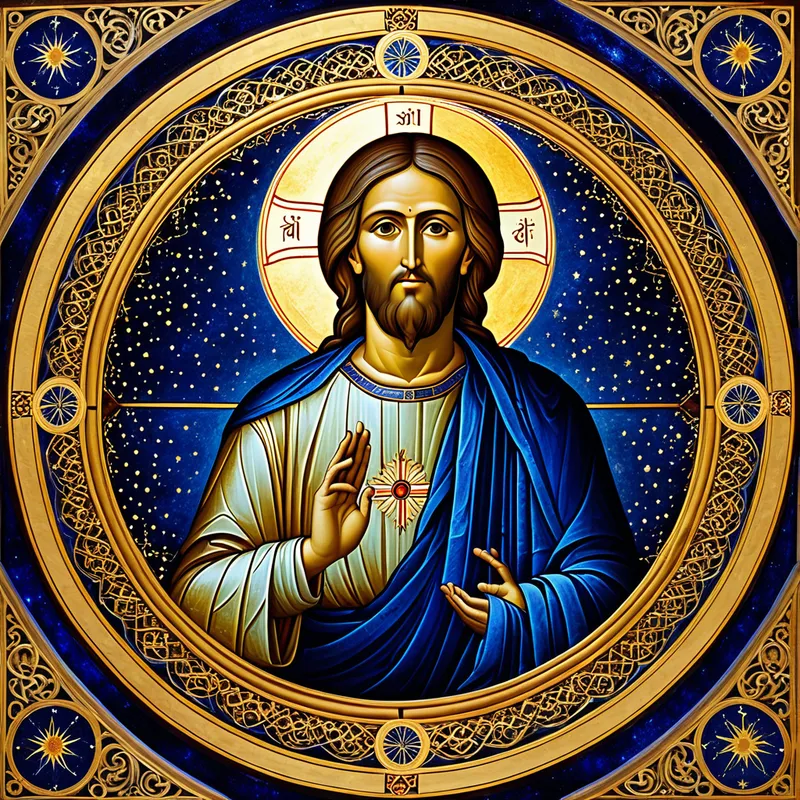
The shape followed him. It became the halo that was not a halo, but a frame. When artists, centuries later, their hands guided by memory and vision, sought to paint his glory, they did not crown his head with a simple ring of gold. They encased his entire risen form in an aura of light shaped like that almond—the mandorla. He stood within the Vesica, the intersection point made manifest, the living proof of where the divine circle and the circle of earthly suffering perfectly met. In the cold stone of cathedrals, masons carved it over doorways, a silent testament that to enter was to pass through that same sacred intersection. It was the eye of the needle, the birth canal of spirit, the shape of the wound in reality that lets eternity through.
Cultural Origins & Context
The Vesica Piscis is a myth written not in words, but in stone, glass, and pigment. Its story is one of Christian sacred geometry, emerging from the ancient Mediterranean world’s fascination with Platonic ideals—the belief that perfect mathematical forms underpin reality. Early Christian theologians, steeped in Hellenistic thought, saw in geometry a language of God.
It was passed down not by bards, but by guilds: the masons of the great cathedrals, the monks illuminating manuscripts, the master glaziers piecing together windows of saintly light. Its societal function was architectural and theological. It served as a cosmic diagram, a visual sermon. Placed on the tympanum above a church door, it signaled that crossing [the threshold](/myths/the-threshold “Myth from Folklore culture.”/) was an act of spiritual passage into a realm where heaven and earth intersect. In the baptismal font, its shape (often the base of the font itself) physically enacted the myth: the initiate was lowered into the watery almond, symbolically dying and being reborn through that sacred intersection.
Symbolic Architecture
At its core, the [Vesica](/symbols/vesica “Symbol: A sacred geometric shape formed by two overlapping circles, representing divine intersection, creation, and spiritual union across many traditions.”/) Piscis is a [symbol](/symbols/symbol “Symbol: A symbol can represent an idea, concept, or belief, serving as a powerful tool for communication and understanding.”/) of [relationship](/symbols/relationship “Symbol: A representation of connections we have with others in our lives, often reflecting our emotional state.”/) and the generative [tension](/symbols/tension “Symbol: A state of mental or emotional strain, often manifesting physically as tightness, pressure, or unease, signaling unresolved conflict or anticipation.”/) that relationship creates. Two circles, each complete and sovereign in themselves, choose to overlap. The resulting [space](/symbols/space “Symbol: Dreaming of ‘Space’ often symbolizes the vastness of potential, personal freedom, or feelings of isolation and exploration in one’s life.”/) is neither one nor the other, but a wholly new [realm](/symbols/realm “Symbol: The symbol of ‘Realm’ often signifies the boundaries of one’s consciousness, experiences, or emotional states, suggesting aspects of reality that are either explored or ignored.”/) born of their communion.
The most sacred things are born not from unity, nor from separation, but from the fertile, tense, and luminous collision of the two.
Psychologically, the two circles represent any pair of fundamental opposites that the [psyche](/myths/psyche “Myth from Greek culture.”/) must reconcile: [spirit](/symbols/spirit “Symbol: Spirit symbolizes the essence of life, vitality, and the spiritual journey of the individual.”/) and matter, conscious and unconscious, self and other, masculine and feminine (in the Jungian sense). The Vesica is the symbolic container where this confrontation occurs. It is not the [resolution](/symbols/resolution “Symbol: In arts and music, resolution refers to the movement from dissonance to consonance, creating a sense of completion, release, or finality in a composition.”/), but the [arena](/symbols/arena “Symbol: An arena symbolizes a space for competition, public scrutiny, or performing under pressure.”/) of transformation. Christ within the mandorla is the [archetypal image](/symbols/archetypal-image “Symbol: A universal, primordial symbol from the collective unconscious that transcends individual experience and carries profound spiritual or mythic meaning.”/) of the Self—the individual who has fully entered and endured the tension of these opposites, and in doing so, has become the luminous content of the space between them. The shape itself is the [birth](/symbols/birth “Symbol: Birth symbolizes new beginnings, transformation, and the potential for growth and development.”/) [canal](/symbols/canal “Symbol: A canal in dreams can symbolize pathways through which emotions, ideas, or experiences flow, often relating to the direction of life’s journey.”/) of [consciousness](/symbols/consciousness “Symbol: Consciousness represents the state of awareness and perception, encompassing thoughts, feelings, and experiences.”/), where new [awareness](/symbols/awareness “Symbol: Conscious perception of self, surroundings, or internal states. Often signifies awakening, insight, or heightened sensitivity.”/) is painfully and beautifully delivered from the [collision](/symbols/collision “Symbol: A sudden, forceful impact between objects or forces, often representing conflict, unexpected change, or the meeting of opposing elements in life.”/) of what we know and what we do not.
The Dreamer’s Resonance
When the Vesica Piscis appears in modern dreams, it rarely presents as a labeled geometric diagram. It manifests as the experience of the intersection. One may dream of standing in a doorway that feels infinitely significant, of being caught between two powerful magnetic forces, or of witnessing two great wheels or spheres slowly moving into alignment. The somatic feeling is one of profound tension, anticipation, and often, awe. There is a sense of being at a threshold where a new reality is about to be disclosed.
This dream motif signals a psychological process of conjunctio—the inner marriage. The dreamer is at a point where two previously separate parts of their psyche (a long-ignored passion and a rigid duty, a logical mind and a sudden intuition, a personal desire and a relational need) are coming into contact. The almond-shaped space in the dream is the psychic womb where this new, third thing—a more integrated attitude, a creative solution, a deeper self-knowledge—is gestating. The dream is an invitation to consciously enter and hold that tension, rather than fleeing to one circle or the other.
Alchemical Translation
The alchemical journey mirrored in the Vesica Piscis myth is the core of Jungian individuation. The process begins with the [separatio](/myths/separatio “Myth from Alchemical culture.”/): the clear definition of the two circles—the conscious attitude and the unconscious content, the [persona](/myths/persona “Myth from Greek culture.”/) and [the shadow](/myths/the-shadow “Myth from Jungian culture.”/). This is a necessary stage of distinction.
The myth then guides us to the coniunctio oppositorum ([the conjunction](/myths/the-conjunction “Myth from Alchemical culture.”/) of opposites). This is not a gentle merging but a deliberate, often difficult, overlapping. We must allow our cherished conscious values to be challenged by the truths of the unconscious, and vice-versa. This stage is the baptism in the Jordan, the moment of tearing open. It feels like a crisis, a crucifixion of the old, isolated self.
The goal is not to become one circle, but to become the luminous content that fills the space where both circles meet.
The final stage is the creatio: the birth of the new. From the sustained tension of the Vesica, a new psychic substance is formed—the philosopher’s stone, which in psychological terms is the integrated Self. The individual is no longer identified solely with one circle ([the ego](/myths/the-ego “Myth from Jungian culture.”/)) but can reside in the mandorla, embodying the reconciled whole. They become the “Christ in the almond,” the living proof that wholeness is found not in purity, but in sacred, creative intersection. For the modern seeker, the myth teaches that our deepest healing and creativity arise when we have the courage to stand precisely at the overlapping edge of our own contradictions, and there, give birth to what wants to become.
Associated Symbols
Explore related symbols from the CaleaDream lexicon: