Veðrfölnir Myth Meaning & Symbolism
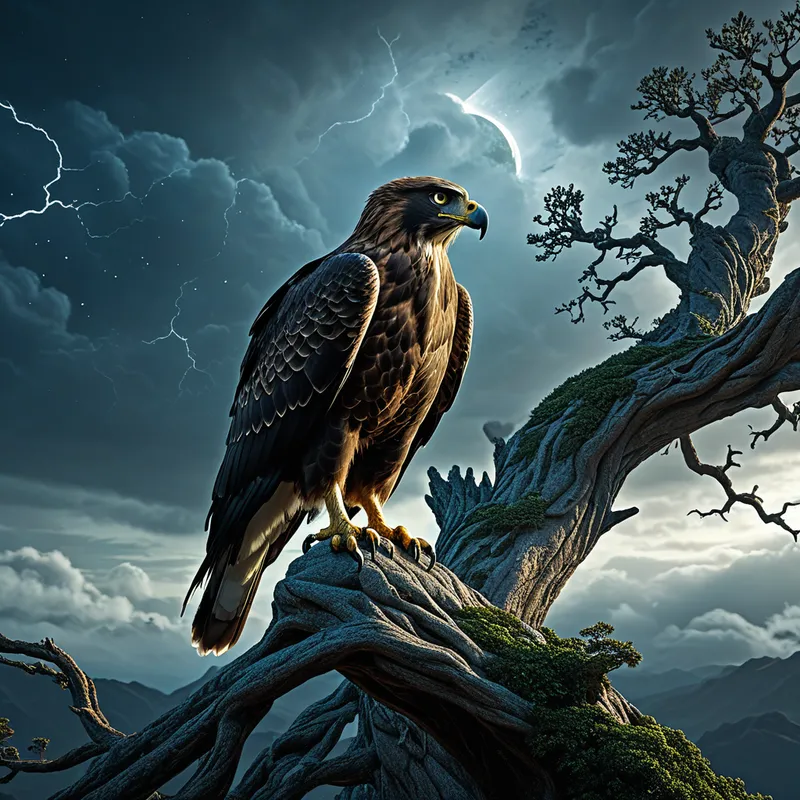
A hawk perched between the eyes of a cosmic eagle, witnessing all worlds from the crown of the World Tree, embodying ultimate perception and hidden knowledge.
The Tale of Veðrfölnir
Listen, and let your mind climb the great trunk of the world. High above the lands of men, above the halls of the gods, beyond even the sun and moon’s weary chase, the branches of Yggdrasil pierce the veil of the sky. Here, in the crown of all existence, the air is not air but the breath of time itself, cold and sharp and clear.
And here sits an eagle. Not a bird of flesh and feather as you know it, but a being of wind and mountain peak, its wings the span of storm fronts, its eyes two burning suns that see the turning of ages. Upon its brow, between those terrible, all-seeing eyes, there is a stillness. A small shape, perched where no other creature could dare. This is Veðrfölnir. His name means “the one bleached by the storm” or “the wind-witherer,” and his feathers are the grey of ancient cliff-face and spent lightning.
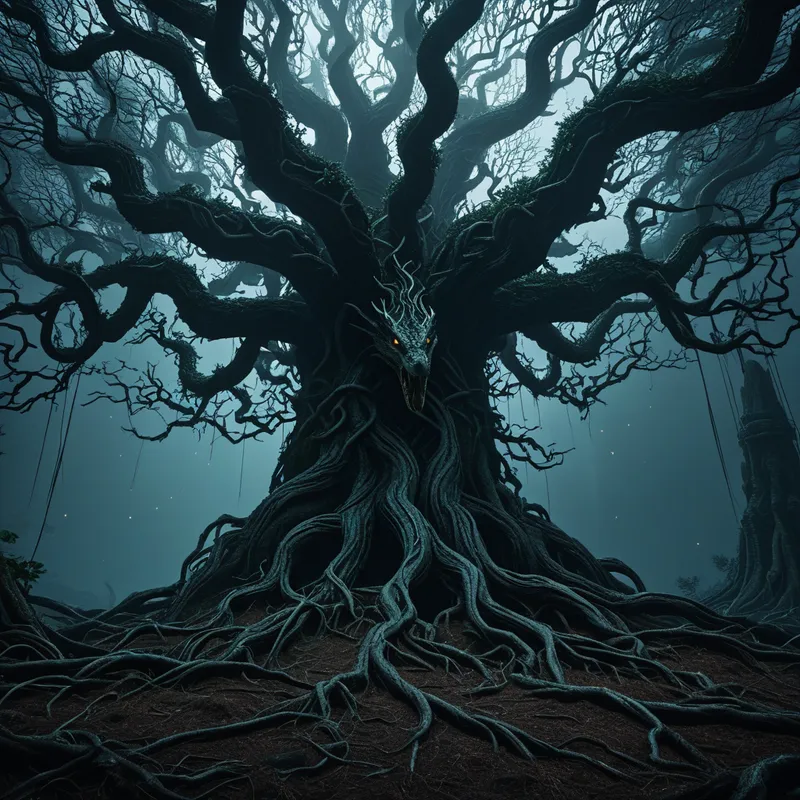
He does not stir. He does not hunt. His role is not action, but witness. From this impossible vantage, he sees all that the eagle sees. He looks down the immense length of the World Tree. He sees Asgard, shining with gold and ambition. He sees Midgard, a busy, hopeful tapestry. He sees the dark, root-tangled realms below, where the great dragon Nidhogg chews ceaselessly on the foundations of everything.
And between them, running up and down the rough bark, is the squirrel Ratatoskr, the gossip-monger. He darts, a streak of red and spite, carrying insults from the eagle at the top to the serpent at the bottom and back again. He fuels the eternal conflict, the tension that thrums through the Tree’s very sap. The eagle shrieks its disdain downwards; Nidhogg hisses its venom upwards. And Veðrfölnir, silent upon the eagle’s brow, hears it all. He receives the squirrel’s chattering malice not as a participant, but as a register. He is the calm at the center of the storm of words, the unmoved observer to whom all messages, all conflicts, ultimately ascend.
This is the order of things. This is the balance. The eagle sees the grand sweep, the serpent feels the foundational decay, the squirrel stirs the pot of strife. And the hawk? The hawk sees the connection between them all. He is the consciousness atop the consciousness, the point of pure awareness where the view from the highest peak and the gossip from the deepest root converge and are held, without judgment, in a single, silent gaze.
Cultural Origins & Context
The figure of Veðrfölnir is found in the Poetic Edda, specifically within the poem Grímnismál (The Sayings of Grímnir). Here, the god Odin, disguised as Grímnir, reveals cosmic knowledge to a young prince. In this context, the description of Yggdrasil and its inhabitants is not a standalone fable but a piece of divine revelation, a map of the cosmos given by the god of wisdom himself.
The myth was not a narrative for entertainment but a piece of cosmological data. It functioned as a mental model for the Norse worldview—a universe that was organic, interconnected, and inherently dynamic with tension. The image of the hawk on the eagle was likely passed down by skalds (poets) and lore-keepers as part of this greater schematic. Its societal function was to instill a sense of one’s place within a vast, living system. It taught that even the highest power (the eagle) has a higher perspective upon it (the hawk), and that all actions, from the divine to the destructive, are observed and integrated into the structure of reality itself.
Symbolic Architecture
Veðrfölnir is the archetype of the transcendent witness. He symbolizes a level of consciousness that is beyond active participation in the drama of existence. The eagle represents vast, sovereign awareness—perhaps the ruling principle of a psyche or a cosmos. But Veðrfölnir represents the awareness of that awareness. He is meta-cognition.
To sit between the eyes of the eagle is to achieve a perspective so complete that one is no longer identified with the seer, but with the act of seeing itself.
His position is critical. He is not above the eagle, which would suggest hierarchy, but upon it, integrated with its perception. He is “storm-bleached,” having been stripped of all color, all partiality, by the relentless winds of experience and conflict (represented by Ratatoskr’s messages). He is rendered neutral, a perfect mirror. In psychological terms, Veðrfölnir symbolizes the emergent function of the Self in Jungian psychology—the central archetype of order and totality that observes and integrates the conflicts between other archetypal forces (the proud eagle of the ego, the destructive serpent of the shadow).
The Dreamer’s Resonance
When this mythic pattern stirs in the modern unconscious, it often manifests not as a literal dream of a hawk, but as a profound shift in the quality of awareness within a dream. You may dream of being in a chaotic situation—a raging argument, a collapsing building, a turbulent sea—and suddenly finding yourself observing it from a detached, calm, and elevated vantage point. You are in the drama, yet not of it. The somatic feeling upon waking is often one of deep calm, spaciousness, and clarity, as if a storm inside has finally been given a silent center.
This dream signals a psychological process of disidentification. The dream ego is learning to separate itself from the compulsive reactions and emotional storms (the eagle’s shrieks, the serpent’s hisses) that typically govern it. The dream is an experience of the nascent Self establishing its observing function. It is the psyche’s innate wisdom creating a “Veðrfölnir position” within itself, a place from which all internal conflicts can be seen, heard, and ultimately held without being destructively enacted.
Alchemical Translation
The individuation process—the alchemical work of becoming whole—requires precisely this Veðrfölnir transformation. Initially, we are identified with the eagle: we believe our conscious viewpoint is supreme, our judgments are truth. Or, we are identified with the serpent: consumed by shadowy, gnawing resentments and instincts. We are run by the squirrel Ratatoskr, the internal gossip that endlessly circulates anxiety, self-criticism, and provocation between these poles.
The alchemical operation is to cultivate the perch. It is the disciplined practice of creating an inner witness. This begins in moments of conflict or overwhelm: instead of being the eagle who shrieks in anger or the serpent who hisses in pain, one attempts, however briefly, to be the hawk that observes both the anger and the pain. This is not passive resignation, but active reception.
The transmutation occurs when the raw material of conflict is not acted out, but is instead brought into the silent, observing space of the Self. There, it loses its compulsive power and becomes mere information—a message delivered, noted, and integrated.
To “become storm-bleached” is to allow the relentless winds of life’s dramas to wear away our personal, colored attachments, leaving only the essential, neutral witness. The triumph of Veðrfölnir is a triumph of perspective. It is the realization that our true center is not the actor in the drama, nor even the primary audience, but the silent awareness that contains the entire play—the eagle, the serpent, the squirrel, the great Tree, and all the nine worlds turning slowly in its branches. In this realization, the seeker finds not escape from the world, but the ultimate way to be in it: fully present, fully conscious, and utterly free.
Associated Symbols
Explore related symbols from the CaleaDream lexicon: